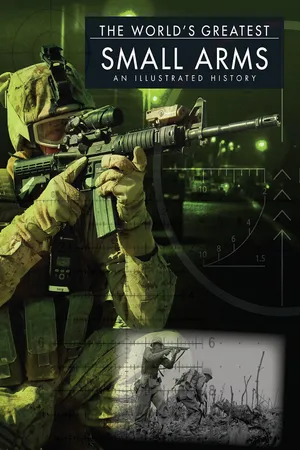
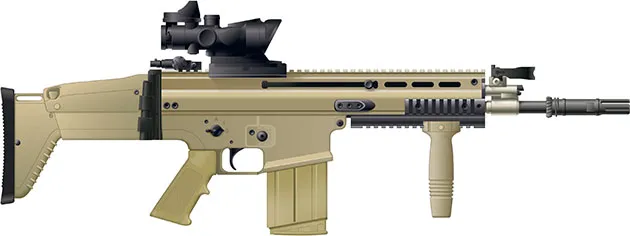
Small arms have developed hugely since the introduction of the machine gun in the 1870s. Magazine-fed rifles, submachine guns, automatic pistols and, later, assault rifles and personal defence weapons have changed the face of infantry warfare, offering a range of weaponry designed for both the specialist and novice. The World's Greatest Small Arms features 52 weapons from the late 19th century to the present day. The book includes the best-known weapons from throughout the modern era, from the Gatling gun, SMLE rifle and Luger pistol, to the Uzi, FN MAG and the M110 sniper rifle. Great iconic weapons, such as the Colt M1911 pistol, Bren Gun, MP5 submachine gun, and Steyr AUG rifle are featured, as well as timeless classics still in use today: the M2 Browning 50 cal, AK-47 and M16 rifle. Each weapon is illustrated with a colour profile artwork and photographs, along with a description of the weapon's development and history, key features and a full specifications box. Including more than 200 artworks and photographs, The World's Greatest Small Arms is a colourful guide for the military historian.
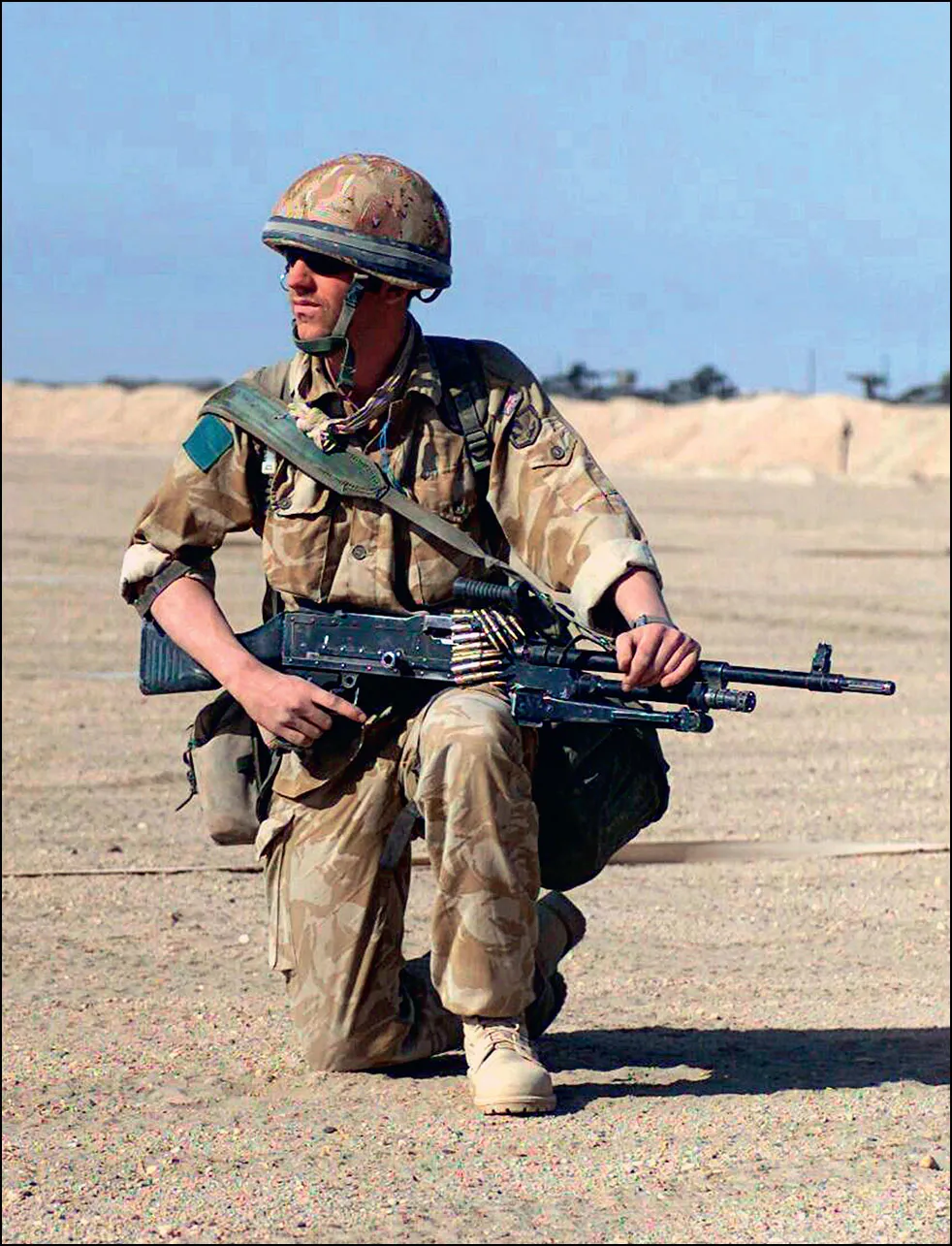
A British soldier in Iraq holds a 7.62mm L7A2 General-Purpose Machine Gun (GPMG), the British variant of the ever-popular FN MAG.
Cold War and Modern Weapons
By the end of World War II, all the essential types of small arms had been established, from handguns to machine guns. In the post-war world, however, there were two main revolutions. First was the rise and standardization of the assault rifle in weapons such as the Soviet AK-47 and the U.S. M16. Second came a transformation in materials and formats, which has led to ‘modular’ weapons capable of shifting between roles through quick adjustments in configuration. Through such changes, the battlefield soldier has never been better armed for combat.
AK-47/AKM (1949)
The AK series of assault rifles have quite literally transformed the world’s security situation. With more than 100 million of the family (including all variants) produced, the AK is the most mass-produced weapon in history.
The AK-47 was a fundamental step forward in Soviet firearms design. During World War II, the principal Soviet weapons had been the bolt-action Mosin-Nagant rifle and the full-auto PPSh-41 and PPS 43 SMGs. Yet as far back as the late 1930s, the Soviets experimented with what are known as ‘intermediate’ cartridges, positioned between the power of a rifle round and an SMG’s pistol round. What such a cartridge delivered was a combat range of about 400m (1312ft), but with a recoil impulse that could be managed on full-auto. Design such a cartridge, and the weapon to fire it, and you could virtually do away with conventional rifles and SMGs in favour of a single weapon for every soldier.
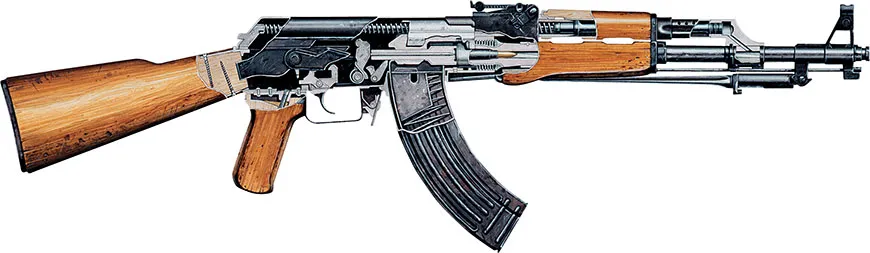
The AKM assault rifle can be distinguished from the earlier AK-47 by, among other things, a polymer pistol grip, angular muzzle brake and the more slender front sight block.
The Germans proved this concept during the war with their MP 44/StG 44 ‘assault rifle’, which fired a 7.92 x 33mm kurz (short) cartridge. In 1943, the Soviets responded by producing a 7.62 x 39mm round and chambered it for a semi-auto carbine, the SKS.
However, in 1944 Russian engineer Mikhail Kalashnikov, supported by a design team, began a competitive development against several other weapon producers to create a new selective-fire rifle that would use the intermediate round. It was a long process, and it should be noted that Kalashnikov himself was not the only key individual behind the final design. Another central figure was Aleksandr Zaitsev, who convinced Kalashnikov of the need for a major redesign to enhance reliability. Yet with the war over, in 1948 their ‘AK-47’ entered army trials and the following year it was adopted as the standard Soviet rifle.
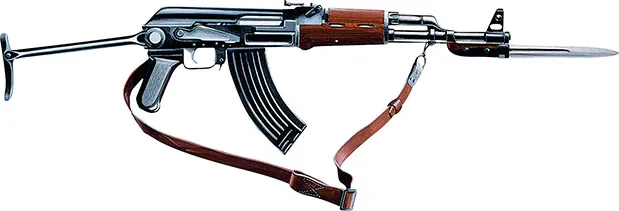
An AK-47 with a fixed bayonet. The AK bayonet can be linked with the bayonet scabbard to form a wire cutter.
In 1959, it was modernized – i.e. cheapened – in terms of its production methods, the receiver being of a stamped design rather than machined steel. Other improvements of the AKM, as it was known, included a basic scoop-like muzzle brake, a Parkerized bolt and a wire-cutting bayonet device. The AKM became the defining, most widely distributed model in the AK series.
The Chinese Type 56 is a near-identical copy of the AK rifle, manufactured from 1956 and still in service with Chinese forces today. An estimated 15 million have been produced.
Mythology
Much mythology has accrued around the AK, mainly on account of Hollywood representations. If you dig deeper, however, you find that it is no more powerful than many other assault rifles and it is not particularly accurate. What it does deliver, and in spades, is awesome reliability, total ease of use and maintenance, and vast distribution across the world.
In basic layout, the AK is a gas-operated weapon feeding from a 30-round detachable, instantly recognizable box magazine. It is selective fire – the large lever on the right of the receiver is the selector switch, which also adds to safety by preventing the bolt being cocked when the switch is in its uppermost position. The gas cylinder sits above the barrel, and houses a long-stroke gas piston that operates the bolt via a bolt carrier. The bolt itself is of the rotating type, and features two large locking lugs that, prior to firing, lock into recesses in the barrel extension. Rotating is performed via a cam track in the bolt carrier.
What this somewhat dry description does not evoke is the fantastic resilience of the AK mechanism. The long-stroke piston and the rotating bolt cope with all manner of dirt and contamination. The author has personally spoken to soldiers who have unearthed an AK after six months buried in the mud at the bottom of an African river, and fired straight through a magazine on full-auto without even cleaning the gun. (The AK barrels are also chromium-lined, and therefore incredibly resilient.) The furniture is similarly tough, whether the variant is fitted with a solid wooden stock or one of the folding metal types. Keep it clean and the AK will last a lifetime.
AKs are also extremely simple to use. To fire the weapon, just hinge a magazine into place, drop the selector level to either semi- or full-auto mode, cock and release the cocking handle and pull the trigger.
Such is the success of the AK design that it has spawned literally dozens of variants or copies (licenced and unauthorized), including SMGs, sniper rifles and even automatic shotguns. Short versions – given the AKS prefix – also served with Soviet Special Forces and continue to be popular today in insurgent hands. A major shift in the series occurred in the 1970s, however, when the Soviets rechambered the AK for the new 5.45 x 39mm M74 cartridge, in imitiation of the type of round used in the U.S. M16 rifle. The AK-74 carried the Soviet and Russian Federation through to the present day, and a truly convincing replacement has yet to be found. (See AK-74 and AK-12 entries.)
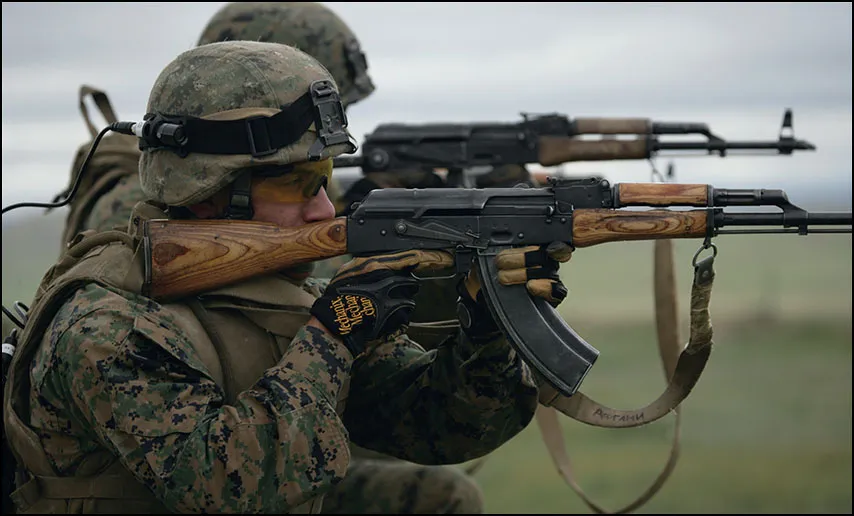
U.S. Marines from 1st Platoon, Echo Company, 3rd Assault Amphibious Battalion, 1st Marine Division, fire AKM assault rifles provided by the Mongolian armed forces.
AK in Action
The extent of the AK series distribution cannot be understated, aided not least by lax post-Cold War sales restrictions. More than 30 countries have officially adopted or used the AK rifles for their armies, serving in every part of the world. If we add illegal use, or employment by insurgent armies, then there is scarcely a country in the world that has not in some way been touched by the AK – it is estimated that more than a quarter of a million people are killed by AKs every year.
Stripping the AK
Stripping down the AK for cleaning is as simple as handling it in action. The first step is to remove the magazine by pressing the magazine release catch forward, then depressing the latch (actually the end of the return spring guide) on the top rear of the receiver. This step allows you to remove the AK’s receiver cover, exposing the recoil spring and bolt mechanism. To remove these for cleaning, push the return spring forward so that it clears the housing, then lift it...
Table of contents
Cover
Title Page
Copyright Page
Contents
Introduction
World War I to World War II
Cold War and Modern Weapons
Index
Trusted by 375,005 students
Access to over 1.5 million titles for a fair monthly price.
Study more efficiently using our study tools.
Frequently asked questions
Yes, you can cancel anytime from the Subscription tab in your account settings on the Perlego website. Your subscription will stay active until the end of your current billing period. Learn how to cancel your subscription
No, books cannot be downloaded as external files, such as PDFs, for use outside of Perlego. However, you can download books within the Perlego app for offline reading on mobile or tablet. Learn how to download books offline
Perlego offers two plans: Essential and Complete
Essential is ideal for learners and professionals who enjoy exploring a wide range of subjects. Access the Essential Library with 800,000+ trusted titles and best-sellers across business, personal growth, and the humanities. Includes unlimited reading time and Standard Read Aloud voice.
Complete: Perfect for advanced learners and researchers needing full, unrestricted access. Unlock 1.5M+ books across hundreds of subjects, including academic and specialized titles. The Complete Plan also includes advanced features like Premium Read Aloud and Research Assistant.
Both plans are available with monthly, semester, or annual billing cycles.
We are an online textbook subscription service, where you can get access to an entire online library for less than the price of a single book per month. With over 1.5 million books across 990+ topics, we’ve got you covered! Learn about our mission
Look out for the read-aloud symbol on your next book to see if you can listen to it. The read-aloud tool reads text aloud for you, highlighting the text as it is being read. You can pause it, speed it up and slow it down. Learn more about Read Aloud
Yes! You can use the Perlego app on both iOS and Android devices to read anytime, anywhere — even offline. Perfect for commutes or when you’re on the go. Please note we cannot support devices running on iOS 13 and Android 7 or earlier. Learn more about using the app
Yes, you can access The World's Greatest Small Arms by Chris McNab in PDF and/or ePUB format, as well as other popular books in History & Military & Maritime History. We have over 1.5 million books available in our catalogue for you to explore.