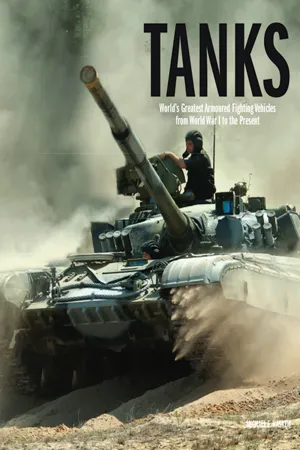
The World's Greatest Tanks features 52 of the best armoured fighting vehicles from World War I to the present day. Beginning with the prototype Mark V Male in 1917, the book ranges from World War I, World War II, through the Cold War and up to the highly sophisticated tanks that have seen recent service in wars in the Balkans, Caususus, and Middle East. From the Soviet T-34 and German Panther tanks of World War II to the M1A2 Abrams, Challenger 2 and T-90 of the present day, The World's Greatest Tanks is an expert examination of the most successful tanks of the past hundred years. Each entry is examined over two spreads and includes a brief description of the tank's development and history, a colour profile artwork, photographs, key features and specifications tables. Packed with more than 200 artworks and photographs, The World's Greatest Tanks is a colourful guide for the military historian and military technology enthusiast.
The T-72 main battle tank has come to symbolize the waning military influence of the former Soviet Union around the globe. Originally intended for the export market, the T-72 has remained in service with the armed forces of various nations for nearly half a century.
Modern Tanks
Tanks of the modern era graphically illustrate the astonishing pace of advancing technology. Since World War II, the tank has evolved to an impressive frontline weapon of war, exhibiting the latest in firepower, laser, digital and thermal imaging, global positioning and precision instrumentation technology. In an ironic twist, soldiers operating such sophisticated military hardware often find themselves in counter-insurgency combat, facing the constant threat of low technology weapons.
IS-3 (1945)
The last Soviet heavy tank to enter production before the end of World War II, the IS-3 became operational too late to influence the outcome of the war but nevertheless became a symbol of the Red Army’s military might.
The combat record of the Soviet IS-3 heavy tank is somewhat shrouded in mystery. Although reports of it being deployed against the Japanese in Manchuria in 1945 have surfaced, the consensus in the West is that it became operational too late for active military deployment during World War II.
While the IS-3 may have been a late arrival, its predecessors in the Josef Stalin series of heavy tanks did exert significant influence on the outcome of the Great Patriotic War. The Red Army victory during more than a month of fighting that swirled around the Kursk salient came at a tremendous price. More than 6000 Soviet tanks had been lost at Kursk and a special commission was convened to determine the cause of the horrendous losses.
In response to the commission’s findings, it was determined that a new heavy tank, one that could perform on par with the legendary T-34 medium tank, was needed. The older KV-1 heavy tank had already given way to the KV-85, mounting a heavy 85mm (3.35in) gun. Still, continuing reengineering of the KV-85, including improving the transmission and redesigning the hull and suspension, gave rise to the new IS-1 heavy tank with a lower silhouette and lighter weight than the KV-85.
Leninist Lineage
With the design improvements came the realization that the IS-1 was capable of mounting an even heavier weapon. Both a 100mm (3.9in) and 122mm (4.8in) gun were installed in experimental models, with the former demonstrating better armour penetration. The 122mm, though, was available in quantity and its high-explosive round was deadly in an anti-personnel role while its armour-piercing ammunition was considered adequate.
With the IS-3 heavy tank, improvements over its predecessor, the IS-2 (aerial view shown here), included enhanced armour protection, a reduced frontal area and a lower silhouette.
Therefore, in 1944, the first IS-2 mounting the long-barrelled 122mm (4.8in) A-19 went into production. It was later supplanted by the 122mm D25-T, with a better rate of fire and improved fire coordination capabilities. The D25-T was recognized by its distinctive double-baffle muzzle brake.
The final production tank of the Stalin series, assembly of the IS-3 began in May 1945 under the engineering supervision of M.F. Balzha at Experimental Plant No 100. With its roots firmly in the recent past, the IS-3 may also be considered the first heavy tank of its kind, or perhaps a bridge between the old and new. Regardless of how it is perceived, the IS-3 influenced Soviet and Eastern Bloc tank design for the next half century and became an early icon of the Cold War military prowess of the Red Army.
Although the IS-3 bears something of a family resemblance to preceding Soviet tanks, its design was distinctly different. At the end of World War II, fewer than 30 of the new tank had been completed, but by mid-1946 the number in Red Army service exceeded 2300. Despite the fact that its combat participation in World War II is doubtful, a regiment of the 45.8-tonne (45-ton) machines participated in a victory parade through Red Square on 7 September 1945.
Several notable improvements were included with the IS-3. The armour protection arrangement that had provided greater protection for the IS-2 but resulted in a lighter tank was retained. The welded hull with its rolled steel plating was sloped to the maximum possible degree, while the frontal area of the tank was actually reduced in width and ov...
Table of contents
Cover
Title Page
Copyright Page
Contents
Introduction
From World War I to World War II
Modern Tanks
Index
Trusted by 375,005 students
Access to over 1.5 million titles for a fair monthly price.
Study more efficiently using our study tools.
Frequently asked questions
Yes, you can cancel anytime from the Subscription tab in your account settings on the Perlego website. Your subscription will stay active until the end of your current billing period. Learn how to cancel your subscription
No, books cannot be downloaded as external files, such as PDFs, for use outside of Perlego. However, you can download books within the Perlego app for offline reading on mobile or tablet. Learn how to download books offline
Perlego offers two plans: Essential and Complete
Essential is ideal for learners and professionals who enjoy exploring a wide range of subjects. Access the Essential Library with 800,000+ trusted titles and best-sellers across business, personal growth, and the humanities. Includes unlimited reading time and Standard Read Aloud voice.
Complete: Perfect for advanced learners and researchers needing full, unrestricted access. Unlock 1.5M+ books across hundreds of subjects, including academic and specialized titles. The Complete Plan also includes advanced features like Premium Read Aloud and Research Assistant.
Both plans are available with monthly, semester, or annual billing cycles.
We are an online textbook subscription service, where you can get access to an entire online library for less than the price of a single book per month. With over 1.5 million books across 990+ topics, we’ve got you covered! Learn about our mission
Look out for the read-aloud symbol on your next book to see if you can listen to it. The read-aloud tool reads text aloud for you, highlighting the text as it is being read. You can pause it, speed it up and slow it down. Learn more about Read Aloud
Yes! You can use the Perlego app on both iOS and Android devices to read anytime, anywhere — even offline. Perfect for commutes or when you’re on the go. Please note we cannot support devices running on iOS 13 and Android 7 or earlier. Learn more about using the app
Yes, you can access Tanks by Michael E Haskew in PDF and/or ePUB format, as well as other popular books in History & Military & Maritime History. We have over 1.5 million books available in our catalogue for you to explore.