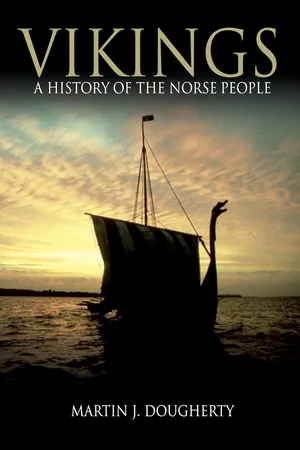
"From the fury of the Northmen, good Lord deliver us." – Anonymous monk, Noirmoutier, France, 9th century AD Beginning in 789AD, the Vikings raided monasteries, sacked cities and invaded western Europe. They looted and enslaved their enemies. But that is only part of their story. In long boats they discovered Iceland and America (both by accident) and also sailed up the Seine to Paris (which they sacked). They settled from Newfoundland to Russia, founded Dublin and fought battles as far afield as the Caspian Sea.
A thousand years after their demise, traces of the Vikings remain all the way from North America to Istanbul. They traded walruses with Inuits, brought Russian furs to Western Europe and took European slaves to Constantinople. Their graves contain Arab silver, Byzantine silks and Frankish weapons.
In this accessible book, the whole narrative of the Viking story is examined from the eighth to the eleventh centuries. Arranged thematically, Vikings: A History of the Norse People examines the Norsemen from exploration to religion to trade to settlement to weaponry to kingdoms to their demise and legacy. But today questions remain: what prompted the first Viking raids? What stopped their expansion? And how much of the tales of murder, rape and pillage is myth?
Illustrated with more than 200 photographs, maps and artworks, Vikings: A History of the Norse People is an expertly written account of a people who have long captured the popular imagination.
- English
- ePUB (mobile friendly)
- Available on iOS & Android
eBook - ePub
About this book
Information
Subtopic
European HistoryIndex
History
The threat of further Viking raids caused the monks to abandon Lindisfarne. It was not until around 1150 AD, after the end of the Viking Era, that the site was reoccupied and Lindisfarne Priory was built.
1
ORIGINS OF THE VIKINGS
History became aware of the people who are today referred to as Vikings in 793 AD, when a force of raiders from across the North Sea landed on Lindisfarne Island and sacked the monastery there. This was no chance landfall, nor was it the first time that Viking ships had landed on the Northumbrian coast.
The raiders knew about the monastery and the easy plunder to be had there from their previous expeditions. The origin of these raiders is open to some debate. Most historians agree that they were Scandinavians, although it has been suggested that they might have been Frisians. It is most likely that they were of Danish or Norwegian origin, possibly sailing from settlements in the Orkney or Shetland Islands. Contemporary sources refer to them as coming ‘from the north’ or ‘from the land of robbers’, which suggests that enough raids had occurred previously for these seafarers to have acquired a reputation long before they struck Lindisfarne.

These greenstone tools date from 7500 to 5500 BC, a time when Jutland and the Danish Islands were sparsely populated by small farming communities.
The sacking of Lindisfarne was a dramatic event, and is now seen as the emergence onto the stage of a new and frightening people. It is a simple and clear-cut starting point for the Viking Age, but the men of the north did not simply wake up one morning and decide to ravage the coasts of Europe for the next 300 years. So why did they do so? Where did they come from and what drove them to such brutality?
Early Habitation
Humans may have inhabited Scandinavia more than 200,000 years ago, before the last Ice Age. Any human population of that era was driven out or killed off by climatic conditions, and it was not until 8000–9000 BC that humans returned to the area. There is evidence of Old Stone Age habitation in Denmark during the period 8000–4000 BC , such as stone carvings.
Farming and livestock herding allowed a more settled lifestyle during the New Stone Age (4000–1500 BC ) and numerous settlements from this era have been discovered. The introduction of bronze tools around 2000–1500 BC allowed improved farming and industrial techniques that could support a larger population – and of course made conflict between rival groups more deadly.

Flint daggers of this sort began to be replaced by bronze around 1700 BC. Bronze use was at first limited, but its clear advantages over stone tools led to a rapid expansion of metalworking in Scandinavia.
In the Bronze Age, society in Scandinavia was based around small communities with some individuals being rich enough to afford lavish burials surrounded by bronze tools and weapons. Many of these weapons show signs of hard use, suggesting that conflict was commonplace. Trade was also widespread, with some areas of Scandinavia importing large quantities of metal for use by local craftsmen.
The Iron Age
The climate in Bronze Age Scandinavia was warmer than it is today, although a cooling that occurred around 500 BC may have made life much harder for the people of the region. At around the same time the use of iron became far more prevalent. At first it was used mainly by bronzesmiths to make their bronze-working tools but eventually a move to iron tools and weapons took place. This made the large-scale importation of metals less necessary, as iron was available locally and in abundance.
Although the Roman Empire never reached into Scandinavia, the people of the region traded with Roman territories and undoubtedly absorbed elements of Roman culture and technology. Roman writings of the period show a vague familiarity with Scandinavian names and some concepts that might have been derived from Scandinavian culture, although some of these sources speak of men with the heads of dogs or vultures, so their accuracy in other areas is debatable.

Ironworking was an important innovation in Scandinavia. Not only could better weapons be produced, but the need to import materials was reduced as Scandinavia had large iron deposits.
Archaeological finds suggest that the Scandinavians of the Iron Age launched seaborne raids, sometimes in significant numbers, and that they built hillforts and other defences. Perhaps these were constructed for protection from the raids of other groups. Technology, particularly metalsmithing, made advances during this period. Intricate designs of gold became quite common, especially as the Roman Empire declined and ceased actively to defend its borders or began bribing its barbarous neighbours to refrain from raiding. Some of this treasure found its way into Scandinavia by various means, and the social elite of the region was rich by anyone’s standards during the period 400–600 AD.

Europe was turbulent in the period after the fall of the Roman Empire, with whole peoples displaced and forced into conflict with others as they sought a place to settle. Scandinavia was much less severely affected, permitting an era of relative prosperity.
Up until this time, the Scandinavians spoke the same language as other Germanic people, but changes between 550 and 750 AD resulted in the emergence of a language known as dönsk tunga, or ‘the Danish Tongue’, now called Old Norse. The Danish Tongue was spoken all across the ‘Viking’ lands of Denmark, Norway, Sweden, Britain, Iceland and the islands in between.
Later in the Viking era, a further divergence occurred between the language as spoken in eastern areas such as Sweden and Denmark, and regions farther west such as Iceland. At the time of that first raid on Lindisfarne, most Norsemen spoke the same tongue. This will have contributed to confusion about the exact origins of a particular raiding party.
The Vendel Period
The years between 400 and 800 AD were chaotic in much of Europe. The arrival of the Huns on the eastern fringes of Europe caused entire peoples to be displaced, pushing them westwards into their neighbours and bringing about an era of conflict as whole societies tried to find a new place to live.
This is known as the Migration Period, or Völkerwanderung, and the turmoil it caused lasted for centuries. By the eighth century AD a new order was emerging in Europe, with the powerful Merovingian kingdom controlling much of what had been Gaul. Scandinavia was not as badly affected by the Hunnic incursion as much of Europe, and continued to be relatively stable. Stability permitted trade and thus prosperity.

The Vendel period gets its name from large archaeological finds dating from this era at Vendel in Sweden. This helmet came from a boat burial. Its construction indicates a high standard of metalworking skill.
Sweden in particular was extremely wealthy at this time. A number of ship-burials discovered at Vendel (north of Stockholm) gave the era its modern name. These burials were magnificent in their extravagance, containing beautifully wrought items of gold, weapons and armour of high quality, and luxury goods that must have been imported into Scandinavia.
Burials and grave-goods of the Vendel period suggest that Scandinavia enjoyed an era of wealth and stability – but probably not peace, if the sagas of the time are to be believed – from 500 to 800 AD. Its people were able to afford trading expeditions into Europe and exploration into the eastern lands that are today Finland and Russia, as well as forays across the North Sea. Settlements were constructed in the Orkney Islands as a stopover on the ‘sea roads’ used for trading expeditions.

Cubbie Roo’s castle on Wyre in the Orkneys was built after the end of the Viking Era by Norsemen who had lived in the Orkneys for centuries. Previously, Mesolithic and Neolithic people lived there, but had probably abandoned the islands long before the Vikings arrived around 600–700 AD.
Dawn of the Viking Age
In 789 AD, not many years before the Lindisfarne raid, three ‘Viking’ (probably Norwegian) ships put into Weymouth on what is widely accepted as having been a trading expedition. A dispute with a local official became a brawl, and the brawl became a deadly fight with swords and axes. Although sometimes portrayed as a Viking raid on the port, this was probably more of an unintended international incident. Conflict with foreign sailors was at the time not uncommon. Piracy and raids against coastal settlements occurred on a fairly frequent basis, and it was not unknown for pirates to venture up rivers and attack towns further inland. The ‘merchants’ involved in the incident at Weymouth may well have been on a trading expedition at that time, but that does not mean that they did not raid on other occasions. This theme was repeated throughout the Viking Age. Tough, well-armed men in seaworthy ships were capable of peaceful exploration and trade, or brutal pillage and rapine. Which activity they engaged in at any given time was perhaps a matter of personal preference in some cases, but more often it was simply a question of which was more profitable.
‘FEAR NOT DEATH, FOR THE HOUR OF YOUR DOOM IS SET AND NONE MAY ESCAPE IT.’
There is some debate as to the origins of the word ‘Viking’. There is strong evidence that it derived from a word meaning ‘expedition’: a sea voyage requiring that the ship’s rowers worked in shifts. This was necessary on any longer journey, so any long-distance exploration, trade or raiding would require such an arrangement and would therefore be a ‘Viking’ expedition.
Whatever the origins of the word, it has come to be applied to those who set out on voyages from Scandinavia in a particular type of ship. The term became a word for sea-raiders and ferocious warriors who worshipped barbarous gods. It has been ever more loosely applied to the inhabitants of Scandinavia during the Viking Age, including peaceful farmers who never went near the sea. Outsiders knew only of what they had seen in their contact with the Vikings, which was often violent.
Plunder and Profit
The Vikings, then, were a hardy and warlike people who had developed a high standard of technology. They were expert weapon-makers and workers of metal, and could build excellent ships. They would trade when it was more profitable than raiding, and they did not destroy for the sake of it – there was no profit in that. The Vikings were driven by the same motivations that had always inspired...
Table of contents
- Cover
- Title Page
- Copyright Page
- Contents
- Introduction
- Chapter One: Origins of the Vikings
- Chapter Two: The Old Norse Religion
- Chapter Three: Viking Lawand Social Order
- Chapter Four: Viking Society
- Chapter Five: The Early Raids
- Chapter Six: Viking Weapons and Combat
- Chapter Seven: Exploration, Settlement and Trade
- Chapter Eight: The Viking Kingdoms
- Chapter Nine: The Viking Kingdoms
- Chapter Ten: The Legacy of the Vikings
- Index
Trusted by 375,005 students
Access to over 1.5 million titles for a fair monthly price.
Study more efficiently using our study tools.
Frequently asked questions
Yes, you can cancel anytime from the Subscription tab in your account settings on the Perlego website. Your subscription will stay active until the end of your current billing period. Learn how to cancel your subscription
No, books cannot be downloaded as external files, such as PDFs, for use outside of Perlego. However, you can download books within the Perlego app for offline reading on mobile or tablet. Learn how to download books offline
Perlego offers two plans: Essential and Complete
- Essential is ideal for learners and professionals who enjoy exploring a wide range of subjects. Access the Essential Library with 800,000+ trusted titles and best-sellers across business, personal growth, and the humanities. Includes unlimited reading time and Standard Read Aloud voice.
- Complete: Perfect for advanced learners and researchers needing full, unrestricted access. Unlock 1.5M+ books across hundreds of subjects, including academic and specialized titles. The Complete Plan also includes advanced features like Premium Read Aloud and Research Assistant.
We are an online textbook subscription service, where you can get access to an entire online library for less than the price of a single book per month. With over 1.5 million books across 990+ topics, we’ve got you covered! Learn about our mission
Look out for the read-aloud symbol on your next book to see if you can listen to it. The read-aloud tool reads text aloud for you, highlighting the text as it is being read. You can pause it, speed it up and slow it down. Learn more about Read Aloud
Yes! You can use the Perlego app on both iOS and Android devices to read anytime, anywhere — even offline. Perfect for commutes or when you’re on the go.
Please note we cannot support devices running on iOS 13 and Android 7 or earlier. Learn more about using the app
Please note we cannot support devices running on iOS 13 and Android 7 or earlier. Learn more about using the app
Yes, you can access Vikings by Martin J Dougherty in PDF and/or ePUB format, as well as other popular books in History & European History. We have over 1.5 million books available in our catalogue for you to explore.