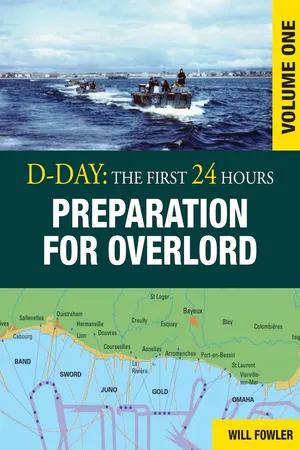
In any military operation throughout history, few 24-hour periods have been as crucial as that of 6th June 1944. With the aid of specially commissioned maps, D-Day: The First 24 Hours series gives the dramatic history of the first 24 hours of the Normandy landings, and explains in detail the events that occurred in each landing zone. In this first volume of the series, the book describes the build-up to the landings themselves, the German preparations for defending the French coastline, and the reasons behind the final Allied decision to attack in Normandy on 6 June 1944. With colour and black & white photographs, the book is a guide to key events in the first 24 hours of the D-Day landings that saw the Allies successfully achieve a foothold in Northern Europe.
- English
- ePUB (mobile friendly)
- Available on iOS & Android
eBook - ePub
D-Day: Preparation for Overlord
About this book
Information
Subtopic
World War IIIndex
History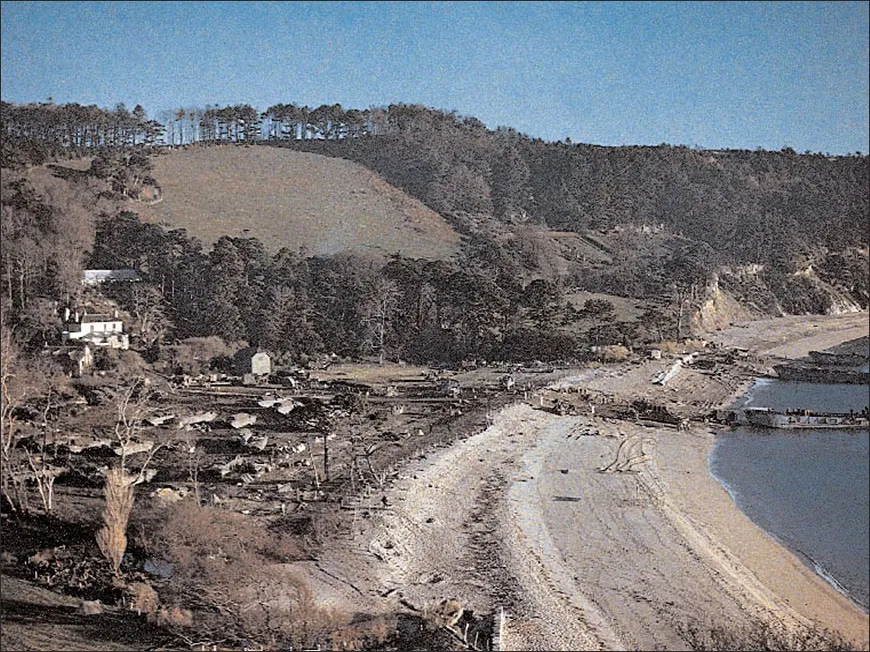
Men and equipment are off-loaded from a US landing craft on a beach in Devon during a training exercise. The beaches of Devon were chosen for their similarity to the beaches of Normandy, with their long, sloping sands running gently into the sea.
CHAPTER ONE
THE ROAD TO
OPERATION
OVERLORD
The Americans pressed for an invasion of Northern Europe as early as 1942, but it would take two more years for the plans and training to reach fruition. US, British, Canadian troops and men and women from the occupied countries of Europe were now massed on a crowded island, as the Allied air forces pounded communications and defences in preparation for the invasion. Now these soldiers awaited the order to go.
BY THE SPRING OF 1944, the Western Allies and the Soviet Union knew that the war in Europe was moving, at times slowly, towards the defeat of Nazi Germany and her partners. However, they had not always enjoyed this confidence.
In September 1939, under its leader Adolf Hitler, Nazi Germany attacked Poland, and France and Britain declared war. Poland fell in a month. To secure her northern flank, Germany then invaded Denmark in April 1940 and had a tough and costly fight for Norway. In June that year, the defeat of France followed after a six-week ‘blitzkrieg’ (‘lightning war’) campaign. France was divided into a Nazi-occupied north and west and a southern ‘neutral’ pro-Nazi Vichy zone. In April 1941, Germany and her allies overran Yugoslavia in 11 days. Greece fell after a tough fight, and by the end of May, German paratroopers had seized the island of Crete. The Soviet Union was still bound by a 1939 non-aggression treaty it had signed with Nazi Germany, while the United States, though sympathetic to Britain, was reluctant to become embroiled in a European conflict. In the spring of 1941, Britain stood alone.
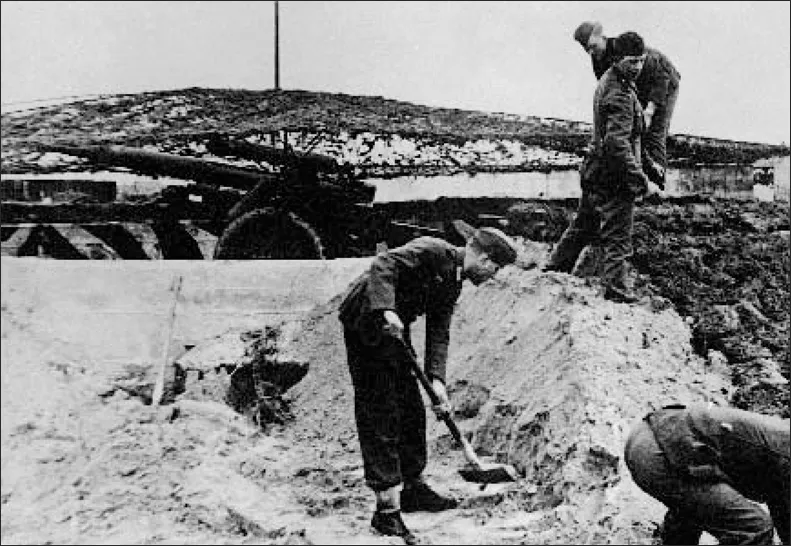
German gunners back fill sand and soil against the concrete gun pit of a 15cm (5.9in) K 18 gun in a coastal artillery position. On the right they are putting turf in place to landscape the pit, which is camouflaged from the air by a netting frame suspended over the gun.
So at the beginning of Operation Barbarossa, the name of the German attack on the USSR in June 1941, and the Japanese air assault on the US fleet at Pearl Harbor in December 1941, the Axis partners of Germany, Japan and Italy enjoyed considerable military successes. In December 1941 however, the German forces were halted outside Moscow, but the following spring, four armies thrust deep into the Caucasus and reached the Volga at Stalingrad. By the winter of 1942, the German Sixth Army was embroiled in fighting at Stalingrad, while hundreds of miles to the south, at El Alamein, in the deserts of Egypt, Rommel’s Afrika Korps had been fought to a stop by the British Eighth Army. Late 1942 was the high water mark of Nazi Germany’s territorial expansion.
The British counter attack at El Alamein in October 1942 and the Soviet victory at Stalingrad in early 1943 marked the ‘end of the beginning’. Germany and her allies were now being pushed onto the defensive. North Africa was cleared of Axis forces by May 1943. British and US forces invaded Sicily in July 1943 and at about the same time, German tank forces were defeated in a massive armoured battle at Kursk in the Soviet Union.
In late 1943, the British and United Forces launched a three-pronged assault on mainland Italy and Hitler’s fascist ally, Benito Mussolini, was forced out of power as Italy surrendered and re-entered the war on the side of the Allies. Fighting northwards through Italy, a country which Churchill had called ‘the soft underbelly of Europe’, was incredibly tough, as the Germans used natural and man-made obstacles to delay the Allied advance.
By 1944, the Allies were bogged down in front of Monte Cassino and only just holding the beachhead at Anzio. On the Eastern Front, the Germans were fighting a slow withdrawal to the borders of Poland, delaying the Soviet advance with local counter-attacks. On March 28, in grim echoes of Stalingrad, the First Panzer Army, commanded by General Hans-Valentin Hube, was trapped in the Ukraine by the combined armies of Gens Zhukov and Konev. Two days later, helped by attacks by two Waffen-SS divisions, they broke out and reached safety by 7 April.
FORTRESS EUROPE
Immediately after the fall of France in 1940, the German forces occupied French naval installations and with them, the local defences. Later, after Britain had failed to sue for peace, field defences had been dug along the French coast and barbed wire entanglements and minefields had been positioned blocking beaches that might be used by amphibious raiders. They were not the concrete bunkers that were constructed in 1942–44, but many were zigzag slit trenches that would be dug by soldiers with their own resources and defence stores after capturing enemy territory.
In 1941, the Organisation Todt (OT) (see box below) had concentrated on building reinforced concrete U-boat pens, Luftwaffe airfields and bases and coastal gun positions in the Pas de Calais. The four batteries in the Pas de Calais covered the narrows of the Channel and could subject Dover, Ramsgate and Folkestone on the British mainland to periodic shell fire. The biggest guns, the three 40.6cm (16in) weapons in the Lindemann battery at Sangatte, could shell all three towns. ‘Hellfire Corner’, as this area of England was known, remained under threat until the late summer of 1944. Some of the guns had originally been emplaced to give supporting fire for Fall Seelöwe (Operation Sea Lion), the proposed invasion of Britain in 1940.
Thirteen coastal artillery batteries were eventually constructed along the French coast, as well as one each in Belgium, the Netherlands and Norway, three in Germany and three in Denmark.
In Britain, the US and British land, sea and air forces waited for orders to open a ‘Second Front’, and the invasion of occupied northern Europe would begin. Like any military operation, the day was designated D-Day, and the hour of attack, H-Hour. Though many of the naval and air forces had already been in action in the Mediterranean and over Europe, for many of the soldiers D-Day would be the lethal validation of three or more years of training.
COMFORTABLE POSTING
For the German Army, garrison duty in France – and particularly Paris – was a comfortable posting and was used to allow units exhausted by combat on the Eastern Front time to recover. Relations were often reasonable between the Germans soldiers and ordinary Frenchmen and women. For 21-year-old Gefreite Klaus Herrig, a wireless operator with the Kriegsmarine Signal Corps based in Le Havre, ‘Our relationship with the French was more correct than friendly. We used to go to the local café for a beer, but there were no strong personal connections. Our discipline was good and the German troops, in general, behaved themselves.’
Monsieur Cassigneuel, a farmer near St Aubin, concurred. ‘Our Germans were fine. We had no problems at all. We had horses on the farm and they had horses too. Many of the Germans were farmers and we were all the same age, we did the same kind of work, and we talked a lot about the way things were done. They told us about German methods and we told them about the way we did things in France. We swapped information. It was quite good really!’
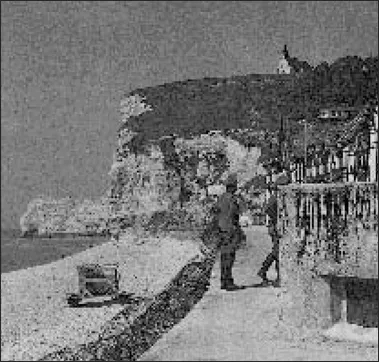
German officers inspect a concrete bunker built on the seafront of a northern French town. The embrasure for the machine gun or light artillery piece inside is angled to give covering fire across the beaches. Barbed wire blocks the seawall.
However, not everyone was happy, and Resistance groups were formed, sponsored and assisted by Britain and the United States, to collect intelligence on, for example, the design and layout of the coastal defences and to sabotage the Nazi war effort in occupied Europe.
BUILDING PLANS
Between June and September 1942, no major construction work was undertaken on defences, but in 1942 the situation began to change. On 23 March, Hitler issued ‘Führer Directive 40’ that anticipated both limited and large scale enemy incursions along the western coast of Europe. The British raid at St Nazaire in 1942 and the disastrous attack at Dieppe later that year gave added impetus to construction work on defences that were named by Hitler Atlantikwall (the Atlantic Wall). In the planned construction programme, 15,000 bunkers and emplacements of Types ‘A’ and ‘B’ – like the massive structures built on the Westwall on Germany’s western border – were to be built. These coastal defences, featured in propaganda films and photographs, eventually stretched 2685km (1668 miles) from the Spanish border to the North Cape in Norway. They combined coastal artillery to engage shipping, infantry and artillery positions, protected by minefields, flame-throwers and barbed wire that could destroy any troops and vehicles that managed to make a landing. Some 17.6 million cubic tonnes (17.3 million cubic tons) of concrete and steel reinforcing bars went into these defences and vast armies of slave labourers lived and worked in appalling conditions to construct them. The Germans were very skilled at boring tunnels, and hospitals, command posts, magazines and shelters were dug deep into rock. At the peak of the construction programme, 260,000 men were employed, of whom only ten percent were German.
This vast operation is undoubtedly the most complicated and difficult that has ever taken place. It involves tides, wind, waves, visibility, both from the air and the sea standpoint, and the combined employment of land, air and sea forces in the highest degree of intimacy and in contact with conditions which could not and cannot be fully foreseen.
Prime Minister Winston Churchill,
Statement to the House of Commons, 6 June 1944
Statement to the House of Commons, 6 June 1944
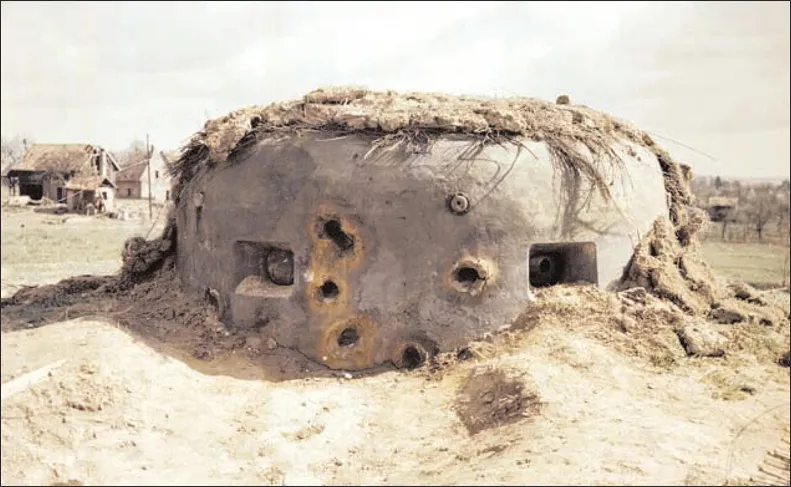
An armoured machine gun and observation post on the Atlantic Wall. Some of the defences had been taken from the French Maginot Line and the obstacles built by the Belgians and Dutch in the late 1930s. Many were very effective.
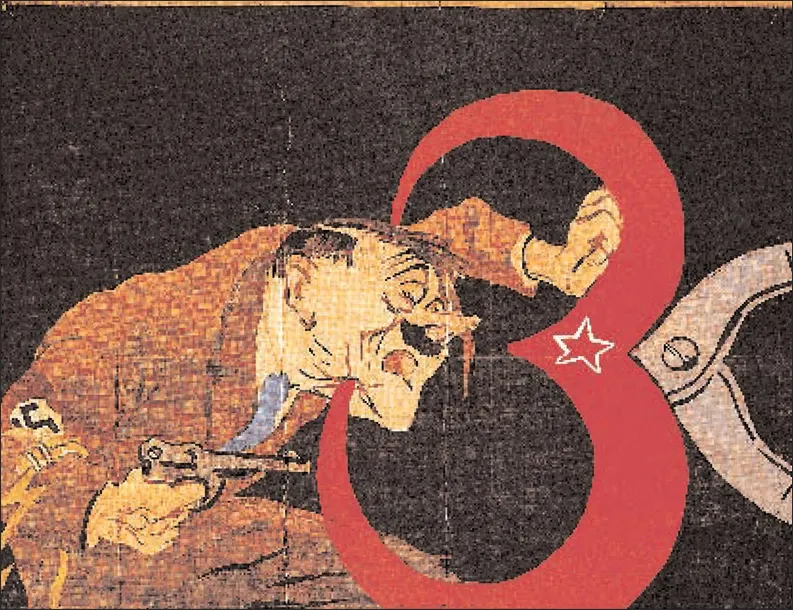
A Soviet Krokodil cartoon shows Hitler caught in the pincers of three years of the war in the East. If the Germans could defeat an Allied landing in Europe they were confident that they could hold the Red Army’s advance and perhaps negotiate a peace.
Bunkers were all gas proof, with double doors and a manually operated filtration system. As well as an entrance, normally an armoured door protected by a machine gun port, there was also an escape shaft if the door was damaged. Behind the front-line positions, the Germans built the Type 621 and Type 622 troop shelters in which men could take cover during heavy bombardments and emerge to deliver counter-attacks or man the weapons in bunkers.
A small, distinctive design that German engineers borrowed from the Italians was the Tobruk. This was a twoor three-man concrete bunker with a short flight of steps to an ammunition store and shelter with a circular access. It came in three forms. The simplest, the Ringstand, was open-topped with a circular rail for mounting a machine gun. The 5cm (1.97in) mortar position had a concrete pillar on which the mortar was mounted with the ammunition store offset down steps. The Panzerstellung mounted a tank turret, normally from a French light tank like the Renault FT-17 or R35, that had been captured in 1940.
The Atlantic Wall also included barbed wire, mines, ditches, concrete ‘Dragon’s Teeth’ concrete cubes, steel tetrahedrons, vertical steel girders and ‘Czech Hedgehog’ anti-tank obstacles. In the light of experience at Dieppe, where Churchill tanks had been unable to cross the low sea wall to exit the beach, the OT engineers designed Panzermauer – huge reinforced concrete walls 3m (9.8ft) high and 2m (6.5ft) thick that had anti-tank gun emplacements built into them. In some cases, existing defences from wars in the 19th century were effectively incorporated with observation posts added to the top of castles or field gun bunkers built into the walls.
Many of the coastal defence guns were French, Czech or Soviet weapons. The formidable Belgian ‘Element C’ or ‘Belgian gate’ steel girder anti-tank obstacles were positioned as anti-invasion obstacles on open beaches. These obstacles, which could be rolled into position and bolted together, were known as Rollböcke.
CAMOUFLAGE AND CONCEALMENT
The concrete on bunkers and gun positions was given a textured surface by ensuring the shuttering was not smooth and reinforcing rods were left exposed to allow camouflage netting to be hung. Further landscaping was provided by soil banked up around the positions. Stone cladding helped positions to be blended into cliffs or among buildings. Some bunkers that had been constructed on the sea front of a coastal town were painted with false windows and doors to resemble a bungalow or villa.
So massive were the bunkers and battery positions of the Atlantic Wall that today many of them remain intact on the cliffs and foreshores of northern Europe.
OSTARBEITER
Eastern Workers, Polish or Russian slave workers in the occupied territories in World War II, were identified by an armband with the letter ‘O’ on it. Ostarbeiter were employed in dangerous or exhausting work, including the construction of defences like the Atlantic Wall. They had poor rations and those who attempted to escape were often hanged publicly as a deterrent to others.
The construction of the Atlantic Wall was not undertaken exclusively by German soldiers, Organisation Todt staff and slave labourers. The local population throughout Europe found work that ranged from simple manual labour to complex construction projects undertaken for the Germans by contractors.
After the Liberation of France, a brutal pu...
Table of contents
- Cover
- Title Page
- Copyright Page
- Contents
- Chapter 1: The Road to Operation Overlord
- Chapter 2: Intelligence and Resistance
- Chapter 3: Logistics and Technology
- D-Day Chronology and Order of Battle
Trusted by 375,005 students
Access to over 1.5 million titles for a fair monthly price.
Study more efficiently using our study tools.
Frequently asked questions
Yes, you can cancel anytime from the Subscription tab in your account settings on the Perlego website. Your subscription will stay active until the end of your current billing period. Learn how to cancel your subscription
No, books cannot be downloaded as external files, such as PDFs, for use outside of Perlego. However, you can download books within the Perlego app for offline reading on mobile or tablet. Learn how to download books offline
Perlego offers two plans: Essential and Complete
- Essential is ideal for learners and professionals who enjoy exploring a wide range of subjects. Access the Essential Library with 800,000+ trusted titles and best-sellers across business, personal growth, and the humanities. Includes unlimited reading time and Standard Read Aloud voice.
- Complete: Perfect for advanced learners and researchers needing full, unrestricted access. Unlock 1.5M+ books across hundreds of subjects, including academic and specialized titles. The Complete Plan also includes advanced features like Premium Read Aloud and Research Assistant.
We are an online textbook subscription service, where you can get access to an entire online library for less than the price of a single book per month. With over 1.5 million books across 990+ topics, we’ve got you covered! Learn about our mission
Look out for the read-aloud symbol on your next book to see if you can listen to it. The read-aloud tool reads text aloud for you, highlighting the text as it is being read. You can pause it, speed it up and slow it down. Learn more about Read Aloud
Yes! You can use the Perlego app on both iOS and Android devices to read anytime, anywhere — even offline. Perfect for commutes or when you’re on the go.
Please note we cannot support devices running on iOS 13 and Android 7 or earlier. Learn more about using the app
Please note we cannot support devices running on iOS 13 and Android 7 or earlier. Learn more about using the app
Yes, you can access D-Day: Preparation for Overlord by Will Fowler in PDF and/or ePUB format, as well as other popular books in History & World War II. We have over 1.5 million books available in our catalogue for you to explore.