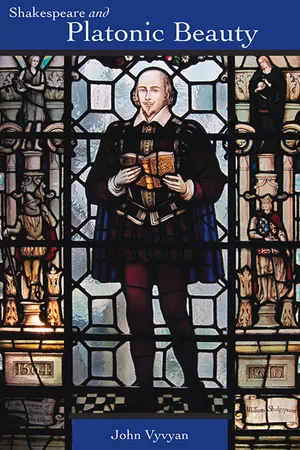
Looking at some of the Shakespearean comedies, author John Vyvyan suggests they express a consistent, profoundly Christian philosophy of life based on the Platonic ideas of beauty and love. In A Midsummer Night's Dream, As You Like It, and All's Well That Ends Well, the heroines bring to life the idea of love as the force that is awakened in the world by beauty which then leads the soul to perfection. Vyvyan believes that for Shakespeare, love was preeminent over human ideas of justice, that self-discovery was a supreme human experience, and that breaking faith with the ideal—as Agamemnon, Cressida, and Hector all do in Troilus and Cressida —sowed the seeds of tragedy. The author's recognition of Shakespeare's use of allegory enables him to make sense of certain developments in these plays that seem weak or absurd from the psychological standpoint. He does not suggest that Shakespeare's philosophy is the most important thing about his plays; it is simply one thing about them that ought to be known. The recognition of this philosophy enhances enjoyment of the plays, giving them a new dimension and richness. This edition contains a list of the author's Shakespearean references and an enhanced index.
- 216 pages
- English
- ePUB (mobile friendly)
- Available on iOS & Android
eBook - ePub
Shakespeare and Platonic Beauty
About this book
Information
Subtopic
Shakespeare DramaIndex
Literature1
Theseus and Hippolyta
THE FIGURES of Theseus and Hippolyta, firmly enthroned, save A Midsummer Night’s Dream from dissolving into moonlight. They are never led astray by the fairies, and they give the play substantiality. This is more than a stage impression, the stiffening is also intellectual. When Theseus hears the story of the night’s confusions, his comment is, ‘More strange than true’. But Hippolyta insists that it ‘grows to something of great constancy’. The play itself does that. But what is the thing of constancy? The brief answer, I think, is beauty. That may sound deceptively simple; for behind it lies a great part of the Neo-Platonist philosophy of the Renaissance.
Why did Shakespeare choose Theseus and Hippolyta to frame his dream-story? This is the kind of question we ought to ask whenever he brings in mythological figures; because they are always more than ornament, they are part of his parable as well. The Theseus-and-Hippolyta theme – as it is presented to us here – is the turning of a war into a wedding, a sword into a ring: out of chaos has come a birth of beauty. It is to this that the regal couple in the background owe their stability. For the symbolic purpose of this play they have attained the thing of constancy towards which the wavering characters are shown to grow.
This miracle – the bringing of order out of confusion – is performed by love. In Theseus and Hippolyta we see it as achieved; while in the bewildered lovers it is gradually taking place. The principle holds throughout Shakespeare’s comedies. And again we touch a subject where philosophy and drama meet.
Considered philosophically, love and beauty were invented by Plato. And whenever the European mind has theorized about them since – until the Freudians set a cat among the pigeons – some echo of the Symposium or the Phaedrus is nearly always to be caught. Even during the centuries when these dialogues were lost, their influence was felt through intermediaries; and when the Platonic revival came in the Renaissance, they pervaded the thinking of the age. The result was not Platonism, but a radical re-interpretation of it, fused with much else, into a brilliant new amalgam of ideas.
In the first speech of the Symposium, love is said to be the unbegotten power that arose from Chaos in the beginning to create an ordered world; and in the Phaedrus it is a longing that will not rest until man has discovered and become united with immortal Beauty. Both these conceptions – love as creator, and revealer – are important in the Renaissance, but altered by their passage through many lively minds. From the point of view of our present enquiry, the most notable minds linking Plato with Shakespeare are Plotinus, Ficino and Spenser. These we shall consider individually. But what must never be forgotten, in spite of all the newness of the Renaissance, is the background power of medieval thought; because it is due to this that ‘Platonism’ in the fifteenth and sixteenth centuries is so confusingly different from the classical philosophy of the same name.
Socrates speaks of the ascent of love, and Dante of its pilgrimage. Shakespeare uses both metaphors, but he prefers the more dramatic idea of love’s testing. Pilgrimage and testing are contributions from medieval religion and drama, and both are valuable to a playwright. But incomparably the most important and striking bequest of the Middle Ages is the heroine: no pretty lady could have insinuated herself into ‘Platonism’ – still less have been enthroned there – but for the prestige of centuries of courtly love.
A Midsummer Night’s Dream, besides everything else that it has to offer, presents a parable. The parable is based on Platonist ideas, but it is erected in a romantic shape that Socrates would have found trivial. Romance was not trivial to Shakespeare. Long before his time, a poetic and mystical tradition had so raised its status that it had become a serviceable vehicle for philosophy: and in studying Shakespeare’s romantic parables, we might perhaps adapt the exclamation of Troilus: ‘This is and is not Plato!’
As soon as the scene has been established by Theseus and Hippolyta, we have a love-test. The union of a pair of lovers, Lysander and Hermia, is opposed by parental and legal authority. If Hermia refuses to give Lysander up, she will either be put to death, or forced to take the veil:
For aye to be in shady cloister mewed,
To live a barren sister all your life.
What ought the lovers to do? Nowadays, we have been so conditioned to accept the rightness of free choice in love that we may not notice that there is an ethical problem. But this is quite a recent outlook. In Shakespeare’s time, even sweethearts would have granted that parents and the law had a certain claim upon their duty, and this consideration is a part of their dilemma. Shakespeare often presents this situation. It is more than a dramatic cliché: it is the problem of Juliet and of Desdemona. And the answer he gives to it is always the same – the highest duty is to love.
Is this mere romanticism? I think it can be shown to be a great deal more. But before attempting to interpret the parable – if there is one – some simpler explanations must be given due weight.
From the point of view of the theatre, Shakespeare took this basic pattern – young love in conflict with old authority – from Terence. In The Lady of Andros, which all Elizabethan schoolboys knew, two pairs of lovers are thwarted by their well-meaning elders; and at the close of a cleverly plotted and amusing story, harmony is made to reign. Terence, with a feeling that is remarkably modern, is always on the side of love, and the sympathies of the audience are engaged accordingly. It is irrelevant, from our present standpoint, that the Roman comedy was indebted to the Athenian; theatrically, The Lady of Andros may be taken as the type of this situation. In Terence, as in Shakespeare, the conclusion is legal marriage; so love and legality are united at last.
In Ovid, whose influence on medieval and Renaissance writers was so great that his ideas can never be safely overlooked, legality does not count for much. For this very reason, since Ovid was far from being a mere Don Juan, a love-relationship imposes for him obligations of its own. And even if Ovid understood these lightly – as matters of good taste and civilized feeling – the love philosophy of the Middle Ages re-interpreted them in depth. When, therefore, Ovid tells his lovers that, because their love is not regulated by law, therefore love itself must make the law between them —
fungitur in vobis munere legis amor…*
he unintentionally enunciated a principle that came to have an almost religious sanction. For Shakespeare’s lovers – although Ovid is not the main reason for it – the love between them is the highest law, and the exterior law must eventually conform to it, and not conversely.
In Ovid, infidelities by either partner were permissible. In the medieval tradition, fidelity between lovers was essential, but marriage was irrelevant and sometimes excluded. The ideal Shakespeare presents combined fidelity with marriage. But marriage may have an other than ordinary meaning in Shakespeare. It is rather a symbol of love’s permanence – ‘the marriage of true minds’ – than any kind of ceremony. And in the sonnets, where his deepest intuitions are expressed, and where no ceremony is in question, what is being recognized is an indestructible relationship:
As easy might I from myself depart,
As from my soul which in thy breast doth lie:
That is my home of love… 109
As in the Phaedrus, sex is beside the point here. But it is not always so. Spenser is also drawing on the Phaedrus – ultimately – for his doctrine of companion souls; and they do become lovers, in the normal romantic sense, on earth. It was possible to have it both ways; and I am inclined to think that Shakespeare did.
In The Passionate Pilgrim, he himself tells us of his admiration for Spenser:
Spenser to me, whose deep conceit is such
As, passing all conceit, needs no defence.
‘Conceit’, of course, is being used in a good sense here; and this reference gives Spenser unique importance as a link.* He is a poet with whose prolixity it is easy to become impatient; but for our present purpose we have only to regard him as a transmitter of ideas, and in this role he is of lively interest. On the one hand, his debt can be traced to the Florentine academicians, and on the other, it is virtually certain that Shakespeare gave sympathetic consideration to his version of their theory of love.
The main points of this theory are conveniently set out in An Hymne in Honour of Beautie. It depends on the Platonic belief in pre-existence – as adapted by the Italian Neo-Platonists – and it explains true love as an act of recognition between immortal companions:
For love is a celestiall harmonie
Of likely harts composed of starres concent,
Which joyne together in sweete sympathie,
To work each others joye and true content,
Which they have harbourd since their first descent
Out of their heavenly bowres, where they did see
And knew each other here belov’d to bee.
If all goes well, something of the harmony of heaven will be realized upon earth. But it is by no means certain that the lovers will recognize each other in this world. They may get entangled with the wrong partners; and in that case, says Spenser warningly, ‘It is not love but a discordant warre’. Clearly, all this has dramatic possibilities; and Shakespeare might have used them, even if he did not believe the theory in its Spenserian form. At all events, it will not be frivolous to enquire if he did, and whether the couples in A Midsummer Night’s Dream, for instance, are moved by such concealed strings.
But whatever conclusion we may come to on this, Shakespeare’s main statement is something more fundamental. If we press our original question – ‘Why, for more than romantic reasons, is the highest duty of Shakespearean lovers neither to their parents nor to the law, but to love?’ – the answer might be because love, and nothing else, will lead the soul to perfection. The Renaissance ‘Platonists’ were agreed about that, and I suggest it provisionally. But it leaves many knots to unravel; and they will be impossible to loosen, unless we take hold of the threads of philosophic argument at their beginnings in Plato and Plotinus. Sometimes, it may almost seem as if Shakespeare is being difficult on purpose, as if he thought rather as Yeats did:
God loves dim ways of glint and gleam;
To please him well my verse must be
A dyed and figured mystery;
Thought hid in thought, dream hid in dream.
It should cause no surprise to us if Shakespeare held the same opinion. The Renaissance was an age of mysterious philosophies; and it delighted to express them in a veiled way, so that they should be both published and not published, in Pico della Mirandola’s phrase, ‘editos esse et non editos’.* At least it would be unwise to assume, in studying Shakespeare, that what shows on the surface is all that he intends. But although his thought may be difficult to explore, I am convinced that it was not confused: he himself knew clearly what he meant, and it should not be impossible for us to find out what it was.
* for you love fulfills the function of law.
* Professor A.F. Potts has shown that the subject is even more important than I had suspected; see his Shakespeare and The Faerie Queene, 1958.
* De hominis dignitate, ed. Garin, p.156.
2
The Classical Background
The Symposium
IT MAY BE thought superfluous – if not rude – to quote from anything so familiar as the Symposium. Writers on Renaissance philosophy usually take Plato and Plotinus as read, and plunge straight into the fifteenth century. This is proper in a general work; but in a book that aims to trace the vicissitudes of one line of thought, it seems to me that the point of origin ought to be included. Nearly all Renaissance theorizing on love and beauty stems from the two great speeches of Socrates, in the Symposium and the Phaedrus. Besides the legitimate development of Plato’s thought on these subjects, a great deal has been fathered on to him that he never said, and would possibly have disapproved of; and this surely makes it excusable to re-iterate his principal points.
During their preliminary conversations, as Socrates relates them, Diotima says to him:
‘What is this activity called Love? Can you tell me that, Socrates?’
‘If I could, my dear Diotima,’ I retorted, ‘I shouldn’t be so...
Table of contents
- Cover
- Title Page
- Copyright
- Contents
- Publishers’ Note
- 1 Theseus and Hippolyta
- 2 The Classical Background
- 3 Plato in Florence
- 4 An Introduction to the Heroine as the Heavenly Venus
- 5 A Midsummer Night’s Dream
- 6 As You like It
- 7 All’s Well That Ends Well
- 8 Troilus and Cressida
- 9 Conclusion
- Appendices
- Author’s Shakespearean References
Trusted by 375,005 students
Access to over 1.5 million titles for a fair monthly price.
Study more efficiently using our study tools.
Frequently asked questions
Yes, you can cancel anytime from the Subscription tab in your account settings on the Perlego website. Your subscription will stay active until the end of your current billing period. Learn how to cancel your subscription
No, books cannot be downloaded as external files, such as PDFs, for use outside of Perlego. However, you can download books within the Perlego app for offline reading on mobile or tablet. Learn how to download books offline
Perlego offers two plans: Essential and Complete
- Essential is ideal for learners and professionals who enjoy exploring a wide range of subjects. Access the Essential Library with 800,000+ trusted titles and best-sellers across business, personal growth, and the humanities. Includes unlimited reading time and Standard Read Aloud voice.
- Complete: Perfect for advanced learners and researchers needing full, unrestricted access. Unlock 1.5M+ books across hundreds of subjects, including academic and specialized titles. The Complete Plan also includes advanced features like Premium Read Aloud and Research Assistant.
We are an online textbook subscription service, where you can get access to an entire online library for less than the price of a single book per month. With over 1.5 million books across 990+ topics, we’ve got you covered! Learn about our mission
Look out for the read-aloud symbol on your next book to see if you can listen to it. The read-aloud tool reads text aloud for you, highlighting the text as it is being read. You can pause it, speed it up and slow it down. Learn more about Read Aloud
Yes! You can use the Perlego app on both iOS and Android devices to read anytime, anywhere — even offline. Perfect for commutes or when you’re on the go.
Please note we cannot support devices running on iOS 13 and Android 7 or earlier. Learn more about using the app
Please note we cannot support devices running on iOS 13 and Android 7 or earlier. Learn more about using the app
Yes, you can access Shakespeare and Platonic Beauty by John Vyvyan in PDF and/or ePUB format, as well as other popular books in Literature & Shakespeare Drama. We have over 1.5 million books available in our catalogue for you to explore.