McCarthyism
eBook - ePub

McCarthyism

Memories of a Blacklisted Bert Corona

  1. English
  2. ePUB (mobile friendly)
  3. Available on iOS & Android
eBook - ePub

McCarthyism

Memories of a Blacklisted Bert Corona

About this book

Carlos Larralde has crafted a study of Bert Corona, a California Latino civil rights activist. This alone is a significant accomplishment. As the reader will undoubtedly surmise, hard copy source materials were scant. This is due primarily to the dearth of paperwork and notes available. This, in turn, was due to the fears that primary source materials could be confiscated and used against the people central to the study, Bert Corona and the Latino activists associated with him. These fears arose in conjunction with the very real danger that local, state, and federal government minions would distort and use against these Latino activists, the very records that would have verified and supported their verbal accounts.

Thus, in many instances, verbal accounts remain our only source materials for the history of this band of brothers and sisters who stood up to individuals and groups determined to squelch the basic human rights of ethnic and social minorities. The reader, whether liberal or conservative, should find succor in the activities of these Latino activists. For if none stand to restrain the government, we will all become subjects rather than citizens. This is why the following narrative is powerful, and is such a valuable part of history.

One of history's problems remains: just what is history and who has the right to craft historical narratives. There is a somewhat accurate concept that the winners get to write history. Fortunately, this tends to be true in the short run. Over time, a more balanced narrative tends to develop which will incorporate voices not heard in the initial historical monologue. I sincerely believe that the volume you are reading serves history by expanding the existing narrative. The multiple voices resonating in this story enrich the history of California, Latinos, the United States, politics, society, and individual persons. Some of these voices have been heard before and some have been heard by only a minute percentage of us.

In developing this narrative, Carlos Larralde has invested his time, talent, and lifeblood in its presentation. The reader is offered a chorus of voices, not a cacophony of noise. This is a difficult endeavor as so many voices and life stories can obfuscate the historical value within multiple lives and personal stories. This work presents many voices and stories. The reader will find it not necessarily an easy read. Please remember that if something is easy, anyone could do it and it usually is not worth much. Easy may be convenient and comfortable, but easy has but limited value.

In this vein, please remember to read the endnotes. This may sound strange, but the endnotes contain more than just sources. Within the source material and the ancillary comments attached to several of the notes is a presentation of the broad range of sources utilized by the author. The endnotes should illuminate the reader with a fuller understanding as to why the narrative has been crafted as it has. This narrative is primarily the story of a single person's life, which has been richly intertwined with the lives of so many other persons, both heroic and base. In this complex tapestry lies a mirror of our own lives and experiences. One history of so many that comprises our individual and communal existence.

This is a work of scholarship and love compiled from multiple sources and frequently derived from personal interviews with the individuals who lived through this period. Oral histories are difficult simply by the manner in which they are obtained, recorded, and stored for subsequent retrieval, often years later. This alone affords such narratives substantial value, by their scarcity and by the craftsmanship of an individual who has dedicated his effort to bring these narratives to light.

When Carlos asked me to collaborate with him, and pen a foreword and appendix to this narrative, I accepted with honor and trepidation. The former as I was truly honored to be a part of this endeavor. The latter as I was unsure that I could add functional benefit to his work. Yet a third concept of mine has driven this narrative. I have been academically associated with Carlos Larralde for twenty years now, and I have never known him to want anything other than to give voice to those now silenced. I consider this a noble effort, as I have always promoted the concept that all voices be heard, and from the chorus, historical narratives will emerge. For this effort I commend Carlos and his opus. To his readers, I wish them a journey of enlightenment.

Michael J. Lynch III, Ph.D.

Associate Professor of History and Geography

University of Arkansas at Pine Bluff

Frequently asked questions

Yes, you can cancel anytime from the Subscription tab in your account settings on the Perlego website. Your subscription will stay active until the end of your current billing period. Learn how to cancel your subscription.
At the moment all of our mobile-responsive ePub books are available to download via the app. Most of our PDFs are also available to download and we're working on making the final remaining ones downloadable now. Learn more here.
Perlego offers two plans: Essential and Complete
  • Essential is ideal for learners and professionals who enjoy exploring a wide range of subjects. Access the Essential Library with 800,000+ trusted titles and best-sellers across business, personal growth, and the humanities. Includes unlimited reading time and Standard Read Aloud voice.
  • Complete: Perfect for advanced learners and researchers needing full, unrestricted access. Unlock 1.4M+ books across hundreds of subjects, including academic and specialized titles. The Complete Plan also includes advanced features like Premium Read Aloud and Research Assistant.
Both plans are available with monthly, semester, or annual billing cycles.
We are an online textbook subscription service, where you can get access to an entire online library for less than the price of a single book per month. With over 1 million books across 1000+ topics, we’ve got you covered! Learn more here.
Look out for the read-aloud symbol on your next book to see if you can listen to it. The read-aloud tool reads text aloud for you, highlighting the text as it is being read. You can pause it, speed it up and slow it down. Learn more here.
Yes! You can use the Perlego app on both iOS or Android devices to read anytime, anywhere — even offline. Perfect for commutes or when you’re on the go.
Please note we cannot support devices running on iOS 13 and Android 7 or earlier. Learn more about using the app.
Yes, you can access McCarthyism by Michael J. Lynch, Carlos Larralde in PDF and/or ePUB format, as well as other popular books in Politics & International Relations & American Government. We have over one million books available in our catalogue for you to explore.
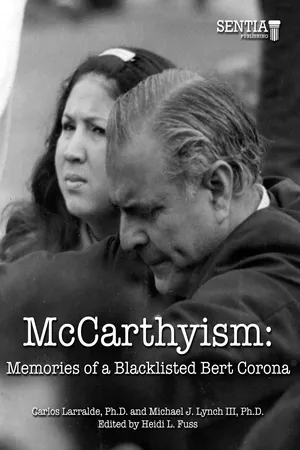
McCarthyism: Memories of a Blacklisted Bert Corona
Carlos Larralde, Ph.D.
and
Michael J. Lynch III, Ph.D.
Edited by Heidi L. Fuss
Copyright ©2016 by Carlos Larralde, Ph.D.
Sentia Publishing Company has the exclusive rights to reproduce this work, to prepare derivative works from this work, to publicly distribute this work, to publicly perform this work, and to publicly display this work.
All rights reserved. No part of this publication may be reproduced, stored in a retrieval system, or transmitted, in any form or by any means, electronic, mechanical, photocopying, recording, or otherwise, without the prior written permission of the copyright owner.
Printed in the United States of America.
ISBN 978-0-9983809-1-9
“A critical chronicle of Latinos who suffered during the McCarthy era, in California that was told by numerous blacklisted Latinos to the author. In the end, the author received most of their personal papers and other documents.”
-Paul Vanderwood, California State University, San Diego
“It is a useful narrative to those who need to understand the Latino struggle for civil rights.”
-Jose Lopez, California State University, Long Beach
About the Authors
Carlos Larralde received his Ph.D. in sociology at UCLA in 1978 and has published numerous studies on the American Latino community.
Michael J. Lynch III received his Ph.D. in historical geography from Texas A&M University in 2003. His academic interests include ethnic studies, ethnic enclaves, and the history of ethnic empowerment.
To Gerald (Jerry) Lee Madison (1937-2015) with devoted affection. He knew Bert Corona.
Foreword
Carlos Larralde has crafted a study of Bert Corona, a California Latino civil rights activist. This alone is a significant accomplishment. As the reader will undoubtedly surmise, hard copy source materials were scant. This is due primarily to the dearth of paperwork and notes available. This, in turn, was due to the fears that primary source materials could be confiscated and used against the people central to the study, Bert Corona and the Latino activists associated with him. These fears arose in conjunction with the very real danger that local, state, and federal government minions would distort and use against these Latino activists, the very records that would have verified and supported their verbal accounts.
Thus, in many instances, verbal accounts remain our only source materials for the history of this band of brothers and sisters who stood up to individuals and groups determined to squelch the basic human rights of ethnic and social minorities. The reader, whether liberal or conservative, should find succor in the activities of these Latino activists. For if none stand to restrain the government, we will all become subjects rather than citizens. This is why the following narrative is powerful, and is such a valuable part of history.
One of history’s problems remains: just what is history and who has the right to craft historical narratives. There is a somewhat accurate concept that the winners get to write history. Fortunately, this tends to be true in the short run. Over time, a more balanced narrative tends to develop which will incorporate voices not heard in the initial historical monologue. I sincerely believe that the volume you are reading serves history by expanding the existing narrative. The multiple voices resonating in this story enrich the history of California, Latinos, the United States, politics, society, and individual persons. Some of these voices have been heard before and some have been heard by only a minute percentage of us.
In developing this narrative, Carlos Larralde has invested his time, talent, and lifeblood in its presentation. The reader is offered a chorus of voices, not a cacophony of noise. This is a difficult endeavor as so many voices and life stories can obfuscate the historical value within multiple lives and personal stories. This work presents many voices and stories. The reader will find it not necessarily an easy read. Please remember that if something is easy, anyone could do it and it usually is not worth much. Easy may be convenient and comfortable, but easy has but limited value.
In this vein, please remember to read the endnotes. This may sound strange, but the endnotes contain more than just sources. Within the source material and the ancillary comments attached to several of the notes is a presentation of the broad range of sources utilized by the author. The endnotes should illuminate the reader with a fuller understanding as to why the narrative has been crafted as it has. This narrative is primarily the story of a single person’s life, which has been richly intertwined with the lives of so many other persons, both heroic and base. In this complex tapestry lies a mirror of our own lives and experiences. One history of so many that comprises our individual and communal existence.
This is a work of scholarship and love compiled from multiple sources and frequently derived from personal interviews with the individuals who lived through this period. Oral histories are difficult simply by the manner in which they are obtained, recorded, and stored for subsequent retrieval, often years later. This alone affords such narratives substantial value, by their scarcity and by the craftsmanship of an individual who has dedicated his effort to bring these narratives to light.
When Carlos asked me to collaborate with him, and pen a foreword and appendix to this narrative, I accepted with honor and trepidation. The former as I was truly honored to be a part of this endeavor. The latter as I was unsure that I could add functional benefit to his work. Yet a third concept of mine has driven this narrative. I have been academically associated with Carlos Larralde for twenty years now, and I have never known him to want anything other than to give voice to those now silenced. I consider this a noble effort, as I have always promoted the concept that all voices be heard, and from the chorus, historical narratives will emerge. For this effort I commend Carlos and his opus. To his readers, I wish them a journey of enlightenment.
Michael J. Lynch III, Ph.D.
Associate Professor of History and Geography
University of Arkansas at Pine Bluff
Introduction
-
Bert Corona: A California Labor Organizer
No narrative is timeless, just as none will have the final word on the reminiscences of Bert Corona, a California Latino (people with genetic and cultural ties to Latin America. Mexicans are the majority). His achievements as a labor union leader made Corona a legend throughout the twentieth century.
Corona became an icon in American labor, civil rights history and an inexhaustible muse of American Latino empowerment. Corona remains “a giant in the history of Latinos in the United States,” stated University of California, Santa Barbara, Professor of Latino Studies, the remarkable historian Mario T. Garcia in his distinctive book, Memories of Chicano History: The Life and Narrative of Bert Corona. Garcia stated that Corona “was a lesser-known figure than Cesar Chavez.” Corona was just as important. He “did what no one had successfully done-organize undocumented laborers. He is the urban counterpart to Chavez, who organized farmworkers.” 1
The Democratic Representative Edward Roybal, who in 1949 was elected to the Los Angeles City Council and later reelected and served until 1962, acknowledged Corona as “a real fighter for civil rights. In the years I was away in Washington [in Congress], Bert was here all the time, fighting for things.” Roybal cherished his friendship. 2
The articulate historian Manuel G. Gonzales praised Corona’s charisma. “Corona was a legendary community organizer” and in California, he became a wide and powerful voice. As a passionate believer in civil rights, he was an uncompromising voice to numerous Latinos. Corona knew how to bring people out and onto the street, if this was essential. 3
An educational policy analyst on Latinos, Professor Carlos F. Ortega, University of Texas, El Paso, Chicano Studies, noted that the public knew the visionary Bert Corona “in casual clothes, with his silver hair, ever-present sideburns, and a confidence that conveyed an attitude of respect for other people, as well as for himself.”
The illustrious Corona earned international respect for his tolerance and liberal politics. He championed fair treatment of immigrants. This figure stood firm on principle. He forged politics, influencing a century of American Latino labor activities. Also as a great thinker and organizer, Corona radiated hope to desperate, impoverished migrants. Most Latinos trusted and cherished Corona, known as the “Father of the Chicano Civil Rights Movement.” Ortega wrote, “He was a great Chicano activist, who fought throughout his eighty-two years for the rights of Mexican Americans, immigrants and workers.” 4
The practical and perceptive Corona refused to be ir...

Table of contents

  1. McCarthyism Memories of a Blacklisted Bert Corona (Lynch & Larralde)