The Early Modern era was a transformative period in the history of warfare. Armies became larger and increasingly professionalized, while gunpowder weaponry changed warfare forever with new firearms and artillery. The Early Modern Wars 1500–1775 – the third volume in the Encyclopedia of Warfare Series – charts this explosive era of invasion, revolt and civil war. A chronological guide to conflict on every continent, including the wars of the Ottoman Empire, the Thirty Years' War (1618–1648) that decimated much of central Europe and the Seven Years' War that saw some of Frederick the Great's most famous victories, this volume gives a comprehensive guide to wars from throughout the period, covering the battlegrounds both on land and at sea. Featuring full colour maps illustrating the formations and strategies used, plus narrative descriptions of the circumstances behind each battle, this is a comprehensive guide to the conflicts of the early modern world. The Encyclopedia of Warfare Series is an authoritative compendium of almost five millennia of conflict, from the ancient world to the Arab Spring. Written in a style accessible to both the student and the general enthusiast, it reflects the latest thinking among military historians and will prove an indispensible reference guide.
- English
- ePUB (mobile friendly)
- Available on iOS & Android
eBook - ePub
Early Modern Wars 1500–1775
About this book
Information
Subtopic
Early Modern HistoryIndex
HistoryEarly Modern Wars 1500–1775
The Early Modern era was a transformative period in the history of warfare. Armies became larger and increasingly professionalized, while gunpowder weaponry introduced firearms and artillery into both naval and land warfare.
Ottoman Wars 1500–1775
■ DIU, 3 FEBRUARY 1509
Aggressive Portuguese expansion in the Indian Ocean during the first decade of the sixteenth century threatened both the balance of power in the region and long-established Ottoman and Mamluk trading interests. This provoked an alliance between the Ottomans, Mamlûks, the Sultanate of Gujarat and the ruler of Calicut, who assembled a fleet of almost 120 vessels to oppose the 18 Portuguese warships under the Viceroy, Dom Francisco de Almeida, which were based at Fort Kochi, southwest India. The Portuguese fleet comprised:
Aggressive Portuguese expansion in the Indian Ocean during the first decade of the sixteenth century threatened both the balance of power in the region and long-established Ottoman and Mamluk trading interests. This provoked an alliance between the Ottomans, Mamlûks, the Sultanate of Gujarat and the ruler of Calicut, who assembled a fleet of almost 120 vessels to oppose the 18 Portuguese warships under the Viceroy, Dom Francisco de Almeida, which were based at Fort Kochi, southwest India. The Portuguese fleet comprised:
• Five large carracks or naus: Flor de la mar (Viceroy’s flagship), Espírito Santo (Cap Nuno Vaz Pereira), Belém (Jorge de Melo Pereira), Great King (Francisco de Távora) and Great Taforea (Fernão de Magalhães). These were large vessels with high stern and forecastles and usually three masts. The foremast and mainmast were square-rigged, while the mizzenmast was lateen-rigged (triangular sail);
• Four smaller naus (each probably with three masts): Small Taforea (Garcia de Sousa), Santo António (Martim Coelho), Small King (Manuel Teles Barreto) and Andorinho (Dom António de Noronha);
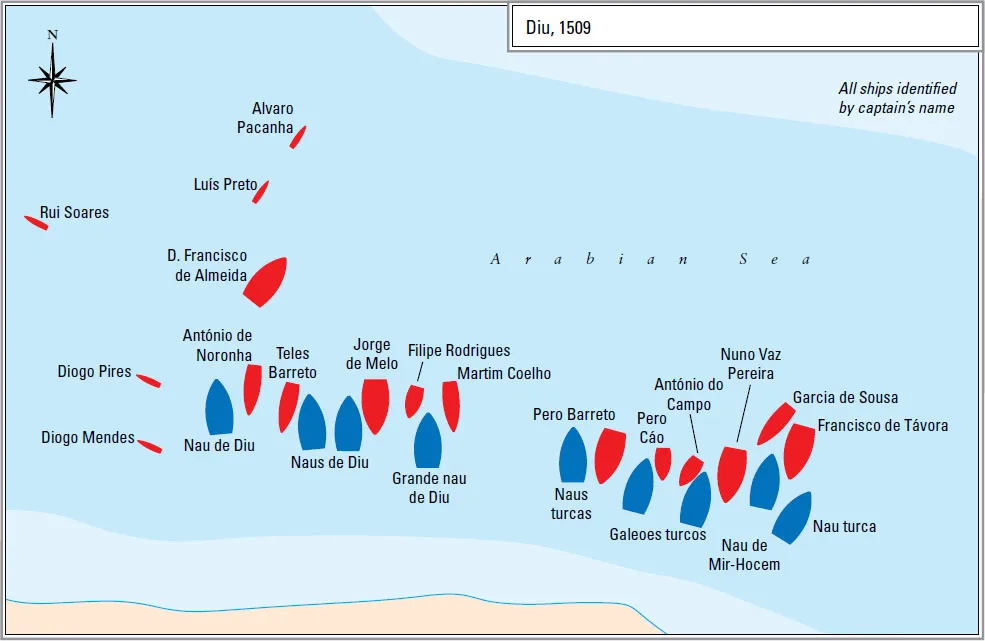
• Four caravelas redondas, three-masted ships with a square foresail and lateen sails on the other two masts. They were probably up to 30m in length and averaged 50 tonnes (captains António do Campo, Pero Cão, Filipe Rodrigues and Rui Soares);
• Two caravelas Latinas (captains Álvaro Peçanha and Luís Preto);
• Two gales, probably two-masted, lateen rigged galleys with 25–30 oars per side, with three men to an oar. Like most galleys, a gale had only forward-firing guns, but could also carry up to 200 troops (captains Paio Rodrigues de Sousa and Diogo Pires de Miranda);
• One bergantim, a smaller, two-masted vessel with a square sail on the foremast and lateen- rigged on the other (captain Simão Martins).
The allied fleet commanded by Ottoman Adm Mir Hussein Pasha included approximately 100 vessels from Gujarat and Calicut, mainly small dhows of limited combat value. Its most effective warships were:
• Four naus from Gujarat
• Four Mamlûk naus
• Two caravelas
• Four galeotas (galliots), small galleys with two lateen-rigged sails and up to 20 oars per side
• Two gales.
Although heavily outnumbered, Almeida’s ships were armed with far more effective cannon than even the best allied vessels, while the 1500 Portuguese troops that it carried were more heavily armed and better armoured than their opponents.
Adm Mir Hussein Pasha deployed the allied fleet in the inner harbour at Diu, covered by shore batteries, which he hoped would offset the superior firepower of the Portuguese vessels. He also relied on the protection given by the narrow channel leading into the harbour, which was notoriously difficult to navigate. However, Almeida captured a local fisherman who agreed to pilot his ships through the harbour approaches. The battle began at about 11:00, when the prevailing winds and the incoming tide were favourable. The Portuguese initially concentrated their fire on the coastal batteries guarding the port and the allied fleet before turning on Mir Hussein Pasha’s ships.
The technological superiority of the state-of- the-art European vessels became obvious as the Portuguese blasted the enemy vessels with cannon fire, before closing in to board, taking two Turkish naus, two Gujarati naus and the two Turkish gales. In addition, two Turkish naus, two Gujarati naus and two Turkish caravelas were sunk. By 17:00, the wind began to change and Almeida ordered his fleet – which had lost no ships – to leave the harbour with their prizes.
■ CHALDIRAN, 23 AUGUST 1514
Sultan Selim I’s 60,000-strong Ottoman army defeated an Iranian army of 55,000 men commanded by Shah Ismail I at Chaldiran in north-western Iran. Selim lost 2000 men, but inflicted 5000 casualties on the Iranians.
Sultan Selim I’s 60,000-strong Ottoman army defeated an Iranian army of 55,000 men commanded by Shah Ismail I at Chaldiran in north-western Iran. Selim lost 2000 men, but inflicted 5000 casualties on the Iranians.
■ MARJ-DARBIK, 24 AUGUST 1516
Sultan Selim I’s 65,000-strong Ottoman army defeated a Mamlûk army of 80,000 men commanded by Sultan Al-Ashraf Qansuh al-Ghawri near Halab in Syria. The Mamlûk army was annihilated, losing 72,000 men, while Ottoman casualties totalled 13,000.
Sultan Selim I’s 65,000-strong Ottoman army defeated a Mamlûk army of 80,000 men commanded by Sultan Al-Ashraf Qansuh al-Ghawri near Halab in Syria. The Mamlûk army was annihilated, losing 72,000 men, while Ottoman casualties totalled 13,000.
■ RIDANIYA, 22 JANUARY 1517
A Mamlûk force under Sultan Tuman Bay II took up a strong defensive position, which was stormed by Sultan Selim I’s 20,000-strong Ottoman army. The Ottomans lost 6000 men, but inflicted 7000 casualties on the Mamlûks.
A Mamlûk force under Sultan Tuman Bay II took up a strong defensive position, which was stormed by Sultan Selim I’s 20,000-strong Ottoman army. The Ottomans lost 6000 men, but inflicted 7000 casualties on the Mamlûks.
■ BELGRADE II, 25 JUNE–29 AUGUST 1521
Suleiman the Magnificent marched along the Danube followed by supply boats. Building a bridge across the Sava failed because of floods, but a bombardment and attack was launched. Belgrade surrendered when a tower was destroyed.
Suleiman the Magnificent marched along the Danube followed by supply boats. Building a bridge across the Sava failed because of floods, but a bombardment and attack was launched. Belgrade surrendered when a tower was destroyed.
■ RHODES, 26 JUNE–22 DECEMBER 1522
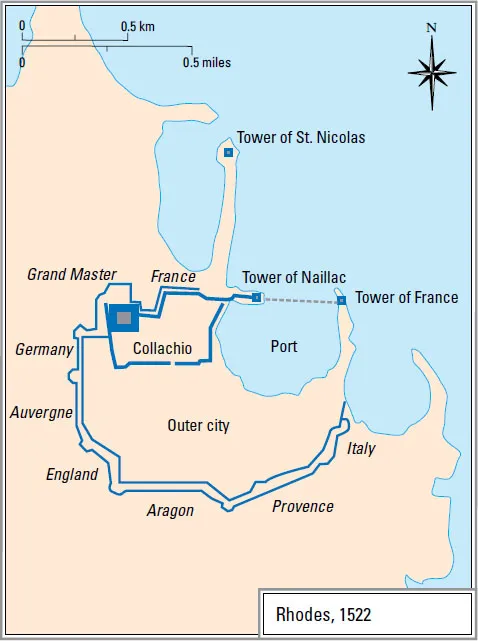
An Ottoman army of 100,000 men commanded by Sultan Suleiman I the Magnificent besieged the Knights Hospitaller’s stronghold of Rhodes, which was defended by a garrison of 7500 men under Grand Master Philippe Villiers de L’Isle-Adam.
An Ottoman army of 100,000 men commanded by Sultan Suleiman I the Magnificent besieged the Knights Hospitaller’s stronghold of Rhodes, which was defended by a garrison of 7500 men under Grand Master Philippe Villiers de L’Isle-Adam.
The Turks blockaded the harbour and subjected the city to repeated artillery bombardments, followed by almost daily infantry attacks. They also attempted to demolish key sectors of the fortifications by mining – on 4 September two mines were detonated under the bastion of England, bringing down a large part of the wall. The Turks stormed this breach, but a counter- attack by the English brothers under Fra’ Nicholas Hussey and the Grand Master drove them back. Further major attacks in September and November were also repulsed, but the city’s supplies were running out and supplies were unable to get through. The Knights surrendered on 22 December after inflicting 50,000 casualties for the loss of 2000 men.
■ MOHÁCS, 29 AUGUST 1526
The Ottoman Empire had been expanding into the Balkans for decades, capturing Belgrade in 1521. In 1526, Sultan Suleiman I the Magnificent advanced northwards towards Budapest with an Ottoman army of 55,000, including Turks, Balkan militia and at least 9000 elite Janissaries. Opposing this army was the Hungarian King Louis II – who was only 19 years old – with an army of 40,000 men consisting of Hungarians, Croatians, Bohemians, Austrians and various European mercenaries. Louis’ field commander was Pál Tomori. The two armies met at Mohács, south of Budapest, to the west of the Danube River. Only part of the Hungarian army arrived on the field in time to take part in the battle, at least 10,000 reinforcements being too late to affect the outcome. Both armies included a mix of heavy and light cavalry, including mounted archers. Both armies also possessed a mix of light and heavy infantry, including some armed with early muskets in the form of arquebuses. The Ottomans had a significant edge in artillery with at least 160 cannon to 85 Hungarian cannon.
The Ottoman Empire had been expanding into the Balkans for decades, capturing Belgrade in 1521. In 1526, Sultan Suleiman I the Magnificent advanced northwards towards Budapest with an Ottoman army of 55,000, including Turks, Balkan militia and at least 9000 elite Janissaries. Opposing this army was the Hungarian King Louis II – who was only 19 years old – with an army of 40,000 men consisting of Hungarians, Croatians, Bohemians, Austrians and various European mercenaries. Louis’ field commander was Pál Tomori. The two armies met at Mohács, south of Budapest, to the west of the Danube River. Only part of the Hungarian army arrived on the field in time to take part in the battle, at least 10,000 reinforcements being too late to affect the outcome. Both armies included a mix of heavy and light cavalry, including mounted archers. Both armies also possessed a mix of light and heavy infantry, including some armed with early muskets in the form of arquebuses. The Ottomans had a significant edge in artillery with at least 160 cannon to 85 Hungarian cannon.
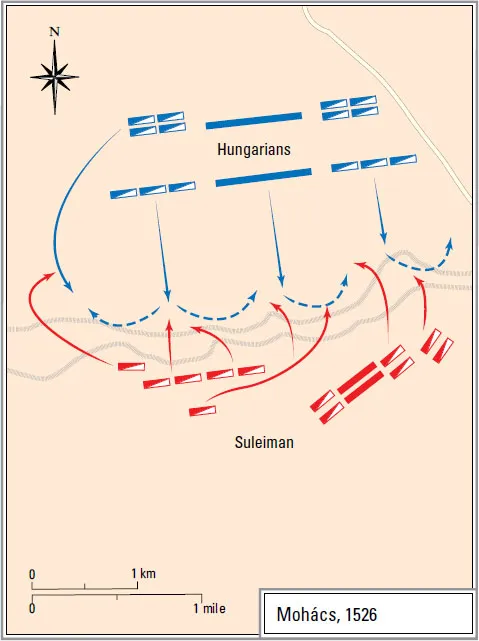
Both armies set up encampments, the Ottoman army with the Danube and marshy ground on their right flank, the Hungarian army facing south with the Danube on their left flank. It was late afternoon, but rather than wait for the next day King Louis decided to attack. Ottoman light cavalry manoeuvred towards the Hungarian right and the Hungarians launched a major attack with heavy armoured cavalry against Ottoman Rumelian light cavalry militia on the left of the Ottoman position. The Hungarian attack was successful, driving in the Ottoman left. The Hungarian cavalry then attempted to wheel in and attack the Ottoman centre, but ran into heavy fire from Ottoman artillery, firing stone projectiles for maximum anti-personnel effect. Elite Ottoman Janissaries, armed with arquebuses, provided close-range fire. Mounted Hungarian archers came close enough to fire at Suleiman in the Ottoman centre, one arrow glancing off of the Sultan’s armour. However, the Hungarian attack had become overextended and the horsemen suffered heavy casualties from Ottoman firepower.
With the Hungarian right engaged and out of position, Suleiman attacked the Hungarian left with Turkish regular cavalry, supported by more Janissaries. Ottoman artillery fire aided the progress of this attack. Ottoman cavalry on the left flank rallied and the Hungarian army was soon enveloped on both flanks. Suffering heavy losses, elements of the Hungarian army began to fall back and Pál Tomori was killed while trying to rally the troops. Many Hungarian infantry were trapped in the centre, while mounted troops fled in disorder. King Louis, caught up in the rout, was thrown from his horse while trying to cross marshy ground and fell into a deep creek. Dressed in heavy armour, the young king was drowned. By nightfall the Hungarian army was completely defeated.
Estimates of Hungarian casualties vary, from 14,000 to 20,000 dead. Adding to controversy are estimates of 2000 prisoners executed by the Ottomans after the battle. Estimates of Ottoman casualties also vary, from 1500 to 7000 men. The decisive battle paved the way for the Ottomans to take Budapest and besiege Vienna within three years. Hungary did not exist as fully independent for nearly three centuries after the battle. The death of Louis without an heir meant that the Austrian Habsburg dynasty became the chief claimants to the throne of Hungary.
■ HUNGARIAN CAMPAIGN, 1527–28
Following the battle of Mohács, Sultan Suleiman the Magnificent was forced to withdraw his field army from Hungary to counter threats to other provinces of the Ottoman Empire. This gave Archduke Ferdinand of Austria an opportunity to attempt to enforce his claim to the Kingdom of Hungary. In 1527–28 he defeated John Zapolya, the Ottoman-backed claimant to the Hungarian throne and captured Buda (now Budapest), Győr, Komárno, Esztergom and Székesfehérvár.
Following the battle of Mohács, Sultan Suleiman the Magnificent was forced to withdraw his field army from Hungary to counter threats to other provinces of the Ottoman Empire. This gave Archduke Ferdinand of Austria an opportunity to attempt to enforce his claim to the Kingdom of Hungary. In 1527–28 he defeated John Zapolya, the Ottoman-backed claimant to the Hungarian throne and captured Buda (now Budapest), Győr, Komárno, Esztergom and Székesfehérvár.
■ BALKAN CAMPAIGN, 1529
Following Ferdinand I’s daring assault on Ottoman Hungary, Suleiman launched an offensive to take Vienna. The 120,000-strong Ottoman army began its advance on 10 May 1529, taking Buda on 8 September and installing John Zapolya as King of Hungary. Suleiman went on to take Gran, Tata, Komoron and Raab, wiping out m...
Following Ferdinand I’s daring assault on Ottoman Hungary, Suleiman launched an offensive to take Vienna. The 120,000-strong Ottoman army began its advance on 10 May 1529, taking Buda on 8 September and installing John Zapolya as King of Hungary. Suleiman went on to take Gran, Tata, Komoron and Raab, wiping out m...
Table of contents
- Cover
- Title Page
- Copyright Page
- Contents
- Maps
- Foreword to the Series
- The Encyclopedia of Warfare: Early Modern Wars 1500–1775
- Authors and Contributors
- How to Use the Maps
- Key to the Map Symbols
- General Index
Trusted by 375,005 students
Access to over 1.5 million titles for a fair monthly price.
Study more efficiently using our study tools.
Frequently asked questions
Yes, you can cancel anytime from the Subscription tab in your account settings on the Perlego website. Your subscription will stay active until the end of your current billing period. Learn how to cancel your subscription
No, books cannot be downloaded as external files, such as PDFs, for use outside of Perlego. However, you can download books within the Perlego app for offline reading on mobile or tablet. Learn how to download books offline
Perlego offers two plans: Essential and Complete
- Essential is ideal for learners and professionals who enjoy exploring a wide range of subjects. Access the Essential Library with 800,000+ trusted titles and best-sellers across business, personal growth, and the humanities. Includes unlimited reading time and Standard Read Aloud voice.
- Complete: Perfect for advanced learners and researchers needing full, unrestricted access. Unlock 1.5M+ books across hundreds of subjects, including academic and specialized titles. The Complete Plan also includes advanced features like Premium Read Aloud and Research Assistant.
We are an online textbook subscription service, where you can get access to an entire online library for less than the price of a single book per month. With over 1.5 million books across 990+ topics, we’ve got you covered! Learn about our mission
Look out for the read-aloud symbol on your next book to see if you can listen to it. The read-aloud tool reads text aloud for you, highlighting the text as it is being read. You can pause it, speed it up and slow it down. Learn more about Read Aloud
Yes! You can use the Perlego app on both iOS and Android devices to read anytime, anywhere — even offline. Perfect for commutes or when you’re on the go.
Please note we cannot support devices running on iOS 13 and Android 7 or earlier. Learn more about using the app
Please note we cannot support devices running on iOS 13 and Android 7 or earlier. Learn more about using the app
Yes, you can access Early Modern Wars 1500–1775 by Dennis Showalter in PDF and/or ePUB format, as well as other popular books in History & Early Modern History. We have over 1.5 million books available in our catalogue for you to explore.