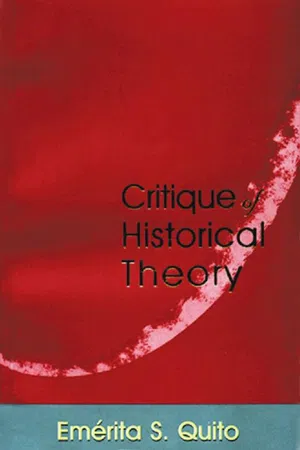
This work is essentially a philosophy of history. The author's research on this topic spans more than three decades. Part One of this book has three chapters. Chapter I is divided into seven sections featuring philosophers who see a plan in history. Chapter II is divided into two sections featuring those who do not see a plan in history. Chapter III is divided into three sections featuring scientists whose ideas are relevant to the philosophy of history. Part Two is divided into four chapters. The first three chapters feature the three philosophers of history—Arnold Toynbee, Jean-Paul Sartre and William Dilthey—who stand out in the 20th century for their uncommon stance. The fourth chapter discusses the relationship between the Philosophy of Man and the Philosophy of History. Finally, Part Three is the Critique. While the philosophers mentioned here have written several volumes, only their ideas relevant to the philosophy of history are discussed.
- English
- ePUB (mobile friendly)
- Available on iOS & Android
eBook - ePub
Critique of Historical Theory
About this book
Information
Subtopic
Philosophy History & TheoryPART ONE

CHAPTER 1
THERE EXISTS A PLAN IN HISTORY
Jacques Bénigne Bossuet, in his Discours sur L’histoire Universelle (Discourse on Universal History) published in Paris in 1681, traces that history of mankind from Adam and Eve to the 17th century. Giambattista Vico, in his Scienza Nuova (New Science) published in Naples in 1744, outlines man’s history through tree periods which he calls the age of the gods, followed by the age of heroes, and concluding with age of men. Johann Gottfried von Herder, in his Ideen zur Philosophie der Geschichte der Menschheit—translated as Outline of a Philosophy of the History of Man—published between 1784 and 1791, notes the rise and fall of men and nations due to Time. Immanuel Kant, in his Ideen zu einer allgemeinen Geschichte in Weltbürgerlicher Absicht (An Idea for a Universal History from the Cosmopolitan Point of View) published in 1784, formulates nine theses about the philosophy of history. Georg Wilhelm Friedrich Hegel, in his Die Philosophie der Geschichte (The Philosophy of History) published in Berlin in 1837, makes of human history a history of the Idea unfolding through the centuries of the development and realization of the Weltgeist or World Spirit. Johann Gottlieb Fichte, in his Die Grundzüge des Gegenwartigen Zeitalters (The Characteristics of the Present Age) published in Berlin in 1806, writes of five basic epochs in history. Friedrich Wilhelm von Schelling, in his System des Transzendentalen Idealismus (System of Transcendental Idealism) published in Stuttgart in 1800, divides history into three periods.
In all these cases, each philosopher arrogates unto himself the infinite wisdom of knowing the entire history of mankind. Or he tries to justify his preconceived plan of history. In either case, these universal histories are placed under a cloud of doubt. No wonder both historians and philosophers are leery of universal histories that purport to explain the entire history of mankind. One individual cannot undertake a universal history, and this accounts for the scorn that universal histories have elicited from both historians and philosophers alike. Yet, in our century, a different variety of universal history stands out and challenges scholars to debunk its theories. Due to advances in communications technology unavailable in the early 20th century, renewed interest in the philosophy of history has surfaced. Or, as Dilthey has emphasized, history—or the philosophy of history—“has to be rewritten from time to time, though past histories may retain some abiding values and truth.”33
SECTION 1
JACQUES BÉNIGNE BOSSUET (1627 – 1704)
Jacques Bénigne Bossuet, an archbishop, has written his Discours sur l’histoire universelle for the perusal of the French Dauphin. He has said that it would be shameful for a prince to ignore the human race and the memorable changes which time brings about in the world.
He divides universal history into three parts, the first of which is divided into 12 epochs beginning with 1) Adam or the creation of the world, 2) Noah, the Deluge, 3) Abraham or the beginning of God’s alliance with his people, 4) Moses or the written law, 5) the siege of Troy, 6) Solomon or the foundation of the temple, 7) Romulus or the founding of Rome, 8) Cyrus or deliverance of God’s people from captivity in Babylon, 9) Scipio or the conquest of Carthage, 10) the birth of Christ, 11) Constantine or peace in the Church, and 12) Charlemagne or the establishment of the new empire.34
The second part is about the religions. Bossuet discusses the life of Jesus Christ, the prophecies, the different forms of idolatry and the triumph of Christ, the Son of God. The long discussion about the life of Christ culminates in the Catholic church and its victory over the different sects. Bossuet points to Divine Providence as the reason of its triumph.
The third part is about the empires. The revolution of empires is regulated by Providence and serves to humiliate the princes. This revolution of empires has particular causes which the princes (like the Dauphin) must study. The empires alluded to are those of the Ethiopians and Egyptians, Assyrians, Persians, the Roman Empire, and their eventual fall. The discourse of Bossuet ends with the fall of the Roman Empire.
The conclusion of Bossuet’s Discourse on Universal History ends with a positive note. Despite the difficult stages of history, “God holds from the heavens the reins of all kingdoms; He has all the hearts in His hands, sometimes He restrains the passions, sometimes He releases them, and by so doing, He moves the human race.”35 It is so that “God reigns over all the people. Let us not talk of chance or fortune; or if we should, it is only to cover our ignorance. What if by chance with regard to uncertain counsels is a concrete design from on high, i.e., in the eternal counsel is enclosed all the causes and effects in the same order. In this manner, everything leads to the same end.”36 What Bossuet means is that human power is unable to attain its own proper ends but God knows all and He can reduce everything to His will.37 Bossuet sidetracks the existence of human freedom which can upset the Divine Will. What is more, Bossuet cancels the elements of chance.
In a way, Bossuet is correct about chance. Very often, what we call chance is the unexpected of the unintended. And yet, chance is the intersection of two intended free acts. For example, A intends to go to the park and B intends to go to the gym. When their paths cross, we call it chance. In history or, for that matter, in life, many so-called “chances” are intersections of free intentions which later on show that they are meant to be. Two persons meet by accident or chance, become acquainted and friendly with each other, and later on enter into a deep relationship for life. Or a man rests under an apple tree, and while resting, an apple falls to the ground. Because of this incident, this man dwells upon the incident and conducts experiments that lead to the formulation of the Law of Gravity. These incidents could be mere chances but from a higher point of view they could be design.
Is there an element of chance in the philosophy of history? Are all the historical events, all the deeds of historical heroes or villains attributed to mere chance? Chance had never been given attention until a Frenchman, Jacques Monod, won the Nobel Prize in Science in 1965. His book, Le Hasard et la Nécéssite (Chance and Necessity) explains how chance plays a role in science. He explains that at the beginning, the elements, hydrogen, oxygen, sodium, etc., are simply floating around. By chance one element unites with another element. If the union is beneficiary or salutary, these elements remain united by necessity as in the union of hydrogen and oxygen or water. Monod theorizes that everything in the world happens by chance. There is no human freedom and there is no Architect or Planner. He jumps from chance to necessity and bypasses freedom, choice, and planning.
Bossuet seems to downgrade human freedom which characterizes the human being and makes different from the lower species of organisms. A philosophy of history does not make sense if human freedom eliminated. There is no history of stones, minerals, plants and animals because these beings merely follow the path of their peculiar natures. But are human being like stones, minerals, plants and animals which merely follow preordained structures? That man has free will is certain, based on experience; that God knows that future is also certain because He is God, but how to reconcile these two certainties is so difficult that many theologians have considered the problem a mystery. Being both a theologian and philosopher, Bossuet counsels us to hold on to the two ends of a long chain without seeing how they are connected.
It is evident that Bossuet reduces everything to the power of God and that the Divine End will be reached despite the false religious and empires that tried to subvert this end. Bossuet’s interpretation of history requires faith. Perhaps what he means is that God is wisdom and sees all universally and totally, whereas men see only a few things dimly and partially.
Bossuet’s universal history is frankly a Biblical history with definite dates. These dates are placed alongside the Biblical figures he discusses. For example, he considers the beginning of history as year 1 or 4004 B.C. Bossuet does not give the impression of accuracy regarding dates. He has an acceptable excuse; his book has been written for the personal perusal of the French Dauphin who ought to know how to deal with nations by understanding human history.
SECTION 2
GIAMBATTISTA VICO (1668-1744)
Giambattista Vico’s Scienza Nuova underwent two editions. The third edition published in Naples in 1744 is the final one, the complete title which is Principles of New Science of Gianbattista Vico Concerning the Common Nature of the Nations. It was written at a time when European scholars wrote in Latin in order to be understood in Europe. His terms were originally in Latin and were translated into Italian.
Vico’s work is made up of numbered paragraphs in Roman and Arabic numerals and divided into books and sections.
Vico’s philosophy of history covers the period of the Hebrews up to the 18th century, the time in which he lived. According to his chronological table, the history of ancient nations began with the universal flood or deluge and continued through the Hebrews, Chaldeans, Scythians, Phoenicians, Egyptians, Greeks, Romans, etc.
He claims that there are three successive stages in the development of nations, namely, that of the gods, that of heroes, and that of men with their corresponding natures of the divine, heroic and human.38 This does not, in any way, mean that man was first a god, then a hero, and lastly a man. For Vico, the three stages are human with the last being the full development of man, or the true and proper nature of man.
Vico’s observation is that all nations, though separate from one another in time and space, having a religion, contract marriage, and bury their dead. This can only mean that if these ideas are common and uniform, they must have a common ground of truth in the history of mankind.
The nature of peoples is first crude, then severe, then benign, then delicate, and finally dissolute.39 Vico gives as example, the Cyclops, huge and grotesque as the first to appear on earth; then the proud and magnanimous Achilles; next the valorous and just Aristides and Scipio Africanus; then the great virtue with great vices like Alexander and Caesar; then the melancholy and reflective like Tiberius; and finally, the dissolute and shameless like Caligula, Nero and Domitian.40 This sequence for Vico follows exactly the individual human who first feels necessity, then looks for utility, then attends to comfort, then amuses himself with pleasure, then grows dissolute in luxury, and finally goes mad and wastes himself.41
Vico admits that “the human mind is naturally impelled to take delight in uniformity.”42 It is natural for man to see patterns and common denominations among historical events. However, “because of the indefinite nature of human mind that whenever men can form no idea of distant and unknown things, they judge them by what is familiar and at hand.”43 And adding to the weakness, he says, “whenever it is lost in ignorance, man makes himself the rule of the universe in respect to everything it does not know.”44
What Vico means is that man always looks for an explanation and, not being able to find any, resorts to the closest and most familiar to him. Vico does not criticize the nature of the human mind. It is only natural that man makes himself the measure of things since it is the human mind and not a superior mind like the angelic that investigates. Man is aware of his limitations and natural tendencies. Men of different nations think in the same sequence in historical events. For example, there is such a faculty as common sense which is “a judgment without reflection, shared by an entire class, an entire people, an entire nation, or the entire human race”.45 Vico is convinced that these are the bounds of human reasons and he who transgresses them transgresses all humanity.46
The role of mythology is given prominence in Vico’s Scienza. He speaks of Logic, Morals, Economy, Politics, Physics, Astronomy, Chronology, Geography, all with the modifier “Poetic” (i.e., Poetic Logic, Poetic Morals, Poetic Economy, etc.). Vico uses the word “poetic” which in Greek is ñïéåsés means “creation”. “The first fables must have contained civil truths, and must therefore have been histories of the first peoples.”47 The first authors among the Orientals, Egyptians, Greeks and Latins and in the recourse of barbarism, the first writers in the ...
Table of contents
- Cover
- Title page
- Copyright page
- Contents
- FOREWORD
- PREFACE
- INTRODUCTION
- PART ONE
- Chapter I There exists a plan in history
- Chapter II There exist no plan in history
- Chapter III Scientist and the Philosophy of History
- PART TWO
- Chapter I Arnold Toynbee
- PART THREE
- Critique
- BIBLIOGRAPHY
- INDEX
- ABOUT THE AUTHOR
- OTHERWORKS BY EMÉRITA S. QUITO
- ENDNOTES
Trusted by 375,005 students
Access to over 1.5 million titles for a fair monthly price.
Study more efficiently using our study tools.
Frequently asked questions
Yes, you can cancel anytime from the Subscription tab in your account settings on the Perlego website. Your subscription will stay active until the end of your current billing period. Learn how to cancel your subscription
No, books cannot be downloaded as external files, such as PDFs, for use outside of Perlego. However, you can download books within the Perlego app for offline reading on mobile or tablet. Learn how to download books offline
Perlego offers two plans: Essential and Complete
- Essential is ideal for learners and professionals who enjoy exploring a wide range of subjects. Access the Essential Library with 800,000+ trusted titles and best-sellers across business, personal growth, and the humanities. Includes unlimited reading time and Standard Read Aloud voice.
- Complete: Perfect for advanced learners and researchers needing full, unrestricted access. Unlock 1.5M+ books across hundreds of subjects, including academic and specialized titles. The Complete Plan also includes advanced features like Premium Read Aloud and Research Assistant.
We are an online textbook subscription service, where you can get access to an entire online library for less than the price of a single book per month. With over 1.5 million books across 990+ topics, we’ve got you covered! Learn about our mission
Look out for the read-aloud symbol on your next book to see if you can listen to it. The read-aloud tool reads text aloud for you, highlighting the text as it is being read. You can pause it, speed it up and slow it down. Learn more about Read Aloud
Yes! You can use the Perlego app on both iOS and Android devices to read anytime, anywhere — even offline. Perfect for commutes or when you’re on the go.
Please note we cannot support devices running on iOS 13 and Android 7 or earlier. Learn more about using the app
Please note we cannot support devices running on iOS 13 and Android 7 or earlier. Learn more about using the app
Yes, you can access Critique of Historical Theory by Emérita S. Quito in PDF and/or ePUB format, as well as other popular books in Philosophy & Philosophy History & Theory. We have over 1.5 million books available in our catalogue for you to explore.