Frank and forward-thinking, Fit to Lead offers a dynamic new vision of leadership development that places the role of your physical body firmly alongside that of your thoughts and emotions. Written by husband-and-wife team Marcus and Sari Marsden, the book combines the principles of executive coaching and fitness training to provide you with a holistic system for transforming your leadership and producing breakthrough results for yourself and the people you lead.
eBook - ePub
Fit to Lead
Transforming Your Leadership with the 5 Pillars of Performance
- English
- ePUB (mobile friendly)
- Available on iOS & Android
eBook - ePub
Fit to Lead
Transforming Your Leadership with the 5 Pillars of Performance
About this book
Information
Subtopic
LeadershipIndex
BusinessPART I
PERSONAL DEVELOPMENT
BY MARCUS

THE CHALLENGE OF DEVELOPMENT
If you are reading this book, then it is highly likely that this is not the first personal development, leadership development or self-help book that you have picked up… and yet, here you are again! If all these self-help books actually worked, then why do people keep writing and buying them? They do so because these books don’t work! Wouldn’t life be great if all you needed to do was to read a book or Google the necessary information? Actually, it probably would not be so great after all, because life happens most powerfully in the process of attaining goals, rather than at the moment that you actually attain them, but that is another story for another time in another self-help book.
Self-help books give you the knowledge to “help yourself”, and we are all brought up to believe that when we have the knowledge or the know-how, we will be able to produce the desired result. However, there is evidence all around us that this is not the case. America (and increasingly, the Western world in general) has a huge amount of knowledge about diet and nutrition, but at the same time it also has a huge proportion of people who are overweight and want to weigh less. Why? Because other things are more important: guy gets home from work, he wants to lose weight, he knows that a chicken salad would be the best choice for that goal, but he has had a bad day at work and so he chooses a burger and fries, because in that moment, feeling comfortable (a theme we shall return to at length!) is more important than losing weight.
However, this is only half the story.
LISTENING
The other reason this book will not work is that human beings are horrible listeners.
Now, look at what you just did with that last statement: “human beings are horrible listeners”. Chances are that you did what 95% of the world’s population will do when given such a statement: you either agreed with it, or you disagreed with it. That is how human beings have evolved to listen: agree or disagree and then move on. However, neither of these options are very effective if you are looking to develop and grow.
Imagine yourself as a box of “X’s”—where the “X’s” represent all your beliefs, attitudes, points of view, experiences, etc.
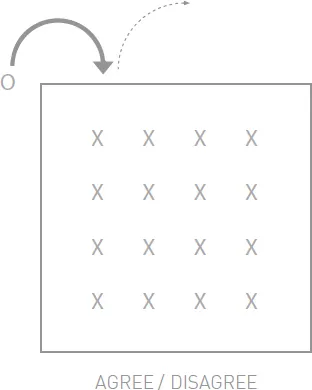
Figure 4.1 The Agree/Disagree Model
Now imagine someone giving you a different point of view, an “O”, if you like. What choices do you have?
1.Agree with it: this statement is “right”, ie. it is consistent with one of your existing “X’s”.
2.Disagree with it: the statement is “wrong”, ie. it is inconsistent with your current “X’s”. When you do this, you are basically erecting a force field around your box of “X’s” to keep the “O” out. You may do it forcefully through argument and pushing back or you may do it subtly by changing the subject or ignoring it, but the result is the same: the “O” never gets close to entering your box of “X’s” (see Figure 4.1).
3.Analyse or assess it: this seems sensible, right? You are a sensible, rational 21st-century human being, so you think about it, you assess it. However, when you do this, what are you assessing the “O” against? What criteria are you using, to see if it is a “good” point of view or not? Your “X’s”! And guess what? The “O” does not look like your “X”, so it ends up in the trash can anyway.
4.Sophisticated analysis: this is the subtle version of option number 3. After an initial analysis, once you see that the “O” does not fit, you deconstruct it, manipulate it, and then rebuild it, so that it looks like, you guessed it, an “X”! Yay! You let it in! But did you really? No, you took a different point of view and twisted it until it mirrored a point of view that you already had, and only then did you let it in.
After all of these options, your box of “X’s” looks exactly the same as it did before! For most people, as they get older, the walls of their box become higher and thicker and the “X’s” become “X’s”. This is why children learn and develop so much quicker than adults: the walls of their box are very low and thin, they don’t have many “X’s” and the ones that they do have are “x’s”. Unlike adults, children are more interested in developing and growing than they are in defending what they already know.
Being Open
There is a fifth option: just to let the “O” in, and to let it sit there in the box as an “O”, a different point of view sitting in your box of “X’s”. This requires you to give up your snap judgements of “agree/disagree” and to be open. This is very counter-cultural in the 21st century—where everything has become about speed and fast decision making. Instead of rushing to a decision and then tweeting about it, you actually just allow a different point of view in, and let it sit there, even if it is in contradiction to your original point of view.
If you do that, then look what happens to your box (see Figure 4.2):
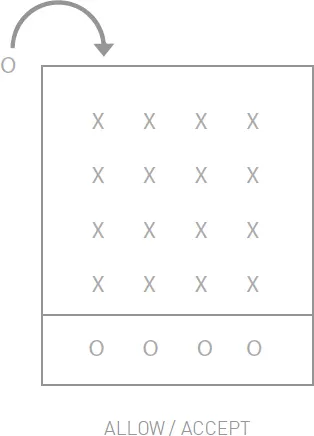
Figure 4.2 The Allow/Accept Model, Step 1
Being open gives you a space in which you can choose how to respond, rather than just making snap judgements based on your history, habits and what makes you comfortable. If you then use this space to assess the “O” based on the question, “Would keeping this ‘O’ help me get closer to my goal?”, then you are on your way to producing the results you say you want to produce. If you choose to keep the “O” then it eventually becomes… an “X”, and look what then happens to your box (see Figure 4.3):

Figure 4.3 The Allow/Accept Model, Step 2
Now, your box is bigger! That is real growth. In comparison, merely continuing to add more and more “X’s” to your box will not make it grow. This is because adding more “X’s” cannot be considered real development; you are simply reinforcing your existing points of view.
So, look back at two of the statements already contained in this book:
•Fitness and nutrition are integral to personal development and leadership.
•Human beings are horrible listeners.
Notice how you responded to these statements. Were you open to them or did you instantly agree/disagree and move on?
Agree/Disagree
If you agree with 100% of the things written in this book and yet are still not leading effectively, then something else is going on. Just like our tired burger-eating fellow, you have the knowledge but are not using it because something else is more important to you, such as being comfortable. If you disagree with 100% of the things written in this book, then congratulations! I am not invested in my “O’s” being right. You are welcome to be right about your “X’s”, but then you need to ask yourself: are they really working for you? If you keep them, will they maximise your physical, mental and emotional states and support you in becoming the most effective leader you could possibly be? Ultimately, you need to ask yourself this question: why did you even pick up this book in the first place? Do you just want to be right? After all, being right is one of the most addictive drugs in human history!
If you really do want to use this book effectively, then my suggestion is to pay attention to how you read it, and whether you are willing to be open as you do so. In particular, pay attention to any “O’s” that you want to violently prevent from breaching your wall of “X’s”. In my experience, it is the “O’s” that you resist the most that contain the most value. As a way to start, consider how open you were to the whole idea of “X’s” and “O’s” in this chapter.
The importance of being open in order to learn, develop and grow is a fundamental part of much of my coaching. Of course, people do not go around consciously saying to themselves, “I want to be closed today”, it often just becomes a habit fuelled by position and experience: “I don’t need to be open to input because I am the boss (or the parent) and I have more experience.” This kind of attitude becomes transparent after a time, and you carry around a fixed box of “X’s” that you unconsciously hold as “right”. But very often, people who have become close-minded in this way are also completely unaware of that fact. How, then, do you become aware of your own blind spots?
CLIENT CASE STUDY
Vinod Tiwari, COO of the Pulp Business with Aditya Birla Group, working with Marcus
Vinod sought my help to improve his working relationship with his team. He could see that his relationships with his team members were not deep enough to hit his stretching targets. After observing him at work, I realised that Vinod was practising a very prevalent attitude, one we term “blindness”: he felt that he was generally right, while some of his team members would often express opposing opinions. He would ask his team to achieve lofty goals, but their differences in opinion often left them unable to reach these goals.
The impact of an attitude of blindness rarely remains confined to the Mental State Pillar. Once it becomes second nature to defend your “X’s” in the domain of the Mental State Pillar, you begin to manifest transparent habits in the domains of the Emotional and Physical State Pillars as well. In the Emotional State Pillar, certain moods and emotions (notably anger) become more prevalent than others, while some others (notably gratitude) completely disappear. Similarly, in the Physical State Pillar, certain physical habits and postures (notably tightness) become habitual, while others (notably looseness) disappear. Once I noticed that Vinod was consistently displaying these emotional and physical habits, I was able to diagnose the main reason for his stagnation: he had become close-minded and blind to the opinions of others.
Naturally, it took a while for Vinod to acknowledge his attitude of blindness, but eventually he had the courage to tell the truth about his situation even though it was not very flattering. Once he came to terms with this, Vinod decided to change his attitude by eliciting feedback from others and looking at situations from perspectives other than his own. He soon found himself seeing new and different options and building deeper relationships with his team members in the process. Vinod’s newfound rapport with his team has allowed him to make bigger requests of them at work, requests that they are now willing to grant. Moving forward together with his team in this way has led to greater success not only for Vinod, but also his team and his bus...
Table of contents
- Cover Page
- Title Page
- Copyright
- Contents
- Acknowledgements
- Foreword
- Preface
- The Structure of this Book
- Overview: Looking Ahead
- Part I: Personal Development
- Part II: The Body
- Part III: Leadership Transformed
- Conclusion: Moving Forward
- Bibliography
- Appendix I: Chocolate Brownies and Willpower
- Appendix II: Physical Activity Readiness Questionnaire (PAR-Q)
- Appendix III: Sample Dynamic Energetics Development Training Plan
- About Sarius Performance International
- Back Cover
Trusted by 375,005 students
Access to over 1.5 million titles for a fair monthly price.
Study more efficiently using our study tools.
Frequently asked questions
Yes, you can cancel anytime from the Subscription tab in your account settings on the Perlego website. Your subscription will stay active until the end of your current billing period. Learn how to cancel your subscription
No, books cannot be downloaded as external files, such as PDFs, for use outside of Perlego. However, you can download books within the Perlego app for offline reading on mobile or tablet. Learn how to download books offline
Perlego offers two plans: Essential and Complete
- Essential is ideal for learners and professionals who enjoy exploring a wide range of subjects. Access the Essential Library with 800,000+ trusted titles and best-sellers across business, personal growth, and the humanities. Includes unlimited reading time and Standard Read Aloud voice.
- Complete: Perfect for advanced learners and researchers needing full, unrestricted access. Unlock 1.5M+ books across hundreds of subjects, including academic and specialized titles. The Complete Plan also includes advanced features like Premium Read Aloud and Research Assistant.
We are an online textbook subscription service, where you can get access to an entire online library for less than the price of a single book per month. With over 1.5 million books across 990+ topics, we’ve got you covered! Learn about our mission
Look out for the read-aloud symbol on your next book to see if you can listen to it. The read-aloud tool reads text aloud for you, highlighting the text as it is being read. You can pause it, speed it up and slow it down. Learn more about Read Aloud
Yes! You can use the Perlego app on both iOS and Android devices to read anytime, anywhere — even offline. Perfect for commutes or when you’re on the go.
Please note we cannot support devices running on iOS 13 and Android 7 or earlier. Learn more about using the app
Please note we cannot support devices running on iOS 13 and Android 7 or earlier. Learn more about using the app
Yes, you can access Fit to Lead by Marcus Marsden, Sari Marsden in PDF and/or ePUB format, as well as other popular books in Business & Leadership. We have over 1.5 million books available in our catalogue for you to explore.