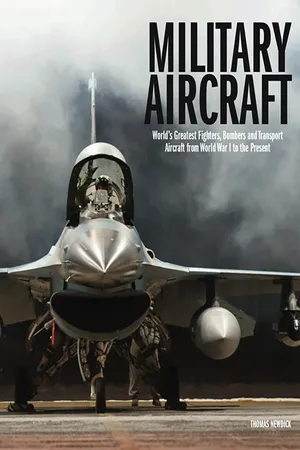
Ever since man first took to the air, combat aircraft have been at the cutting edge of aviation technology, resulting in some of the greatest and most complex designs ever built. The World's Greatest Military Aircraft features 52 of the most important military aircraft of the last hundred years. The book includes all the main types, from biplane fighters and carrier aircraft to tactical bombers, transport aircraft, multirole fighters, strategic strike aircraft and stealth bombers. Featured aircraft include: the Fokker Dr.1 triplane, the legendary fighter flown by German flying ace Manfred von Richthofen, 'the Red Baron', during World War I; the Mitsubishi A6M Zero, Japan's highly-manoeuvrable fighter that dominated air-to-air combat in the early part of the Pacific War; the tank-busting Il-2 Shturmovik, the most produced aircraft in World War II; the Harrier jump jet, a vertical take-off and landing (VTOL) fighter that has been service for more than 40 years; the B-2 Spirit bomber, an American precision strike aircraft used in recent conflicts in Kosovo, Iraq and Afghanistan; and the F-22 Raptor, an air superiority fighter with state-of-the-art stealth technology that makes it almost invisible to radars. Each entry includes a brief description of the model's development and history, a profile view, key features and specifications. Packed with more than 200 artworks and photographs, The World's Greatest Military Aircraft is a colourful guide for the military aviation enthusiast.
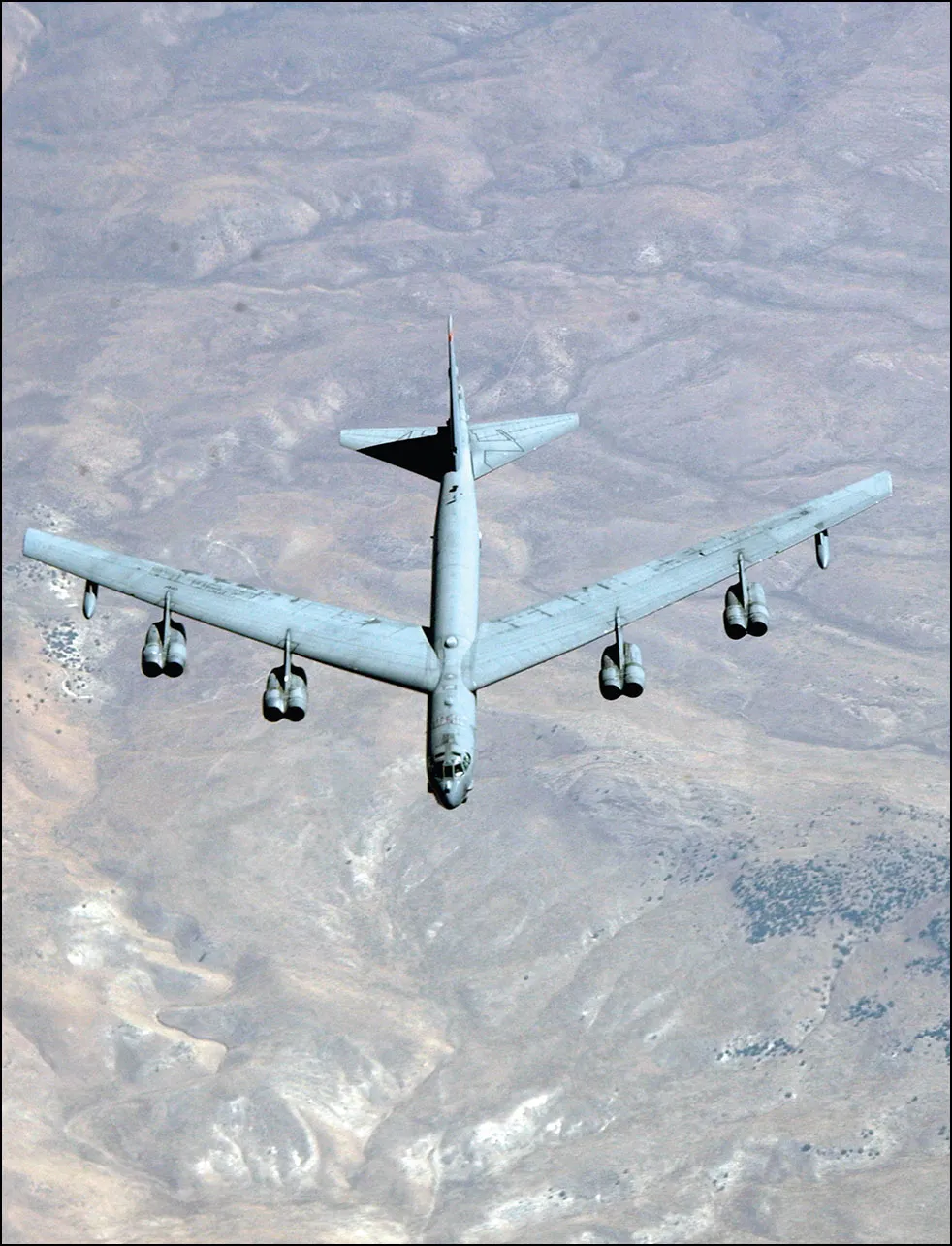
A U.S. Air Force B-52H Stratofortress from the 5th Bomb Wing at Minot AFB, North Dakota, prepares to refuel from a tanker over the western United States in 2002. This venerable Cold War warrior entered service in 1955 and remains a potent weapon in the second decade of the twenty-first century.
Cold War and Modern Era
In World War II, military aeroplanes had introduced the turbine engine and the atomic bomb to the world, and combat aircraft would continue to lead the way in technological developments in the years after 1945. The superpower rivalry of the Cold War saw the limits of science pushed yet further, as aircraft designers battled to provide the ultimate combination of performance, agility, weapons and sensors. As the Cold War came to an end, stealth added another possible requirement to the designer’s remit, while in the twenty-first century network-centric warfare and precision-guided munitions are the order of the day.
North American F-86 Sabre (1949)
Perhaps the finest jet fighter of its generation, the F-86 won its spurs over Korea and went on to enjoy unprecedented success in a variety of combat roles and with dozens of different air arms around the world, serving for close to 50 years. With nearly 10,000 built, it is the most prolific Western jet fighter of all time.
Best known for its MiG-killing exploits over Korea, the F-86 was first flown in prototype form in 1947, and remained in front-line service in Bolivia as late as 1994. Originally developed to meet a USAAF specification, the design was intended to be a day fighter, albeit one that would also be capable of operating as an escort fighter or dive-bomber. The result was the North American NA-140 design.
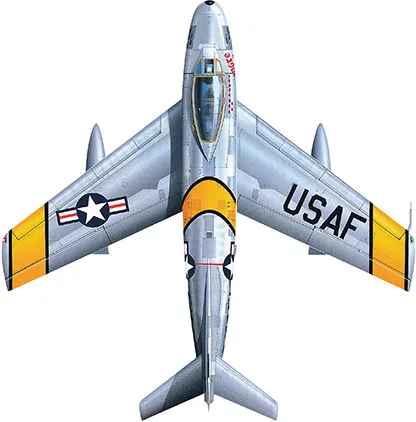
This F-86D was flown by the ‘Geiger Tigers’ of the 520th Fighter Interceptor Squadron, Air Defense Command, based at Geiger Field, Washington, in 1955. The three stripes on the fuselage indicate this is the commander’s aircraft.
The USAF’s Sabre was evolved from an earlier, straight-wing North American jet fighter, the FJ-1 Fury that was built for the U.S. Navy. The addition of a swept wing on the F-86 ensured that it would be one of the finest dogfighters of its era, with performance that far exceeded the previous generation of jet fighters. In late 1944 North American received a contract for two XP-86 prototypes, but these were originally to be straight-winged. The acquisition of technical data from Nazi Germany after the war forced a major rethink, and the XP-86 was redrafted with swept wing and tail surfaces. The result was a year’s delay to the programme, pushing back the maiden flight to October 1947. The XP-86 as initially flown was powered by a General Electric TG-180 turbojet developing 16.68kN (3750lb) of thrust. It was re-engined in April 1948 with a General Electric J47, becoming the YP-86A, capable of exceeding Mach 1 in a shallow dive.
The initial-production P-86A version was powered by a 21.57kN (4850lb) J47-GE-1 and first took to the air in May 1948. The first recipient of the F-86A (as it had been renamed in June 1948) was the 94th Fighter Squadron of the USAF’s 1st Fighter Group at March Field, California, in February 1949. It was swiftly followed by the 4th and 81st FGs. The A-model was also the first to see combat, when the 4th FG was despatched to Japan in late 1950 for service in the Korean War. A total of 554 F-86As were completed, most being powered by the 23.13kN (5200lb) J47-GE-3, -7, -9 or -13 turbojets.
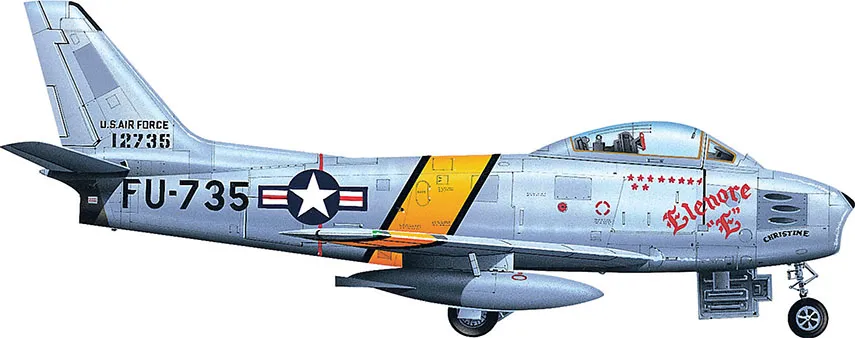
A Korean War F-86E of the 25th Fighter Interceptor Squadron, 51st Fighter Interceptor Wing. The pilot of this aircraft, named Elenore ‘E’, was William Whisner, an ace with 5.5 MiG kills.
1 x 39.7kN (8920lb) General Electric J33-GE-3D turbojet
Maximum speed:
1114km/h (692mph)
Range:
835km (519 miles)
Service ceiling:
15,485m (50,800ft)
Crew:
1
Armament:
4 x 20mm (0.79in) cannon and 2 x 227kg (500lb), 340kg (750lb) or 454kg (1000lb) bombs, or 16 127mm (5in) rockets
The improved F-86E, and the definitive F-86F day-fighter model also saw action in Korea, and between them Sabres were initially credited with almost 800 MiG-15s destroyed, for the loss of only around 80 of their own, to give a victory ratio of 10:1. More recent research suggests that the actual ratio was closer to 2:1. Meanwhile, of the 41 American pilots who achieved ace status during the Korean War, all but one flew the F-86. The F-86E added an all-moving tailplane, while handling was further improved in the F-86F (of which 1539 were built), which featured an extensively modified wing.
Last of the fighter line from North American production was a dedicated fighter-bomber, the F-86H, with a more powerful J73 engine contained within a much-redesigned fuselage, additional fuel capacity and nuclear-weapons capability. A total of 477 were built.
While the day fighters are the best known Sabre variants today, the most numerous member of the family was the F-86D all-weather fighter that was intended for service with Air Defense Command. Originally designated the F-96 on account of its considerable changes, the F-86D incorporated an interception radar and fire-control system and carried an armament of 27 70mm (2.75in) Mighty Mouse rockets in a retractable ventral tray. The other new-build model was the F-86K (120 built), essentially a D-model adapted for service with NATO allies, and with gun armament. ‘Sabre Dogs’ accounted for 2504 of the total production run of 9860 North American F-86s. A total of 827 ‘Sabre Dogs’ were subsequently rebuilt as F-86Ls, featuring an increased-span wing and updated avionics.
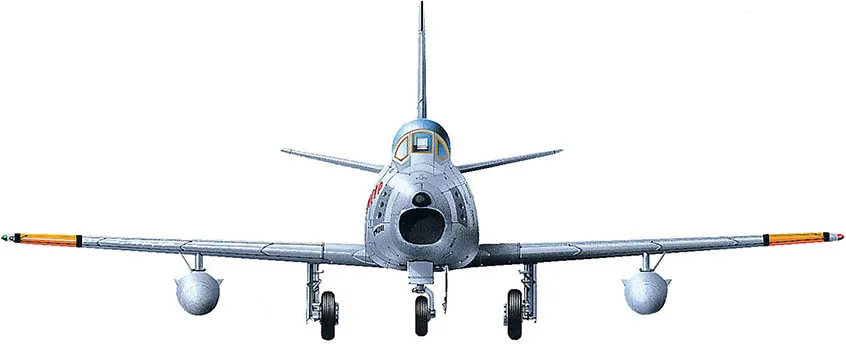
In the neat undercarriage of the Sabre, the nosewheel unit retracted backwards to lie in the forward fuselage, while the mainwheels retracted inwards to lie in the fuselage.
This total was added to by licensed production in Australia by the Commonwealth Aircraft Corporation (112 aircraft) and in Canada by Canadair (1815). The CAC Sabre differed in its use of the 33.35kN (7500lb) thrust Rolls-Royce Avon 26 engine and armament of two 30mm (1.1in) cannon. A total of 100 were built. Canadair produced F-86Es for the USAF, as well as the similar Sabre Mk 2 (290 aircraft) for Canada and NATO allies. The 438 Sabre Mk 4s built by Canadair were supplied to the UK, with General Electric engines, while the 370 Sabre Mk 5s had 28.26kN (6355lb) Orenda 10 turbojets.
Last of the Canadian production models was the Sabre Mk 6, 655 of which were completed with the 32.35kN (7275lb) Orenda 14. Finally, Fiat in Italy was responsible for assembly of 221 F-86Ks that were provided in kit form by North American Aviation, and Mitsubishi of Japan assembled a further 300 Sabres.
Fury: Sabres at Sea
A first-generation naval jet fighter, the North American FJ-1 Fury had provided the initial basis for the design of the land-based Sabre. Successive marks of F-86 then contributed to the further development of swept-wing FJ Fury derivatives for use by the U.S. Navy and Marine Corps. The experimental XFJ-2 was essentially a naval version of the F-86E, equipped with arrester hook, extending nose gear and catapult hitches. A total of 200 FJ-2 production models followed, these being equipped with folding wings. T...
Table of contents
Cover
Title Page
Copyright Page
Contents
Introduction
World War I and World War II
Cold War and Modern Era
Index
Trusted by 375,005 students
Access to over 1.5 million titles for a fair monthly price.
Study more efficiently using our study tools.
Frequently asked questions
Yes, you can cancel anytime from the Subscription tab in your account settings on the Perlego website. Your subscription will stay active until the end of your current billing period. Learn how to cancel your subscription
No, books cannot be downloaded as external files, such as PDFs, for use outside of Perlego. However, you can download books within the Perlego app for offline reading on mobile or tablet. Learn how to download books offline
Perlego offers two plans: Essential and Complete
Essential is ideal for learners and professionals who enjoy exploring a wide range of subjects. Access the Essential Library with 800,000+ trusted titles and best-sellers across business, personal growth, and the humanities. Includes unlimited reading time and Standard Read Aloud voice.
Complete: Perfect for advanced learners and researchers needing full, unrestricted access. Unlock 1.5M+ books across hundreds of subjects, including academic and specialized titles. The Complete Plan also includes advanced features like Premium Read Aloud and Research Assistant.
Both plans are available with monthly, semester, or annual billing cycles.
We are an online textbook subscription service, where you can get access to an entire online library for less than the price of a single book per month. With over 1.5 million books across 990+ topics, we’ve got you covered! Learn about our mission
Look out for the read-aloud symbol on your next book to see if you can listen to it. The read-aloud tool reads text aloud for you, highlighting the text as it is being read. You can pause it, speed it up and slow it down. Learn more about Read Aloud
Yes! You can use the Perlego app on both iOS and Android devices to read anytime, anywhere — even offline. Perfect for commutes or when you’re on the go. Please note we cannot support devices running on iOS 13 and Android 7 or earlier. Learn more about using the app
Yes, you can access The World’s Greatest Military Aircraft by Thomas Newdick in PDF and/or ePUB format, as well as other popular books in History & Military & Maritime History. We have over 1.5 million books available in our catalogue for you to explore.