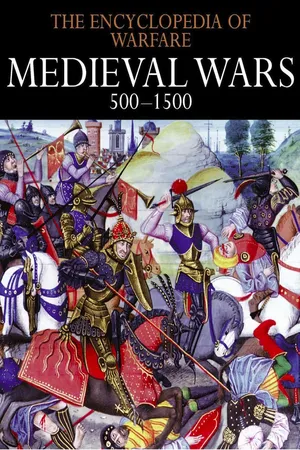
The wars of the medieval period were brutal affairs fought over dynastic or religious issues. The era began with battles fought at close range with impact weapons and the crossbow, but ended with gunpowder weapons reshaping the nature of the battlefield. The Medieval Wars 500-1500CE – the second volume in the Encyclopedia of Warfare Series – charts the bloody history of medieval warfare from the post-Roman world to the rise of the professional army. A chronological guide to conflict on every continent, from the expansion of Islam, the various Crusades (1096–1291), the conquests of Gengis Khan (1211–27), and the Hundred Years' War (1337–1457), this volume gives a comprehensive guide to the wars and battles of the period. Featuring full colour maps illustrating the formations and strategies used, plus narrative descriptions of the circumstances behind each battle, this is a comprehensive guide to the conflicts of the medieval world. The Encyclopedia of Warfare Series is an authoritative compendium of almost five millennia of conflict, from the ancient world to the Arab Spring. Written in a style accessible to both the student and the general enthusiast, it reflects the latest thinking among military historians.
- English
- ePUB (mobile friendly)
- Available on iOS & Android
eBook - ePub
Medieval Wars 500–1500
About this book
Information
Subtopic
European Medieval HistoryIndex
HistoryMedieval Wars 500–1500
The wars of the medieval period were brutal affairs, conducted primarily at close range with edged and impact weapons, supported by the bow and arrow and the crossbow. Yet by the end of the era, gunpowder weapons were starting to reshape the nature of the battlefield, from infantry battles to siege warfare against fortresses.
Post-Roman Britain 500–1100
■ CAMLANN, 537
The Annales Cambriae record the deaths of King Arthur and Mordred, often interpreted as belligerents. Gildas’ contemporary descriptions of internal discord suggest civil war, but neither this nor the location are certain.
The Annales Cambriae record the deaths of King Arthur and Mordred, often interpreted as belligerents. Gildas’ contemporary descriptions of internal discord suggest civil war, but neither this nor the location are certain.
■ ARFDERYDD, 573
Gwendoleu of Arfderydd, the area encompassing Hadrian’s Wall and Carlisle, fought against Peredur and Gywri of Strathclyde. The Annales Cambriae record that Gwendoleu fell and Merlin went mad.
Gwendoleu of Arfderydd, the area encompassing Hadrian’s Wall and Carlisle, fought against Peredur and Gywri of Strathclyde. The Annales Cambriae record that Gwendoleu fell and Merlin went mad.
■ DEORHAM, 577
The forces of Gloucester, Cirencester and Bath united to dislodge Ceawlin’s ‘Wessex’ forces from Hinton Hill, overlooking the Avon valley. The towns were defeated and their kings Connmail, Condida and Farinmail were slain. The victory extended Ceawlin’s power from the Solent to the Thames and the Severn Estuary, isolating the West Country Britons from those of the Welsh Marches and Wales.
The forces of Gloucester, Cirencester and Bath united to dislodge Ceawlin’s ‘Wessex’ forces from Hinton Hill, overlooking the Avon valley. The towns were defeated and their kings Connmail, Condida and Farinmail were slain. The victory extended Ceawlin’s power from the Solent to the Thames and the Severn Estuary, isolating the West Country Britons from those of the Welsh Marches and Wales.
■ DEGSASTAN, c. 603
Aidan, king of the Scotti, attempted to halt the expansionist warfare of Ethelfrid of Northumbria. Ethelfrid defeated the numerically superior army at Degsas’ Stone. His brother, Theobald, was killed with all his men.
Aidan, king of the Scotti, attempted to halt the expansionist warfare of Ethelfrid of Northumbria. Ethelfrid defeated the numerically superior army at Degsas’ Stone. His brother, Theobald, was killed with all his men.
■ CHESTER, 616
Ethelfrid of Northumbria vanquished an army from the British kingdoms of Powys and Rhos, possibly allied with the Anglo-Saxon Cearl of Mercia. Despite heavy losses, Ethelfrid was victorious and King Selyf Sarffagadan of Powys and Cadwal Crysban of Rhos fell. Notably, 1200 British monks from Bangor-on-Dee were slaughtered. The victory isolated the British kingdoms in Wales from those of Strathclyde and Rheged in the north.
Ethelfrid of Northumbria vanquished an army from the British kingdoms of Powys and Rhos, possibly allied with the Anglo-Saxon Cearl of Mercia. Despite heavy losses, Ethelfrid was victorious and King Selyf Sarffagadan of Powys and Cadwal Crysban of Rhos fell. Notably, 1200 British monks from Bangor-on-Dee were slaughtered. The victory isolated the British kingdoms in Wales from those of Strathclyde and Rheged in the north.
■ HATFIELD CHASE, 12 OCTOBER 633
Edwin of Northumbria was defeated by an alliance of Cadwalla of Gwynedd and Penda of Mercia. Edwin was killed, his army destroyed and Northumbria fragmented as Cadwalla pursued a year of rapine in the north.
Edwin of Northumbria was defeated by an alliance of Cadwalla of Gwynedd and Penda of Mercia. Edwin was killed, his army destroyed and Northumbria fragmented as Cadwalla pursued a year of rapine in the north.
■ HEAVENFIELD, 634
Oswald of Northumbria, possibly with allies from Dal Riata, defeated Cadwalla’s numerically superior forces. Oswald took a defensive position alongside Hadrian’s Wall and hemmed in Cadwalla’s advancing army.
Oswald of Northumbria, possibly with allies from Dal Riata, defeated Cadwalla’s numerically superior forces. Oswald took a defensive position alongside Hadrian’s Wall and hemmed in Cadwalla’s advancing army.
■ MASERFELTH, 642
Penda of Mercia defeated Oswald of Northumbria. The location is uncertain; contenders include Oswestry, ‘Oswald’s Tree’. Tradition states Penda had Oswald’s body ritually dismembered and displayed in a tree as a sacrifice to Woden.
Penda of Mercia defeated Oswald of Northumbria. The location is uncertain; contenders include Oswestry, ‘Oswald’s Tree’. Tradition states Penda had Oswald’s body ritually dismembered and displayed in a tree as a sacrifice to Woden.
■ WINWAED, 655
Oswy of Bernicia defeated the superior forces of Penda of Mercia and his Deiran and East Anglian allies. Mercians and their allies were killed, including the East Angle Ethelhere. Oswy beheaded Penda.
Oswy of Bernicia defeated the superior forces of Penda of Mercia and his Deiran and East Anglian allies. Mercians and their allies were killed, including the East Angle Ethelhere. Oswy beheaded Penda.
■ INVASION OF NORTH WALES, 1063
Harold Godwinson led a land and sea campaign from Gloucester to curb the power of Gruffudd ap Llewellyn, ‘King over all of the Welsh’. Harold attacked Rhyddlan, razed Gruffudd’s fleet and put his men to flight. Harold secured the submissions of Welsh sub-kings as Tostig led a campaign of plunder. Gruffudd was murdered by his own men and Harold sent his head to Edward the Confessor.
Harold Godwinson led a land and sea campaign from Gloucester to curb the power of Gruffudd ap Llewellyn, ‘King over all of the Welsh’. Harold attacked Rhyddlan, razed Gruffudd’s fleet and put his men to flight. Harold secured the submissions of Welsh sub-kings as Tostig led a campaign of plunder. Gruffudd was murdered by his own men and Harold sent his head to Edward the Confessor.
■ NORTHUMBRIAN REVOLT, 1065
Following a series of murders, the northern aristocracy rebelled against Tostig Godwinson, Earl of Northumbria, slew his men and declared him an outlaw. The lords of Northumbria and Mercia marched south to confirm Morcar of Mercia as their new Earl and plundered the area around Northampton. Harold Godwinson allied himself with Morcar against his brother. Tostig fled into exile in Flanders and sent emissaries to Harald Hardrada of Norway.
Following a series of murders, the northern aristocracy rebelled against Tostig Godwinson, Earl of Northumbria, slew his men and declared him an outlaw. The lords of Northumbria and Mercia marched south to confirm Morcar of Mercia as their new Earl and plundered the area around Northampton. Harold Godwinson allied himself with Morcar against his brother. Tostig fled into exile in Flanders and sent emissaries to Harald Hardrada of Norway.
Early Medieval Scotland 500–1100
■ DUNNICHEN, 20 MAY 685
Ecgfrith of Northumbria attempted to reinforce his power in northern Britain in an attack against the Pictish Kingdom of Fortiu, to the north of the Mounth. The southern Pictish zone above the Forth acknowledged Northumbrian suzerainty, but Bridei of Fortiu challenged Northumbrian power and harassed its allies.
Ecgfrith of Northumbria attempted to reinforce his power in northern Britain in an attack against the Pictish Kingdom of Fortiu, to the north of the Mounth. The southern Pictish zone above the Forth acknowledged Northumbrian suzerainty, but Bridei of Fortiu challenged Northumbrian power and harassed its allies.
The Northumbrians marched into north Angus near the Lake Lunn Garan, an area marked by deep hills, a narrow pathway and boggy terrain. Feigning retreat, the Picts led Ecgfrith’s men into a narrow mountain pass where they were ambushed. Ecgfrith was killed and the greater part of his army slaughtered. The defeat marked the independence of the Pictish kingdoms from Northumbria and the end of their tributary status. The recovery of lands from Northumbrian control coincided with the rejection of the newly established See at Abercorn, which was symbolic of Northumbrian-sponsored ‘Roman’ Christianity.
■ CARHAM, 1018
Huctred, Earl of Northumbria, marched against Malcolm II of the Scots Kingdom (south of the Forth and Clyde) and Owain of Strathclyde. Huctred was defeated and killed and the Scots gained control of Lothian.
Huctred, Earl of Northumbria, marched against Malcolm II of the Scots Kingdom (south of the Forth and Clyde) and Owain of Strathclyde. Huctred was defeated and killed and the Scots gained control of Lothian.
■ DUNSINANE (BATTLE OF THE SEVEN SLEEPERS), 1054
Siward of Northumbria led land and sea forces against Macbeth of Scotland, following Scottish attacks on Northumbria. Battle was met north of the Firth of Forth on the feast of the Seven Sleepers of Ephesus. Siward was victorious; 3000 Scots and 1500 English fell and Macbeth put to flight. The English regained control of Cumbria, installing Malcolm III as King of Strathclyde.
Siward of Northumbria led land and sea forces against Macbeth of Scotland, following Scottish attacks on Northumbria. Battle was met north of the Firth of Forth on the feast of the Seven Sleepers of Ephesus. Siward was victorious; 3000 Scots and 1500 English fell and Macbeth put to flight. The English regained control of Cumbria, installing Malcolm III as King of Strathclyde.
■ LUMPHANAN, 15 AUGUST 1057
Malcolm III of Scotland mortally wounded his rival Macbeth at an engagement north of the Mounth. Retreating over the Cairnamounth pass, Macbeth staged a last stand and was defeated. He died at Lumphanan.
Malcolm III of Scotland mortally wounded his rival Macbeth at an engagement north of the Mounth. Retreating over the Cairnamounth pass, Macbeth staged a last stand and was defeated. He died at Lumphanan.
■ ALNWICK, 13 NOVEMBER 1093
Malcolm of Scotland led his fifth and last invasion of northern England, besieging the castle at Alnwick. Robert de Mowbray, Earl of Northumbria, set out to relieve the castle. Although lacking the manpower to engage the Scots in open battle, Robert succeeded in taking them unawares and attacked Malcolm’s besieging forces before the ramparts. Malcolm and his son were both killed, resulting in ongoing dynastic struggles in Scotland.
Malcolm of Scotland led his fifth and last invasion of northern England, besieging the castle at Alnwick. Robert de Mowbray, Earl of Northumbria, set out to relieve the castle. Although lacking the manpower to engage the Scots in open battle, Robert succeeded in taking them unawares and attacked Malcolm’s besieging forces before the ramparts. Malcolm and his son were both killed, resulting in ongoing dynastic struggles in Scotland.
Wars of the Franks 500-1000
■ VOILLE, 507
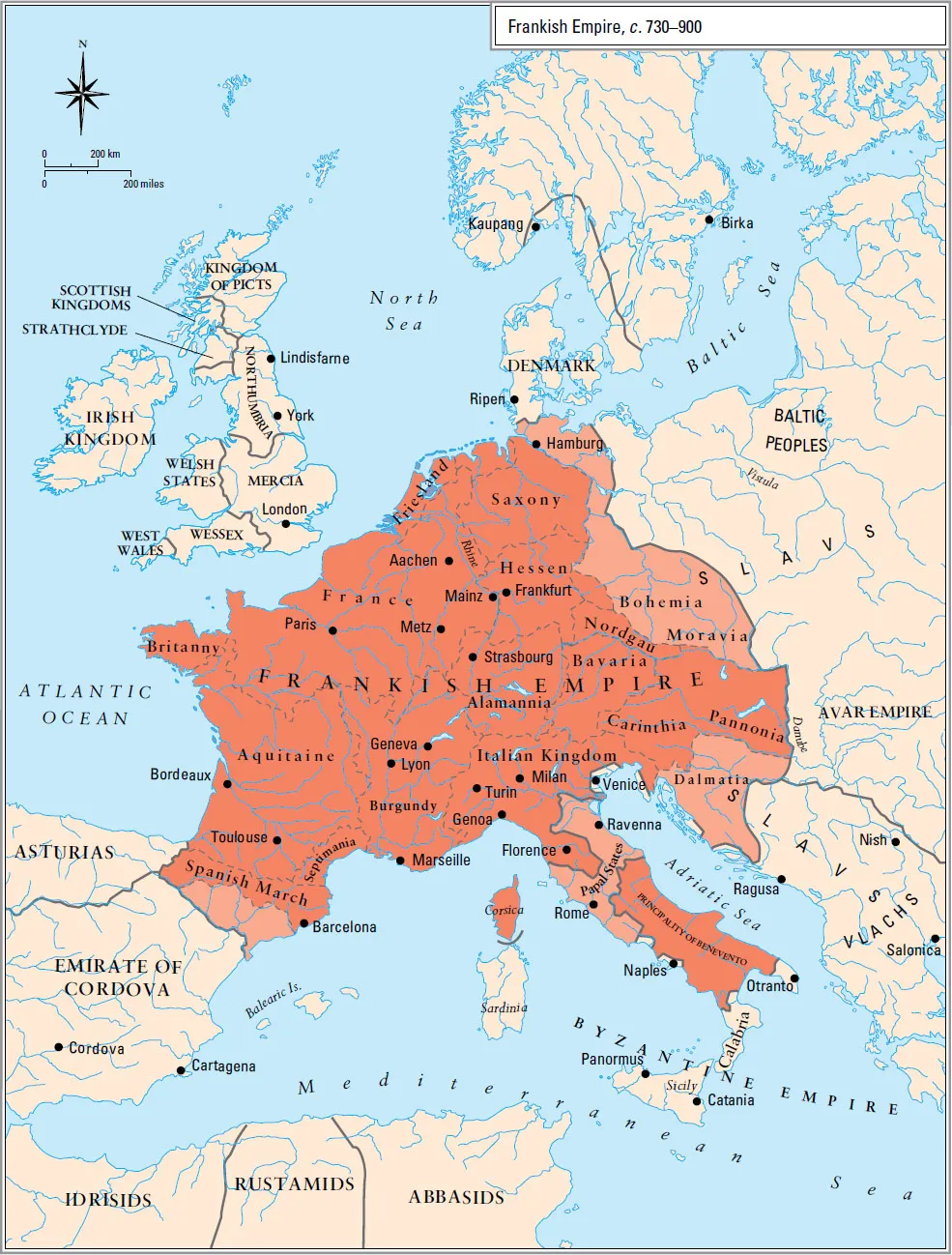
Clovis’ victories over the Alemanni east of the Rhine and the Burgundian Kingdom on the Rhone valley brought the Franks into the orbit of the Gothic kingdoms and the scene of Mediterranean politics. Despite the mediation of Theodoric, Clovis moved against the Visigothic kingdom of Aquitaine. The superior army of Alaric II of Toulouse met Clovis’ forces in the northern marches of Visigothic territory. Fighting took place with javelins and hand-to-hand combat, the Goths deserted the field and the Senatorial leaders of the Auvergnats under the command of Appollinarius were all killed. Clovis killed Alaric and plundered his treasury at Toulouse. He drove the Goths from Angoulême and his son, Theuderic, subdued the Visigothic kingdom south to the Pyrenees. Clovis was made consul by the Emperor Anastasius.
Clovis’ victories over the Alemanni east of the Rhine and the Burgundian Kingdom on the Rhone valley brought the Franks into the orbit of the Gothic kingdoms and the scene of Mediterranean politics. Despite the mediation of Theodoric, Clovis moved against the Visigothic kingdom of Aquitaine. The superior army of Alaric II of Toulouse met Clovis’ forces in the northern marches of Visigothic territory. Fighting took place with javelins and hand-to-hand combat, the Goths deserted the field and the Senatorial leaders of the Auvergnats under the command of Appollinarius were all killed. Clovis killed Alaric and plundered his treasury at Toulouse. He drove the Goths from Angoulême and his son, Theuderic, subdued the Visigothic kingdom south to the Pyrenees. Clovis was made consul by the Emperor Anastasius.
■ VEZERONCE, 25 JUNE 524
Following the death of Clovis, his four sons continued the Frankish Wars against Burgundy. Clotair and Childebert finally defeated Gundomar and his Ostrogothic allies and the Burgundian Kingdom was annexed into the Merovingian lands.
Following the death of Clovis, his four sons continued the Frankish Wars against Burgundy. Clotair and Childebert finally defeated Gundomar and his Ostrogothic allies and the Burgundian Kingdom was annexed into the Merovingian lands.
■ WOGASTISBURG, 631
Dagobert I sent three armies recruited from the Austrasians, Alemanni and Lombards to stem the growing cohesion of Slavic power united under Samo, once a Frankish merchant. Dagobert’s armies were heavily defeated, probably in Bohemia.
Dagobert I sent three armies recruited from the Austrasians, Alemanni and Lombards to stem the growing cohesion of Slavic power united under Samo, once a Frankish merchant. Dagobert’s armies were heavily defeated, probably in Bohemia.
■ COMPIÈGNE, 26 SEPTEMBER 715
The first in a series of battles in the Frankish civil wars following the death of Pepin of Heristal. Pepin’s grandson Theudoald succeeded him briefly as Mayor of the Palace to Dagobert III. Theudoald was ousted in favour of Ragenfrid of Neustria and Pepin’s illegitimate son, Charles Martel, was declared mayor by the nobles of Austrasia. Ragenfrid defeated Theudoald with the support of Eudo, Duke of Aquitaine.
The first in a series of battles in the Frankish civil wars following the death of Pepin of Heristal. Pepin’s grandson Theudoald succeeded him briefly as Mayor of the Palace to Dagobert III. Theudoald was ousted in favour of Ragenfrid of Neustria and Pepin’s illegitimate son, Charles Martel, was declared mayor by the nobles of Austrasia. Ragenfrid defeated Theudoald with the support of Eudo, Duke of Aquitaine.
■ COLOGNE, 716
Chilperic II and Ragenfrid, Mayor of the Palace of Neustria, led a force against Austrasia. A simultaneous invasion was led by their ally Radbod of Frisia. Charles Martel, recently escaped from imprisonment by Plectrude and Theudoald in their power base at Cologne, retreated rather than face insuperable odds. Cologne fell after a short siege and Chilperic II and Ragenfrid were declared king and mayor respectively by the Austrasians.
Chilperic II and Ragenfrid, Mayor of the Palace of Neustria, led a force against Austrasia. A simultaneous invasion was led by their ally Radbod of Frisia. Charles Martel, recently escaped from imprisonment by Plectrude and Theudoald in their power base at Cologne, retreated rather than face insuperable odds. Cologne fell after a short siege and Chilperic II and Ragenfrid were declared king and mayor respectively by the Austrasians.
■ AMBIEVE, 716
Charles Martel defeated the army of Chilperic II and Ragenfrid of Neustria. Attacking as they rested at midday, Charles Martel employed a feigned retreat to draw them from their defensive position into open ground.
Charles Martel defeated the army of Chilperic II and Ragenfrid of Neustria. Attacking as they rested at midday, Charles Martel employed a feigned retreat to draw them from their defensive position into open ground.
■ VINCY, 717
Charles Martel routed the troops of Chilperic II and Ragenfrid of Neustria. Having pursued them to Paris, Charles Martel moved against Plectrude in Cologne and secured the remains of Pepin’s treasury.
Charles Martel routed the troops of Chilperic II and Ragenfrid of Neustria. Having pursued them to Paris, Charles Martel moved against Plectrude in Cologne and secured the remains of Pepin’s treasury.
■ SOISSONS, 718
Chilperic II, Ragenfrid and Eudo, Duke of Aquitaine were defeated by Charles Martel’s army of veterans. Ragenfrid fled to Angers, Eudo and Chilperic II to lands south of the Loire. Eudo handed Chilperic II over to Charles Martel in return for recognition of his Dukedom. On the death of Chlothar IV, Charles Martel recognized Chilperic II as king in return for royal legitimization of his mayoralty.
Chilperic II, Ragenfrid and Eudo, Duke of Aquitaine were defeated by Charles Martel’s army of veterans. Ragenfrid fled to Angers, Eudo and Chilperic II to lands south of the Loire. Eudo handed Chilperic II over to Charles Martel in return for recognition of his Dukedom. On the death of Chlothar IV, Charles Martel recognized Chilperic II as king in return for royal legitimization of his mayoralty.
■ THE BOARN, 734
Charles Martel’s army was ferried over the Aelmere to the Boarn, where he defeated and killed Poppo, king of the Frisians. Looting and destruction of heathen temples followed. Charles Martel annexed the Frisian kingdom.
Charles Martel’s army was ferried over the Aelmere to the Boarn, where he defeated and killed Poppo, king of the Frisians. Looting and destruction of heathen temples followed. Charles Martel annexed the Frisian kingdom.
■ RONCESVALLES, 778
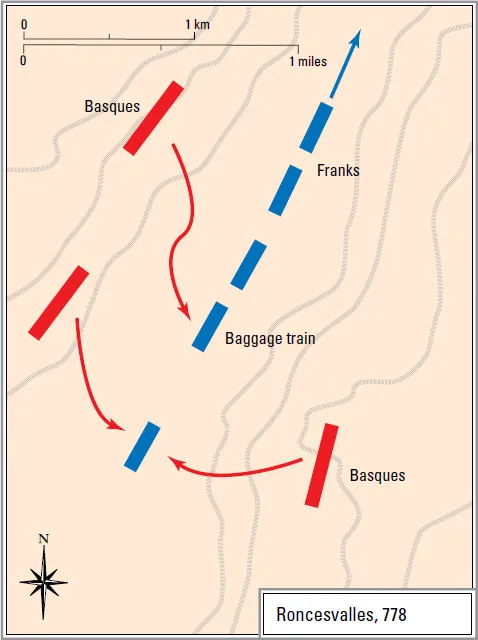
The rearguard of the Frankish Army was ambushed and defeated in the Pass of Roncesvalles by an alliance of Christian Basques of Pamplona and the forces of the Emir of Cordova.
The rearguard of the Frankish Army was ambushed and defeated in the Pass of Roncesvalles by an alliance of Christian Basques of Pamplona and the forces of the Emir of Cordova.
■ BALLON, 22 NOVEMBER 845
Charles the Bald of West Francia was defeated by the numerically inferior troops of Nominoe, Duke of Brittany. The Bretons lured the Frankish troops into the treacherous marshlands between the Oust and the Aff.
Charles the Bald of West Francia was defeated by the numerically inferior troops of Nominoe, Duke of Brittany. The Bretons lured the Frankish troops into the treacherous marshlands between the Oust and the Aff.
■ SOISSONS, 923
The climax of the rebellion by West Frankish nobles against Charles III (the Simple), led by his brother, Robert, Count of Paris. Charles III was defeated and deposed and Robert was killed.
The climax of the rebellion by West Frankish nobles against Charles III (the Simple), led by his brother, Robert, Count of Paris. Charles III was defeated and deposed and Robert was killed.
Wars of the Germanic Migrations 500–750
■ THE ICE OF LAKE VANERN, c. 530
Onela of Sweden was defeated by the exiled Swedish princes Eanmund and Eadgils and the Geatish King Heardred. The battle, fought on the frozen lake, is recorded in Beowulf and Norse sagas.
Onela of Sweden was defeated by the exiled Swedish princes Eanmund and Eadgils and the Geatish King Heardred. The battle, fought on the frozen lake, is recorded in Beowulf and Norse sagas.
■ ASFELD, 552
Audoin, leader of the Lombards and allied to the Emperor Justinian, defeated the Gepid army of Thorisind. Jordanes records the battle as one of the bloodiest of his time, with the loss of 60,000 lives.
Audoin, leader of the Lombards and allied to the Emperor Justinian, defeated the Gepid army of Thorisind. Jordanes records the battle as one of the bloodiest of his time, with the loss of 60,000 lives.
■ CORONATE, 689
Cunipert, King of the Lombards, returned from exile with an army of Piedmontese and defeated the rebellion of Alahis, Duke of Trent and Brescia, along with his Venetian forces....
Cunipert, King of the Lombards, returned from exile with an army of Piedmontese and defeated the rebellion of Alahis, Duke of Trent and Brescia, along with his Venetian forces....
Table of contents
- Cover
- Title Page
- Copyright Page
- Contents
- Maps
- Foreword to the Series
- Medieval Wars 500–1500
- Authors and Contributors
- How to Use the Maps
- Key to the Map Symbols
- Battles and Sieges Index
- General Index
Trusted by 375,005 students
Access to over 1.5 million titles for a fair monthly price.
Study more efficiently using our study tools.
Frequently asked questions
Yes, you can cancel anytime from the Subscription tab in your account settings on the Perlego website. Your subscription will stay active until the end of your current billing period. Learn how to cancel your subscription
No, books cannot be downloaded as external files, such as PDFs, for use outside of Perlego. However, you can download books within the Perlego app for offline reading on mobile or tablet. Learn how to download books offline
Perlego offers two plans: Essential and Complete
- Essential is ideal for learners and professionals who enjoy exploring a wide range of subjects. Access the Essential Library with 800,000+ trusted titles and best-sellers across business, personal growth, and the humanities. Includes unlimited reading time and Standard Read Aloud voice.
- Complete: Perfect for advanced learners and researchers needing full, unrestricted access. Unlock 1.5M+ books across hundreds of subjects, including academic and specialized titles. The Complete Plan also includes advanced features like Premium Read Aloud and Research Assistant.
We are an online textbook subscription service, where you can get access to an entire online library for less than the price of a single book per month. With over 1.5 million books across 990+ topics, we’ve got you covered! Learn about our mission
Look out for the read-aloud symbol on your next book to see if you can listen to it. The read-aloud tool reads text aloud for you, highlighting the text as it is being read. You can pause it, speed it up and slow it down. Learn more about Read Aloud
Yes! You can use the Perlego app on both iOS and Android devices to read anytime, anywhere — even offline. Perfect for commutes or when you’re on the go.
Please note we cannot support devices running on iOS 13 and Android 7 or earlier. Learn more about using the app
Please note we cannot support devices running on iOS 13 and Android 7 or earlier. Learn more about using the app
Yes, you can access Medieval Wars 500–1500 by Dennis Showalter in PDF and/or ePUB format, as well as other popular books in History & European Medieval History. We have over 1.5 million books available in our catalogue for you to explore.