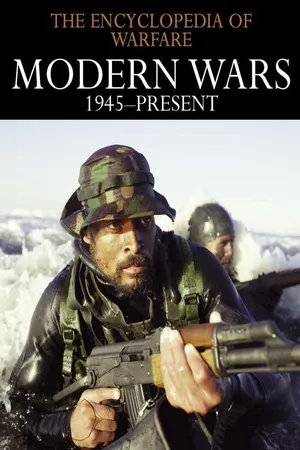
Even as the last shots of World War II were being fired, new conflicts were springing up around the globe. The wars that followed 1945 ranged from minor insurgencies through to full-blown conventional conflicts, and they have changed the political and social map of the world while creating millions of casualties and refugees. The Modern Wars 1945–Present – volume seven in the Encyclopedia of Warfare Series – charts the wars and revolutions that have taken place across the globe since the end of World War II. This is a chronological guide to conflicts on every continent, including the Cuban Revolution, the Vietnam War, the various Iraq wars and the events of the Arab Spring and the current uprising in Syria. Covering the key military events from the past few decades and featuring specially-commissioned full colour maps illustrating the formations and strategies used, the narrative descriptions of the circumstances behind each battle build into a comprehensive guide to the conflicts of the modern world. The Encyclopedia of Warfare Series is an authoritative compendium of almost five millennia of conflict, from the ancient world to the Arab Spring. Written in a style accessible to both the student and the general enthusiast, it reflects the latest thinking among military historians.
- English
- ePUB (mobile friendly)
- Available on iOS & Android
eBook - ePub
Modern Wars 1945–Present
About this book
Information
Subtopic
Military & Maritime HistoryIndex
HistoryModern Wars 1945–Present
Even as the last shots of World War II were being fired, new conflicts were springing up around the globe.The wars that followed 1945 ranged from minor insurgencies through to full-blown conventional conflicts, and they have changed the political and social map of the world while creating millions of casualties and refugees.
Chinese Civil War 1945–49
■SHANTUNG, 10 SEPTEMBER–12 OCTOBER 1945
Shanxi, in central China’s mountainous north-west, had been a centre of communist power before the Second Sino-Japanese War. With the surrender of Japan in 1945, the region became the scene of renewed hostilities with the government. In the autumn, 35,000 Guomindang government troops, under warlord Gen Yan Xishan, attacked the People’s Liberation Army (PLA) stronghold in the Shangdang Prefecture of southern Shanxi. More than 80,000 communist soldiers, including 50,000 militiamen loyal to Liu Bocheng, confronted the government army. Well armed, the nationalists seized Changzhi city, but could not dominate the surrounding countryside. For their part, the communists could not penetrate the city’s defences. The campaign stalemated until the nationalists,under Shi Zebo,attempted a breakout and were defeated at the Peach river. Both sides had approximately 4000 troops killed, although the communists captured more than 30,000 government troops.
Shanxi, in central China’s mountainous north-west, had been a centre of communist power before the Second Sino-Japanese War. With the surrender of Japan in 1945, the region became the scene of renewed hostilities with the government. In the autumn, 35,000 Guomindang government troops, under warlord Gen Yan Xishan, attacked the People’s Liberation Army (PLA) stronghold in the Shangdang Prefecture of southern Shanxi. More than 80,000 communist soldiers, including 50,000 militiamen loyal to Liu Bocheng, confronted the government army. Well armed, the nationalists seized Changzhi city, but could not dominate the surrounding countryside. For their part, the communists could not penetrate the city’s defences. The campaign stalemated until the nationalists,under Shi Zebo,attempted a breakout and were defeated at the Peach river. Both sides had approximately 4000 troops killed, although the communists captured more than 30,000 government troops.
■MUKDEN(SHENYANG), MARCH 1946
The Soviets withdrew in the spring of 1946 from Manchuria. In the opening moves of the renewed Chinese Civil War, Guomindang government troops of Gen Liu Yuzhang’s Twenty-Fifth and Fifty-Second Armies moved in to occupy Shenyang. PLA general Lin Biao unsuccessfully tried to oust his former classmate, Liu. Despite the setback, the communists marched on elsewhere in north-eastern China. By the end of April, they had occupied Siping, and captured Changchun and Harbin.
The Soviets withdrew in the spring of 1946 from Manchuria. In the opening moves of the renewed Chinese Civil War, Guomindang government troops of Gen Liu Yuzhang’s Twenty-Fifth and Fifty-Second Armies moved in to occupy Shenyang. PLA general Lin Biao unsuccessfully tried to oust his former classmate, Liu. Despite the setback, the communists marched on elsewhere in north-eastern China. By the end of April, they had occupied Siping, and captured Changchun and Harbin.
■FIRST SIPING, 15–17 MARCH 1946
In January 1946, bandit militias loyal to the Guomindang government attempted to drive a communist occupation force from this important Manchurian railway depot. The PLA counter-attacked in the spring, defeating Siping’s 3000-man nationalist garrison.
In January 1946, bandit militias loyal to the Guomindang government attempted to drive a communist occupation force from this important Manchurian railway depot. The PLA counter-attacked in the spring, defeating Siping’s 3000-man nationalist garrison.
■SECOND SIPING, 17 APRIL–19 MAY 1946
Government troops again besieged the communist occupation force at Siping. The veteran New First and Seventy-First Armies, under Gen Du Yuming, drove the PLA out after a month of heavy fighting.
Government troops again besieged the communist occupation force at Siping. The veteran New First and Seventy-First Armies, under Gen Du Yuming, drove the PLA out after a month of heavy fighting.
■FIRST CHANGCHUN, 17 APRIL–19 MAY 1946
Controlling Manchurian railway lines and surrounding municipalities were strategic objectives for the Guomindang government. At Changchun, the PLA had violated a 10 January ceasefire, driving out government troops on 15 April. With former Japanese armaments, the communists had fortified themselves against a siege. As Gen Du Yuming’s nationalist troops moved against Changchun, their mechanized units became precariously over-extended and bogged down, unable to penetrate Gen Biao’s PLA defences.
Controlling Manchurian railway lines and surrounding municipalities were strategic objectives for the Guomindang government. At Changchun, the PLA had violated a 10 January ceasefire, driving out government troops on 15 April. With former Japanese armaments, the communists had fortified themselves against a siege. As Gen Du Yuming’s nationalist troops moved against Changchun, their mechanized units became precariously over-extended and bogged down, unable to penetrate Gen Biao’s PLA defences.
■SUNGARI SONGHUA RIVER, 17 DECEMBER 1946–1 APRIL 1947
In the Linjiang campaign, 19 Guomindang government divisions attempted four futile offensives to seize communist bases south of the Songhua river. Each of the nationalists’ thrusts failed, resulting in more than 40,000 casualties (killed and captured).
In the Linjiang campaign, 19 Guomindang government divisions attempted four futile offensives to seize communist bases south of the Songhua river. Each of the nationalists’ thrusts failed, resulting in more than 40,000 casualties (killed and captured).
■THIRD SIPING, 11 JUNE 1947–13 MARCH 1948
Now on the defensive in Manchuria, three government divisions attempted unsuccessfully to defend the city against a siege by Gen Biao’s 60,000 PLA troops. The communists finally overwhelmed Siping, killing more than 30,000 of its defenders.
Now on the defensive in Manchuria, three government divisions attempted unsuccessfully to defend the city against a siege by Gen Biao’s 60,000 PLA troops. The communists finally overwhelmed Siping, killing more than 30,000 of its defenders.
■JINAN, 16–24 SEPTEMBER 1948
In September 1948 90,000 PLA troops under Gen Chen Yi attacked the weakly fortified capital of Shantung. Gen Wang Yao-wu held the ancient, three-walled city with 50,000 troops. As Communist batteries opened fire, LGen Wu Huawen, commanding the government’s 84th Division assigned to the city’s south-western front, defected along with many of his men.These helped seal the communist victory. More than 22,000 nationalists died, with another 60,000 captured.
In September 1948 90,000 PLA troops under Gen Chen Yi attacked the weakly fortified capital of Shantung. Gen Wang Yao-wu held the ancient, three-walled city with 50,000 troops. As Communist batteries opened fire, LGen Wu Huawen, commanding the government’s 84th Division assigned to the city’s south-western front, defected along with many of his men.These helped seal the communist victory. More than 22,000 nationalists died, with another 60,000 captured.
■MUKDEN (SHENYANG)-JINZHOU, 12 SEPTEMBER–12 nOVEMBER 1948
More than 200,000 PLA troops besieged Mukden for 10 months. An American diplomat said the campaign was among ‘the ... final ... military debacles for nationalist arms’. Mukden fell. Five Guomindang armies defected to the communists.
More than 200,000 PLA troops besieged Mukden for 10 months. An American diplomat said the campaign was among ‘the ... final ... military debacles for nationalist arms’. Mukden fell. Five Guomindang armies defected to the communists.
■HWAI HAI, 6 NOV 1948–10 JANUARY 1949
As Lin Biao completed his conquest of Manchuria, Chen Yi’s East China Field Army (ECFA) and Liu Bocheng’s Central Plains Field Army (CPFA) launched two major offensives aimed at linking communist gains and destroying nationalist combat power in important eastern and central Chinese provinces. These operations evolved into the decisive campaign of the war. On 6 November, the CPFA moved north. At the same time, government troops were redeploying to buttress Xuzhou. The Seventh Army, slowed by a narrow crossing over the Grand Canal at Yaowan, attempted to reposition itself east of the city. Meanwhile, a mass defection of government troops in the Third Pacification Area emboldened the communists. By 11 November, the CPFA had blocked and surrounded the Seventh Army, 30km east of the city. Still, the nationalists held on, until the Seventh Army finally collapsed on 23 November. As many as 3000 soldiers escaped east of Xuzhou, but the communists had killed 25,000 and captured another 80,000. In the second major operation of the campaign, on 12–16 November, the CPFA besieged and captured Suxian, cutting the railway supply line for the Second, Thirteenth and Sixteenth Guomindang Armies at Xuzhou. Bloody combat ensued, with the PLA annihilating the Twelfth Army on 15 December. The defeat cost the nationalists 46,000 dead and as many as 50,000 captured. The communists also seized much of the government’s American-made equipment, vehicles, weapons and supplies. The remnant of the nationalist force limped away south and the campaign came to an end. In all, the communists had killed or captured 500,000 government troops, comprising five of the best-trained and best-equipped Guomindang armies. From this point, the government was on the back-foot against the PLA’s inexorable advance on the Yangtze river delta.
As Lin Biao completed his conquest of Manchuria, Chen Yi’s East China Field Army (ECFA) and Liu Bocheng’s Central Plains Field Army (CPFA) launched two major offensives aimed at linking communist gains and destroying nationalist combat power in important eastern and central Chinese provinces. These operations evolved into the decisive campaign of the war. On 6 November, the CPFA moved north. At the same time, government troops were redeploying to buttress Xuzhou. The Seventh Army, slowed by a narrow crossing over the Grand Canal at Yaowan, attempted to reposition itself east of the city. Meanwhile, a mass defection of government troops in the Third Pacification Area emboldened the communists. By 11 November, the CPFA had blocked and surrounded the Seventh Army, 30km east of the city. Still, the nationalists held on, until the Seventh Army finally collapsed on 23 November. As many as 3000 soldiers escaped east of Xuzhou, but the communists had killed 25,000 and captured another 80,000. In the second major operation of the campaign, on 12–16 November, the CPFA besieged and captured Suxian, cutting the railway supply line for the Second, Thirteenth and Sixteenth Guomindang Armies at Xuzhou. Bloody combat ensued, with the PLA annihilating the Twelfth Army on 15 December. The defeat cost the nationalists 46,000 dead and as many as 50,000 captured. The communists also seized much of the government’s American-made equipment, vehicles, weapons and supplies. The remnant of the nationalist force limped away south and the campaign came to an end. In all, the communists had killed or captured 500,000 government troops, comprising five of the best-trained and best-equipped Guomindang armies. From this point, the government was on the back-foot against the PLA’s inexorable advance on the Yangtze river delta.
■BEIJING–TIANJIN, 29 NOV 1948–31 JAN 1949
In the first move of its campaign to seize the ancient cities of Beijing and Tianjin, the PLA encircled Zhangjiakou, a walled city north of the ancient capital. On 15 January, the communists took Tianjin, destroying two Guomindang armies, approximately 130,000 soldiers. The PLA command hesitated over whether to wrest Beijing from the government by force. Nationalist Gen Fu Zuoyi’s two armies finally withdrew on 21 January. Ten days later, the communists entered the city unopposed.
In the first move of its campaign to seize the ancient cities of Beijing and Tianjin, the PLA encircled Zhangjiakou, a walled city north of the ancient capital. On 15 January, the communists took Tianjin, destroying two Guomindang armies, approximately 130,000 soldiers. The PLA command hesitated over whether to wrest Beijing from the government by force. Nationalist Gen Fu Zuoyi’s two armies finally withdrew on 21 January. Ten days later, the communists entered the city unopposed.
■YANGTZE INCIDENT, 20 APRIL–30 JULY 1949
The frigate HMS Amethyst, ordered to Nanking to relieve HMS Consort as guard ship for the British mission, came under fire by communist artillery on the north bank of the Yangtze. Despite Amethyst flying the colours of a neutral nation, two PLA batteries fired on the ship, badly damaging it and driving it aground. Rescue attempts by Consort and two other British ships failed. Amethyst escaped on 30 July. Twenty-two British sailors had been killed; 31 others were wounded.
The frigate HMS Amethyst, ordered to Nanking to relieve HMS Consort as guard ship for the British mission, came under fire by communist artillery on the north bank of the Yangtze. Despite Amethyst flying the colours of a neutral nation, two PLA batteries fired on the ship, badly damaging it and driving it aground. Rescue attempts by Consort and two other British ships failed. Amethyst escaped on 30 July. Twenty-two British sailors had been killed; 31 others were wounded.
■GUNINGTOU, 25–27 OCTOBER 1949
In October 1949 a PLA amphibious expeditionary force attacked the Quemoy archipelago. Waiting until after the PLA’s troops had landed, Guomindang air and naval forces destroyed the communists’ transport ships. Thousands of Mao Zedong’s stranded soldiers were defeated and captured.
In October 1949 a PLA amphibious expeditionary force attacked the Quemoy archipelago. Waiting until after the PLA’s troops had landed, Guomindang air and naval forces destroyed the communists’ transport ships. Thousands of Mao Zedong’s stranded soldiers were defeated and captured.
Indochina 1945–54
■SIEGE OF HUE, DECEMBER 1946–FEBRUARY 1947
Responding to the French colonial government demands to disarm, the communist Viet Minh attacked major cities in the north of Vietnam, including Hue. By February 1947, a French battalion had successfully resisted a six-week siege to maintain control of the ancient imperial capital. The Viet Minh withdrew after ransacking portions of the city. Consolidating their successes, the French launched an offensive drive north to the Chinese border.
Responding to the French colonial government demands to disarm, the communist Viet Minh attacked major cities in the north of Vietnam, including Hue. By February 1947, a French battalion had successfully resisted a six-week siege to maintain control of the ancient imperial capital. The Viet Minh withdrew after ransacking portions of the city. Consolidating their successes, the French launched an offensive drive north to the Chinese border.
■FORT CAO BANG, 3–7 OCTOBER 1950
Gen Vo Nguyen Giap’s Viet Minh attacked the French colonial garrisons at Cao Bang and Dong Khe, north of Hanoi. Gen Marcel Carpentier evacuated the posts, retreating via ‘Route Colonial 4’ (RC4). Attacked all the way, the French lost more than 4000 troops.
Gen Vo Nguyen Giap’s Viet Minh attacked the French colonial garrisons at Cao Bang and Dong Khe, north of Hanoi. Gen Marcel Carpentier evacuated the posts, retreating via ‘Route Colonial 4’ (RC4). Attacked all the way, the French lost more than 4000 troops.
■VINH YEN, 13–17 JANUARY 1951
To solidify communist gains in the north, Gen Giap’s 20,000 Viet Minh attacked French forts between Hanoi and the Gulf of Tonkin. Fighting on open ground and from bunkers, French troops under Gen Jean de Lattre held back all but the most determined of Giap’s human-wave assaults. These the French turned with air strikes, using napalm. Although successful in capturing some positions, Giap’s divisions ultimately suffered 6000 casualties before withdrawing.
To solidify communist gains in the north, Gen Giap’s 20,000 Viet Minh attacked French forts between Hanoi and the Gulf of Tonkin. Fighting on open ground and from bunkers, French troops under Gen Jean de Lattre held back all but the most determined of Giap’s human-wave assaults. These the French turned with air strikes, using napalm. Although successful in capturing some positions, Giap’s divisions ultimately suffered 6000 casualties before withdrawing.
■DIEN BIEN PHU, 20 NOV 1953–7 MAY 1954
Recognizing the deficiencies of the Vietnamese People’s Army in training and materiel, Gen Giap’s strategy was to use guerilla warfare to overcome France’s military advantages. By striking at targets less well defended than Hanoi, Giap hoped to isolate the France’s combat units and negate their weapons superiority. For his part, French Gen Henry Navarre wanted to break the stalemate that had left the Viet Minh in control of the north, and isolated French power at Hanoi and along the Red river delta. Against Giap’s 125,000 communist soldiers, Navarre had 178,000, including French and Vietnamese colonial troops, as well as 200,000 troops of the Vietnamese National Army (VNA). To change the situation, Navarre planned to go on the offensive. By using small-unit tactics behind enemy lines, he hoped to turn the Viet Minh’s asymmetric advantage against it. Additionally, the French sought to lure the main body of Giap’s army into a pitched battle where his weaknesses could be exploited. Learning of a Viet Minh supply route to Laos, Navarre deployed forces to Dien Bien Phu valley to put his strategy into action. He reinforced the garrison with an airborne landing on 20 November 1953, with forces arrayed in five camps (each given a woman’s name). By 13 March, the French had deployed almost 11,000 troops to the area around the Dien Bien Phu airfield, under the command of Brig Christian de Castries. However, the French had not secured the surrounding hillsides. Seeing an opportunity to use the terrain against his foe, Giap moved a large force of almost 50,000 troops into the valley, placing his own guns on the higher ground and in individual dugouts among the trench lines his engineers had dug around the French encampment. In the opening attack, Giap’s 308th Division assaulted the French camps ‘Gabrielle’ and ‘Beatrice,’ both of which fell after two days of intense fighting. Viet Minh anti-aircraft fire – much more powerful than the French anticipated – helped to check French warplanes’ attempts to support the defenders. Giap’s guns shot down 12 French aircraft during the first phase of the battle. Communist artillery fire also closed the airfield and restricted French resupply missions to imprecise, high-altitude air drops. Meanwhile, under covering fi...
Recognizing the deficiencies of the Vietnamese People’s Army in training and materiel, Gen Giap’s strategy was to use guerilla warfare to overcome France’s military advantages. By striking at targets less well defended than Hanoi, Giap hoped to isolate the France’s combat units and negate their weapons superiority. For his part, French Gen Henry Navarre wanted to break the stalemate that had left the Viet Minh in control of the north, and isolated French power at Hanoi and along the Red river delta. Against Giap’s 125,000 communist soldiers, Navarre had 178,000, including French and Vietnamese colonial troops, as well as 200,000 troops of the Vietnamese National Army (VNA). To change the situation, Navarre planned to go on the offensive. By using small-unit tactics behind enemy lines, he hoped to turn the Viet Minh’s asymmetric advantage against it. Additionally, the French sought to lure the main body of Giap’s army into a pitched battle where his weaknesses could be exploited. Learning of a Viet Minh supply route to Laos, Navarre deployed forces to Dien Bien Phu valley to put his strategy into action. He reinforced the garrison with an airborne landing on 20 November 1953, with forces arrayed in five camps (each given a woman’s name). By 13 March, the French had deployed almost 11,000 troops to the area around the Dien Bien Phu airfield, under the command of Brig Christian de Castries. However, the French had not secured the surrounding hillsides. Seeing an opportunity to use the terrain against his foe, Giap moved a large force of almost 50,000 troops into the valley, placing his own guns on the higher ground and in individual dugouts among the trench lines his engineers had dug around the French encampment. In the opening attack, Giap’s 308th Division assaulted the French camps ‘Gabrielle’ and ‘Beatrice,’ both of which fell after two days of intense fighting. Viet Minh anti-aircraft fire – much more powerful than the French anticipated – helped to check French warplanes’ attempts to support the defenders. Giap’s guns shot down 12 French aircraft during the first phase of the battle. Communist artillery fire also closed the airfield and restricted French resupply missions to imprecise, high-altitude air drops. Meanwhile, under covering fi...
Table of contents
- Cover
- Title Page
- Copyright Page
- Contents
- Maps
- Foreword to the Series
- Modern Wars 1945–Present
- Authors and Contributors
- How to Use the Maps
- Key to the Map Symbols
- Battles and Sieges Index
- General Index
Trusted by 375,005 students
Access to over 1.5 million titles for a fair monthly price.
Study more efficiently using our study tools.
Frequently asked questions
Yes, you can cancel anytime from the Subscription tab in your account settings on the Perlego website. Your subscription will stay active until the end of your current billing period. Learn how to cancel your subscription
No, books cannot be downloaded as external files, such as PDFs, for use outside of Perlego. However, you can download books within the Perlego app for offline reading on mobile or tablet. Learn how to download books offline
Perlego offers two plans: Essential and Complete
- Essential is ideal for learners and professionals who enjoy exploring a wide range of subjects. Access the Essential Library with 800,000+ trusted titles and best-sellers across business, personal growth, and the humanities. Includes unlimited reading time and Standard Read Aloud voice.
- Complete: Perfect for advanced learners and researchers needing full, unrestricted access. Unlock 1.5M+ books across hundreds of subjects, including academic and specialized titles. The Complete Plan also includes advanced features like Premium Read Aloud and Research Assistant.
We are an online textbook subscription service, where you can get access to an entire online library for less than the price of a single book per month. With over 1.5 million books across 990+ topics, we’ve got you covered! Learn about our mission
Look out for the read-aloud symbol on your next book to see if you can listen to it. The read-aloud tool reads text aloud for you, highlighting the text as it is being read. You can pause it, speed it up and slow it down. Learn more about Read Aloud
Yes! You can use the Perlego app on both iOS and Android devices to read anytime, anywhere — even offline. Perfect for commutes or when you’re on the go.
Please note we cannot support devices running on iOS 13 and Android 7 or earlier. Learn more about using the app
Please note we cannot support devices running on iOS 13 and Android 7 or earlier. Learn more about using the app
Yes, you can access Modern Wars 1945–Present by Dennis Showalter in PDF and/or ePUB format, as well as other popular books in History & Military & Maritime History. We have over 1.5 million books available in our catalogue for you to explore.