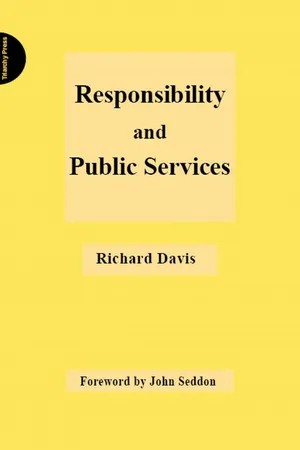
In this important book, Richard Davis looks at the issue of 'responsibility' in public services – on both the government's part and that of the users. While government wrestles with how to cut the cost of services, Davis shows that government can provide responsible, sustainable and effective services significantly more cheaply by focusing on what is of 'value' to individuals and communities. What is of 'value' can only be determined by fully understanding the context in which problems arise and then providing tailored support to get people's lives back on track and as quickly as possible. The emphasis needs to change, Davis shows, from supplying services (chosen in advance by government regardless of actual need) to helping people to look after themselves and take responsibility for their own lives. It's a simple logic. The current system defines problems according to predetermined services and categories. But there are many people who never fit into the categories the system has allocated and constantly fall between the cracks and remain in trouble - so the wider system continues to have to give them emergency help because the principle services are ineffective. This racks up further costs. Responsibility and Public Services shows that it is cheaper to offer people tailored services that meet their needs than to continue providing 'off-the-shelf' services that don't meet their needs. The thinking is that if a little time is taken to understand people in context and to find out what matters to them, the solutions are far easier and cheaper. And, because you build in resilience and help people take their own measures, it stays cheaper.
- English
- ePUB (mobile friendly)
- Available on iOS & Android
eBook - ePub
Responsibility and Public Services
About this book
Information
PART ONE
Introduction
A social services manager discovered for herself how well the system was working for the people it was designed to care for. Her reaction was profound: “I felt physically sick. I went home and decided that all I could do was to resign – I was responsible for this awful failure.” She was not responsible, but her discovery raised an important question: Why have we designed public services in such a way that they fail to deliver what matters? The cost of failure is huge and a waste of public money but, worse, and as the manager discovered, services can sometimes do more harm than good.
I have written this book for those of you who work in the public sector who would like to find real solutions to people’s needs. There is little point in trying to explain how to do this to politicians or public sector leaders. The politicians want simple answers delivered quickly and seem unable to understand why there is a need to rethink the logic and redesign public services; and it is my contention that public sector leaders, influenced by Blair’s ruthless pressure to deliver on targets, have developed a Whitehall mentality where the purpose is simply to ‘make the numbers’.
It is very difficult to find any useful leadership in the public sector – those who might provide focus and inspiration are looking at their performance numbers and not at the public they serve. However, I believe that this is actually good news on another level. It leaves the way open for operational managers and locally elected politicians to become leaders, to take control and make a difference. This is precisely what is happening in the public sector areas that we, Vanguard, are involved in. Historically it was unheard of for the elected members to be part of the work but now they are willing and influential partners giving much needed backing, understanding and enthusiasm to the operational managers.
As it is, the public sector doesn’t function very well. This is a statement that can be verified from many viewpoints – complaints about the National Health Service (NHS) and police services continue to rise, education standards have stalled, access to social services is ever more difficult and local authorities are struggling to provide what people see as basic services, such as libraries and pothole repairs. My own work in the public sector has shown it to be inefficient and largely ineffective – it’s simply not good at delivering what matters. It is awash with money and yet all that is heard is the clamour for more. We tend to believe the media narrative that the quality of services is directly related to funding and nothing else. We have created a narrative of doom about costs: ‘We are living longer, families are broken, treatments are more expensive, the health and care bill will be out of control...’. This is plausible but a non sequitur. There is no evidential link between an ageing population and a much higher need for services, yet it is ‘true’ in most people’s minds. A recent report in the BMJ1, for example, clarified that the increase in demand on the NHS was largely down to medical practice – overdiagnosis, unnecessary procedures, fragmented and uncoordinated treatment and the unnecessary use of expensive technology. Data show that the elderly add only about 2% to NHS costs2. A study in Canada also concluded that the impending ‘catastrophe’ of the ageing populations is a myth3.
So why are we in this mess with poorly performing services? As citizens, as humans, we like to attribute success and failure to a group of individuals. It helps us to explain things to ourselves and each other with a ‘convincing’ narrative. The blame usually falls on a predictable set of suspects – the unions, Westminster politicians, the civil service, and the belief that the workforce in frontline public sector organisations are inefficient and badly managed. Vanguard’s experience, however, is that there is nothing wrong with any particular group of people but that there is much wrong with the system within which they work and of which they have to try and make some sense. Nonetheless, it’s very difficult to accept an argument that says ‘it’s not the people who are at fault, it’s the system that’s at fault’.
Politicians are responsible for the design and running of the system. They are responsible for making decisions based on knowledge. They are responsible for understanding the connection between the design, the way the public sector works and how the workers behave. And we need to ask those politicians some serious questions about the design when people start blaming the police for being dishonest about their crime statistics!
Every government comes to power promising a better set of policies and practices. It usually rails against the previous government’s incompetence and then, somewhere along the line, it decides that it was alright really, that they just didn’t do the work properly. Governments are the masters of Ackoff’s4 proposition, that most of our problems arise from doing the wrong thing righter. The public sector workforce and the citizen are told that each new government policy is going to make things better, and yet both end up with different versions of the same ineffectiveness.
Is there an alternative to the current system? And if there is, how would we know if it was any better? Some parts of the system will always be political – based on the values that politicians wish to promote. However, most changes should be based on empirical evidence (what works). Current political thinking takes little notice of this. For example, there is a growing body of empirical evidence that shows that children learn better if academic learning is delayed and early learning is focused on socialisation, but UK government policy is instead bolstering academic content in the early years. Recent governments have made great play of evidence-based policies yet regularly ignore the contribution of the experts they consult and employ.
One wonders on what basis and with what evidence politicians do design their systems! It purports to be common sense and thus to carry some apparent authority, but many decisions are based on nothing more than plausibility – we just kid ourselves that it is common sense. This is why empiricism, finding out what actually works, is so vital.
Let’s look at Margaret Thatcher’s policy to bring the public sector into the realms of professional business practice. The argument was, indeed, plausible; if the public purse is paying for these organisations, the public should expect nothing less than full accountability and assurance that their money is well spent. There were three assumptions:
1.
the private sector is efficient
2.
the private sector model can be transferred to the public sector
3.
the public sector is inefficient.
Assumption 1 – the private sector is efficient
One example of the private sector failing to produce efficiency is in the motor insurance trade. Insurers have commissioned third parties to manage various parts of the claims process in order to harvest the kickbacks. These third parties are paid on the financial value of the job and so readily inflate it, and insurance premiums have to rise to accommodate the practice. In practice, the market behaves like a monopoly.
Decades of experience with private sector companies has shown that they all operate on the same business philosophy – they have the same set of assumptions about what a ‘good’ organisation looks like and how it is run. They all build the same waste and failure into their systems and practices. The result is that the good ones are merely the best of a bad set.
Assumption 2 – the private sector model can be transferred to the public sector
Can the private sector model ever be applied to the public sector? The answer is ‘yes’, but not the model currently being used which is based on Adam Smith’s notion of division of labour and economies of scale. Smith had a clear goal – to make products as cheap as possible and as many of them as possible in order to allow the British mercantile system to dominate the world market. It was all about cost efficiency and supply – the more you make the more you sell. Organisations in developed countries have followed the logic’ and it is now so ingrained that most people have forgotten its roots and don’t ask themselves if this method will solve the problems they are facing today.
Similarly’ managerial methods were established a long time ago. In the late 1800s there was a serious rail accident (rail companies were all private companies at the time) in New England. An enquiry was convened to find out who was at fault. In the process, specific responsibilities were established for the company’s hierarchy to ensure that it was absolutely clear who would be accountable for any failure in future. The incident is widely believed to have been responsible for the establishment of the hierarchy as an accountability system and not simply as a means of ensuring productive capacity. Combined with Smith’s logic’ the basis of the management system as we know it today was established’ ensuring both outputs and accountability. The elements of what has been called the second industrial revolution – oil prospecting, extraction, refinement and distribution, coupled with assembly line production systems – simply reinforced the need for such management.
The separation of operation from management, which comes from the natural hierarchy of supervision accountability, has created characteristic managerial behaviour. This varies depending on the assumptions about what makes a good manager (administrative, financial or technical, for example). What does not appear to vary very much is how senior managers become absorbed into the ‘management factory’ and rely on the hierarchy for communication. This has added the feature of top-down management which can be described as ‘command and control’.
The logic and practice of command and control dramatically alters the nature of ‘knowledge’ Knowledge is not just cast in terms of cost efficiency as a measure of success but it is determined by the characteristics of the up and down flow of the hierarchy. It is never, therefore, direct knowledge but only ever second-hand at best. Some may point to IT systems as giving a form of direct access, but then who designed the IT system and for what purpose. The answer is usually, ‘it was designed for the management, in order to keep the management factory going.’
The system learns to convince itself that it has knowledge. We need to be critical of this so-called knowledge and assess it for what it is and is not. Recent governments have been tackling the problem of how to get people off benefits and back to work. They claim to have knowledge of how to achieve this, but Andrew Mawson5, one of the UK’s leading social entrepreneurs, questions this. In his book, The Social Entrepreneur, he shows how to achieve exactly what government is striving for. He shows the need to pay attention to what matters to people in the local community, engage them in rebuilding it and, through that, build skills and confidence that allows and encourages them to thrive and develop. He details the formidable struggle he has had to convince ministers and the civil servants that this model is worth supporting. It is clear that if it doesn’t fit government policy it doesn’t happen. Knowledge of what works takes a back seat. He had much success in getting ministers’ interest but great difficulty getting that interest translated into cogent and substantive support, despite the fact that his work has decades of evidence.
It is a moot point as to whether ministers can be held accountable for this failure to understand how to use evidence to build policy and create effective methods of implementation. They could have learned from Toyota, but then very few others did. Toyota introduced a fundamentally different set of assumptions about the design of organisations, but most leaders in the west, both political and industrial, missed the logic6. They could have sought more evidence and knowledge but the ‘big four’ accountancy and consultancy companies, on whom they all rely for such knowledge, also missed the logic.
I started this section by saying that private sector models can be applied to the public sector but that it depends on the thinking behind the model. What characterises the Toyota revolution is that the system is designed backwards. The emphasis is not on production efficiency but on meeting consumer demand. If a customer orders a particular model then the system starts with that order and works backwards to plan what will be required to make that car. Toyota calls this a ‘pull system’ – each step determines what is ‘pulled’ from the line to complete the car7. If the operating model in both sectors were to change to a Toyota style pull system, where the nature of demand determines the design of the system, then the answer to the question of whether the private and public sectors are comparable is, yes. Taiichi Ohno, the Chief Engineer of Toyota and its revolution, said that he had looked at mass production (in the 1950s) and could not see a market for which it was suited. While Adam Smith saw that economy of scale was the foundation for cost reduction, Ohno saw economy of flow as the basis of success; in other words, design the right flow for...
Table of contents
- Front Cover
- Copyright Page
- Contents
- Foreword
- PART ONE Introduction
- PART TWO The Logic of the Current System
- Part Two Summary
- Conclusion A call to arms
- About the Author
- About the Publisher
Trusted by 375,005 students
Access to over 1.5 million titles for a fair monthly price.
Study more efficiently using our study tools.
Frequently asked questions
Yes, you can cancel anytime from the Subscription tab in your account settings on the Perlego website. Your subscription will stay active until the end of your current billing period. Learn how to cancel your subscription
No, books cannot be downloaded as external files, such as PDFs, for use outside of Perlego. However, you can download books within the Perlego app for offline reading on mobile or tablet. Learn how to download books offline
Perlego offers two plans: Essential and Complete
- Essential is ideal for learners and professionals who enjoy exploring a wide range of subjects. Access the Essential Library with 800,000+ trusted titles and best-sellers across business, personal growth, and the humanities. Includes unlimited reading time and Standard Read Aloud voice.
- Complete: Perfect for advanced learners and researchers needing full, unrestricted access. Unlock 1.5M+ books across hundreds of subjects, including academic and specialized titles. The Complete Plan also includes advanced features like Premium Read Aloud and Research Assistant.
We are an online textbook subscription service, where you can get access to an entire online library for less than the price of a single book per month. With over 1.5 million books across 990+ topics, we’ve got you covered! Learn about our mission
Look out for the read-aloud symbol on your next book to see if you can listen to it. The read-aloud tool reads text aloud for you, highlighting the text as it is being read. You can pause it, speed it up and slow it down. Learn more about Read Aloud
Yes! You can use the Perlego app on both iOS and Android devices to read anytime, anywhere — even offline. Perfect for commutes or when you’re on the go.
Please note we cannot support devices running on iOS 13 and Android 7 or earlier. Learn more about using the app
Please note we cannot support devices running on iOS 13 and Android 7 or earlier. Learn more about using the app
Yes, you can access Responsibility and Public Services by Richard Davis in PDF and/or ePUB format, as well as other popular books in Politique et relations internationales & Affaires publiques et administration. We have over 1.5 million books available in our catalogue for you to explore.