The struggle for naval supremacy and the naval arms race inspired by HMS Dreadnought may have captured the headlines, but the opening stages of the naval war were dominated by the threat from German cruisers stationed outside European waters, until they were hunted down and sunk by the Royal Navy, notably at the Battle of the Falkland Islands in 1914.
Germany switched its focus to the U-boat, seeing it as a weapon capable of winning the war by starving Britain into surrender. Unrestricted submarine warfare led to the sinking of millions of tons of shipping, but it would also force the USA to enter the war on the Allied side in 1917.
In the Mediterranean, the French fleet took the lead, while Austria-Hungary supported German actions. The Allied attempt in 1915 to use maritime power to break the strategic deadlock with an amphibious operation in the Dardanelles ultimately failed, although Allied sea power helped sustain the successful campaigns against the Ottoman Empire in the Middle East.
What would prove to be the decisive naval engagement of the war took place in 1916 at the Battle of Jutland. Whilst the clash itself was inconclusive, the German High Seas Fleet would be all but confined to port for the rest of the war, handing the initiative to the Royal Navy. The resultant command of the seas allowed the Allies to carry fresh American armies and much-needed supplies to Europe in 1917.
However, victory for the Allies was ultimately delivered by the naval economic blockade. By preventing the import of war materials and food, the fighting power and morale of the German armed forces was weakened. It was the mutiny of the High Seas Fleet in October 1918 that prompted the German Revolution and the subsequent abdication of the Kaiser.
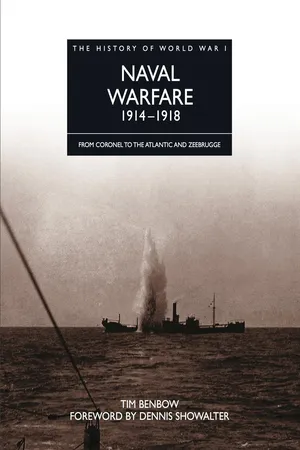
With the aid of over 300 photographs, complemented by full-colour maps, Naval Warfare provides a detailed guide to the background and conduct of World War I naval operations, describing the struggle to win control of the high seas around the globe.
- English
- ePUB (mobile friendly)
- Available on iOS & Android
eBook - ePub
About this book
Information
Subtopic
Militär- & Seefahrtsgeschichte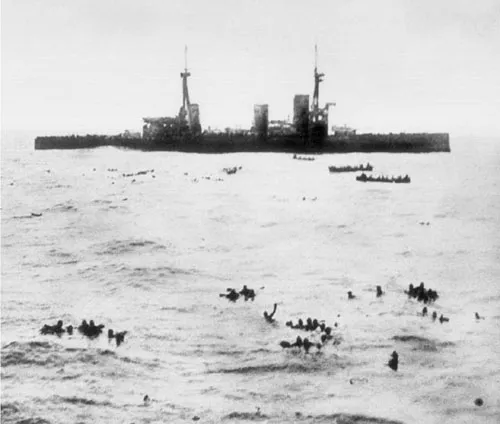
Survivors from SMS Gneisenau floating in the water during the Battle of the Falkland Islands, 8 December 1914. The early months of the war saw two major engagements take place far from European waters; the first (Coronel) was a German victory, the second (the Falklands) a British one.
CHAPTER 1
Distant Waters
At the start of the war in August 1914, there were three challenges to the Royal Navy’s command of the seas: German cruisers stationed outside Europe, the German battlefleet based across the North Sea and the novel threat of the submarine. While in northern European waters, the opposing battlefleets remained cautiously outside their opponent’s reach, in more distant waters the threat from the cruisers would dominate the opening stages of the war, predominantly in the Indian, Pacific and South Atlantic oceans.
The Royal Navy had long deployed powerful squadrons on many overseas stations. Despite Fisher’s rebalancing of the fleet, the outbreak of the war still saw British warships spread across the world, although these were not first-rank ships. Their responsibilities were considerable and widespread, though they benefited from an impressive network of bases and support facilities.
Germany, albeit on a smaller scale, had sought to gain diplomatic benefits from her growing naval power. In the early years of the century, her warships had seen action in the Far East and the Caribbean, and off South America and North Africa. At the beginning of the war, Germany had a number of cruisers patrolling foreign waters. The light cruiser Königsberg was off East Africa, the Dresden was in the western Atlantic and the Karlsruhe was en route to relieve her. Their standing orders in the event of war were to conduct classic cruiser operations against enemy commerce. The idea of creating a chain of fortified bases from which these ships could operate had been dropped, in view of the high probability that such bases would fall and any warships stationed there would be lost. As an alternative, Germany built up a network of agents in neutral ports to arrange the supply of fuel, food and other materials.
Vice Admiral Maximilian Graf von Spee (1861–1914)
Spee was born in Copenhagen to a noble German family (‘graf’ equates to ‘count’) and entered the Imperial German Navy in 1878. He was a gunnery specialist who gained much experience in overseas service. This was to stand him in good stead in 1912, when he was appointed commander of Germany’s principal overseas naval force, the East Asiatic Squadron. On the outbreak of war, Spee took this powerful, modern force across the Pacific – a formidable achievement in terms of arranging refuelling and resupply in an increasing hostile region – before reaching the coast of Chile. Here, at the Battle of Coronel he inflicted on the Royal Navy its first defeat in over a hundred years. Thereafter, he steamed into the South Atlantic, where he took the risky decision to raid the British base at the Falkland Islands. The resulting battle cost Spee’s life and also those of his two sons, who were serving in other warships of the East Asiatic Squadron.
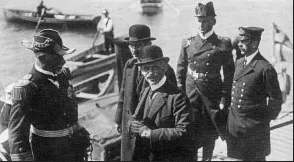
Spee (left) was responsible for an early boost to the prestige of the Imperial German Navy, but it was only a matter of time before his force was run to ground.
SPEE IN THE PACIFIC
Germany’s principal overseas force was the East Asiatic Squadron, under the command of Vice Admiral Maximilian Graf von Spee. It operated from the only major German overseas base at the fortified port of Tsingtao (Qingdao) in China. This force was centred on the modern armoured cruisers Scharnhorst and Gneisenau, each displacing 12,900 tonnes (12,700 tons) and carrying eight 8.2in and six 5.9in guns, with light cruisers in support. Both had well trained and experienced crews, and their gunnery was impressive even by the high standards of the German Navy.
Britain had powerful forces east of Suez, but, reflecting the importance and spread of its trading and imperial commitments, these were widely dispersed. Thus, the China Station had a force including the pre-Dreadnought Triumph (armed with comparatively feeble 10in guns) with two armoured cruisers and two light cruisers; the East Indies were protected by the battleship Swiftsure (sister ship of Triumph), with two light cruisers; and Australia and New Zealand contributed a battlecruiser and four light cruisers. Many of these ships were effectively obsolete, but in wartime they would be reinforced by Allied vessels from the French and Russian navies, and perhaps even the powerful and modern Japanese fleet. Furthermore, the British Grand Fleet provided distant support by hindering additional German cruisers in their efforts to menace the shipping lanes. The Admiralty was well aware of the strength of the German East Asiatic Squadron, viewing it with a wary respect, and realized that British forces would need to concentrate to be sure of defeating it.
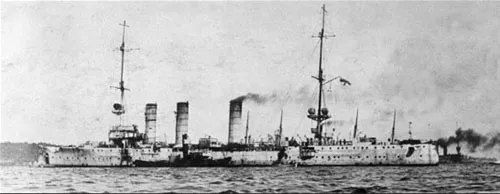
As part of Spee’s East Asiatic Squadron, the light cruiser Nürnberg finished off the badly damaged HMS Monmouth at the Battle of Coronel. At the subsequent Battle of the Falkland Islands she sought to escape, but was chased down and sunk by HMS Kent, inflicting some damage in return.
Rear Admiral Sir Christopher Cradock (1862–1914)
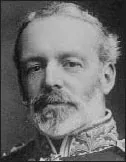
Cradock joined the Royal Navy at the tender age of 13. His formative experiences ranged from fighting ashore in Egypt and the Sudan, to helping suppress the Boxer Rebellion in China, to serving on the Royal Yacht. He also found the time to publish three books. Cradock was an experienced and brave officer, popular with his crews and his fellow officers and well regarded by his superiors. In 1913, he was appointed to command the North America and West Indies Station, becoming responsible on the outbreak of war for protecting shipping over a huge area. His action at the Battle of Coronel, leading the British force from his flagship HMS Good Hope against a far superior German force, showed immense courage and determination, but he has subsequently been criticized as reckless. He could have avoided the battle that cost his life, but chose not to.
Spee’s orders gave him considerable freedom to act according to his own appreciation of the situation. At the start of the war, his squadron was scattered, but its core ships, Scharnhorst and Gneisenau, together with the light cruiser Nürnberg, were training in the Caroline Islands. Spee led his force to Pagan Island in the Marianas, where he was met by the light cruiser Emden, escorting the supply ships and colliers (coaling ships) that had departed Tsingtao in anticipation of its being blockaded. He decided to keep his force concentrated rather than dispersing it. Some historians later suggested that he would have achieved more by splitting his force and having it prey on British shipping, to maximize disruption and to force Britain to disperse its navy to hunt each vessel down. However, Spee believed that keeping them together would prevent individual ships from being cornered and destroyed. Moreover, keeping the force concentrated offered him the prospect of engaging at an advantage a smaller enemy squadron. Some of his captains, particularly Karl von Müller of the light cruiser Emden, put the case for conducting classic cruiser warfare against British trade. Spee accepted that a single cruiser could cause significant disruption and would be able to refuel itself from captured vessels. He therefore detached Emden, as the fastest light cruiser, to attack British merchant shipping in the Indian Ocean.
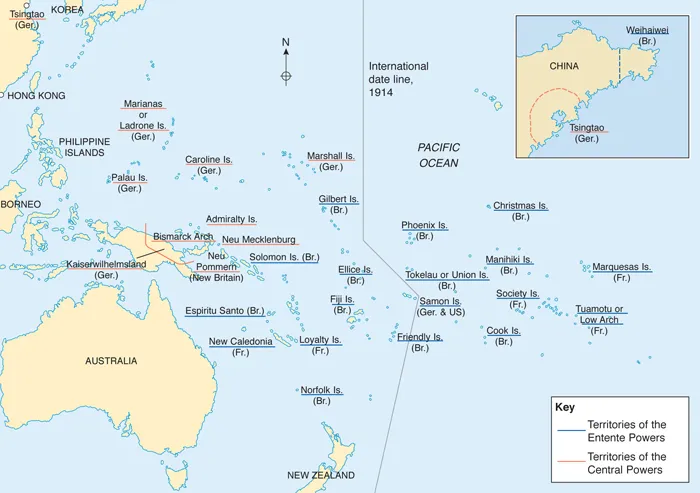
The Pacific, 1914. The naval balance in this region was generally favourable to the Entente powers, particularly after they were joined by Japan. Nevertheless, the sheer size of the area and the amount of shipping that needed protection meant that Allied naval forces would be stretched.
Spee was aware that British and Dominion forces were patrolling near Hong Kong and Australia, and had been warned that, at best, Japan would be neutral. This meant that the base at Tsingtao would be untenable and made the option of raiding British trade in East Asia unappealing. His decision proved prudent, as on 23 August Japan declared war on Germany. The rising power in Asia was keen to use the opportunity presented by the war in Europe to enhance its position in the Pacific, while its navy was equally eager to improve its prestige in comparison with the army. The Japanese Navy made a valuable contribution to the Allied cause, escorting convoys as far as Europe, as well as occupying German-owned islands in the Pacific, including the Carolines, Marianas and Marshalls, all names that would become familiar in the next world war. In September 1914, Japan launched an amphibious assault against Tsingtao. Her forces advanced over land, besieged the base and captured it in November. In the meantime, other German colonies were mopped up, with New Zealand seizing Samoa, and Australia taking New Guinea, New Britain and the Solomons.
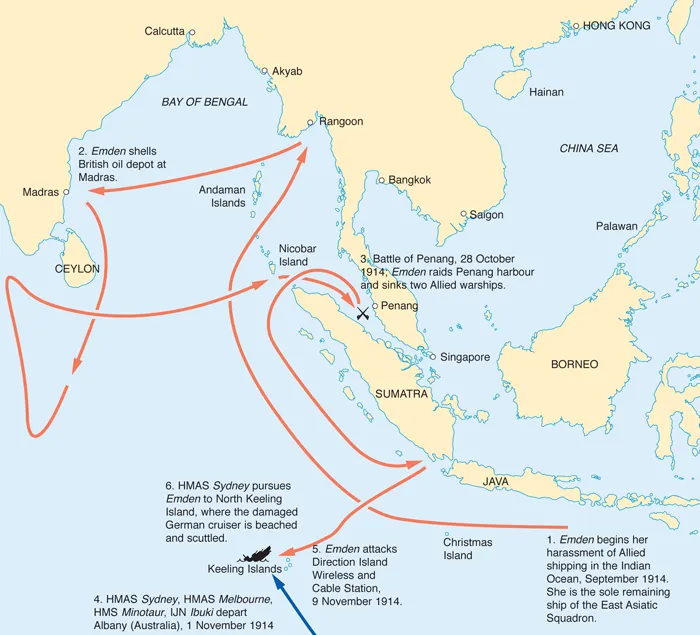
Emden‘s area of operations. Spee was persuaded to allow the light cruiser Emden to separate from the rest of his squadron in order to raid enemy shipping in the Indian Ocean. She took 23 vessels and caused great disruption for two months before being sunk by HMAS Sydney.
The Pacific was therefore rapidly becoming hostile to German forces. However, it was to Spee’s advantage that many of the British and Allied warships in the area were occupied in supporting operations to capture German colonies (a far from urgent task, which could have waited until his force had been dealt with) and in escorting troop convoys heading for Europe. Despite the network of colliers and friendly agents in neutral ports built up by Germany before the war, the availability of fuel was the main consideration for Spee.
He therefore headed south and east, towards the coast of Chile, where he expected to be able to acquire coal. On the way, he was joined at Easter Island by the light cruisers Leipzig (which had steamed south from the coast of California) and Dresden (which had rounded Cape Horn, having been in the South Atlantic at the outbreak of war). Each had taken two British merchant ships before joining the main force. Spee then managed largely to disappear into the vast expanses of the southern Pacific. Britain had no firm idea of his location, but the best guess of naval commanders was that he was heading for South America, which was supported by occasional sightings of his force. On 14 September, he was spotted off Samoa; on 22 September, a French steamer radioed a sighting of the German ships at Tahiti; and in mid-October they were spotted at Easter Island. These sightings confirmed indications gleaned from intercepted wireless messages that he was heading for South America, though this was far from certain.
German Cruiser Operations
Accounts of naval warfare often focus on great clashes between fleets, but no less significant were the activities of cruisers. They patrolled the seas, often at some distance from home and for long periods, either defending or attacking merchant shipping. Targeting trade could damage an enemy’s economy and hinder his transportation of key war materials and troops, as well as forcing him to devote disproportionate resources in dispersing his fleet to hunt down the attackers. The American historian Alfred T. Mahan dismissed the impact of cruisers in harassing shipping, as opposed to a full blockade. Nevertheless, in the early months of World War I they tied down considerable Allied resources and brought some striking German successes.
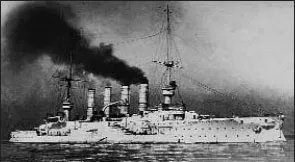
German cruiser operations caused considerable disruption and achieved favourable publicity, but their impact was negligible next to that of the U-boats.
Rear Admiral Sir Christopher Cradock was in command of the North America and West Indies Squadron, responsible for a huge area with a great deal of merchant traffic. His squadron of cruisers was in the Caribbean at the outset of the war. It had been hunting German cruisers in the North Atlantic, but as the threat there declined and reinforcements arrived, it moved south. His forces were small relative to the vast area for which they were responsible, and though capable of taking on a raiding light cruiser, they were old and greatly inferior to Spee’s squadron. Cradock’s flagship was the armoured cruiser HMS Good Hope, which displaced 14,325 tonnes (14,100 tons). Her two 9.2in guns were backed by 16 outdated 6in guns, although it was generally known that these low-mounted weapons could not be used in heavy seas, further weakening their offensive power. She was accompanied by the 9750-tonne (9600-ton) armoured cruiser Monmouth, carrying 14 of the same 6in guns. These cruisers were very much second-line warships, and had not been retained for service with the Grand Fleet precisely because of their age and limited armament. Furthermore, the policy of concentrating forces at home – which had involved disbanding the South Atlantic Squadron – and reinforcing overseas stations only on mobilization, meant that their crews were inexperienced reserves. The ships were supported by the more modern light cruiser Glasgow (4880 tonnes/4800 tons, armed with two 6in and ten 4in guns) and the armed merchant cruiser Otranto, which was expected to fight similar vessels among the enemy forces rather than warships. While the light cruisers on either s...
Table of contents
- Cover
- Title
- Dedication
- Copyright
- Foreword
- Introduction
- Chapter 1
- Chapter 2
- Chapter 3
- Chapter 4
- Chapter 5
- Chapter 6
- Chapter 7
- Further Reading
- Index
- Picture Credits
Trusted by 375,005 students
Access to over 1.5 million titles for a fair monthly price.
Study more efficiently using our study tools.
Frequently asked questions
Yes, you can cancel anytime from the Subscription tab in your account settings on the Perlego website. Your subscription will stay active until the end of your current billing period. Learn how to cancel your subscription
No, books cannot be downloaded as external files, such as PDFs, for use outside of Perlego. However, you can download books within the Perlego app for offline reading on mobile or tablet. Learn how to download books offline
Perlego offers two plans: Essential and Complete
- Essential is ideal for learners and professionals who enjoy exploring a wide range of subjects. Access the Essential Library with 800,000+ trusted titles and best-sellers across business, personal growth, and the humanities. Includes unlimited reading time and Standard Read Aloud voice.
- Complete: Perfect for advanced learners and researchers needing full, unrestricted access. Unlock 1.5M+ books across hundreds of subjects, including academic and specialized titles. The Complete Plan also includes advanced features like Premium Read Aloud and Research Assistant.
We are an online textbook subscription service, where you can get access to an entire online library for less than the price of a single book per month. With over 1.5 million books across 990+ topics, we’ve got you covered! Learn about our mission
Look out for the read-aloud symbol on your next book to see if you can listen to it. The read-aloud tool reads text aloud for you, highlighting the text as it is being read. You can pause it, speed it up and slow it down. Learn more about Read Aloud
Yes! You can use the Perlego app on both iOS and Android devices to read anytime, anywhere — even offline. Perfect for commutes or when you’re on the go.
Please note we cannot support devices running on iOS 13 and Android 7 or earlier. Learn more about using the app
Please note we cannot support devices running on iOS 13 and Android 7 or earlier. Learn more about using the app
Yes, you can access Naval Warfare 1914–1918 by Tim Benbow in PDF and/or ePUB format, as well as other popular books in Geschichte & Militär- & Seefahrtsgeschichte. We have over 1.5 million books available in our catalogue for you to explore.