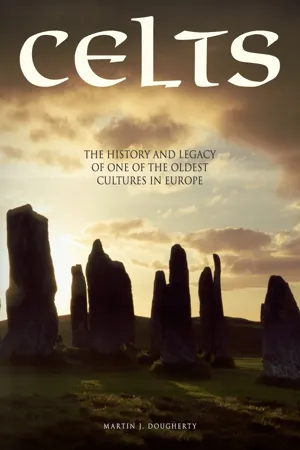
"They cut off the heads of enemies slain in battle and attach them to the necks of their horses... They embalm the heads... [and]... display them with pride to strangers." – Diodorus Siculus Before the Vikings, before the Anglo-Saxons, before the Roman Empire, the Celts dominated central and western Europe. Today we might think of the Celts only inhabiting parts of the far west of Europe – Ireland, Great Britain, France and Spain – but these were the extremities in which their culture lasted longest. In fact, they had originated in Central Europe and settled as far afield as present day Turkey, Poland and Italy.
From their emergence as an Iron Age people around 800 BC to the early centuries AD, Celts reveals the truth behind the stories of naked warriors, ritual beheadings, druids, magic and accusations of human sacrifice. The book examines the different tribes, the Hallstatt and La Tène periods, as well as Celtic survival in western Europe, the Gallic Wars, military life, spiritual life, slavery, sexuality and Celtic art.
Celts is an expertly written account of a people who have long captured the popular imagination.
- English
- ePUB (mobile friendly)
- Available on iOS & Android
eBook - ePub
About this book
Information
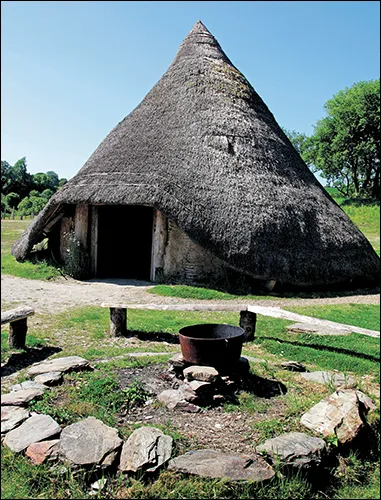
The distinctive straw-thatched Celtic round house may seem primitive compared to Roman villas and Greek temples of the same era, but it was well-constructed, weatherproof and durable. It could be built or repaired with natural materials obtained locally.
1
WHO WERE THE CELTS?
Looking back into history, we need to compartmentalize events and eras in order to make sense of them. Thus we try to create neat blocks of history built around clearly defined protagonists.
This is necessary to avoid information overload, and there are so many exceptions, special cases and complex situations that it is impossible to perceive the norm. As a result, many people know a few simple facts about the Celts and their society, and it is possible to assume that this is the whole truth. The reality, however, was anything but simple or clear-cut.
The question of who the Celts were is far more complex than at first it might appear. The name conjures up an image of a redhaired warrior people, whose men sported impressive moustaches and whose women were strong and somewhat formidable. They were the enemies of Rome, the builders of strange carved-stone monuments and worshippers of spirits that have remained part of popular folklore ever since. They were also instrumental in spreading Christianity throughout much of Europe.
We know that the Celts were excellent workers of metal, fearsome warriors and capable of producing colourful, finely made clothing. They lived in round houses or hill-forts, and were organized into tribes that often warred among themselves. Yet much of this common perception is so general as to be virtually meaningless, and in some cases it is inaccurate or misleading. This is hardly surprising; when trying to encapsulate a culture that covered most of Europe and existed for centuries, a few sentences can give only the broadest of indications. As we begin to focus on the details of Celtic society, apparent contradictions begin to manifest themselves.
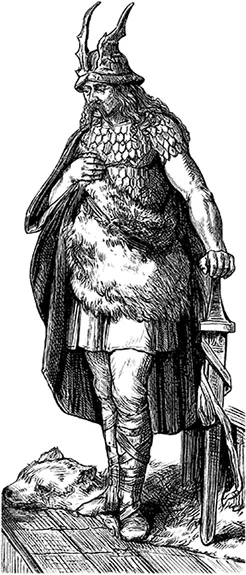
The popular image of the Celts is one of ‘noble barbarians’ who sported fearsome moustaches and loved to fight. This is only one small part of the story, however; the Celts were a complex and sophisticated people.
This, too, is only natural. The Celtic people of the British Isles or those that settled in what is now Turkey were subject to different cultural influences than those of Iberia and Gaul. The Celtic people of 800 BCE, at the beginning of the Iron Age, were different to those that spread Christianity after the fall of Rome. Such a vast expanse of distance and time is bound to encompass large changes in culture and society; what is surprising is not so much the similarities that remain as the fact that Celtic society remains recognizable as such throughout.
Defining Celtic History
Many cultures have a distinct start and end date, albeit one imposed by historians long after the fact. Usually there is an event that can be pegged as the start or the end of an era, such as the fall of a city or the rise of a new society. This is true of some segments of the Celtic world, but the Celts were so widespread that although distinctly Celtic society ended in some areas at a certain date, it continued elsewhere.
In truth, although it is possible to estimate a start date, there is no clearly defined end to the ‘Celtic Era’. The Celtic people were marginalized or subsumed in some areas, and in others their identity was gradually absorbed into a new culture. Yet elements of Celtic society still exist today in the form of languages still spoken and popular folklore that is still repeated. The Celts did not come to an end; they evolved as societies always do. This process is still going on today, and it was happening throughout the era in which Celtic societies were dominant in Europe.
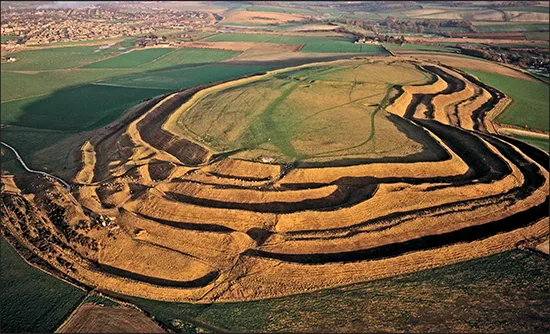
The hill fort at Maiden Castle is one of the largest Iron Age fortifications ever discovered. Its complex system of banks and ditches dates from the La Tène period (around 450 BCE); before this the fort was significantly smaller and less well defended.
People in the past did not live in a clearly defined era; they lived in a time they called ‘now’. This era was subject to constant – if often slow – changes in culture, language and relations with other groups. Society might evolve slowly or be wracked by catastrophe and rapidly changed as a result. Different cultures and various genetic groups met and mingled, affecting and influencing one another. The result was continual change, and it is only by focusing tightly on a specific place and time that we can obtain a clear snapshot of what life was like in that particular ‘now’.
As soon as the focus is expanded, in terms of both time and place, we must begin to generalize based on observed trends and situations that existed sufficiently long or in enough areas to be considered the norm. The more precise a detail, the more likely it is to belong only to a specific moment in time at a given place. That said, we can create some good working generalizations from our observations of the Celts, and so long as these are not taken to be the definite truth everywhere at every time, they will suffice for most purposes.
First Impressions
Around 400 BCE, a large group of ‘barbarians’ became known to the inhabitants of northern Italy. They were tall, fair- or red-haired people with loud voices, and they were sufficiently warlike to drive the local people, the Etruscans, from at least part of their lands. This brought the new arrivals to the attention of Rome, which was at that time only beginning its rise to greatness.
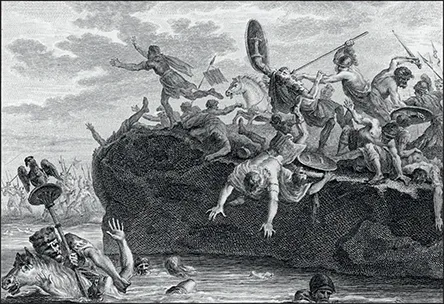
Around 400 BCE, a force of citizen-soldiers from Rome was decisively defeated at the River Allia by the Senones, a Celtic tribe. This was the beginning of an era of war between the Celts and the rising power of Rome.
Roman chroniclers found much to write about the new arrivals. Their clothing, consisting of a shirt and trousers with a cloak over the top, was well made and of bright colours, and their practice of spiking their hair with a mixture of lime and water gave these ‘barbarians’ a dramatically fierce appearance. This was compounded by an array of notable moustaches.
The newcomers were of impressive physical build and some were armoured with helmets and body protection. Others apparently chose to go into combat naked. Either way these were very powerful warriors and the Etruscans were soon pushed out of the Po Valley. They asked for help from their Roman neighbours, who sent envoys to the new arrivals.
Negotiations between the Roman envoys and the Celtic ‘barbarians’ were initially conducted in an atmosphere of mutual respect. The Celts recognized that if the Etruscans looked to Rome for military assistance, then Rome was clearly powerful. An agreement was plainly preferable to war, so the Celts offered what amounted to a land-for-peace deal. The Roman envoys challenged this on the grounds that it amounted to military extortion, but the Celtic point of view was clear – they had the might to make it happen, so they had the right to do it.
The Romans decided to assist their Etruscan neighbours, earning the enmity of the Celts who demanded justice for their slain warriors. Since the envoys were powerful in Roman politics, this was refused. Indeed, instead of being punished for breaking the ‘law of nations’ by taking sides after declaring neutrality as envoys, the perpetrators were promoted to high office.
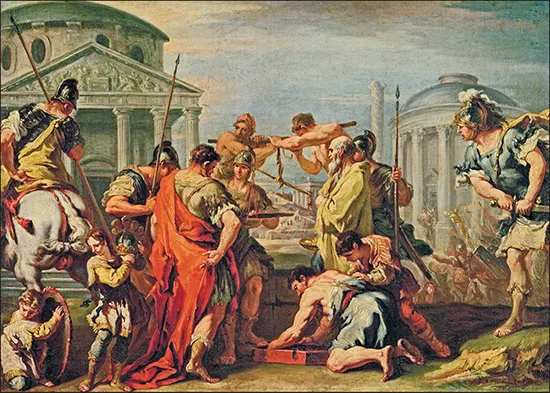
The Senones were able to force Rome to the brink of paying a vast tribute before they were driven from the city by a force under Marcus Furius Camillus. This required two days of bitter street fighting in Rome itself before the Celts were finally defeated.
The Celts then marched on Rome, which deployed six legions to oppose them. The legion of the time was modelled on the Greek style of warfare, with well-equipped hoplites in the centre and lighter troops on the flanks. Estimates of the date fall around 390–387 BCE, but there is more certainty about the outcome of the battle.
The two forces met at the River Allia, where the Celtic leader, Brennus, quickly divined the Romans’ weakness. The Roman military system of the time was based on a militia in which men had to provide their own equipment. The centre of the Roman line was a solid mass of spears and shields held by armoured men, but the ill-equipped troops of the flanks were an easier target.
A Celtic charge broke the flanking forces, some of whom fled to Veii and others to Rome. The centre force was then surrounded and overwhelmed, which robbed Rome of its best-equipped and experienced fighting men. Perhaps worse, these were the most powerful and affluent citizens; decision-makers and leaders were lost in the disaster at the Allia, leaving the way open for an attack on the city of Rome itself.
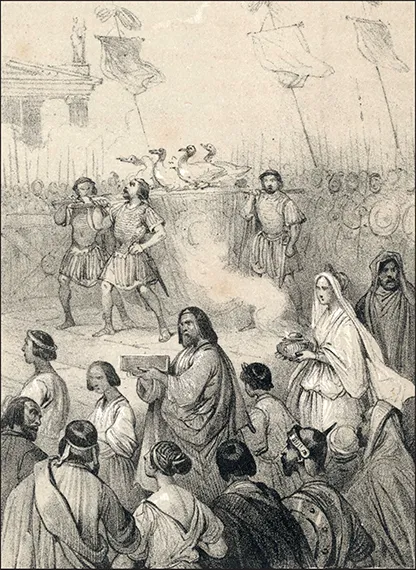
According to legend, Roman guard dogs failed to raise the alarm when the Senones attacked the city at night, but the honking of geese alerted the defenders. Thereafter, dogs were punished in an annual ritual whilst geese were showered with honours.
The Celts were able to storm the weakly held city without undue difficulty, although some Roman forces held out on the Capitoline Hill. Attacks on this position were beaten off, and the Celts agreed to withdraw if paid a huge bribe. Naturally, negotiations for payment broke down and a second Roman force reached the city. After inconclusive street fighting a field battle took place and this time the Celts were defeated.
The Celts were driven away from Rome, but they had left an indelible mark upon history. A massive reorganization of the Roman military was begun, moving away from the Greek style of warfare to a more flexible approach, and Rome was heavily fortified. It would be centuries before the city once again suffered invasion.
This assault upon Rome was carried out by just one Celtic tribe, the Senones, who warred with Rome on and off for another century before finally being defeated. The Roman name for the Senones and their fellow Celts was Galli, or Gauls, which essentially meant ‘barbarians’ but eventually came to refer to what we now call the Celtic people of Europe. As the Romans discovered when they tried to expand their territory northwards, there were a great many tribes of these Gauls and they had spread all across northern Europe in the preceding centuries.
Origins of the Celts
The name ‘Celt’ comes from the Greek Keltoi, which, like the Roman name for them, also means ‘barbarians’. Exactly when the Ancient Greeks came into contact with the proto-Celts is open to speculation, but it is known that the Celtic people interacted with various Greek civilizations over a lengthy period. Sometimes Celts might be found serving as mercenaries in Greek wars and sometimes they fought against various Greek forces.
It is probable that interactions of some kind took place from at least as early as the end of the Greek Dark Age. This lasted from around 1200 to 800 BCE and followed the collapse of earlier Greek civilizations. The Greek Dark Age also coincided with the collapse of other societies in the Eastern Mediterranean region, resulting in a dearth of written records from that period.
The Bronze Age Collapse, as this period is known, saw the New Kingdom of Egypt, the Hittite Empire of Anatolia (Turkey) and the Mycenaean Greek kingdoms all succumb to some great disaster. The reasons remain obscure; causes have been suggested ranging from drought and natural disasters such as earthquakes and volcanoes to invasions by foreigners.
Table of contents
- Cover
- Title Page
- Copyright Page
- Contents
- Introduction
- Chapter One Who Were the Celts?
- Chapter Two Celtic Society
- Chapter Three Celtic Art and Religion
- Chapter Four Celtic Myths and Legends
- Chapter Five Technology and Warfare
- Chapter Six Expansion and Decline in Europe
- Chapter Seven The Celts in Gaul
- Chapter Eight The Celts in the British Isles
- Bibliography
- Index
Trusted by 375,005 students
Access to over 1.5 million titles for a fair monthly price.
Study more efficiently using our study tools.
Frequently asked questions
Yes, you can cancel anytime from the Subscription tab in your account settings on the Perlego website. Your subscription will stay active until the end of your current billing period. Learn how to cancel your subscription
No, books cannot be downloaded as external files, such as PDFs, for use outside of Perlego. However, you can download books within the Perlego app for offline reading on mobile or tablet. Learn how to download books offline
Perlego offers two plans: Essential and Complete
- Essential is ideal for learners and professionals who enjoy exploring a wide range of subjects. Access the Essential Library with 800,000+ trusted titles and best-sellers across business, personal growth, and the humanities. Includes unlimited reading time and Standard Read Aloud voice.
- Complete: Perfect for advanced learners and researchers needing full, unrestricted access. Unlock 1.5M+ books across hundreds of subjects, including academic and specialized titles. The Complete Plan also includes advanced features like Premium Read Aloud and Research Assistant.
We are an online textbook subscription service, where you can get access to an entire online library for less than the price of a single book per month. With over 1.5 million books across 990+ topics, we’ve got you covered! Learn about our mission
Look out for the read-aloud symbol on your next book to see if you can listen to it. The read-aloud tool reads text aloud for you, highlighting the text as it is being read. You can pause it, speed it up and slow it down. Learn more about Read Aloud
Yes! You can use the Perlego app on both iOS and Android devices to read anytime, anywhere — even offline. Perfect for commutes or when you’re on the go.
Please note we cannot support devices running on iOS 13 and Android 7 or earlier. Learn more about using the app
Please note we cannot support devices running on iOS 13 and Android 7 or earlier. Learn more about using the app
Yes, you can access Celts by Martin J Dougherty in PDF and/or ePUB format, as well as other popular books in History & European History. We have over 1.5 million books available in our catalogue for you to explore.