The two world wars were amongst the most convulsive events in human history. Millions of people died, many millions more had their lives transformed, and the nature of warfare itself was changed forever. The Era of World Wars 1914-45 – volume six in the Encyclopedia of Warfare Series – charts the cataclysmic world wars of the twentieth century. This is a chronological guide to conflict on every continent, including the far-reaching effects on Africa, China and the Middle East, as well as the more familiar battlegrounds such as Verdun and the Somme in 1916, Stalingrad in 1942, and Normandy in 1944. This volume tells the story of the millions involved in the world wars and surrounding conflicts. Featuring full colour maps illustrating the formations and strategies used, plus narrative descriptions of the circumstances behind each battle, this is a comprehensive guide to the two world wars and the other conflicts of the era. The Encyclopedia of Warfare Series is an authoritative compendium of five millennia of conflict, from the ancient world to the Arab Spring. Written in a style accessible to both the student and the general enthusiast, it reflects the latest thinking among military historians and will prove to be an indispensible reference guide.
- English
- ePUB (mobile friendly)
- Available on iOS & Android
eBook - ePub
World Wars 1914–1945
About this book
Information
Subtopic
Military & Maritime HistoryIndex
HistoryThe Era of World Wars 1914–45
The two world wars of the twentieth century were amongst the most convulsive events in human history. As well as costing millions of lives, they changed the nature of warfare itself, placing the advantage with manoeuvre and firepower.
World War I 1914–18
Western Front
■ LIÈGE, 5–16 AUGUST 1914
Liège was one of the most powerful fortress complexes in the world in 1914, comprising a dozen interlocking strongpoints. The German Second Army needed to neutralize it quickly to secure the rail and road network of Belgium. The Germans used every weapon in their arsenal, including Zeppelins and custom-designed 420mm artillery guns. The fortresses held out long enough to slow the German advance and provide something of a moral victory for the Allies. Ludendorff became a hero in Germany when he pounded on the door of the citadel with his sword to demand Liège’s surrender. Its capture allowed the Germans to continue their aggressive 1914 war plans.
Liège was one of the most powerful fortress complexes in the world in 1914, comprising a dozen interlocking strongpoints. The German Second Army needed to neutralize it quickly to secure the rail and road network of Belgium. The Germans used every weapon in their arsenal, including Zeppelins and custom-designed 420mm artillery guns. The fortresses held out long enough to slow the German advance and provide something of a moral victory for the Allies. Ludendorff became a hero in Germany when he pounded on the door of the citadel with his sword to demand Liège’s surrender. Its capture allowed the Germans to continue their aggressive 1914 war plans.
■ MULHOUSE, 7–10 AUGUST 1914
The 45,000 troops of France’s VII Corps, under Gen Louis Bonneau, failed to seize Mulhouse from the 30,000-strong German XIV and XV Corps, led by Gen Josias von Heeringen. About 7000 French soldiers died.
The 45,000 troops of France’s VII Corps, under Gen Louis Bonneau, failed to seize Mulhouse from the 30,000-strong German XIV and XV Corps, led by Gen Josias von Heeringen. About 7000 French soldiers died.
■ HAELEN, 12 AUGUST 1914
German Uhlan light cavalry and infantrymen were unable to outflank the Belgians across the River Gete. The Germans’ poor tactics, lacking artillery support, together with strong response from the Belgian infantry and cavalry, decided the day.
German Uhlan light cavalry and infantrymen were unable to outflank the Belgians across the River Gete. The Germans’ poor tactics, lacking artillery support, together with strong response from the Belgian infantry and cavalry, decided the day.
■ LORRAINE, 14–25 AUGUST 1914
France’s ill-starred offensive failed to recover Alsace-Lorraine. The French First and Second Armies were defeated by the German Sixth Army, under Bavarian Crown Prince Rupprecht, and the Seventh Army, under von Heeringen.
France’s ill-starred offensive failed to recover Alsace-Lorraine. The French First and Second Armies were defeated by the German Sixth Army, under Bavarian Crown Prince Rupprecht, and the Seventh Army, under von Heeringen.
■ NAMUR, 20–23 AUGUST 1914
At the confluence of the Sambre and Meuse rivers, German FM Karl von Bülow’s Second Army, and elements of the Third Army, under Gen Max von Hausen – comprising 107,000 men in total – besieged the garrison at Namur fort and 37,000 soldiers of the Belgian 4th Division, under LGen Michel. German and Austrian siege artillery proved decisive, with 304mm mortars and the 420mm ‘Big Bertha’ siege howitzer smashing the ill-prepared fortress and Belgian entrenchments.
At the confluence of the Sambre and Meuse rivers, German FM Karl von Bülow’s Second Army, and elements of the Third Army, under Gen Max von Hausen – comprising 107,000 men in total – besieged the garrison at Namur fort and 37,000 soldiers of the Belgian 4th Division, under LGen Michel. German and Austrian siege artillery proved decisive, with 304mm mortars and the 420mm ‘Big Bertha’ siege howitzer smashing the ill-prepared fortress and Belgian entrenchments.
■ CHARLEROI, 21 AUGUST 1914
Von Bülow’s Second Army pushed south across the Sambre, driving into French Gen Charles Lanrezac’s Fifth Army. A flank attack by von Hausen’s Third Army, threatening encirclement, forced the French withdrawal. The French lost 30,000 men, the Germans 11,000.
Von Bülow’s Second Army pushed south across the Sambre, driving into French Gen Charles Lanrezac’s Fifth Army. A flank attack by von Hausen’s Third Army, threatening encirclement, forced the French withdrawal. The French lost 30,000 men, the Germans 11,000.
■ ARDENNES, 21–23 AUGUST 1914
Having misperceived German moves north of the Meuse, France’s Gen Joseph Joffre ordered Gen Pierre Ruffey’s Third Army and Gen Fernand de Langle de Cary’s Fourth Army on a disastrous attack into the Belgian Ardennes. Their defeat cost France the vital Briey coalfield.
Having misperceived German moves north of the Meuse, France’s Gen Joseph Joffre ordered Gen Pierre Ruffey’s Third Army and Gen Fernand de Langle de Cary’s Fourth Army on a disastrous attack into the Belgian Ardennes. Their defeat cost France the vital Briey coalfield.
■ MONS, 23 AUGUST 1914
Deployed on the French left flank, the British Expeditionary Force (BEF), comprising two infantry corps and one cavalry division (70,000 men), was under the command of FM Sir John French. In its first fight of the war, the BEF faced the German First Army (160,000 men), under GenOb Alexander von Kluck, which attempted to envelop the Allied armies in the west. With 600 guns supporting, the German juggernaut advanced. The BEF’s defence cost von Kluck 5000 casualties.
Deployed on the French left flank, the British Expeditionary Force (BEF), comprising two infantry corps and one cavalry division (70,000 men), was under the command of FM Sir John French. In its first fight of the war, the BEF faced the German First Army (160,000 men), under GenOb Alexander von Kluck, which attempted to envelop the Allied armies in the west. With 600 guns supporting, the German juggernaut advanced. The BEF’s defence cost von Kluck 5000 casualties.
■ LE CATEAU, 26 AUGUST 1914
British Gen Sir Horace Smith-Dorrien’s 55,000 troops of the BEF II Corps withstood 140,000 Germans of von Kluck’s First Army. A gallant artillery duel checked the German advance long enough for BEF infantry to escape the encirclement.
British Gen Sir Horace Smith-Dorrien’s 55,000 troops of the BEF II Corps withstood 140,000 Germans of von Kluck’s First Army. A gallant artillery duel checked the German advance long enough for BEF infantry to escape the encirclement.
■ GUISE (ST QUENTIN), 29 AUGUST 1914
With the French withdrawing south to the Marne, Lanrezac’s Fifth Army counter-attacked, slowing the advance of von Bülow’s Second Army south of the Oise. The fighting cost 10,000 French and British casualties, and 7000 Germans.
With the French withdrawing south to the Marne, Lanrezac’s Fifth Army counter-attacked, slowing the advance of von Bülow’s Second Army south of the Oise. The fighting cost 10,000 French and British casualties, and 7000 Germans.
■ MOSELLE RIVER, 4–9 SEPTEMBER 1914
The French First and Second Armies, under Gens Castelnau and Dubail, held the eastern end of Gen Joffre’s line against Bavarian Crown Prince Rupprechet’s Sixth and Seventh Armies (Bavarians) advancing on Nancy. Frustrated by their repulse, the Germans shelled the city before withdrawing.
The French First and Second Armies, under Gens Castelnau and Dubail, held the eastern end of Gen Joffre’s line against Bavarian Crown Prince Rupprechet’s Sixth and Seventh Armies (Bavarians) advancing on Nancy. Frustrated by their repulse, the Germans shelled the city before withdrawing.
■ OURCQ RIVER, 5–9 SEPTEMBER 1914
French Gen Michel-Joseph Maunoury’s Sixth Army held ground against von Kluck’s First Army advancing on Paris. The delaying action helped widen the gap between the First and von Bülow’s other four German armies.
French Gen Michel-Joseph Maunoury’s Sixth Army held ground against von Kluck’s First Army advancing on Paris. The delaying action helped widen the gap between the First and von Bülow’s other four German armies.
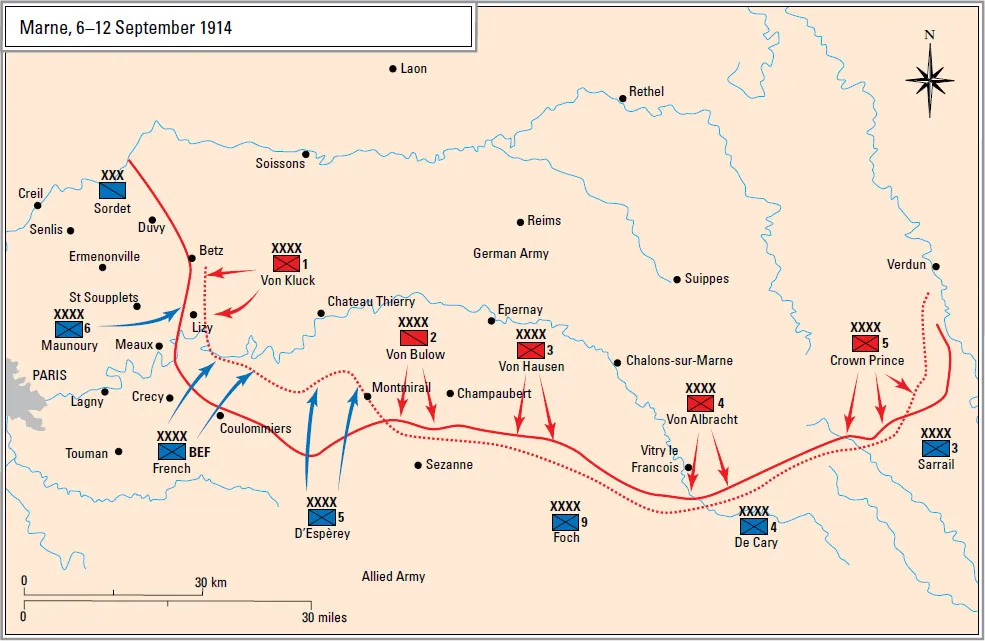
■ MARNE RIVER I, 6–12 SEPTEMBER 1914
The culminating battle of the opening campaign of WWI, the First Battle of the Marne was then the largest battle ever fought. After moving through Belgium and northern France, the German First Army was supposed to move to the west of Paris as part of a giant encirclement. Their aim was to cut the city off from support and supplies, in theory, forcing its quick surrender. Without Paris, the Germans presumed that the French and British would surrender, allowing them to move the bulk of their forces east to face the Russians. The plan demanded much from inexperienced soldiers and left little room for the inevitable fog and friction of war. Due to the unexpected stiff resistance of the Belgians, German forces could not match the pace that their pre-war planners had set for them.
The culminating battle of the opening campaign of WWI, the First Battle of the Marne was then the largest battle ever fought. After moving through Belgium and northern France, the German First Army was supposed to move to the west of Paris as part of a giant encirclement. Their aim was to cut the city off from support and supplies, in theory, forcing its quick surrender. Without Paris, the Germans presumed that the French and British would surrender, allowing them to move the bulk of their forces east to face the Russians. The plan demanded much from inexperienced soldiers and left little room for the inevitable fog and friction of war. Due to the unexpected stiff resistance of the Belgians, German forces could not match the pace that their pre-war planners had set for them.
After several weeks of fighting they were unable to complete the manoeuvre as designed, although they had managed to place leading elements within 50km of Paris. Their success was sufficient to chase the French Government to Bordeaux and to force the British commander, Sir John French, to consider a withdrawal of his battered forces out of the line. Only strong pressure from the French and from the British Secretary of State for War, Lord Kitchener, convinced Sir John to return his weary troops to the fight. Instead of executing the risky manoeuvre west of Paris, the Germans opted instead to send the First Army east of the city as part of a proposed double envelopment of the Allied armies. Both sides had extended their lines from Paris to Verdun, a distance of almost 240km. The Germans hoped to pressure the Allies from both sides, forcing them in upon themselves and destroying them in one campaign.
Allied aviators detected the German maneuvre and the resulting exposure of the First Army’s right flank. Quick work by French commander Joseph Joffre and Paris district commander Joseph Gallieni put Allied forces in a position to pressure the German flanks. A renewed effort by the BEF and a French Ninth Army commanded by Ferdinand Foch attacked the centre of the extended German line while the Allied right held around the fortresses of Verdun. The German attempt had failed. On 9 September, fearful that the Allies could move quickly into a gap that had opened up between the German First and Second Armies, Gen Helmuth von Moltke ordered his forces to retreat to the Aisne river and entrench. There were more than 250,000 casualties on each side. The Germans had suffered twice as many casualties as they had in the entire Franco-Prussian War. Trench warfare had begun.
■ AISNE RIVER I, 12 SEPT–3 OCTOBER 1914
Von Bülow made his stand on the plateau north of the river. His armies constructed the first of what would become an elaborate system of entrenchments. Initially, their line extended from Verdun in the east, west across the Aisne to Noyon on the Oise. The British and French attempted a frontal assault but soon dug their own defensive trenches against fierce German resistance.
Von Bülow made his stand on the plateau north of the river. His armies constructed the first of what would become an elaborate system of entrenchments. Initially, their line extended from Verdun in the east, west across the Aisne to Noyon on the Oise. The British and French attempted a frontal assault but soon dug their own defensive trenches against fierce German resistance.
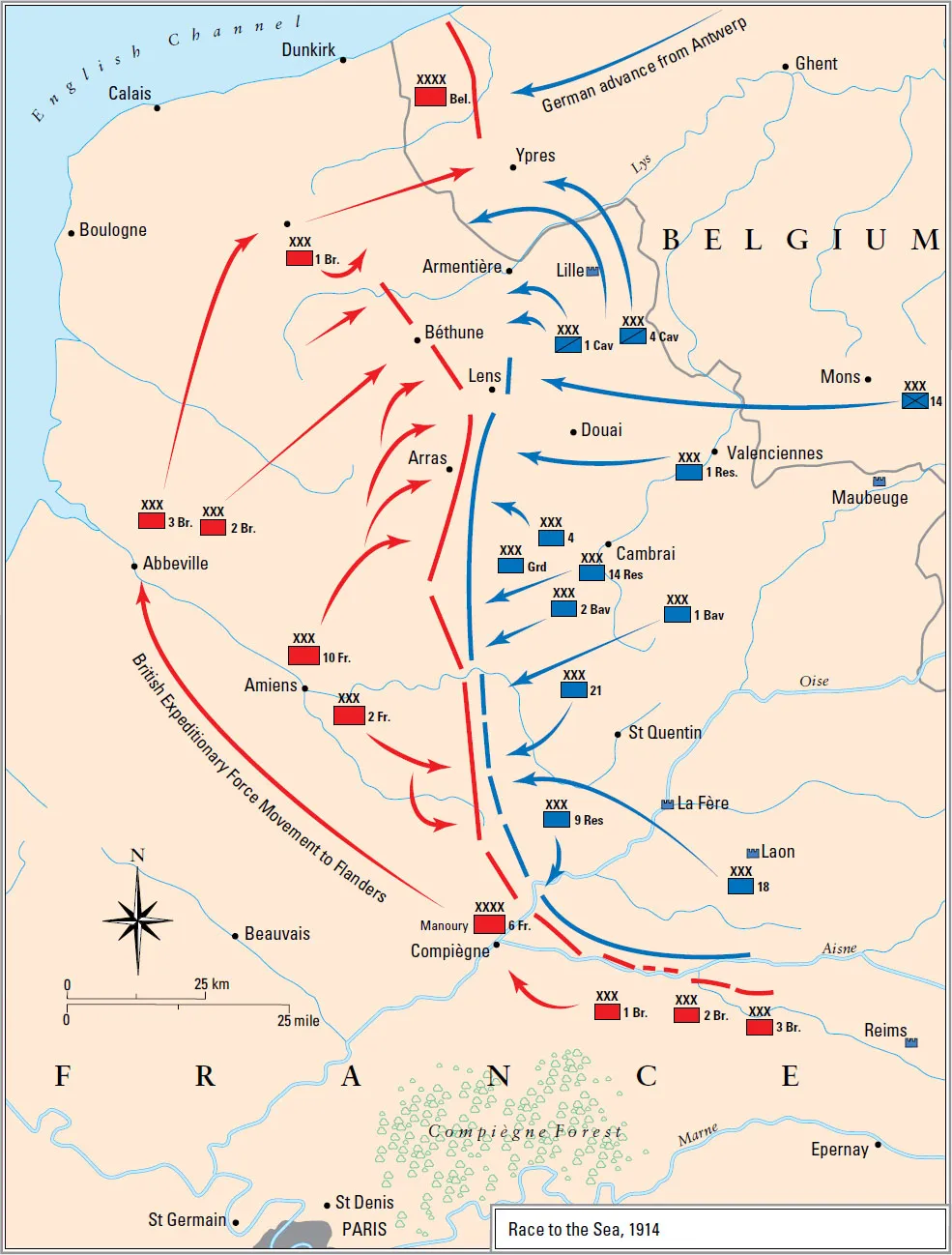
■ ARTOIS I, 27 SEPTEMBER–10 OCTOBER 1914
As the situation along the Aisne became static, both sides attempted to flank one another north of Noyon. The French Eighth Army and the BEF eventually outmaneuvered the German Fourth Army, led by GenFM Albrecht, Duke of Württemberg, in this ‘race to the sea’.
As the situation along the Aisne became static, both sides attempted to flank one another north of Noyon. The French Eighth Army and the BEF eventually outmaneuvered the German Fourth Army, led by GenFM Albrecht, Duke of Württemberg, in this ‘race to the sea’.
■ ANTWERP, 28 SEPTEMBER–10 OCTOBER 1914
German artillery systematically battered down the city’s great forts and dykes, inundating the outer line of Belgian entrenchments. France and Britain sent reinforcements, including 2000 Royal Marines, but they could not halt the German advance for long.
German artillery systematically battered down the city’s great forts and dykes, inundating the outer line of Belgian entrenchments. France and Britain sent reinforcements, including 2000 Royal Marines, but they could not halt the German advance for long.
■ YPRES I, 8 OCTOBER–20 NOVEMBER 1914
This was the opening of the Flanders Campaign, during which 4.4 million Allied soldiers confronted 5.4 million Germans. The major Central Powers forces were the Duke of Württemberg’s Fourth Army, with Gen Erich von Falkenhayn’s reserves, and Bavarian Crown Prince Rupprecht’s Sixth Army. Gen Foch commanded the French Tenth Army and a detachment of Belgians. FM French led the BEF. Foch and French repulsed von Falkenhayn’s attack at great cost: almost 20,000 Germans and as many as 85,000 Allies were killed.
This was the opening of the Flanders Campaign, during which 4.4 million Allied soldiers confronted 5.4 million Germans. The major Central Powers forces were the Duke of Württemberg’s Fourth Army, with Gen Erich von Falkenhayn’s reserves, and Bavarian Crown Prince Rupprecht’s Sixth Army. Gen Foch commanded the French Tenth Army and a detachment of Belgians. FM French led the BEF. Foch and French repulsed von Falkenhayn’s attack at great cost: almost 20,000 Germans and as many as 85,000 Allies were killed.
■ CHAMPAGNE I, 20 DEC 1914–17 MARCH 1915
The battlefront having stalemated in Flanders, both sides made probing attacks throughout the winter. Gen Fernand Langle de Cary’s French Fourth Army advanced into the Champagne-Ardennes, sparking a battle that pinned down German reserves and cost each side more than 90,000 casualties.
The battlefront having stalemated in Flanders, both sides made probing attacks throughout the winter. Gen Fernand Langle de Cary’s French Fourth Army advanced into the Champagne-Ardennes, sparking a battle that pinned down German reserves and cost each side more than 90,000 casualties.
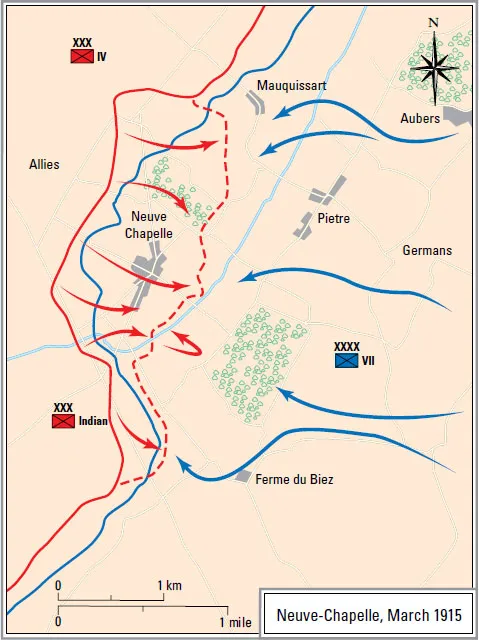
■ NEUVE CHAPELLE, 8–15 MARCH 1915
Decimated after Ypres, the BEF was rebuilt at Neuve Chapelle with fresh troops from Britain and India. A sustained British artillery barrage preceded the attack. The battle cost more than 11,600 British and Indian casualties, and 12,000 Germans.
Decimated after Ypres, the BEF was rebuilt at Neuve Chapelle with fresh troops from Britain and India. A sustained British artillery barrage preceded the attack. The battle cost more than 11,600 British and Indian casualties, and 12,000 Germans.
■ YPRES II, 22–25 APRIL 1915
German commander Erich von Falkenhayn began the second of three major battles in the Ypres sector of Belgium to cover his preparations for a massive offensive on the Eastern Front at Gorlice-Tarnow. Falkenhayn wanted to distract British and French attention and prevent them from providing material assistance to the Russians, his main target for 1915. With so many resources going east, however, Falkenhayn lacked the troops and equipment needed for a major breakthrough in Ypres, where the Germans had failed the previous autumn.
German commander Erich von Falkenhayn began the second of three major battles in the Ypres sector of Belgium to cover his preparations for a massive offensive on the Eastern Front at Gorlice-Tarnow. Falkenhayn wanted to distract British and French attention and prevent them from providing material assistance to the Russians, his main target for 1915. With so many resources going east, however, Falkenhayn lacked the troops and equipment needed for a major breakthrough in Ypres, where the Germans had failed the previous autumn.
The Germans introduced poison gas to the Western Front. Although the Russians had used small amounts of gas in the east and although both sides had gas stockpiles, Ypres saw the first large-scale use of gas as a weapon. On the first day of the battle, the Germans used 168 tons of chlorine gas carried in more than 5000 cylinders. The introduction of gas allowed the Germans to minimize their use of artillery, helping to achieve surprise. A greenish cloud of gas covering 6.4km drifted towards a part of the line held by French Algerian and territorial troops. The Germans had targeted a sector north of Ypres near the town of Langemarck. Of the 10,000 Allied troops who faced the first wave of gas, more than half died of asphyxiation within a few minutes. More than 2000 soldiers surrendered, while the rest panicked and fled. The Germans were as surprised as the Allies that the gas had opened such a major hole Lacking adequate reserves and protecting their troops with only the most primitive respirators, the Germans faced an unusual situation: they had their enemy on the run but could do little to exploit their success.
The Allies were surprised, but they began to respond, deducing that the gas cloud was chlorine based. British and Canadian engineers devised emergency counter-measures, including advising troops to breathe through cloth masks soaked in urine, whose ammonia mitigated the effects of the chlorine. A second gas attack on 24th April was less successful in the face of a heroic defence by Canadian troops. The battle resulted in the Germans gaining pieces of high ground of minor significance, but little else. Casualties were high, with 69,000 Allied (mostly British and Canadian) casualties against 35,000 Germans. Once the Allies recovered from the initial setbacks caused by the gas, the casualty numbers evened out. The Second Battle of Ypres opened the Pandora’s Box of gas warfare.
■ CHAMPAGNE II, 23 SEP–2 OCTOBER 1915
The French Second Army, under Gen Pétain, and the Fourth Army, under Gen Langle de Cary, attacked the German Sixth Army, under Bavarian Crown Prince Rupprecht. After initial success, the French fell back losing 145,000 casualties to the Germans’ 72,500.
The French Second Army, under Gen Pétain, and the Fourth Army, under Gen Langle de Cary, attacked the German Sixth Army, under Bavarian Crown Prince Rupprecht. After initial success, the French fell back losing 145,000 casualties to the Germans’ 72,500.
■ ARTOIS II, 25 SEPTEMBER–15 OCTOBER 1915
Having failed to take Vimy Ridge in the spring, the French Tenth Army, under Gen Auguste Dubail, attacked again at Artois, facing the well-prepared German Sixth Army, led by Bavarian Crown Prince Rupprecht. In the new offensive, Joffre sought to exploit the Allies’ numerical advantage, having deployed 132 divisions contrasted with the Germans’ 102 divisions. After four days of artillery preparation, the French attacked through t...
Having failed to take Vimy Ridge in the spring, the French Tenth Army, under Gen Auguste Dubail, attacked again at Artois, facing the well-prepared German Sixth Army, led by Bavarian Crown Prince Rupprecht. In the new offensive, Joffre sought to exploit the Allies’ numerical advantage, having deployed 132 divisions contrasted with the Germans’ 102 divisions. After four days of artillery preparation, the French attacked through t...
Table of contents
- Cover
- Title Page
- Copyright Page
- Contents
- Maps
- Foreword to The Series
- The Era of World Wars 1914–45
- Authors and Contributors
- Consultant Editors
- How to Use the Maps
- Key to the Map Symbols
- Battles and Sieges Index
- General Index
Trusted by 375,005 students
Access to over 1.5 million titles for a fair monthly price.
Study more efficiently using our study tools.
Frequently asked questions
Yes, you can cancel anytime from the Subscription tab in your account settings on the Perlego website. Your subscription will stay active until the end of your current billing period. Learn how to cancel your subscription
No, books cannot be downloaded as external files, such as PDFs, for use outside of Perlego. However, you can download books within the Perlego app for offline reading on mobile or tablet. Learn how to download books offline
Perlego offers two plans: Essential and Complete
- Essential is ideal for learners and professionals who enjoy exploring a wide range of subjects. Access the Essential Library with 800,000+ trusted titles and best-sellers across business, personal growth, and the humanities. Includes unlimited reading time and Standard Read Aloud voice.
- Complete: Perfect for advanced learners and researchers needing full, unrestricted access. Unlock 1.5M+ books across hundreds of subjects, including academic and specialized titles. The Complete Plan also includes advanced features like Premium Read Aloud and Research Assistant.
We are an online textbook subscription service, where you can get access to an entire online library for less than the price of a single book per month. With over 1.5 million books across 990+ topics, we’ve got you covered! Learn about our mission
Look out for the read-aloud symbol on your next book to see if you can listen to it. The read-aloud tool reads text aloud for you, highlighting the text as it is being read. You can pause it, speed it up and slow it down. Learn more about Read Aloud
Yes! You can use the Perlego app on both iOS and Android devices to read anytime, anywhere — even offline. Perfect for commutes or when you’re on the go.
Please note we cannot support devices running on iOS 13 and Android 7 or earlier. Learn more about using the app
Please note we cannot support devices running on iOS 13 and Android 7 or earlier. Learn more about using the app
Yes, you can access World Wars 1914–1945 by Dennis Showalter in PDF and/or ePUB format, as well as other popular books in History & Military & Maritime History. We have over 1.5 million books available in our catalogue for you to explore.