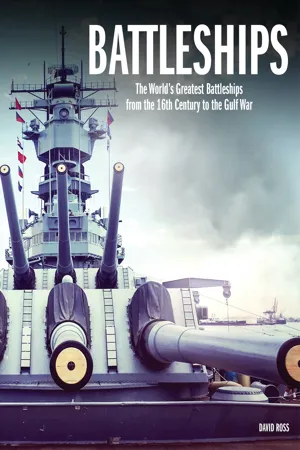
For more than 400 years, the big-gun warship stood as the supreme naval war machine. It was not only a major instrument of warfare, but a visible emblem of a nation's power, wealth and pride. The World's Greatest Battleships features 52 of the greatest warships to have sailed in the last 500 years. Beginning with English king Henry VIII's flagship, Henry Grace à Dieu, the book covers all the main periods of battleship development, including the great sail ships, such as Sovereign of the Seas, Santissima Trinidad and HMS Victory. The advent of steam-driven warships provides the core of the book, beginning with the introduction of Gloire in 1859, and continuing through all the major pre-Dreadnoughts, such as Inflexible, Maine and Tsessarevitch. There is detailed coverage of the great battleships of the two world wars, including Derfflinger, Yamato and Iowa, while the book closes with the last new battleship to be commissioned, Vanguard, in 1946. Each entry includes a brief description of the battleship's development and history, a colour profile artwork, key features and specifications. Packed with more than 200 artworks and photographs, The World's Greatest Battleships is a colourful guide for the military historian and naval warfare enthusiast.
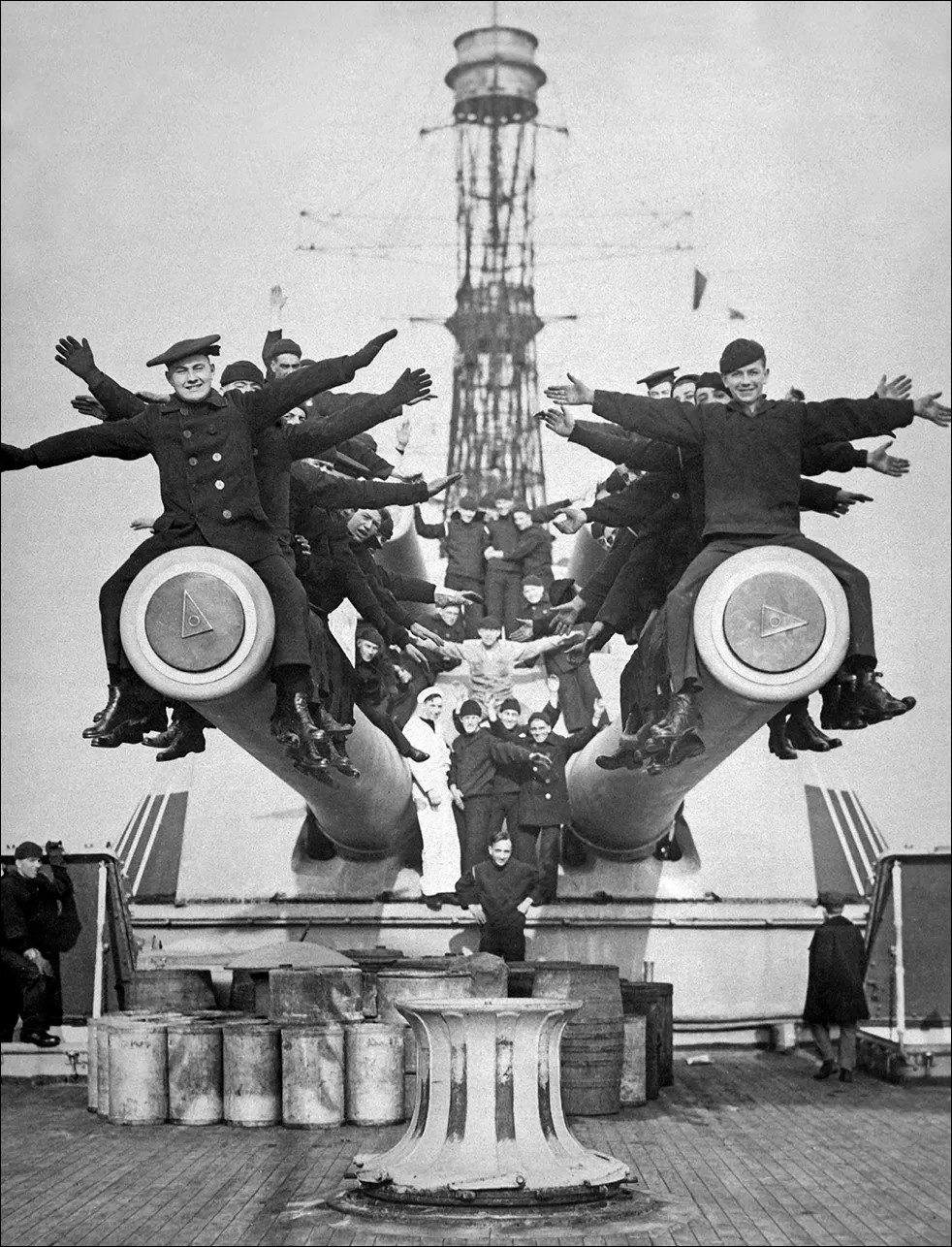
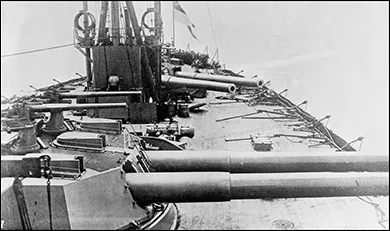
‘Gobs and Guns’. A scene aboard the USS Texas, just back from foreign waters circa 1918, showing the ‘gobs’ enjoying a little fun on the 356mm (14in) main guns.
Dreadnoughts and Battleships
Four decades of the twentieth century saw the capital ship reach a peak in size, armament, protective armour, speed – and cost. Their immense destructive power was very real, and helped make them potent symbols of national prestige and pride. But this was the final era – by the 1940s, it was clear that battleships no longer ruled the waves.
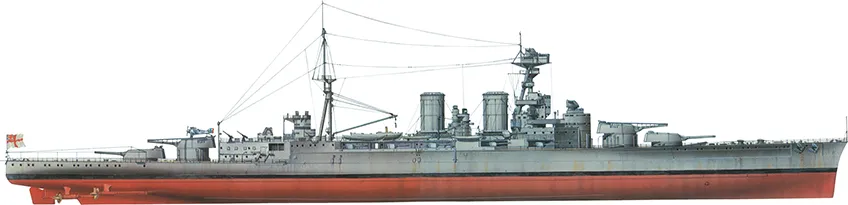
Dreadnought (1906)
A new era of fast, big-gun battleships was inaugurated by the appearance of HMS Dreadnought. Similar ships were already being planned or considered by other navies and the effect, instead of assuring British dominance, was to start a naval arms race.
When the Battle of Tsushima was fought on 27 May 1905, the British Navy was already contemplating a battleship in which many lessons taught by the battle seemed to have been anticipated. Dreadnought was laid down at Portsmouth on 2 October 1905, launched on 10 February 1906, and completed in December 1906. The cost was £1,783,883. Speed of construction was remarkable, made possible by pre-assembly of the materials, but several years of debate went before it.
Steam turbines, quadruple screws, and good armour protection, combined with 10 305mm (12in) guns, made Dreadnought a world-beater.
Genesis of Dreadnought
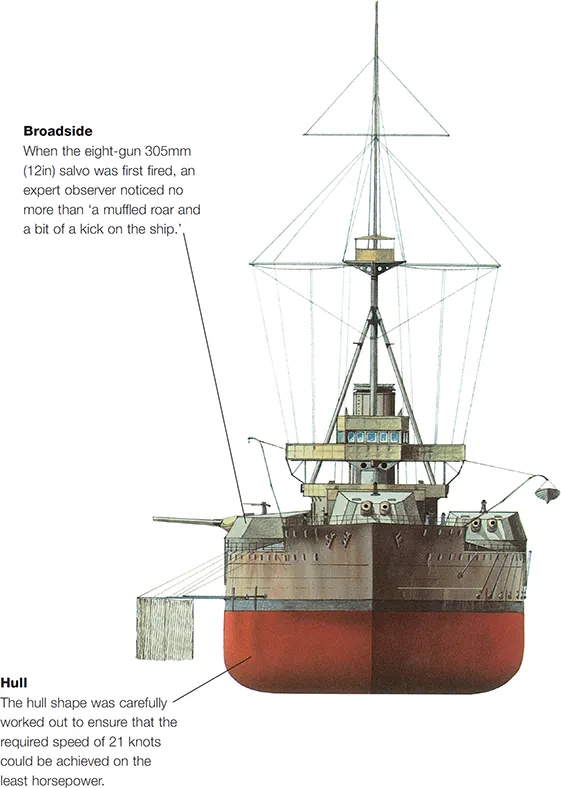
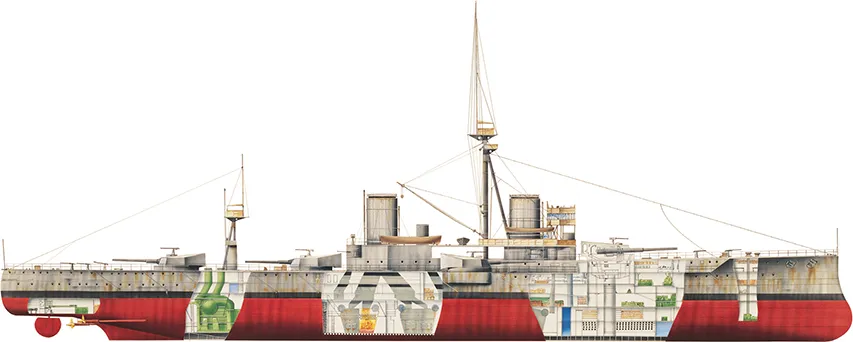
In 1903 the Italian engineer Vittorio Cuniberti had suggested that the ‘ideal battleship’ for the Royal Navy was a 15,422 tonne (17,000 tons) ship with 12 305mm (12in) guns, 305mm (12in) armour, and capable of 24 knots. Admiral Lord Fisher had already initiated a project for what he called ‘HMS Untakeable’, whose prime feature was ‘the most powerful and powerfully arranged armament’, with a view to long-range fire rather than the 1000–3000m/yd considered normal at the time. Fisher was appointed First Sea Lord in October 1904 and convened an expert committee which proceeded to draw up six alternative preliminary designs. As built, based essentially on ‘Design H’, there was a long flush main deck of 5.8m (19ft) freeboard, with a forecastle deck raised to 8.5m (28ft). Ten 305mm (12in) guns in double turrets were disposed in symmetrical array, three on the centreline and one each to port and starboard just abaft of the main deckhouse and leading funnel. This funnel, unusually and unsuitably, was place ahead of the foremast, making the fighting top filthy with smoke and soot. Another novelty, not particularly appreciated, was the berthing of officers in the forward part (close to their work posts) and of the men aft.
Exactly 4536 tonnes (5000 tons) of armour was applied, and armour plating was extended, at diminishing thickness, along the entire sides. Within the hull a system of fully watertight compartments was rigorously applied, with no doors or openings and each compartment having independent ventilation, pumps (electrically driven) and drainage. Lifts were fitted for giving quick access between the machinery compartments. The aim was that the ship could safely sustain two torpedo strikes. Magazines were located centrally, well away from the sides.
Gunnery
Led by a few keen senior officers, the Royal Navy took great steps forward in improving its gunnery from the late 1890s. Dreadnought’s capacity for firing heavy salvoes demanded a high degree of fire control to make it effective. For effective fire control, correctly establishing the target’s distance was essential, and crucial items were optical rangefinders, developed from the 1890s by the Barr & Stroud company. Other new instruments were devised, including range projectors (Dumaresqs, an early form of computer which related the movement of the firing craft and target) and range clocks, calibrated up to 11,000m (12,000yd). The German optical firm of Zeiss was also producing a range of similar instruments. A central director could be aimed at the target and the required elevation and training angle automatically calculated. Plotting boards, with scales and protractors, were brought into use. Even so, a 10 per cent hit rate in a long-range naval battle was good; 90 per cent of ammunition vanished into the sea.
In order to speed up construction, the 305mm (12in) guns were ‘lifted’ from two other ships then building, Lord Nelson and Agamemnon, which were not launched until after Dreadnought, effectively becoming £3,000,000 worth of instantly-obsolescent sea-power.
Fuel: 1016 tonnes (1120 tons) of oil fuel was carried in the bottom under the machinery spaces. A maximum 2631 tonnes (2900 tons) of coal could be carried in the bunkers.
Fastest battleship
The most revolutionary aspect of the new ship was its motive power. Turbines had never been applied to a battleship before, though they were in use on ocean liners and fast packet boats. The decision proved a triumphant success. Dreadnought was faster than any other battleship, mechanically more reliable, more economical on fuel, and provided infinitely better working conditions in the engine-room. In addition the engine space was more compact, sat lower in the hull, and gave substantially more power per tonne of weight.
Total weight of machinery was 1079 tonnes (1190 tons). Turbines could not be reversed, but a stern turbine was placed on each of the four shafts, one high- and one low-pressure on each side, and Dreadnought was at least as easy to handle as any other battleship and had very good manoeuvring qualities, assisted by twin rudders placed immediately abaft the inner propellers.
Dreadnought was assigned to the Home Fleet, and from January–March 1907 went on a shake-down cruise to the Mediterranean, then across to Trinidad. Its return journey of 11,265km (7000 miles) was accomplished with no mechanical hold-ups and at an average speed of 17.5 knots. No warship before had been capable of this. From April 1907 to May 1912 it was flagship of the C-in-C. Home Fleet, then flagship of the 4th Battleship Squadron until May 1916. In World War I it sank U-29 by ramming in the North Sea on 18 February 1915: an ironic exploit considering that a ram bow had been deliberately omitted from its design as something not required in a modern battleship. From July 1916 it was flagship of the 3rd Battleship Squadron at Sheerness, but briefly rejoined the Grand Fleet between March and August 1918. In February 1919 it was placed on reserve at Rosyth, and stricken on 31 March 1920. In May 1921 it was sold for scrapping, at Inverkeithing.
Deck plan: an eight-gun broadside salvo could be fired on either b...
Table of contents
Cover
Title Page
Copyright Page
Contents
Introduction
Wooden Walls to Armour Plate
Dreadnoughts and Battleships
Index
Trusted by 375,005 students
Access to over 1.5 million titles for a fair monthly price.
Study more efficiently using our study tools.
Frequently asked questions
Yes, you can cancel anytime from the Subscription tab in your account settings on the Perlego website. Your subscription will stay active until the end of your current billing period. Learn how to cancel your subscription
No, books cannot be downloaded as external files, such as PDFs, for use outside of Perlego. However, you can download books within the Perlego app for offline reading on mobile or tablet. Learn how to download books offline
Perlego offers two plans: Essential and Complete
Essential is ideal for learners and professionals who enjoy exploring a wide range of subjects. Access the Essential Library with 800,000+ trusted titles and best-sellers across business, personal growth, and the humanities. Includes unlimited reading time and Standard Read Aloud voice.
Complete: Perfect for advanced learners and researchers needing full, unrestricted access. Unlock 1.5M+ books across hundreds of subjects, including academic and specialized titles. The Complete Plan also includes advanced features like Premium Read Aloud and Research Assistant.
Both plans are available with monthly, semester, or annual billing cycles.
We are an online textbook subscription service, where you can get access to an entire online library for less than the price of a single book per month. With over 1.5 million books across 990+ topics, we’ve got you covered! Learn about our mission
Look out for the read-aloud symbol on your next book to see if you can listen to it. The read-aloud tool reads text aloud for you, highlighting the text as it is being read. You can pause it, speed it up and slow it down. Learn more about Read Aloud
Yes! You can use the Perlego app on both iOS and Android devices to read anytime, anywhere — even offline. Perfect for commutes or when you’re on the go. Please note we cannot support devices running on iOS 13 and Android 7 or earlier. Learn more about using the app
Yes, you can access The World's Greatest Battleships by David Ross in PDF and/or ePUB format, as well as other popular books in History & Military & Maritime History. We have over 1.5 million books available in our catalogue for you to explore.