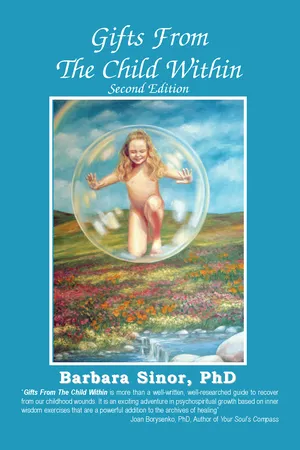
Gifts From the Child Within brings a refreshing approach to guiding its reader to understanding the initial or underlying basis to their emotional suffering due to past childhood trauma. This recovery book is geared toward both professional and layperson. Its pages are filled with offerings from psychological, physiological, and spiritual perspectives which takes the reader on a journey into the soul. It is written with sensitivity and clarity inviting the reader to search within for healing.
As the author shares her own journey of childhood abuse, the reader is asked to address issues surrounding physical, mental, spiritual, and sexual abuse. Instructions are captured to guide one toward reaching for their own child within; releasing negative emotions; re-creating outdated childhood beliefs; and, to recognize the gifts the inner child has for us.
The process of Re-Creation Therapy(tm) is introduced by the author allowing the reader who follows its guidance to reap the effects of gradual changes in self-awareness which lead to a greater understanding of the psychodynamics the child within plays in the adult life. Included are a series of healing visualizations and autohypnosis suggestions; blank journal pages; and sample affirmations following each chapter.
What Experts Say About Gifts From The Child Within
"This is indeed a valuable self-help book and a tool for the Counselor, Hypnotherapist, Minister, Psychotherapist, or Clinician. I assure you, the world will look much brighter after you read this book." --Lavona Stillman, PhD, CC, HT
"Barbara Sinor has written a book that will help the violated and traumatized child within to heal. Gifts From The Child Within helps guide survivors with repressed memories of trauma, as well as those with current memories of incest, through the healing process." Marilyn Van Derbur, Miss America 1958, Founder: Survivor's United Network
"Barbara Sinor has bridged the gap for clients and therapists alike between the mere discovery of the inner child and the building of a true relationship with this most important being within. Gifts From The Child Within is an important and highly readable work." Rick Boyes, M. Coun, CHT, Author A Body To Die For
"Gifts From The Child Within is a wonderful book that takes the reader on a journey into the soul. Flowing and readable, this book is filled with stories, myths, information, and revelation." Marilyn Gordon, CHT, Author, Healing is Remembering Who You Are
- English
- ePUB (mobile friendly)
- Available on iOS & Android
eBook - ePub
About this book
Information
Part I
The
Child Within
“Somewhere, sometime, you were a child.”
—W. Hugh Missildine
1 | The Concept of |  |
“…the child symbolizes the pre-conscious and the post-conscious essence of man.”
—C.G. Jung
When I was a little girl, my family lived near a reservoir called Puddingstone Dam. It was used for recreational fishing, boating, and swimming by the local communities. On hot summer days my Mother, two sisters, and I would wait for Daddy to come home from work then head off for our favorite swimming spot. The water deepened gradually where we swam, so I was able to “fake it” for many years. You see, I was almost nine years old before learning to really swim.
I will never forget how much I wanted to please my Father by swimming across the roped-off area. Even my younger sister was swimming and diving off the raft out in the deep end by three years old! I desperately wanted to receive the praise and smiles she was commanding from Daddy. I was so afraid to bring both my feet up to kick that for many years I would keep one foot on the bottom while kicking on the surface with the other foot making it look like I was swimming. Then one summer Daddy decided to test me. He literally picked me up and threw me into the deep water. I immediately learned to swim with both feet kicking high!
What I remember most about this swimming episode was not the trauma of how I learned to swim but my “feelings” surrounding the need for Daddy's approval. As a child, I would have done anything he asked to get his approval—and I did. He was a big-hearted, self-engrossed alcoholic and I bought right into the typical codependent, self-effacing, self-sacrificing role of the child adult, later becoming an adult child.
Through my adult years, I studied, researched, analyzed, have been analyzed, and worked with my personal childhood trauma resulting from living in a dysfunctional family. I learned a great deal about my child within and the different concepts for healing and recovery. During the 1980s to present, I have been fortunate to experience and clinically introduce a healing process which directly addresses the phenomenon of healing the wounded inner child. Whether seeking recovery from drug or alcohol abuse, codependency, victimization, physical, emotional or spiritual abuse, or the trauma of living in a dysfunctional family, Re-Creation Therapy™ may be the long awaited guidance for which you have been searching.
Can you remember your childhood? Can you consciously recall a particular age and sense your emotions at that time in your life? If you were asked to close your eyes and visualize yourself at the age of five or twelve, could you sense or see yourself at this age? Can you imagine the surroundings where you grew up and/or the emotions you felt? Can you remember the qualities you liked or disliked about your mother, father, relatives, teachers, or friends during your childhood years? There may be several different memories within each year of your childhood. All these, as well as, the ones you do not recall are held tight within your subconscious mind by your child within.
As we become adults, we learn to put aside our childhood, believing it to be over and that the past no longer matters. However, the child within us still plays, laughs, cries, yells, desires attention and needs love. Our inner child is usually adventuresome, curious, fearful and nervous, inventive, caring and compassionate; but most importantly, it is a part of us. The experiential exercises, visualizations, and techniques within this book will help you rediscover your child within, which in turn will lead you to forgotten memories, unfulfilled dreams, past woundedness, and outmoded beliefs which may be blocking a more creative, successful adult life.
Conceptual Background
The concept of the inner child is not a new one. When renowned psychotherapist Carl G. Jung talked of the “inner child archetype,” he was referring to the universal unconscious mindset found within the “Collective Unconscious.” However, Jung also noted an individual inner child, a child which actually exists within each adult. Jung explained, “The child motif is a picture of certain forgotten things in our childhood…. [it] represents the preconscious, childhood aspect of the collective psyche.”
One noted psychoanalyst of the 1950s, Eric Berne, spoke of the aspect of the “child” as one of the ego components in his Transactional Analysis (TA) process. The other two ego components of TA are the “parent” and the “adult.” Berne's TA theory of human personality demonstrates how each ego state directs our individual lives. Berne's intent was to find “the briefest, most economical way for his clients to increase their autonomy by reawakening their potential for awareness, spontaneity, and intimacy—capacities which are inherent in all of us, but which are sometimes limited as a result of the stresses and traumas of growing up.”
Many feel Berne's personality theory to be a close glimpse of the child within concept but disagree with Berne's labeling the inner child an “ego state.” Perhaps the word ego is too strong when describing these three personality components and the term “aspect” might be more suitable to denote the fine line divisions between the adult, parent, and child selves. These three aspects are parts of our personality and are linked to an “inner core”—the higher spiritual-self—which is most readily connected to the child within.
Charles Whitfield, doctor and author, introduces the “healing nature” of the child within through the recovery process found in the widely emerging Adult Children of Alcoholics (ACoA) groups. In his book, Healing the Child Within: Discovery and Recovery for Adult Children of Dysfunctional Families, Whitfield states,
“When the Child Within is not nurtured or allowed freedom of expression, a false or codependent self emerges. We begin to live our lives from a victim stance, and experience difficulties in resolving emotional traumas. The gradual accumulation of unfinished mental and emotional business can lead to chronic anxiety, fear, confusion, emptiness and unhappiness.”
We can recapture our emotional stability and independence-of-self by allowing ourselves to remember, experience, and communicate with this hidden child within who learned so aptly to adapt to his or her environment as a means of tactical survival. During a workshop I attended (May 1990) Whitfield commented that most alcoholics start out being a “child adult” learning to cope with many adult responsibilities as a child, then later, they become an “adult child.”
There are many therapists who have given us insight into the concept of the child within, one such master of hypnosis is Milton Erickson. Erickson was one of the earliest founders of the child within concept via his renown work with Hypnotherapy. His research and clinical work with literally thousands of patients has revealed truly miraculous techniques and methods for healing and recovery.
One of Erickson's more noted case histories exploring the child within is that of “The February Man” in which he draws on psychotherapeutic age regression techniques. One of his methods surrounding this important work is the hypnotic tool of “reframing” (developing new frames of reference for the past). Erickson demonstrates just how inseparable the mind/body phenomenon is in this case of a client who has a fear of being able to adequately raise her child-to-be because of her lack of secure familial ties in childhood.
During therapy, Erickson introduced to his client's “subconscious mind” a friend, a confidant. This fatherly figure was brought into the age regression sessions while she was in a hypnotic state. Over a succession of meetings, Erickson repeatedly employed techniques of age regression incorporated with an amnesia effect so his client would not recall this fictitious acquaintance in a conscious waking state of mind. The use of age regression facilitated Erickson's success in generating past real-life memories which were intertwined with the use of indirect hypnotic suggestions regarding the fictional “February Man” (later named because he had met this client in the month of February).
Erickson demonstrated perfectly with this case that there is no separation of mind/body—for change in belief structure precedes the body's experience. In other words, belief precedes experience and change. When Erickson's client firmly embraced on a subconscious level that she had been aided and cared for by the February Man in her childhood, she was able to re-create her fear and apprehension into stability and confidence in her ability to raise her unborn child.
Re-Creation Therapy™ employs a form of Hypnotherapy which incorporates the main theme of age regression and reframing employed by Erickson. This process can be executed alone by using self-hypnosis (autohypnosis) or with the assistance of a Hypnotherapist. This emotional release therapy introduces tools to acknowledge, meet, and communicate with one's inner child. A new frame of reference is established which brings with it a clear, enlightened view of who you are becoming.
You can release limiting emotions, fears, and inappropriate patterns which bind you to your parents and the learned behavior of the past. While in the state of guided hypnosis, or within autohypnosis, a new element of reference can be introduced to the subconscious mind. An unpleasant event can be re-created into a positive experience; or you can re-create a totally different scenario altogether to wash away old fears, rejections, or childhood turmoil. As with Erickson's reframing methods which made it “…possible to introduce a new element not actually belonging to the situation but that could easily fit into it,” the process of Re-Creation Therapy™ allows you to touch the hidden past of your child within and re-create your own reality making it suitable to you now as an adult.
Illusional Reality
We all use adaptability in one form or another in childhood to “fit-in” and gain approval. However, like my trick of deceiving my family that I really knew how to swim, many of the traits, beliefs, and feelings we adopt may not be sufficient for a healthy adulthood. Do you rely on childhood behaviors of adaptability to help you gain acceptance or recognition which no longer serve you as an adult? These automatic responses and emotions may have surfaced time and again but you were not ready to uncover their foundation. Perhaps now is the time and this book is the opportunity for you to discover why your life is not unfolding the way you would like. Whether your desire is to find success in personal or public relationships, increased creativity, prosperity, motivation, physical health, healing of past childhood trauma, or to awaken spirituality, your own inner child can help guide you.
Jung tells us that the goal of the individuation process is the synthesis of the Self-uniting conscious and unconscious (subconscious), as well as, balancing body, mind and spirit. The techniques found in Re-Creation Therapy™ can help to revive and heal the unaware or subconscious elements. Each of these subconscious aspects retain outmoded belief systems, repressed emotions, predisposed illness, religious suppressions, and other blockages which can prevent us from achieving autonomy and wholeness.
On a physical level, to maintain a state of physical balance, or homeostasis, a constant flux of new cells replace the destruction of old cells. On the emotional/mental level, we keep our balance by “staying calm” and at the same time actively alert to our environment. On the spiritual level, we assume attunement with a Higher Power. These methods of maintaining a state of balance are usually accomplished unconsciously. They become conscious only when we choose to act and react from a level of awareness. Therefore, to bring a conscious awareness to each level—body, mind, and spirit—one's highest potential can be revealed.
On a physical level: During childhood we take into our bodies all the stress and emotional turmoil we experience and witness. Not understanding stress management or quiet healing time at this age, some claim we actually hold these negative elements from childhood in our cellular structure during our maturation. As we become adults much of these traumatic stresses are built upon until our bodies can cope no longer and a breaking down of cell structure results in illness. Working through childhood trauma can help release and heal the physical body and its trauma.
On the emotional/mental level: You may find that a great deal of the time you are oblivious to your thoughts and feelings, allowing them to wander aimlessly within the subconscious realm. However, it has been proven within the medical arena that “what” you think directly affects your physical health. Subscribers of positive thinking indicate that how we use our mental/emotional energies is directly related to how we experience our reality. If we choose to act and react consciously toward ourselves and others, we will stay in balance; however, if we do not choose but instead remain locked into subconscious mental and emotional patterns, we find ourselves entertaining frustration, discouragement, depression, confusion, unhappiness, fear, and the many other symptoms which accompany the imbalance of the conscious and subconscious mind. Taking responsibility for emotional health means being willing to feel even when afraid to do so.
On the spiritual level: Instilled within us before birth is an enlightened fragment of the Divine which can be consciously called upon for guidance at any time in our lives. However, even if not consciously activated this spiritual aspect remains hidden manifesting through intuitive glimpses, a sixth sense, and synchronistic events (coincidences which cannot be ignored). This spiritual nature is directly connected to the Child Within. As children we came into our lives with this purity of spirit, our inner child is the link. The process of Re-Creation Therapy™ and your own child within can unlock your subconscious mind to assist your remembrance of this true-Self.
The techniques of hypnosis and autohypnosis found in this book can liberate many of the hidden blockages and forgotten assets held tight in the subconscious. In his book, Global Mind Change, Willis Harman speaks of the phenomenon of hypnosis and the concept of reality:
…it is well established from research in hypnosis and other areas of experimental psychology that once a person has an internalized picture of reality, further experience tends to confirm that picture. Reality is experienced in accordance with the established picture, sometimes at the cost of gross perceptual distortion and elaborate rationalization to make it all hold together.
Rationalization is just one of the adapted techniques we employ to keep the picture of our reality alive and well. When we are challenged by new information from our environment often our first reaction is—from the internal subconscious—to review our past attempting to gain reassurance regarding our established picture. However, this picture is many times just an illusion of the true reality.
To demonstrate this illusional reality let me tell you how an elephant is trained in India. When an elephant is very young the trainer places a thick heavy rope around its leg and ties the other end to a secure post or tree. As the elephant matures and grows larger the trainer gradually reduces the size and weight of the rope. Finally, when full grown the elephant needs only a small flimsy strap tied to a short stub in the ground to become submissive and completely controlled. We humans construct our belief systems and our reality in this same mann...
Table of contents
- Cover Page
- Title Page
- Copyright
- Table of Contents
- Dedication
- Foreword
- Introduction
- Part I: The Child Within
- Part II: Re-Create Your Own Reality
- Part III: Adult Child Games
- Part IV: Gifts from the Child Within
- Afterword
- References
- About the Author
- Index
Trusted by 375,005 students
Access to over 1.5 million titles for a fair monthly price.
Study more efficiently using our study tools.
Frequently asked questions
Yes, you can cancel anytime from the Subscription tab in your account settings on the Perlego website. Your subscription will stay active until the end of your current billing period. Learn how to cancel your subscription
No, books cannot be downloaded as external files, such as PDFs, for use outside of Perlego. However, you can download books within the Perlego app for offline reading on mobile or tablet. Learn how to download books offline
Perlego offers two plans: Essential and Complete
- Essential is ideal for learners and professionals who enjoy exploring a wide range of subjects. Access the Essential Library with 800,000+ trusted titles and best-sellers across business, personal growth, and the humanities. Includes unlimited reading time and Standard Read Aloud voice.
- Complete: Perfect for advanced learners and researchers needing full, unrestricted access. Unlock 1.5M+ books across hundreds of subjects, including academic and specialized titles. The Complete Plan also includes advanced features like Premium Read Aloud and Research Assistant.
We are an online textbook subscription service, where you can get access to an entire online library for less than the price of a single book per month. With over 1.5 million books across 990+ topics, we’ve got you covered! Learn about our mission
Look out for the read-aloud symbol on your next book to see if you can listen to it. The read-aloud tool reads text aloud for you, highlighting the text as it is being read. You can pause it, speed it up and slow it down. Learn more about Read Aloud
Yes! You can use the Perlego app on both iOS and Android devices to read anytime, anywhere — even offline. Perfect for commutes or when you’re on the go.
Please note we cannot support devices running on iOS 13 and Android 7 or earlier. Learn more about using the app
Please note we cannot support devices running on iOS 13 and Android 7 or earlier. Learn more about using the app
Yes, you can access Gifts From The Child Within by Barbara Sinor in PDF and/or ePUB format, as well as other popular books in Psychology & Psychotherapy Counselling. We have over 1.5 million books available in our catalogue for you to explore.