The German campaigns in Poland and the West in 1939 and 1940 ushered in a new era in warfare. The theory of the Blitzkrieg (Lightning War) developed by Hitler's forward-thinking generals - including the foreword writer, Heinz Guderian - was put into devastating effect. Based on a German book published during World War II and never before translated, Blitzkrieg in their own Words is a military history of these campaigns written by those taking part.

eBook - ePub
Blitzkrieg in their own Words
First-hand accounts from German soldiers 1939–1940
- English
- ePUB (mobile friendly)
- Available on iOS & Android
eBook - ePub
About this book
Information
Subtopic
Military & Maritime HistoryIndex
History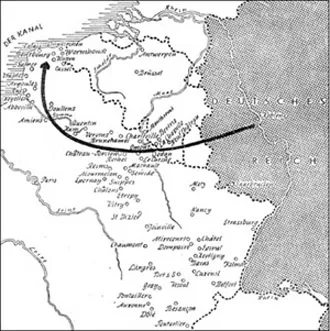
The main German Panzer assault crossed the River Meuse at Sedan on 13 May 1940 and pushed to the coast at Boulogne. Despite some spirited French and British counterattacks, the British Expeditionary Force and French First Army were cutoff around Dunkirk.
Breakthrough to the Atlantic
__________________________________
The Alert Signal in the Eifel Mountains
__________________________________
It is two o’clock in the afternoon of 9 May 1940, in a small village in the remote Eifel region. Suddenly – a general alert!
The alert was the command, the signal that we soldiers in the west of the Reich had been waiting for with feverish anticipation throughout the seven long frost-bound months of the 1939/1940 winter on the West Wall. Was that all it was, anticipation? No, it was burning desire. The yearning for action and fighting, the soldier’s life-blood.
Alert! It ran through our ranks like the removal of a heavy weight from the shoulders of every one of us. Couldn’t you hear a sigh of relief from every comrade? Wasn’t there a bright gleam in their eyes? Didn’t everyone have a happy song on their lips? The iron discipline, the hard military training of the past few months, all made profound sense at last.
Now was our chance to enter the decisive battle and to prove ourselves. An uncertain future lay ahead of us. Who knew what he would have to face? Who among us would have to give his life in the great struggle towards which we were marching?
Certain of victory? For us there was no other outcome but victory. We never discussed it. Confidence in our victory was too strongly anchored in our hearts for us ever to doubt it; though we never underestimated the strength and stamina of our enemy in the west. We knew that defeating him would demand great sacrifices from us and tear out many a breach in our ranks. But none of that could shake our belief in our ultimate victory.
And it was this absolute faith in victory, together with the feeling of relief from almost unbearable tension, as well as the expectation of unique military experience, that inspired in us the mood and the spirit that welded us into a determined community and rendered us as hard as steel for the coming conflict.
‘Forwards’, said the rhythm of our hearts, and ‘forwards’ was the song of our engines!
By Unteroffizier Keitner
Border Crossings: Three Frontiers in Two Days
__________________________________
Behind us lies a long, hot march right across the Eifel, on minor roads widened by the construction battalions. Over there is a signpost: ‘Wallendorf 1 Kilometre’ (1090 yards). We have reached our first-stage objective, the Luxembourg border! The sight of the yellow road signs has clearly perked up our tank drivers, after sitting for five hours in this terrific heat behind their gear levers, changing gear – steering uphill and downhill – stopping and starting.
The afternoon of 10 May 1940 …
Our lead vehicles are crossing the Sauer Bridge. It looks rather strange; our pioneers have laid thick planks across a block of wood barring access to the bridge, so that a small bridge has been formed on top of the larger one. Luxembourg makes an orderly impression. It seems a clean and affluent country. The inhabitants look at us with curiosity, neither friendly nor hostile. They have probably not yet got over their astonishment at watching an endless procession of German columns with artillery, armoured reconnaissance vehicles, radio cars and now tanks filing past them since early this morning. On the straight, wide, well-paved roads we keep up a good pace. Woods, waving corn-fields, streams and villages follow each other in quick succession: Reisdorf – Diekirch – the Rivers Alzette and Wark – Grossbus – the Forest of Arsdorf – Martelange, then the Belgian frontier!The bridge across the Sauer has been blown up. There are gaping craters at bottlenecks in the road; mines, as well as road blocks made of iron stakes and mounds of stones, delay our advance. The river itself snakes between two high ranges of hills, from which narrow and partly mud-covered paths lead down.
At dusk, the regiment is ordered to push on to Witry via Gremelange and Bodange. But the advance soon comes to a halt. The terrain along the river at Bodange is marshy and has been mined. The pioneers have not yet finished their work. We’ve got to wait. The path is finally cleared by midnight! In total darkness, tank after tank is ‘piloted’ over the timber laid on the soft ground and across the narrow bridge.
At 02.00 hours the regiment tucks in close behind the forward security for a short break. We throw ourselves down on a farmer’s floor. The contrast between Luxembourg and Belgium could not be more striking. Back there, obvious affluence, well-dressed, well-fed people; here, clearly, a good deal of poverty, misery and dirt. We are so tired that the clatter of newly arriving vehicles and the bustle of in-coming orders and reports can only rouse us momentarily from our sleep.
I wake up at first light. Shivering, I disentangle myself from my blanket and go outside. The village is a sad sight in daylight: tumbledown houses, dung heaps in the road, neglected paths, and careworn peasants, whose anxiety about where their daily bread is coming from is etched upon their faces.
Parked close to barns and other buildings stand our proud tanks. The stragglers from the march have nearly all caught up by now. Most of the crews are awake and shivering, trying to shrug off the cold by running around, eating breakfast and smoking. All of them ask the same question: when are we going on? All we know is that our sister regiment, the artillery, and most of the riflemen have not arrived yet. The obstacles at the frontier did succeed in slowing down the advance, after all, despite minimal enemy resistance. But we must make ground and get on; we are a young, dynamic service, eager to prove ourselves and impatient at any delay. Headquarters agrees to our regimental commander’s proposal that we should at least move up immediately into the agreed assembly area.
Instantly, our men spring to life. Engines are warmed up, vehicles drawn up ready to leave, muzzle covers are removed, radio antennae slotted into place, and officers brief their platoon commanders. Over here, someone curses; over there somebody shouts a joking remark to a comrade. I clamber up into my command tank; the commander, too, is already aboard. Two minutes until we fall in. All sorts of things go through your head at that moment. Will the radio network, the nerve system of a tank regiment, function OK? When will we have our first brush with the enemy? Enemy tanks? Is it true what intelligence tells us about fortifications in our sector? What about the French artillery, for which old soldiers from the Great War have taught us so much respect?
The order comes through on the intercom: ‘Move now!’ The regiment moves off, initially in the direction of Neufchâteau. We are just going through Traimont, when we suddenly stop. There is a hold up! ‘Mines and enemy motorbike troops ahead’, comes over the radio. The lead company has opened fire, a few machine guns rattle, we can hear explosions, but the shooting does not sound familiar, not like the way our shells explode. Suddenly we have space again up ahead. What is going on? The commander of the leading platoon has had a sudden brainwave and opens fire on the mines visibly set into the road surface, blowing them sky-high.
We get to the stretches of woodland east of Namoussart, the assembly area for the attack on the stronghold of Neufchâteau. The vehicles rapidly go to ground in the woods. Armoured patrols scout cautiously beyond the low ridge ahead of us. The grey of the early morning has meanwhile given way to bright sunlight; fresh dew glistens on the grass and shrubs. It is a busy scene. There is a familiar sound of cotter-pins being driven home; fresh water is being drawn in a neighbouring farmyard; the Opel-Blitz tanker trucks are roaring up; fuel cans are clanking, and vehicles are quickly got ready. If you have time, you take a rest.
The commanding general is coming! Are we going straight into the attack? A visit by a high-up is always followed by some action! – The briefing is over. I just manage to catch the last words: ‘the regiment will attack!’
We travel in two groups. Not a sound from the enemy. The tanks are getting close to the Belgian defence line. Shouldn’t we be getting to the anti-tank ditches? Nothing! Shouldn’t we be getting within range of the forward gun emplacement at Le Sart? Nothing. Only around Neufchâteau do we come across some minor fortifications, keeping the riflemen quite busy. We skirt around to the south of the place: we don’t like towns.
The regiment is approaching the Posiere sector. The rear detachment moves forward on the left at a higher level under cover of a ridge, while the leading detachment takes to the valley floor. A brief pause in radio traffic, which has kept us busy encoding grid references in this brisk advance, gives me time for a quick look through my binoculars. Up ahead are the reconnaissance patrols; behind them, in a V-formation, the two light companies. The heavy combat vehicles lumber along behind, and above the ridge can be seen the threatening outline of the other detachment’s turrets.
On the floor of the valley lies a peaceful village with whitewashed houses, baking in the sun – Petitvoir. Machine-gun and gun fire comes from the leading companies, rattling down into the village. I can make out artillery. This spot of resistance is soon overcome. Now, on our left at the edge of the woods, things become lively. You can see vehicles, and figures running about. Tracer ammunition is flying, one or two vehicles are burning, but it soon goes quiet over there, too.
High up behind the village, enemy gunners are trying to bring their guns into action. They are soon caught in machine gun and shell fire. Those not put out of action disappear at top speed. Our first group gains the slope on the other side. The woods are unoccupied by the enemy. Over there, on the road to Bertrix, a dense column is pouring westwards. The shells from our main armament just manage to catch the tail-end of them.
It is only some days later that we discover that French tanks had passed us and reached Bertrix. There the inhabitants told them that ‘many German tanks’ had passed by two hours earlier, travelling westwards. On hearing this, the Frenchmen had panicked and left their vehicles, so that parts of our division bringing up the rear had found them abandoned.
As a result of this sudden chase, our units had become rather disorganized. The sections re-group behind the shelter of security precautions. A quick radio message to the brigade. We ask for fuel, for artillery – to extend the range at which we can engage the enemy – and for troops to secure the flanks of the territory we have captured. After all, we are just a single regiment, all alone in open land, with nothing to right or left of us. Brigade agrees to send us troops and artillery. But when? – We can’t wait that long. Better to trust to the fortunes of war and our own strength! After half an hour’s rest, we press on.
‘Halt!’ shouts the commanding officer suddenly. Clunk – the driver pulls on the gear stick, the tank dips a bit, and we stop. ‘Back!’ Hello, what’s happening? The others are still moving forward. I take a look. A fine state of affairs! We were inches away from plunging into a pit a good 8 metres (26 feet) deep, with rocky vertical sides. The driver could not see this treacherous hole, because the edges were overgrown with shrubs.
Like a squadron of ships in a gently undulating sea the tanks plough on at a smart pace through fields, meadows, hedgerows, rivulets and scrubland. They descend into valleys, climb up slopes. Unopposed, we cover the ground. Nevraumont, Orgeo and Saupont Bertrix heave into sight to right and left, and disappear again. South of Bertrix dragons portés [light armoured vehicles] offer a fight; they are scattered by the first wave of tanks.
The large wooded area further to the south-east slows us down. As a result, when we get to the village of Fay les Veneurs the lead vehicles of the rest of the division link up with us again. We had made an advance of 40 kilometres (24 miles) alone!
We receive new orders. In two groups, we are instructed to secure a crossing over the Semois. It is a steep valley; there are only a few bridges.
Initially, only the tanks are available. So forward we go to the river – perhaps we can take a bridge by surprise attack. We are covered in thick dust; roadblocks force us to make detours. Finally, shortly after sunset, we arrive in Rochehaut. But it turns out there is no suitable bridge there. We reconnoitre in the direction of Poupehan.
The road bridge at Poupehan is intact, but the opposite bank is heavily defended. By the early morning light, the commanders carry out a joint exploration of the terrain. Positioned high up on the steep banks, the enemy responds to every movement with machine-gun fire from out of the mist. We try sending in our medium-weight tanks, but to no avail. So at about 06.00 hours there is a new decision: ‘Group B will cross with all sections at Mouzaive!’
The re-routing to Mouzaive is not without problems. Many vehicles, narrow roads, and constant French artillery fire!
We arrive at the ford. Our flak guns are very busy chasing away a few French planes that are not too happy with what we are up to here. The motorcycle troops cross by a narrow bridge, while the tanks churn through the Semois. Near this footbridge the river is easily forded; with a stony bed, it is about 40 metres (43 yards) wide and 70 centimetres (27 inches) deep. Only a few vehicles need towing. Then we go swiftly on over the Alle to the crossroads at Ban d’Alle
We are in the middle of a dense forest, the Ardennes. Our lead tanks sometimes catch a glimpse of shadowy enemy reconnaissance cars flitting round corners, but they can never catch up with them, however hard they try. Otherwise, the only signs that we are facing an enemy are the immobilized vehicles and the jettisoned equipment. The enemy troops have disappeared into the thick undergrowth to left and right of our route.
We have reached the crossroads, with its few houses. Everything is deserted and quiet as the grave. The French frontier is only a few hundred metres away. Suddenly the lead tank, which has forged on so rapidly until now, begins to falter. The head of the column even comes to a complete standstill. The commander is annoyed. What’s that sergeant doing up there? A massive explosion interrupts his chain of thought. A thick cloud of smoke rolls across the road. When the commander hurries forward to the leading tank, he is soon enlightened. ‘The blighters have blown up the road. I didn’t drive on, because I could see movement, and the whole thing seemed suspicious to me’. Nothing like the instincts of an old soldier!
We skirt round the enormous crater, and on we go. Our first few companies are directed southwards. On a winding road they drive uphill, through woods with fresh green leaves dappled by the sun. Abandoned weapons and equipment litter the road. The tanks have clocked up 220 kilometres (137 miles) since we left our last base in the Reich. Hello! Just ahead gleam the red, white and blue stripes of the frontier post! Another 1000 metres (1090 yards) to the edge of the forest, and we will have reached our first objective. But already a signpost reminds us of our next assignment: ‘Sedan 11 km [7 miles]’. We are about to be put to a tough test, but one which we will pass.
By Hauptmann Carganico
The Advance
___________________________________
The sun beats down mercilessly upon the bare roads of France. The waiting for action is over. Battle is close at hand, has become a living reality. We feel that we have broken free from all that surrounded us before, and from what we possessed. Now we are living entirely the life of comradeship, fulfilment of our duty, and the sacred struggle for Germany!
The tanks roar ahead of us. It is a massive show of military might. They have smashed through all resistance, so that until now we have driven unopposed through enemy towns and villages. We have been on the move for five days and five nights. How long since we had any sleep? Our eyes are burning and stinging. It is as though the eyelids were inflamed.
The drivers are the silent heroes of this march. They clench their teeth. Stay awake at all costs! Roads, roads, roads – always the same. The men at their side talk to them, telling them anything that comes into their heads. Anything to stay awake!
It has been dark for some time. Suddenly, we stop. Four hours of rest. We wrap ourselves in blankets and lie down somewhere on the grass or in a field. We can stretch our legs out properly at last. How marvellous it is to shut your eyes. We don’t need to fight the tiredness any more. We sleep … sleep …
Dawn breaks. It is cold. We pull our knees right up to our chins. The command to ‘mount!’ We roll onwards, devouring the kilometres. Tanks roar past us again, an endless chain. The roads are clear. We are driving in two columns now, close to the edge of the road. The sun burns relentlessly down.
We have wound cloths around our necks, a new fashion. Someone started it, now everyone is doing it. It’s a marvellous feeling to have a soft cloth nestling around your raw, painful neck.
We advance – on and on. Past endless ditches by the roadside. For us there is a kind of ‘mystery’ in roadside ditches. They characterize the nature of the advance! Abandoned vehicles, broken weapons, discarded ammunition of all kinds, helmets, uniform items. And...
Table of contents
- Cover
- Title
- Copyright
- Content
- Publisher Note
- Foreword
- INVASION OF POLAND
- Photo Insert
- BREAKTHROUGH TO THE ATLANTIC
- BEHIND THE MAGINOT LINE AND TO THE SWISS FRONTIER
- Index
Trusted by 375,005 students
Access to over 1.5 million titles for a fair monthly price.
Study more efficiently using our study tools.
Frequently asked questions
Yes, you can cancel anytime from the Subscription tab in your account settings on the Perlego website. Your subscription will stay active until the end of your current billing period. Learn how to cancel your subscription
No, books cannot be downloaded as external files, such as PDFs, for use outside of Perlego. However, you can download books within the Perlego app for offline reading on mobile or tablet. Learn how to download books offline
Perlego offers two plans: Essential and Complete
- Essential is ideal for learners and professionals who enjoy exploring a wide range of subjects. Access the Essential Library with 800,000+ trusted titles and best-sellers across business, personal growth, and the humanities. Includes unlimited reading time and Standard Read Aloud voice.
- Complete: Perfect for advanced learners and researchers needing full, unrestricted access. Unlock 1.5M+ books across hundreds of subjects, including academic and specialized titles. The Complete Plan also includes advanced features like Premium Read Aloud and Research Assistant.
We are an online textbook subscription service, where you can get access to an entire online library for less than the price of a single book per month. With over 1.5 million books across 990+ topics, we’ve got you covered! Learn about our mission
Look out for the read-aloud symbol on your next book to see if you can listen to it. The read-aloud tool reads text aloud for you, highlighting the text as it is being read. You can pause it, speed it up and slow it down. Learn more about Read Aloud
Yes! You can use the Perlego app on both iOS and Android devices to read anytime, anywhere — even offline. Perfect for commutes or when you’re on the go.
Please note we cannot support devices running on iOS 13 and Android 7 or earlier. Learn more about using the app
Please note we cannot support devices running on iOS 13 and Android 7 or earlier. Learn more about using the app
Yes, you can access Blitzkrieg in their own Words by Alan Bance in PDF and/or ePUB format, as well as other popular books in History & Military & Maritime History. We have over 1.5 million books available in our catalogue for you to explore.