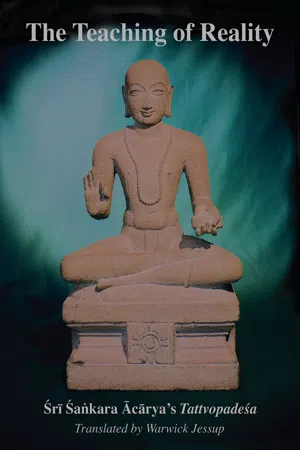
The Teaching of Reality is, as far as we know, the first translation into English of Tattvopade?a, a work attributed to the great spiritual teacher ?ankara. The text reveals the full significance of the great sentence 'You are That' (tat twam asi), which is said to convey the essence of the entire teaching of the Upanishads and to be the key to Advaita, the philosophy of non-duality. The reader is led through a systematic process enabling the real Self to be realised in practice.
- English
- ePUB (mobile friendly)
- Available on iOS & Android
eBook - ePub
The Teaching Of Reality
About this book
Information
Subtopic
Existentialism in PhilosophyTHE TEACHING OF REALITY

1 The Teacher spoke these words to his disciple1 in order to make clear the meaning of the word ‘reality’ (tattva). “Ponder2 the significance of the word ‘You’ (tvam) in the sentence ‘You are That’ (tat tvam asi).”3

2 You (tvam) are not the body, because it is an object of perception and is subject to birth and death etc.4 Besides, it is a material substance which is impure and ever changing.

3 You (tvam) are not an object of perception. You (tvam) are beyond form. You (tvam) are not subject to birth and death. Also, you (tvam) are devoid of material substances. You are pure and eternal, of the nature of an observer. A material substance like a pot could not be an observer.

4 You are not the senses,5 for organs such as the ear are instruments. You are the origin, distinct from organs of sense. You could not be an agent or an instrument.

5 Hear why you are distinct from the organs of sense. The senses are many, while you (tvam) are by nature one. Nor are you (tvam) of the nature of a single sense organ, for you know yourself in all circumstances as ‘I’ (aham).6

6 You are not a combination of the senses, nor are you any particular sense organ. This must be true, for even when the senses disappear you are still aware of yourself.

7 Listen! It is also unreasonable to think of yourself as the senses operating in sequence one by one, for this body, having various masters, would then perish, being reliant on divergent views.

8 Neither can it be supposed that you are various selves, for they would have fields of action at variance with each other; but a master would be established as one, as in the case of a country with one king.

9 You (tvam) are not the mind (manas), nor the vital force (prāṇa), for these are inanimate.7 For we experience absent-mindedness in the form ‘My mind was elsewhere’.

10 We also experience separation from the vital force in the form ‘This, my life, is oppressed by hunger and thirst’. The observer of these two is separate from them, just as the observer of a pot is separate from the pot.

11 O twice-born, you are not the intellect (buddhi), which is bound by the shadow of consciousness (cit), which is dissolved in deep sleep, and which pervades the whole body when one is awake.

12 In the waking state the very unsteady intellect takes on manifold forms, and in deep sleep is absorbed. You (tvam) are the observer, by nature one, illuminating that from which you are distinct.

13 Although the body etc. are absent in deep sleep, you are still the witness. Since by nature you experience yourself, you are not different from that which you cause to appear.

14 Those people who wish to realise through thought (māna)8 that consciousness which powers the means of knowledge (pramāṇa),9 are like those who wish to use fuel to burn fire itself.10

15 The Self (ātman) experiences the universe; the Self is not experienced by the universe. The Self illumines the universe; the Self is not illumined by the universe.

16 You are that Absolute (brahman), the observer of all, which is verily present and realiseable, but is not of a particular kind with a form of something visible such as a body.

17 That which appears as this universe (idam) is being eliminated as well as all that which appears as ‘That’ (tat).11 The reality (tattva) is not of this universe and cannot be expressed or known, since it is evident by itself.

18 It is said that the Absolute (brahman) is characterised as truth (satya), knowledge (jñāna) and infinity (ananta).12 You are that Absolute (brahman), for you are full of truth, you are by nature knowledge, and you are infinite.

19 When there are the limiting adjuncts (upādhi) of body etc., the personal soul (jīva) appears to limit the Absolute (brahman). This takes place when there is perception of duality as a result of the self-luminous Supreme Being (īśvara) appearing to be subject to the limiting adjuncts of its own powers (śakti).

20 The Absolute (brahman) is the source of all conceptions, but has no need of any conception. It is accessed through the sentences of the Veda, and known when one knows oneself (ātman).

21 Therefore we h...
Table of contents
- Cover
- Halftitle
- Title
- Copyright
- Dedication
- Acknowledgments
- Introduction
- The Teaching of Reality
- About the author
Trusted by 375,005 students
Access to over 1.5 million titles for a fair monthly price.
Study more efficiently using our study tools.
Frequently asked questions
Yes, you can cancel anytime from the Subscription tab in your account settings on the Perlego website. Your subscription will stay active until the end of your current billing period. Learn how to cancel your subscription
No, books cannot be downloaded as external files, such as PDFs, for use outside of Perlego. However, you can download books within the Perlego app for offline reading on mobile or tablet. Learn how to download books offline
Perlego offers two plans: Essential and Complete
- Essential is ideal for learners and professionals who enjoy exploring a wide range of subjects. Access the Essential Library with 800,000+ trusted titles and best-sellers across business, personal growth, and the humanities. Includes unlimited reading time and Standard Read Aloud voice.
- Complete: Perfect for advanced learners and researchers needing full, unrestricted access. Unlock 1.5M+ books across hundreds of subjects, including academic and specialized titles. The Complete Plan also includes advanced features like Premium Read Aloud and Research Assistant.
We are an online textbook subscription service, where you can get access to an entire online library for less than the price of a single book per month. With over 1.5 million books across 990+ topics, we’ve got you covered! Learn about our mission
Look out for the read-aloud symbol on your next book to see if you can listen to it. The read-aloud tool reads text aloud for you, highlighting the text as it is being read. You can pause it, speed it up and slow it down. Learn more about Read Aloud
Yes! You can use the Perlego app on both iOS and Android devices to read anytime, anywhere — even offline. Perfect for commutes or when you’re on the go.
Please note we cannot support devices running on iOS 13 and Android 7 or earlier. Learn more about using the app
Please note we cannot support devices running on iOS 13 and Android 7 or earlier. Learn more about using the app
Yes, you can access The Teaching Of Reality by Warwick Jessup in PDF and/or ePUB format, as well as other popular books in Philosophy & Existentialism in Philosophy. We have over 1.5 million books available in our catalogue for you to explore.