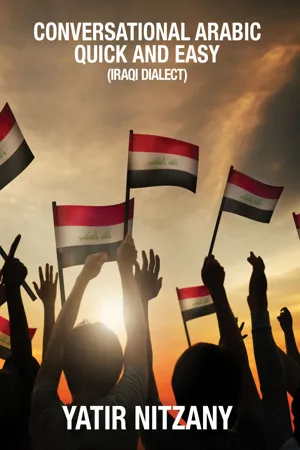
Conversational Arabic Quick and Easy
eBook - ePub

Conversational Arabic Quick and Easy

Iraqi Dialect

  1. English
  2. ePUB (mobile friendly)
  3. Available on iOS & Android
eBook - ePub

Conversational Arabic Quick and Easy

Iraqi Dialect

About this book

Have you always wanted to learn how to speak the Iraqi Arabic Dialect but simply didn't have the time?
Well if so, then, look no further. You can hold in your hands one of the most advanced and revolutionary method that was ever designed for quickly becoming conversational in a language. In creating this time-saving program, master linguist Yatir Nitzany spent years examining the twenty-seven most common languages in the world and distilling from them the three hundred and fifty words that are most likely to be used in real conversations. These three hundred and fifty words were chosen in such a way that they were structurally interrelated and, when combined, form sentences. Through various other discoveries about how real conversations work—discoveries that are detailed further in this book—Nitzany created the necessary tools for linking these words together in a specific way so that you may become rapidly and almost effortlessly conversant —now.
If your desire is to learn complicated grammatical rules or to speak perfectly proper and precise Arabic, this book is not for you. However, if you need to actually hold a conversation while on a trip to the Gulf States, to impress that certain someone, or to be able to speak with your grandfather or grandmother as soon as possible, then the Nitzany Method is what you have been looking for.
This method is designed for fluency in a foreign language, while communicating in the first person present tense. Nitzany believes that what's most important is actually being able to understand and be understood by another human being right away. Therefore, unlike other courses, all words in this program are taught in both the Arabic alphabet as well as English transliteration. More formalized training in grammar rules, etc., can come later.
This is one of the several, in a series of instructional language guides, the Nitzany Method's revolutionary approach is the only one in the world that uses its unique language technology to actually enable you to speak and understand native speakers in the shortest amount of time possible. No more depending on volumes of books of fundamental, beginner, intermediate, and advanced levels, all with hundreds of pages in order to learn a language. With Conversational Arabic Quick and Easy, all you need are sixty pages.
Learn Arabic today, not tomorrow, and get started now!

Frequently asked questions

Yes, you can cancel anytime from the Subscription tab in your account settings on the Perlego website. Your subscription will stay active until the end of your current billing period. Learn how to cancel your subscription.
At the moment all of our mobile-responsive ePub books are available to download via the app. Most of our PDFs are also available to download and we're working on making the final remaining ones downloadable now. Learn more here.
Perlego offers two plans: Essential and Complete
  • Essential is ideal for learners and professionals who enjoy exploring a wide range of subjects. Access the Essential Library with 800,000+ trusted titles and best-sellers across business, personal growth, and the humanities. Includes unlimited reading time and Standard Read Aloud voice.
  • Complete: Perfect for advanced learners and researchers needing full, unrestricted access. Unlock 1.4M+ books across hundreds of subjects, including academic and specialized titles. The Complete Plan also includes advanced features like Premium Read Aloud and Research Assistant.
Both plans are available with monthly, semester, or annual billing cycles.
We are an online textbook subscription service, where you can get access to an entire online library for less than the price of a single book per month. With over 1 million books across 1000+ topics, we’ve got you covered! Learn more here.
Look out for the read-aloud symbol on your next book to see if you can listen to it. The read-aloud tool reads text aloud for you, highlighting the text as it is being read. You can pause it, speed it up and slow it down. Learn more here.
Yes! You can use the Perlego app on both iOS or Android devices to read anytime, anywhere — even offline. Perfect for commutes or when you’re on the go.
Please note we cannot support devices running on iOS 13 and Android 7 or earlier. Learn more about using the app.
Yes, you can access Conversational Arabic Quick and Easy by Yatir Nitzany in PDF and/or ePUB format, as well as other popular books in Languages & Linguistics & Languages. We have over one million books available in our catalogue for you to explore.

The Program

Let's Begin! “Vocabulary” (Memorize the Vocabulary)
I | I am - Ani
I | I am - Ani
With you - Wayyak / Wayyach
With him / with her - Wayyah / Wayyaha
With us - Wayyana
For you - (masc) Lek / (fem) lech
Without him - Mo wayyah
Without them - Mo wayyahom
Always - Doum
Was - Chan
This, this is - Hatha/hathi
Is, it's, it is - Wohow
Sometimes - Marrat
Maybe - Yimkin
Are you? / is it? - (M) int?(F) inti?/ Wohow
Better - Azyan
You, you are - (M)Inta / (F)inti
He / she - Wohow /'ehya
From - Min/mni
Sentences from the vocabulary (now you can speak the sentences and connect the words)
I am with you
Ani wayyak
This is for you
(M)Hatha lik/(F) Hatha lich
I am from Iraq
Ani mni el'iraq
Are you from Iraq?
Inta mni Il-Iraq?
Sometimes you are with us at the mall
Marrat inta tkoon wayyana fil mall
I am always with her
Ani dom wayyaha
Are you without them today?
Inta mo wayyahom elyom?
Sometimes I am with him
Marrat ani akoon wayah
*In Arabic, there are gender rules. Saying “for you” to a male is lik, but if you are talking to a female then its lich. In spoken Arabic, which has no rules, they say Il kitab hatha lik, and they also say ilkitab hatha alashanik, or ilkitab hatha lik.
*In spoken Arabic words like hal / “are” are usually dropped, and we only say ehya aklat (she ate)? 'oho Nayim (he sleeps)?, etc., which, if written in Classical Arabic, would have been Hal aklat ehya? or "Hal wohow na’im?”Hal huwi Na’im?”
I was - Ani chint
To be - (M)Ykun/(F)Tkun
The - Il
Same / like (as in similar) - Mithl
Good - Zain
Here – Hni
Very - Kollish, kteer
And - Ow
Between - Bain
Now –Hassa’a
Later / after / afterwards - Ba’din
If - Law
Yes - Eeh
To - Li
Tomorrow - Bachir
Person - Wahad/ Shakhs
Also / too / as well - Ba'ad
It's better tomorrow
Azyan Bachir
This is good as well
Hatha zain ba'ad
To be the same person
Ykun nafs ilshakhs
Yes, you are very good
Eeh, inta kteer zain
I was here with them
Ana chint hni wayyahom
You and I
Inta w-ana
The same day
Nafs elyom
*In the Arabic language, adjectives follow the noun. For example, “the same day” is nafs ilyom, “small house” is beit zigheer, “tall person” is wahid toweel, and “short person” is wahid giseer.
*In this program the article “the” / il, al will sometimes become a prefix at the beginning of the noun. For nouns beginning with d, n, r, s, sh, t, th, and ...

Table of contents

  1. Introduction to the Program
  2. Introduction to Iraqi Arabic
  3. Memorization Made Easy
  4. Arabic Pronunciation
  5. Note to the Reader
  6. The Program
  7. Building Bridges
  8. Useful Vocabulary
  9. Conclusion
  10. Also by Yatir Nitzany
  11. Note from the Author