Alzheimer's disease is the most frequent cause of dementia that slowly and progressively causes cognitive impairment and profoundly alters the daily activities of the patients. Approximately, ten percent of all persons over the age of seventy experience significant memory loss, and in more than half of the cases, the cause is Alzheimer's disease. This reference book is an update on the most relevant pathological and clinical findings of this neurological disorder. Chapters cover the basic hypothesis of Alzheimer's disease, pathological features of the disease in the brain, Alzheimer's disease diagnosis and therapy. Information provided in the book is focused on research in developed countries. The book offers students of medicine and nursing as well as medical practitioners and specialists (internists, neurologists, gerontologists, and psychiatrists), the necessary information to understand the pathological and clinical aspects of the disease in depth, with the goal of improving medical outcomes in the care of their patients.
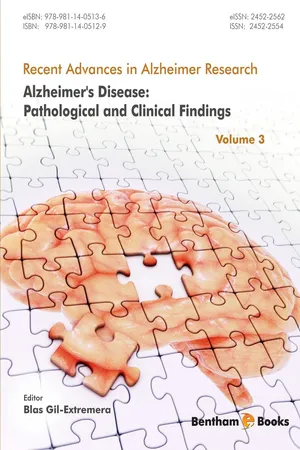
- English
- ePUB (mobile friendly)
- Available on iOS & Android
eBook - ePub
Alzheimer's Disease: Pathological and Clinical Findings
About this book
Information
Palliative Care at the End of Life
Alfredo J. Pardo-Cabello*
Department of Internal Medicine. San Cecilio University Hospital, Granada, Spain
Abstract
In patients with advanced dementia, eating problems followed by infections were the most common complications. Several scales (NHO, ADEPT, PALIAR) have been proposed to estimate 6-months survival. In these patients, a better quality of life could be achieved with palliative care rather than with continued aggressive medical interventions. There is no evidence enough to suggest that enteral tube feeding is beneficial in these patients so careful hand feeding should be offered to them. There is a lack of randomized trials that had examined the effects of antibiotics both on survival and on symptom relief, so caution regarding the initiation of antimicrobial treatment in these patients is recommended. Pain is difficult to assess so it is frequently under-diagnosed and undertreated. No conclusive data are available to support the use of anti-dementia drugs in patients at stage 7 on the GDS scale. Palliative sedation is indicated in patients with advanced or terminal dementia that present a refractory suffering or symptoms. Midazolam is the first-line choice in palliative sedation in all prevailing symptoms, except delirium, in which case levomepromazine is the first-line choice. In dying patients, current medication should be assessed and non-essentials drugs should be discontinued. At the end of life, drugs needed to be continued should be switched to the subcutaneous route. If appropriate, a syringe driver may be used for continuous infusion. In dying patients, inappropriate interventions (e.g. intravenous fluids, antibiotics, blood tests, measurement of vital signs...) should be stopped.
Keywords: Alzheimer Disease, Anti-Bacterial Agents, Anti-Infective Agents, Aspiration Pneumonia, Decision Making, Deglutition Disorders, Dementia, Enteral Nutrition, Memantine, Mortality, Pain, Palliative Care, Palliative Sedation, Pressure Ulcer, Rivastigmine, Terminal Care, Vascular Dementia.
* Corresponding author Alfredo J. Pardo-Cabello: Department of Internal Medicine. San Cecilio University Hospital. Avda de la Investigación, s/n . 18016-Granada, Spain; Tel: +34 958.840.991; Fax: +34 958.122.307; E-mail: [email protected]
INTRODUCTION
Dementia constitutes a clinical syndrome characterized by a progressive impairment of one or more cognitive domains, producing a decline from the previous level of function to one that interferes with daily function and independence [1].
Age has been reported by all epidemiological studies to be the main risk factor for dementia. Due to progressive ageing of the worldwide population, the overall burden associated with dementia is progressively increasing. Dementia has been estimated to affect 24 million people worldwide in 2001 and this number of patients was projected to almost double every 20 years [2].
In Europe, Lobo et al [3] reported an age-standardized prevalence of 6.4% for all kind of dementia in persons aged ≥65 years old, of which 4.4% was for Alzheimer Disease and 1.6% for vascular dementia; according to this study, the prevalence of dementia increased with age, ranging from 0.8% in the people aged 65-69 years to 28.5% in people aged 90 years and older. According to Sorbi et al [4], in the European Union, a crude prevalence of dementia was estimated at 6.2% what represents almost 9.95 million of patients with any form of dementia with an expectative of almost 14 million Europeans diagnosed with dementia in 2030.
CLINICAL COURSE AND END OF LIFE IN ADVANCED DEMENTIA
In relation to the clinical course of dementia, Mitchell et al [5] reported results after following 323 people with advanced dementia who lived in nursing homes in the United States of America. In this study [5], known as “Choices, Attitudes, and Strategies for Care of Advanced Dementia at the End-of-Life” (CASCADE), advanced dementia was considered if patient scored 5 or 6 on the Cognitive Performance Scale (CPS) [6] (a score of 5 in CPS equal to a score of 5.1±5.3 on the Mini-Mental State Examination) and a cognitive impairment due to dementia in stage 7 of the Global Deterioration Scale (GDS) [7]. Main results were [5]:
- 55% of residents died in the 18-months that lasted the study; the median survival was of 1.3 years.
- The eating problem was the most frequent clinical complication affecting 85.8% of patients followed by infections, mainly a febrile episode in 52.6% of patients and pneumonia in 41.1%.
- Other illnesses (e.g. hip fracture or myocardial infarction) were uncommon at the end of life.
- The adjusted 6-months mortality rate for patients with pneumonia was 46.7%; with a febrile episode, was 44.5% and with an eating problem, was 38.6%.
- In residents, the most common distressing symptoms were dyspnoea (46%) and pain (39.1%).
- 40.7% of residents underwent, at least, one burdensome medical intervention (including emergency room visit, hospitalization, tube feeding, or parenteral therapy) in their last 3 months of life.
- Residents with health care proxies who have an understanding of the clinical course and prognosis were likely to receive less aggressive interventions at the end of life.
Among elderly people with advanced dementia, different criteria have been reported as prognostic indicators of mortality (Table 1). In the United States, many efforts have been done in this issue because an estimated survival of six months or less is required to access to the US Medicare hospice benefit.
According to prognostic indicators included in Medicare hospice benefit guidelines [8] by National Hospice Organization (NHO), to be eligible for hospice (estimated survival of six months or less), patients with a diagnosis of dementia must meet both of the following requirements:
- Stage 7 or higher on the Functional Assessment Staging (FAST) scale [9]: unable to walk, to dress or to bathe without assistance; intermittent or constant urinary and faecal incontinence; and no consistently meaningful verbal communication (the limitation of the ability to speak only six or fewer intelligible words or only stereotypical phrases).
- Medical conditions: Patients must have presented, at least, one of the listed medical conditions over the last year:
- Aspiration pneumonia
- Septicaemia
- Pyelonephritis
- Recurrent fever treatment with antimicrobials
- Pressure ulcer, multiple, stage 3-4
- Dysphagia or refusal to eat of sufficient severity that patient cannot maintain sufficient fluid and calorie intake to sustain life with a weight loss of 10% in the last 6 months or a level of serum albumin below 2.5 g/dl.
The Advanced Dementia Prognostic Tool (ADEPT) is another model proposed to estimate survival in advanced dementia [10] and it is based on the sum of scores in twelve variables that best predicted survival in a study including 222,405 patients with advanced dementia who lived in nursing homes (Table 1):
- Recent nursing home admission: 3.3 points
- Age: 60<75 years: 1 point; 70<75 years: 2 points; 75<80 years: 3 points; 80<85 years: 4 points; 85<90 years: 5 points; 90<95 years: 6 points; 95<100 years: 7 points; ≥100 years: 8 points.
- Sex: Male: 3.3 points.
- Pressure ulcers (at least one) in stage ≥ 2: 2.7 points.
- Dyspnoea: 2.7 points.
- Total functional dependence (Activity of Daily Living Score =28): 2.1 points.
- Bedfast most of day: 2.1 points.
- Faecal incontinence: 1.9 points.
- Body mass index < 18.5 kg/m2: 1.8 points.
- Weight loss of > 5% of body weight in last 30 days, or > 10% in last 180 days: 1.6 points.
- Congestive heart failure: 1.5 points.
The area under Receiver Operating Characteristic (ROC) curve for the final model was 0.68 [10].
When ADEPT was compared to NHO...
Table of contents
- Welcome
- Table of Contents
- Title
- BENTHAM SCIENCE PUBLISHERS LTD.
- PREFACE
- List of Contributors
- Amyloid Hypothesis in Alzheimer´s Disease
- Brain Connectivity in Alzheimer’s Disease: From the Disconnection Syndrome to the Search for New Biomarkers
- Pain and Dementia
- Dysphagia in Alzheimer’s Disease
- Biomarkers for the Diagnosis of Alzheimer’s Disease
- Neuroimaging in Alzheimer’s Disease
- Palliative Care at the End of Life
- Nutrition and Alzheimer’s Disease
- Treatment and Control of Behavioral and Psychololgical Symptoms
- Action of Nurses to Improve Prospective Memory in People Affected by Alzheimer’s
Trusted by 375,005 students
Access to over 1.5 million titles for a fair monthly price.
Study more efficiently using our study tools.
Frequently asked questions
Yes, you can cancel anytime from the Subscription tab in your account settings on the Perlego website. Your subscription will stay active until the end of your current billing period. Learn how to cancel your subscription
No, books cannot be downloaded as external files, such as PDFs, for use outside of Perlego. However, you can download books within the Perlego app for offline reading on mobile or tablet. Learn how to download books offline
Perlego offers two plans: Essential and Complete
- Essential is ideal for learners and professionals who enjoy exploring a wide range of subjects. Access the Essential Library with 800,000+ trusted titles and best-sellers across business, personal growth, and the humanities. Includes unlimited reading time and Standard Read Aloud voice.
- Complete: Perfect for advanced learners and researchers needing full, unrestricted access. Unlock 1.5M+ books across hundreds of subjects, including academic and specialized titles. The Complete Plan also includes advanced features like Premium Read Aloud and Research Assistant.
We are an online textbook subscription service, where you can get access to an entire online library for less than the price of a single book per month. With over 1.5 million books across 990+ topics, we’ve got you covered! Learn about our mission
Look out for the read-aloud symbol on your next book to see if you can listen to it. The read-aloud tool reads text aloud for you, highlighting the text as it is being read. You can pause it, speed it up and slow it down. Learn more about Read Aloud
Yes! You can use the Perlego app on both iOS and Android devices to read anytime, anywhere — even offline. Perfect for commutes or when you’re on the go.
Please note we cannot support devices running on iOS 13 and Android 7 or earlier. Learn more about using the app
Please note we cannot support devices running on iOS 13 and Android 7 or earlier. Learn more about using the app
Yes, you can access Alzheimer's Disease: Pathological and Clinical Findings by B. Gil-Extremera in PDF and/or ePUB format, as well as other popular books in Medicine & Neurology. We have over 1.5 million books available in our catalogue for you to explore.