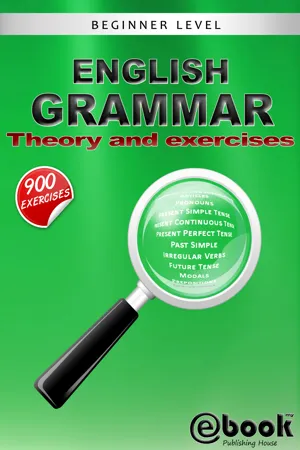
"English Grammar - Theory and Exercises" presents the most important elements of English Grammar in a clear and simple manner. The book addresses all those who want to learn English, regardless of age, offering, through clear explanations and algorithms, a better and faster understanding of English grammar. Each lesson is accompanied by examples and exercises. The book contains 900 exercises.
- English
- ePUB (mobile friendly)
- Available on iOS & Android
eBook - ePub
English Grammar - Theory and Exercises
About this book
Information
Subtopic
Langue anglaiseChapter 1 - Adjectives and Adverbs
Adjectives and Adverbs are used to describe nouns and verbs. Adjectives such as blue or pretty describe nouns. Adverbs such as slowly or beautifully describe verbs.
The adjectives which indicate religion or nationality begin with a capital letter, whether they refer to people or objects:
Greg goes to a Catholic church.
Tom is an English pupil.
In most cases, the adjective is put in front of the noun. When two adjectives precede a noun, they can be connected by a comma (,) or by the conjunction “and”. A batch of adjectives, is usually connected by a comma (,) or at the last one by the conjunction “and”.
– Examples:
Timmy is a good, nice and obedient dog.
Timmy likes long and quiet walks with his master.
In order to get perfect, we have to practice learning English for many long, hard hours.
Adjectives that are placed directly before a noun:
– Examples:
Tom is an excellent baseball player.
I bought a comfortable sofa.
Timmy is thinking about playing with a new toy.
– If an adjective is used in a sentence with the verb 'to be', then the adjective describes the subject of the sentence:
– Examples:
Timmy is sad.
John was very angry.
Adverbs are, in most cases, made from adjectives, by adding ly, but for a few exceptions.
– Examples:
Soft – softly
Sad – sadly
Cold – coldly
– Exceptions:
Good – well
Late – late
Early – early
Fast – fast
Hard - hard
– Placement of the adverbs
An adverb which modifies a verb is generally put at the end of the sentence.
Timmy plays nicely.
Jane learned her lessons well.
Joseph work...
Table of contents
- Chapter 1 - Adjectives and Adverbs
- Chapter 2 - Comparatives and Superlatives
- Chapter 3 - Articles
- Chapter 4- Pronouns
- Chapter 5 - Present Simple
- Chapter 6 - Present Continuous Tense
- Chapter 7 - Present Perfect Tense
- Chapter 8 - Past Simple Tense
- Chapter 9 - Past Tense Irregular Verbs
- Chapter 10 - Future
- Chapter 11 - Modal Form Basics
- Chapter 12 - PREPOSITIONS
- Chapter 13 - Conjunctions
- Chapter 14 - Solutions
Trusted by 375,005 students
Access to over 1.5 million titles for a fair monthly price.
Study more efficiently using our study tools.
Frequently asked questions
Yes, you can cancel anytime from the Subscription tab in your account settings on the Perlego website. Your subscription will stay active until the end of your current billing period. Learn how to cancel your subscription
No, books cannot be downloaded as external files, such as PDFs, for use outside of Perlego. However, you can download books within the Perlego app for offline reading on mobile or tablet. Learn how to download books offline
Perlego offers two plans: Essential and Complete
- Essential is ideal for learners and professionals who enjoy exploring a wide range of subjects. Access the Essential Library with 800,000+ trusted titles and best-sellers across business, personal growth, and the humanities. Includes unlimited reading time and Standard Read Aloud voice.
- Complete: Perfect for advanced learners and researchers needing full, unrestricted access. Unlock 1.5M+ books across hundreds of subjects, including academic and specialized titles. The Complete Plan also includes advanced features like Premium Read Aloud and Research Assistant.
We are an online textbook subscription service, where you can get access to an entire online library for less than the price of a single book per month. With over 1.5 million books across 990+ topics, we’ve got you covered! Learn about our mission
Look out for the read-aloud symbol on your next book to see if you can listen to it. The read-aloud tool reads text aloud for you, highlighting the text as it is being read. You can pause it, speed it up and slow it down. Learn more about Read Aloud
Yes! You can use the Perlego app on both iOS and Android devices to read anytime, anywhere — even offline. Perfect for commutes or when you’re on the go.
Please note we cannot support devices running on iOS 13 and Android 7 or earlier. Learn more about using the app
Please note we cannot support devices running on iOS 13 and Android 7 or earlier. Learn more about using the app
Yes, you can access English Grammar - Theory and Exercises by My Ebook Publishing House in PDF and/or ePUB format, as well as other popular books in Langues et linguistique & Langue anglaise. We have over 1.5 million books available in our catalogue for you to explore.