Alzheimer's disease (AD) is currently recognized as an untreatable, progressive, degenerative and terminal disease that is globally afflicting an estimated 36 million people and this number is growing in an unabated and frightening manner. Advances in Alzheimer Research, provides researchers with an integrated approach to AD academic literature ranging from basic to advanced clinical research. The series highlights the latest information in order to unravel the origin, pathogenesis and prevention of AD. The purpose of this book series is, therefore, to capture and discuss both, improvements towards the diagnosis and potential treatment of AD by established and novel strategies.
This first volume of the series provides an important mechanism to bring individuals having a variety of scientific interests and expertise under one roof to specifically focus on AD and related dementias. This volume presents articles on beta amyloid protein targets as well as research on secretase enzyme systems among other topics that deal with AD therapy.
- English
- ePUB (mobile friendly)
- Available on iOS & Android
eBook - ePub
Advances in Alzheimer's Research: Volume 1
About this book
Information
The What, Where, and How of γ-Secretase Complex Assembly
Daniel R. Dries*, †, Gang Yu*
Department of Neuroscience, The University of Texas Southwestern Medical Center, Dallas, TX75390-9111, USA
Abstract
Here we discuss the biology of γ-secretase, an enigmatic enzyme complex that is responsible for the generation of the β-amyloid peptide that constitutes the amyloid plaques of Alzheimer’s disease. We begin with a brief review on the processing of the amyloid precursor protein and a brief discussion on the family of enzymes involved in regulated intramembrane proteolysis, of which γ-secretase is a member. We then identify the four major components of the γ-secretase complex – presenilin, nicastrin, Aph-1, and Pen-2 – with a focus on the identification of each and the role that each plays in the maturation and activity of the complex. Next, we summarize the known subcellular locations of each γ-secretase component and the sites of γ-secretase activity, as defined by the production of β-amyloid. Finally, we close by synthesizing all of the included topics into an overarching model for the assembly and trafficking of the γ-secretase complex, which serves as a launching point for further questions into the biology and function of γ-secretase in Alzheimer’s disease.
Keywords: : Alzheimer’s disease, amyloid precursor protein, Aph-1, γ-secretase, nicastrin, Pen-2, presenilin, protease, aging, alzheimer's disease, amyloid precursor protein (APP), Aph-1, aspartyl protease, beta-amyloid (lowercase "beta"), brain, complex, dementia, membrane, neurofibrillary tangle, neuron, nicastrin, notch, Pen-2, plaque, presenilin, protease, secretase, tau..
* Address correspondence to Daniel R. Dries and Gang Yu: Department of Neuroscience, The University of Texas Southwestern Medical Center, 6000 Harry Hines Blvd., NA04.508, Dallas, TX 75390-9111, USA; Tel: 214-648-5157; Fax: 214-648-1801; E-mail: [email protected] and [email protected]† Current Address: Juniata College, Chemistry Department, 1700 Moore Street Huntingdon, PA 16652, USA; Tel: 814-641-3557; E-mail: [email protected]
Introduction
In 1906, Dr. Alois Alzheimer first described the amyloid plaques and neurofibrillary tangles (NFTs2 ) that represent the definitive pathological features of the disease that bears his name. Yet after more than a century of research, these hallmarks remain two of the best criteria on which the diagnosis of Alzheimer’s disease (AD) lies. The vague nature of its diagnosis is indicative of the myriad of unanswered questions that plague the AD field. We now know that these two hallmark pathological features of AD brains – amyloid plaques and NFTs – are composed of the amyloid-β (Aβ) peptide and the tau protein, respectively. Though
still contentious as to which is the more important pathological marker and therapeutic target of the two, it is now generally accepted that the formation of amyloid plaques precedes NFT formation in AD and is more intimately and directly associated with the mental decline associated with AD [1]. Here, we describe the components, assembly, and localization of γ-secretase, the enzyme complex that is directly responsible for the final step in the formation of the neurotoxic Aβ peptide.
Proteolytic Processing of the Amyloid Precursor Protein to AΒ
The advent of modern molecular biology techniques made possible the ability to pin a genetic and molecular origin on AD, which had eluded detection since the clinical characterization of AD nearly 80 years previous. The first definitive genetic studies began with two papers that identified an amyloid peptide in the cerebrovasculature of Down’s syndrome individuals that was identical to that found in AD brains [2, 3]. Shortly thereafter, the cloning of the amyloid precursor protein (APP) gene provided the beginning of a series of mutational analyses that pinned APP as the cause of several inherited forms of AD [4-8]. APP is a type I integral membrane protein, with a large, N-terminal extracellular domain and a short, C-terminal cytoplasmic domain (Fig. 1). The APP gene is alternatively spliced to yield isoforms of various lengths: the 751- and 770-(longest) amino acid isoforms predominate non-neuronal tissues, while the 695-amino acid form (APP695) is by far the most predominant isoform in neurons [9]. APP and the APP-like protein (APLP) have orthologues across nearly all vertebrate and invertebrate animals, and possible roles for APP and its proteolytic products range from axonal transport to transcriptional control to cell adhesion to apoptosis [10-12].
While very little is known about its biological function in the cell, very much is known about APP genetics and proteolytic processing with respect to AD [13, 14]. APP can undergo a series of cleavages to generate a wide array of proteolytic products (Figs. 1 and 2). APP is first cleaved by either α- or β-secretase at the α- or β-sites, respectively. These two sites lie close to (within ~10-30 amino acids of) the extracellular/luminal side of APP’s transmembrane domain (TMD), and cleavage at these sites results in a process known as “ectodomain shedding” [15]. These proteases compete for APP cleavage to give two products: a soluble APP (sAPPα or sAPPβ), which is released into the extracellular space, and a membrane-anchored C-terminal stub (C83 or C99, for α- and β-secretase cleavage, respectively). It is this stub upon which γ-secretase acts, with peptide bond hydrolysis occurring at a most unlikely location: within the hydrophobic lipid bilayer. Cleavage of C83 (the α-secretase product) generates the 6-kDa APP-intracellular domain (AICD) and releases the N-terminal ~3 kDa peptide (p3) into the extracellular space; cleavage of C99 (the β-secretase product) generates AICD and the nefarious Aβ peptide. Because the α- and β-secretases compete for APP, cleavage of APP by α-secretase to generate C83 precludes formation of Aβ; therefore, the two main culprits in Aβ biogenesis and AD are the β- and γ-secretases (Fig. 1).
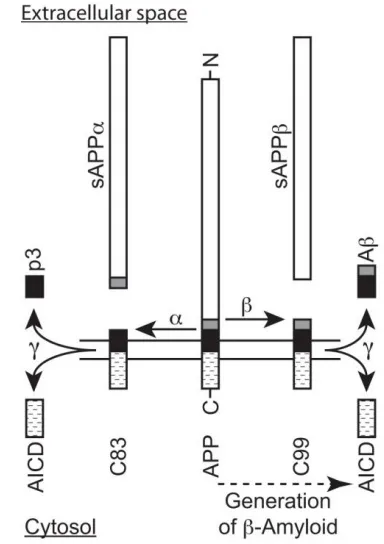
Proteolytic processing of the amyloid precursor protein (APP). APP is processed by either of two pathways. First, the large extracellular domain is removed by either α- (left) or β-secretase (right) in a process termed “ectodomain shedding” to release the soluble APP ectodomain (sAPPα and sAPPβ, respectively) into the extracellular space. The resulting APP C-terminal stubs (C83 and C99, respectively) can then serve as substrates for intramembranous cleavage by γ-secretase. Cleavage of C83 generates the p3 peptide and the APP intracellular domain (AICD), whereas cleavage of C99 generates the Aβ peptide and AICD. p3 and Aβ are ultimately released into the extracellular space, whereas AICD remains in the cytosol. Note that cleavage of APP by α-secretase precludes formation of Aβ.
γ-secretase cleavage is promiscuous, as the growing list of γ-secretase substrates show little sign of any sequence similarity [16, 17]. Interestingly, however, these substrates are all type I transmembrane proteins which require ectodomain shedding as a prerequisite to γ-secretase cleavage [17, 18]. In addition to APP, a second heavily studied substrate of γ-secretase is the Notch receptor, which, upon binding to ligand, undergoes sequential proteolysis by an α-secretase-like protease and γ-secretase to analogously produce a soluble Notch receptor fragment and the Notch intracellular domain (NICD). The proteolytic activity of γ-secretase on Notch is crucial for developmental pathways and, thus, represents a possible undesirable “off-target” effect for AD therapies based on γ-secretase inhibition [19]. Similarly, ErbB4, the low-density lipoprotein (LDL)-receptor-related protein (LRP), and the neurotrophin receptor (p75NTR) are just a few of the many seemingly-unrelated type I membrane proteins that serve as substrates for γ-secretase [16, 17, 19].
The promiscuity of γ-secretase further persists within substrates, as γ-secretase cleavage of APP occurs at any number of sites to generate Aβ peptides from 37 to 49 residues long; these resulting peptides are termed Aβ37 through Aβ49, numbered according to the site of cleavage from the N-terminus of C99 ([20] and Fig. 2). While a thorough discussion of “subsite” selectivity with respect to γ-secretase enzymology is beyond the scope of this chapter (for an example, the reader is referred to [21]), it is important to note that two forms are most pertinent to AD etiology: Aβ40, which is considered “normal” and accounts for ~90% of all non-AD Aβ peptides, and the more aggregation-prone Aβ42, which accounts for 5-10% of Aβ pep...
Table of contents
- Welcome
- Table of Contents
- Title
- BENTHAM SCIENCE PUBLISHERS LTD.
- PREFACE
- LIST OF CONTRIBUTORS
- How and When Environmental Agents and Dietary Factors Affect the Course of Alzheimer’s Disease: The “ LEARN ” Model (Latent Early-Life Associated Regulation) May Explain the Triggering of AD
- Therapeutics Targeting Intracellular Amyloid β-Protein in Alzheimer’s Disease: A Novel Effect of Apomorphine
- Protection Mechanisms Against Aβ42 Aggregation
- An Increase in Aβ42 in the Prefrontal Cortex is Associated with a Reversal Learning Impairment in Alzheimer’s Disease Model Tg2576 APPsw Mice
- The Regulation of βAPP and PrPc Processing by α-Secretase
- Regulation and Activation of Metalloproteinase-Mediated APP α-Secretase Cleavage
- Taking Down the Unindicted Co-Conspirators of Amyloid β−Peptide-Mediated Neuronal Death: Shared Gene Regulation of BACE1 and APP Genes Interacting with CREB, Fe65 and YY1 Transcription Factors
- The What, Where, and How of γ-Secretase Complex Assembly
- Pro-Inflammatory Cytokines and Anti-Inflammatory Drugs Modulate Glial Expression of Apolipoprotein E Protein
- Lipoprotein Receptors in Alzheimer´s Disease: Beyond Lipoprotein Transport
- Tau-Induced Neurodegeneration in Alzheimer Disease and Related Tauopathies
- Prevalence of Neuropsychiatric Symptoms in Alzheimer’s Disease and Vascular Dementia
- Fatty Aspirin: A New Perspective in the Prevention of Dementia of Alzheimer’s Type?
Trusted by 375,005 students
Access to over 1.5 million titles for a fair monthly price.
Study more efficiently using our study tools.
Frequently asked questions
Yes, you can cancel anytime from the Subscription tab in your account settings on the Perlego website. Your subscription will stay active until the end of your current billing period. Learn how to cancel your subscription
No, books cannot be downloaded as external files, such as PDFs, for use outside of Perlego. However, you can download books within the Perlego app for offline reading on mobile or tablet. Learn how to download books offline
Perlego offers two plans: Essential and Complete
- Essential is ideal for learners and professionals who enjoy exploring a wide range of subjects. Access the Essential Library with 800,000+ trusted titles and best-sellers across business, personal growth, and the humanities. Includes unlimited reading time and Standard Read Aloud voice.
- Complete: Perfect for advanced learners and researchers needing full, unrestricted access. Unlock 1.5M+ books across hundreds of subjects, including academic and specialized titles. The Complete Plan also includes advanced features like Premium Read Aloud and Research Assistant.
We are an online textbook subscription service, where you can get access to an entire online library for less than the price of a single book per month. With over 1.5 million books across 990+ topics, we’ve got you covered! Learn about our mission
Look out for the read-aloud symbol on your next book to see if you can listen to it. The read-aloud tool reads text aloud for you, highlighting the text as it is being read. You can pause it, speed it up and slow it down. Learn more about Read Aloud
Yes! You can use the Perlego app on both iOS and Android devices to read anytime, anywhere — even offline. Perfect for commutes or when you’re on the go.
Please note we cannot support devices running on iOS 13 and Android 7 or earlier. Learn more about using the app
Please note we cannot support devices running on iOS 13 and Android 7 or earlier. Learn more about using the app
Yes, you can access Advances in Alzheimer's Research: Volume 1 by Debomoy K. Lahiri in PDF and/or ePUB format, as well as other popular books in Medicine & Neurology. We have over 1.5 million books available in our catalogue for you to explore.