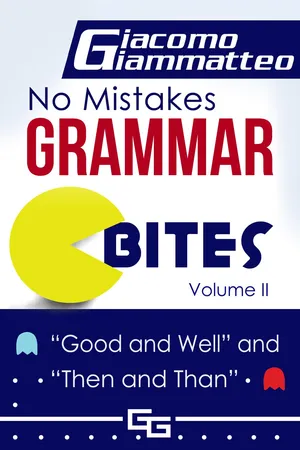
Guaranteed Not to Be Confusing Don't Ever Be Confused by Grammar Again. Take a "bite" out of Grammar with No Mistakes Grammar Bites. It seems as if many dictionaries and books on grammar do their best to confuse people. Words and explanations are defined using grammatical terminology that is difficult to understand; in fact, if you knew that terminology, you probably wouldn't have to look up the words to begin with. We're aiming to get rid of that and explain things in plain English, using language that is easy to understand. Try it out and see for yourself. If you find these books confusing, write to me and get a refund; they're guaranteed.
- English
- ePUB (mobile friendly)
- Available on iOS & Android
eBook - ePub
About this book
Information
Subtopic
English LanguageGood and Well

There are a lot of phrases and words that are often misused. One of those phrases concerns the response to the often-heard questions “How are you?” and “How are you feeling?”
This isn’t the most difficult usage to grasp. That designation belongs to lie versus lay, but good versus well runs a close second.
I go to therapy twice a week. Invariably, I need to sit in the waiting room, and it’s while I’m sitting there I often hear people’s responses to the questions “How are you?” and “How are you feeling?”
A few people respond with “Good, how are you?” But most say, “I’m doing well,” or “Well, thank you.”
Many of us grew up learning to respond that way, being taught that “well” was the preferred response because well is an adverb and good is an adjective. The problem is that the questions “How are you?” and “How are you feeling?” do not require an adverb as a response.
I’m not going to get technical here as I’ve said I wouldn’t do that. If you want technical reasons for why you need to use good or any adjective, for that matter, feel free to write to me. For this book, let’s restrict our answer to “plain English.”
Any of the “to be” verbs such as am, is, are, was, were, been, etc. as well as “sense” verbs, those verbs that describe the five senses—sight, hearing, feel, smell, and taste—require adjectives.
Let’s Look Closer at Sense Verbs
I’m going to list a few examples of statements or questions using sense verbs. And I’ll list them with both adjectives and adverbs.
✅ That lasagna smells delicious. (Adjective)
❌ That lasagna smells deliciously. (Adverb)
✅ The apple pie tastes wonderful. (Adjective)
❌The apple pie tastes wonderfully. (Adverb)
✅ That apple seems crisp. (Adjective)
❌That apple seems crisply. (Adverb)
✅ She looks amazing. (Adjective)
❌She looks amazingly. (Adverb)
✅ He said he feels great. (Adjective)
❌He said he feels greatly. (Adverb)
As you can see, the sentences marked with the “green check” use adjectives, and they sound right. The ones marked with the “red X” use adverbs and do not sound natural.
So yes, “How are you?” and “How are you feeling?” Require an adjective as an answer, not an adverb.
To Really Confuse You...
Table of contents
- Copyright NonFiction
- Title Page
- Introduction
- Contents
- 1. Good and Well
- 2. Action Verbs
- 3. The Big Problem
- 4. Then and Than
- Acknowledgments
- About the Author
- Also by Giacomo Giammatteo
Trusted by 375,005 students
Access to over 1.5 million titles for a fair monthly price.
Study more efficiently using our study tools.
Frequently asked questions
Yes, you can cancel anytime from the Subscription tab in your account settings on the Perlego website. Your subscription will stay active until the end of your current billing period. Learn how to cancel your subscription
No, books cannot be downloaded as external files, such as PDFs, for use outside of Perlego. However, you can download books within the Perlego app for offline reading on mobile or tablet. Learn how to download books offline
Perlego offers two plans: Essential and Complete
- Essential is ideal for learners and professionals who enjoy exploring a wide range of subjects. Access the Essential Library with 800,000+ trusted titles and best-sellers across business, personal growth, and the humanities. Includes unlimited reading time and Standard Read Aloud voice.
- Complete: Perfect for advanced learners and researchers needing full, unrestricted access. Unlock 1.5M+ books across hundreds of subjects, including academic and specialized titles. The Complete Plan also includes advanced features like Premium Read Aloud and Research Assistant.
We are an online textbook subscription service, where you can get access to an entire online library for less than the price of a single book per month. With over 1.5 million books across 990+ topics, we’ve got you covered! Learn about our mission
Look out for the read-aloud symbol on your next book to see if you can listen to it. The read-aloud tool reads text aloud for you, highlighting the text as it is being read. You can pause it, speed it up and slow it down. Learn more about Read Aloud
Yes! You can use the Perlego app on both iOS and Android devices to read anytime, anywhere — even offline. Perfect for commutes or when you’re on the go.
Please note we cannot support devices running on iOS 13 and Android 7 or earlier. Learn more about using the app
Please note we cannot support devices running on iOS 13 and Android 7 or earlier. Learn more about using the app
Yes, you can access No Mistakes Grammar Bites, Volume II by Giacomo Giammatteo in PDF and/or ePUB format, as well as other popular books in Languages & Linguistics & English Language. We have over 1.5 million books available in our catalogue for you to explore.