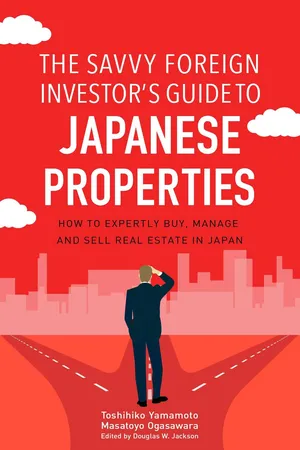
Did you know that Japan is the world's second-largest real estate investment market? No surprise if you didn't, because even many Japanese investors aren't aware of it—or that a 2018 report from leading investment research firm MSCI Inc. valued Japan's market at US$798 billion in 2017.
One problem foreign investors face, in fact, is the crucial lack of dependable, actionable information about Japanese properties. In the Savvy Foreign Investor's Guide to Japan, real estate advisor and investor Toshihiko Yamamoto and U.S.–trained global architect Masatoyo Ogasawara tell you exactly how to find, assess, buy, manage and even build great properties in Japan—and how to avoid all the pitfalls along the way.
Here are just some of the insights they'll give you:
Who's buying property in Japan, and where and why
How top investors see the market, and two real-world cases
Investment options both conventional (condos, apartment buildings, etc.) and unconventional (Airbnb, kominka and more)
Practical property-hunting tips and techniques
How to find the right property management firm
How the new Minpaku Law affects rental properties
Insuring your investment wisely, including disaster coverage
Building countermeasures for fire and earthquake
How to find and deal with architects and contractors
Whether you're a pure investor, have plans to live in Japan or are already here, this book gives you several potential roads to solid yields in one of the world's most stable and desirable property markets.
Toshihiko Yamamoto was a corporate executive working for major firms such as Konami Corporation and Sony Pictures Entertainment and a commodities trader in London for five years before getting deep into the real estate market as an investor, real estate broker and property advisor. He's determined to raise the reputation of real estate investment in Japan, and specializes in assisting foreign buyers and sellers the market.
Masatoyo Ogasawara is a registered architect in New York and a first-class architect in Japan who graduated from the University of Tokyo with dual degrees in aeronautics and architecture, went on to the Harvard University Graduate School of Design, and then joined Pei Cobb Freed & Partners in New York. The latter was the domain of Pritzker prizewinner I. M. Pei. He now runs his own firm in Tokyo, Masatoyo Ogasawara Architects, which specializes in high-end residential and commercial structures, providing world-class, high-end and diversified services in English to international clients.
All rights reserved. No part of this publication may be reproduced, distributed or transmitted in any form or by any means, including photocopying, recording or other electronic or mechanical methods, without the prior written permission of the publisher, except in the case of brief quotations embodied in critical reviews and certain other noncommercial uses permitted by copyright law. For permission requests, please email the publisher at the following address:
All information within this book is of relevant content and written solely for motivation and direction. No financial guarantees are made or implied. All information is considered valid and factual to the knowledge of the writers.
Epub ISBN : 978-4-907278-70-0
Version : 1.0
Front cover image by Yuki Fujiwara
Published by petite lettre Co. Ltd. 2-6-6, Akabane-minami Tokyo, Japan, 166-0001
www.petite-lettre.com
Contents
Introduction
Chapter 1 Why Should You Invest in Japanese Real Estate?
A Potential Disaster
Beautiful Stories, Hard Realities
A Brief Japan Market Overview
Chapter 2 Who’s Buying in Japan, and Why
Knowing Where to Look
The State of the Bubble
Chapter 3 How Top Investors See the Japanese Market
The Positive Aspects
The Negative Aspects
A Fresh Global Snapshot from CBRE
Chapter 4 Evaluating and Managing Properties
Always Assess the Owners Association
Finding the Right Property Management Firm
Insuring Your Investment
Have an Exit Strategy Ready
Chapter 5 Investment Options—Conventional and Unconventional
Conventional Investment Possibilities
Unconventional Investment Possibilities
Where We Look
The new Minpaku Law
Chapter 6 Successful Real-World Cases to Study
Case No. 1
Case No. 2
Chapter 7 The 2025 Problem and Environmental Aspects
Bright Spots Despite a Downsizing Trend
Environmental Concerns
Getting Disaster Coverage
Chapter 8 Practical Property-Hunting Tips and Techniques
Chapter 9 Some Natural Concerns About Purchasing Real Estate in Japan
Better Regulations From Hard Experience
Protecting Your Property From Earthquakes
Protecting Your Property From Fire
The Building Standards Law and Fire Defense Law
Chapter 10 Insider Tips for Smooth and Successful Projects in Japan
Two Real-World Cases
Case No. 1 Renovating an ultra-luxury apartment in the city center
Case No. 2 Suburban villa rehabilitation
A Double Failure to Communicate
Cost, Scheduling and Choosing the Right Contractor
Introduction
From Toshihiko Yamamoto
Japan is the second-largest real estate investment market in the world. That’s according to a June 2018 report from leading investment research firm MSCI Inc., which said it was worth US$798 billion in 2017.
Most people aren’t aware of that fact, even Japanese investors. Many who do know still hesitate to get into the property investment game here, despite the possibilities. Why?
Well, one major problem investors from abroad face is a lack of information in English about this market—or in any other language, for that matter. Consequently, foreign investors—who are the primary audience for this book, including foreign residents of Japan—don’t know how the Japanese market works, what kinds of properties to look for, who to deal with (and who to avoid), sources of financing or what yields to expect.
This book answers those questions, and a great many more. The answers are based on my own decades of experience in investing in property here, feedback during regular seminars I’ve provided for fledgling investors for the past seven years, and from the perspective of a licensed real estate broker. I bought my first condo at the age of 27, and my first residential building—a 13-unit apartment complex in Tokyo—in 2008, and another 13-unit complex in Chiba. I’ve dealt with real estate agents and brokers, property management firms, contractors providing renovation services and many others.
Let me acknowledge two more issues: the real estate business in Japan does not have a stellar reputation—something that is also unfortunately true elsewhere—and very few in the industry are equipped to deal with foreign investors.
I am one of the few who can. My background has a great deal to do with that. I was born and raised in the international port city of Kobe, and have a B.A. in economics from Osaka Prefecture University as well as an MBA from Bond University in Australia. I began my professional career in Tokyo working for a large trading company, Nissho Iwai Corporation (now Sojitz Corporation). I’ve held senior positions at major multinationals, including an international video game company, Konami Corporation, and a major Hollywood studio, Sony Pictures Entertainment. I also worked in London for over five years as a commodities trader.
Along the way, I’ve conducted business with hundreds of people from over twenty nations, including China and Hong Kong, Australia, the U.S., Germany, the UAE, Tanzania and Thailand. Even if I don’t really know the country firsthand, I can handle the cultural differences and cues, and always respect them.
My primary focus now—and the reason for writing this book—is to advise foreign investors looking to acquire great properties in Japan, negotiate on their behalf, and help them profit from their investments. My services include:
Boutique agency services (for both buyers and sellers) to foreign investors and owners
One-to-one consultancy services for private investors
Assistance in finding kominka (old traditional Japanese houses) for investment
House flipping assistance
Mortgage assistance
Real estate and neighborhood tours
Residential houses and buildings acquisition
Commercial buildings acquisition
Unusual real estate opportunities such as hotels, hostels, vacation rentals (Airbnb), and abandoned and distressed properties
My coauthor, architect Masatoyo Ogasawara, answers questions related to building or renovating structures here, and addresses concerns you may have related to earthquakes and other natural disasters in Japan. (More from him below.)
I doubt that you’ll find this combination of insider insights and information on the Japanese property market anywhere else. I also provide up-to-date information on market trends via my blog, https://www.toshihikoyamamoto.jp/, and on LinkedIn. You can find links to my LinkedIn, Twitter and Facebook pages on my blog.
My advisory welcomes all inquiries about the possibility of investing in what is one of the most stable and profitable real estate markets in the world. My network extends beyond Tokyo, and I’m happy to connect you to others I trust in areas I do not cover directly.
From Masatoyo Ogasawara
What I bring to this book is a global architect’s perspective and practical experiences both abroad and in Japan.
In my first chapter, I get into the detailed countermeasures taken in Japan to guard against disasters such as earthquakes and fires so that you can judge any potential threat to your investment properly. I’ll tell you what those countermeasures are, how they developed, and what you should look for.
My second chapter tells you how to find a top architectural firm in Japan and the most effective ways of interacting with them, how to ensure you have the right contractor and get your property built or renovated to your satisfaction, and what pitfalls to watch out for along the way.
Some of the issues I get into are how communication styles differ between Japan and the rest of the world, project logistics and who controls them, and other aspects. I also provide a few case histories about clients my firm has worked with, and what we do to ensure ultimate satisfaction.
About my professional background: I’m a U.S.–trained architect who specializes in high-end architecture, both residential and commercial, and the founder of Masatoyo Ogasawara Architects (https://masatoyo.com/en/projects/), an architectural firm in Tokyo. I’m both a registered architect in the State of New York and a first-class architect in Japan.
After graduating from the University of Tokyo with dual degrees in aeronautics and architecture, I attended the Harvard University Graduate School of Design, and then moved to New York to join the well-established firm of Pei Cobb Freed & Partners.
I acquired many skills as a professional at Pei Cobb Freed, surrounded by seasoned architects who worked on high-profile projects with Pritzker prizewinner I. M. Pei such as the Grand Louvre modernization (the glass pyramid in Paris), National Gallery East Wing in Washington, DC and the Bank of China in Hong Kong. This experience gave me access to and knowledge about top-class materials and construction details, and also provided me the chance to deal with high-end international clients.
After four years at Pei Cobb Freed, I came back to Japan to pursue professional excellence and seek out opportunities to be the lead architect on projects. I also earned my doctoral degree in engineering in fall 2017 from the University of Tokyo.
My firm has a proven track record of providing aesthetically elegant and technologically efficient buildings and houses.
Our clientele are diverse, including a European company, an Asian billionaire, a Chinese business owner and others. It is noteworthy that our clients are predominantly non-Japanese who own properties in Japan.
My firm provides world-class, high-end and diversified services in English (and I also speak a bit of Mandarin) in Tokyo. We welcome your inquiries on projects already in progress or upcoming.
Chapter 1 Why Should You Invest in Japanese Real Estate?
I’m a licensed real estate broker, longtime investor and property owner, and since I re...
Table of contents
The Savvy Foreign Investor’s Guide to Japanese Properties
Trusted by 375,005 students
Access to over 1.5 million titles for a fair monthly price.
Study more efficiently using our study tools.
Frequently asked questions
Yes, you can cancel anytime from the Subscription tab in your account settings on the Perlego website. Your subscription will stay active until the end of your current billing period. Learn how to cancel your subscription
No, books cannot be downloaded as external files, such as PDFs, for use outside of Perlego. However, you can download books within the Perlego app for offline reading on mobile or tablet. Learn how to download books offline
Perlego offers two plans: Essential and Complete
Essential is ideal for learners and professionals who enjoy exploring a wide range of subjects. Access the Essential Library with 800,000+ trusted titles and best-sellers across business, personal growth, and the humanities. Includes unlimited reading time and Standard Read Aloud voice.
Complete: Perfect for advanced learners and researchers needing full, unrestricted access. Unlock 1.5M+ books across hundreds of subjects, including academic and specialized titles. The Complete Plan also includes advanced features like Premium Read Aloud and Research Assistant.
Both plans are available with monthly, semester, or annual billing cycles.
We are an online textbook subscription service, where you can get access to an entire online library for less than the price of a single book per month. With over 1.5 million books across 990+ topics, we’ve got you covered! Learn about our mission
Look out for the read-aloud symbol on your next book to see if you can listen to it. The read-aloud tool reads text aloud for you, highlighting the text as it is being read. You can pause it, speed it up and slow it down. Learn more about Read Aloud
Yes! You can use the Perlego app on both iOS and Android devices to read anytime, anywhere — even offline. Perfect for commutes or when you’re on the go. Please note we cannot support devices running on iOS 13 and Android 7 or earlier. Learn more about using the app
Yes, you can access The Savvy Foreign Investor's Guide to Japanese Properties by Toshihiko Yamamoto, Masatoyo Ogasawara, Douglas W. Jackson in PDF and/or ePUB format, as well as other popular books in Business & Real Estate. We have over 1.5 million books available in our catalogue for you to explore.