Winner, 2022 Children's Literature Association Book Award, given by the Children's Literature Association
Winner, 2020 World Fantasy Awards
Winner, 2020 British Fantasy Awards, Nonfiction
Finalist, Creative Nonfiction IGNYTE Award, given by FIYACON for BIPOC+ in Speculative Fiction
Reveals the diversity crisis in children's and young adult media as not only a lack of representation, but a lack of imagination
Stories provide portals into other worlds, both real and imagined. The promise of escape draws people from all backgrounds to speculative fiction, but when people of color seek passageways into the fantastic, the doors are often barred. This problem lies not only with children's publishing, but also with the television and film executives tasked with adapting these stories into a visual world. When characters of color do appear, they are often marginalized or subjected to violence, reinforcing for audiences that not all lives matter.
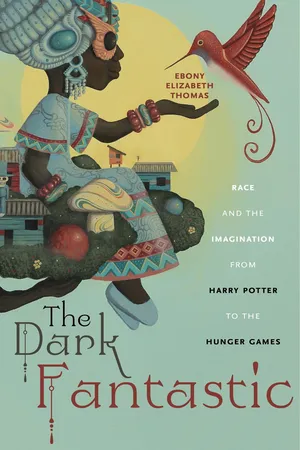
The Dark Fantastic is an engaging and provocative exploration of race in popular youth and young adult speculative fiction. Grounded in her experiences as YA novelist, fanfiction writer, and scholar of education, Thomas considers four black girl protagonists from some of the most popular stories of the early 21st century: Bonnie Bennett from the CW's The Vampire Diaries, Rue from Suzanne Collins's The Hunger Games, Gwen from the BBC's Merlin, and Angelina Johnson from J.K. Rowling's Harry Potter. Analyzing their narratives and audience reactions to them reveals how these characters mirror the violence against black and brown people in our own world.
In response, Thomas uncovers and builds upon a tradition of fantasy and radical imagination in Black feminism and Afrofuturism to reveal new possibilities. Through fanfiction and other modes of counter-storytelling, young people of color have reinvisioned fantastic worlds that reflect their own experiences, their own lives. As Thomas powerfully asserts, "we dark girls deserve more, because we are more."
eBook - ePub
The Dark Fantastic
Race and the Imagination from Harry Potter to the Hunger Games
- English
- ePUB (mobile friendly)
- Available on iOS & Android
eBook - ePub
The Dark Fantastic
Race and the Imagination from Harry Potter to the Hunger Games
About this book
Information
1
Toward a Theory of the Dark Fantastic
“I nearly reached the point of believing”: that is the formula which sums up the spirit of the fantastic. Either total faith or total incredulity would lead us beyond the fantastic: it is hesitation which sustains its life.
—Tzvetan Todorov, The Fantastic: A Structural Approach to a Literary Genre, 1973
If the spectacle of the lynched Black body haunts the modern age, then the slow disintegration of Black bodies and souls in jail, urban ghettos, and beleaguered schools haunts our postmodern times.
—Hazel Carby, Race Men, 1998
In Him was life, and that life was the light of all mankind. The light shines in the darkness, and the darkness has not overcome it.
—John 1:4–5
The Dangers of Myth-Making: Why We Need to Examine the Dark Fantastic
In her landmark essay, Playing in the Dark: Whiteness and the Literary Imagination, Toni Morrison explained that she could understand and theorize Whiteness in American literature only when she “stopped reading as a reader and began to read as a writer.”1 It was only when I began to read fantasy and fairy tales as an aspiring author that I began to understand the function of darkness in the fantastic. My first fanfiction was sparked by the Ron/Hermione versus Harry/Hermione shipping wars in the Harry Potter fan communities of the early 2000s (discussed in chapter 5).2 It was a crowdsourced story, with beta readers from England to Brazil, and fandom personalities showing up as characters—and lampooned caricatures—in every chapter. Although I conceded that Rowling would likely put Ron and Hermione together in the end, I shipped Harry and Hermione together for reasons that I wanted to show in my take on things. As a fan of color, I was also curious about what the wizarding world might be like outside England. Without colonialism or slavery, how on earth did Black children end up at Hogwarts with English names? Adoption? Immigration? Or had witches and wizards of color been somehow subjugated—was their magic less powerful? As a young writer, I audaciously dreamed about someday creating and publishing my own fantasy stories that weren’t based primarily on European folklore or myth.
Wanting to know more about the possibilities of characters that had been focalized only through Harry’s point of view in the book series, I set my second fanfiction in the most magical place I could think of at the time—Brazil. Of course, I had never actually visited Brazil. As I was growing up, my parents had neither the money nor the desire to travel abroad. After college and graduate school, there were student loans and the financial realities of striking out on my own. Yet like many other African Americans, I was enthralled with the prospect of making my pilgrimage to Brazil—Salvador, Bahia, to be exact. It was thought that in Salvador the cultural loss and trauma of slavery had been far less severe than it had been in the United States, and that Brazilians of African descent had retained more of their memories from our Motherland. Just as my Irish American friends made pilgrimages to Dublin, and my Italian American friends regularly visited their relatives in Sicily, I hoped to someday travel to Brazil and then West Africa to reclaim a part of my heritage, perhaps experiencing a bit of what I believed was authentic magic along the way.3
While browsing the Brazzil.net forum in the early 2000s, I read a heated exchange between two participants. One was a Brazilian man, an anthropologist living in Rio de Janeiro and using the alias of Macunaima. The other was a Black American woman who shared the same vision of Bahia as a racism-free Afrotopia that I had internalized. The more this woman posted her fantasies about visiting Brazil, the more offended Macunaima seemed to become. Finally, he wrote something on that thread that affected me so profoundly that I saved it to mull over:
Myth-making is not a good cure for amnesia. In fact, given your original statement as to “stagnant” African culture, it seems that your amnesia has resulted in your unconscious incorporation of some incredibly racist opinions and beliefs. This is why myth-making is dangerous for subordinate peoples: your imagination is more controlled by the dominant social formation than you’re probably willing to admit. Only by deep and wide engagement with history can we begin to reconstruct a reasonable notion as to what has happened and why.4
The idea that my imagination had been controlled in any way floored me. As a child and teen, I had been an omnivorous reader, seeking my own bliss without much concern about the politics of my reading. The cartography of my imagination had been inscribed by Tove Jansson’s Moominland Midwinter as much as it had been by Julius Lester’s To Be a Slave. I greatly enjoyed reading Virginia Hamilton’s lyrical retellings of traditional Black American folktales but counted Lucy Maud Montgomery’s idealized Edwardian-era Prince Edward Island story girls as my favorite characters of all. I dutifully read Mildred Taylor’s Roll of Thunder, Hear My Cry series in order to learn about my ancestors’ plight, but when it was time for imaginative escape, I turned to Michael Ende’s Neverending Story. When it came to works that made the leap from page to screen, I watched the film adaptation of William Howard Armstrong’s Sounder once while in school, but I have watched The Princess Bride and Labyrinth so many times that I have both movies memorized. Although I grew up in the first generation after the classical phase of the Civil Rights movement, my literate imagination was quite segregated. Books and movies about children and teens who looked like me were read and viewed out of duty, in order to learn something about the past.5 Books and movies that showcased the pleasures of dreaming, imagination, and escape were stories about people who did not look like me.
And yet I was most drawn to those magical stories, for I longed to dream.
Macunaima’s online post was the first moment I began thinking deeply about the myth-making that all human beings engage in to make sense of an oft-nonsensical world. This myth-making process—which fantasist Brian Attebery described as creating “stories about stories”—forms metanarratives that shape society, culture, and ultimately, the imagination. For, as Attebery notes, “Fantasy is an arena—I believe the primary arena—in which competing claims about myth can be contested and different relationships with myth tried out.”6 Literary historian Farah Mendlesohn further theorizes the relationships between the reader and the fantastic metanarrative as rhetorical.7 A reader or viewer of the fantastic can enter a portal and go on a quest. He or she can be immediately immersed within the fantasy world from the first page, the first scene, or the first swell of the movie score. The fantastic can intrude upon the world the reader knows, or the reader can choose to remain in the liminal space between the real and the unreal.
What unites all of these paths into the fantastic is belief: one must believe the world that one is entering. This common thread, found in scholarship by Attebery and Mendlesohn, has its genesis in Todorov: “‘I nearly reached the point of believing’: that is the formula which sums up the spirit of the fantastic. Either total faith or total incredulity would lead us beyond the fantastic: it is hesitation which sustains its life.”8 This point of hesitation—whether it is the first flutter of a dragon’s wing, blood dripping from a fang, the shimmer of fairy dust, or an otherworldly glow in a character’s eyes—is very familiar to readers, viewers, and fans of fantasy, fairy tales, and other imaginative works. From our earliest years, we are inclined toward finding that point of hesitation that signals the fantastic.
But not everyone is positioned the same way in or by the fantastic. As Nigerian author Chimamanda Ngozi Adichie so aptly noted in her popular TED Talk about the dangers of a single story:
I wrote exactly the kinds of stories I had been reading. All my characters were White and blue-eyed. They played in the snow. They ate apples and they talked a lot about the weather: how lovely it was that the sun had come out! Now, this despite the fact that I had never left Nigeria. . . . We didn’t have snow, we ate mangoes, and we never talked about the weather because there was no need to. . . . What this demonstrates, I think, is how impressionable and vulnerable we are in the face of a story, particularly as children.9
The positioning of readers, viewers, and fans within the “stories about stories” of the fantastic is vital. While there has been some critical attention to the ways that women are positioned within fantasy, Adichie points to another problem: What happens when neither characters nor narrators in the fantastic seem to imagine you as a possible interlocutor?
Although it is generally assumed that audiences are positioned to identify with the heroes and heroines in “stories about stories,” I began to wonder how the fantastic shapes the collective consciousness toward perceptions of difference. When might young readers experience moments of dissonance? Specifically, when might young readers of color realize that the characters I am rooting for are not positioned like me in the real world, and the characters that are positioned like me are not the team to root for? How do these readers respond to this absence? Do they assume an assimilationist stance? People are people—I can relate to any character. Do they assume a stance of resistance? This story contains no one like me—therefore, it is not for me. More research is needed on what happens when children and teens of color read texts where either they are not represented, or their representation is problematic.10
Recent conversations about diversity in publishing and the media advocate for greater inclusion of people of color within stories, especially stories written for young people. But the challenge of getting readers to voluntarily choose to identify with the Dark Other is a perennial one. For those of us who are always already positioned as monsters, even current theories of the monstrous fall short. To demonstrate their limits, I provide the following counterstory from the monster’s perspective.
Through a Looking Glass, Darkly: Theorizing Fantasy from the Monster’s Point of View
The traditional purpose of darkness in the fantastic is to disturb, to unsettle, to cause unrest. This primal fear of darkness and Dark Others is so deeply rooted in Western myth that it is nearly impossible to find its origin. Some scholars have traced the fear of darkness to ancient Greece and the classical tradition,11 while others locate a corresponding valuation of Whiteness and lighter skinned peoples in the Christianization of the late Roman Empire and Dark Ages Europe, and in the emergence of the Islamic world.12 No matter what the reasons were for the way our culture came to view all things dark in the past, the consequences have been a nameless and lingering fear of dark people in the present.13
In the West, the mysterious unknowability of darkness in nature was extended to a corresponding fear of unknown and unknowable dark things, including imaginary monsters beyond the boundaries of the known world during medieval times and, in the modern period, conquered and enslaved people from its margins. “Darky,” a colloquial term for people of African descent during the late eighteenth century, signals that in modern English, darkness has never been just a metaphor. Darkness is personified, embodied, and most assuredly racialized.
My quest for the origins of fantastic darkness within history, culture, and society is part of a long intellectual tradition. Jeffrey Jerome Cohen’s Monster Theory is but one of many influential texts that posits fantastic beasts, witches, zombies, vampires, dragons, manticores, shades, and the rest of a monstrous menagerie as analogous to those who are positioned as different in the real world. Cohen’s seven theses of monster culture echo some of the observations that I began making as I read text after text. If monsters and people of color inhabit the same place in our stories, what would it be like to read monster theory from the monster’s perspective? Thus, I offer the following call and response to Cohen’s seven theses of monster culture:
- 1. The monster’s body is a cultural body. Cohen notes that “the monster’s body quite literally incorporates fear, desire, anxiety, and fantasy . . . giving them life and an uncanny independence. The monstrous body is pure culture. A construct and a projection, the monster exists only to be read.”14 From my experiences with the fantastic, this echoes my suspicion that the Dark Other is constructed through text primarily as a spectacle. The Dark Other occupies the same space in reality that the monster occupies in fantasy. Hazel Carby’s observation that the Black body is the spectacle of the modern age and Toni Morrison’s illustration of the Africanist Other as always already imagined by the dreamer seem to warrant this countertheorization.
- 2. The monster always escapes. “The monster’s body is both corporeal and incorporeal; its threat is its propensity to shift.”15 From Henry Louis Gates’s groundbreaking critical text The Signifying Monkey, I knew that the role of the Dark Other in the West has been that of the Trickster—African American language, rhetoric, and culture has had this shapeshifting quality since its inception.16 While this escapist tendency may be frustrating from the point of view of the heroic protagonist, from the point of view of the monster, it is an essential strategy for self-preservation.
- 3. The monster is the harbinger of category crisis. The monster’s “refusal to participate in the classificatory ‘order of things’ is true of monsters generally: they are disturbing hybrids whose externally incoherent bodies resist attempts to include them in any systematic structuration. And so the monster is dangerous, a form suspended between forms that threaten to smash distinctions.”17 Fro...
Table of contents
- Cover
- Title Page
- Copyright Page
- Dedication
- Contents
- Introduction: The Dark Fantastic: Race and the Imagination Gap
- 1 Toward a Theory of the Dark Fantastic
- 2 Lamentations of a Mockingjay: The Hunger Games’ Rue and Racial Innocence in the Dark Fantastic
- 3 A Queen out of Place: Dark Fantastic Dreaming and the Spacetime Politics of Gwen in BBC’s Merlin
- 4 The Curious Case of Bonnie Bennett: The Vampire Diaries and the Monstrous Contradiction of the Dark Fantastic
- 5 Hermione Is Black: A Postscript to Harry Potter and the Crisis of Infinite Dark Fantastic Worlds
- Acknowledgments
- Notes
- Bibliography
- Index
- About the Author
Trusted by 375,005 students
Access to over 1.5 million titles for a fair monthly price.
Study more efficiently using our study tools.
Frequently asked questions
Yes, you can cancel anytime from the Subscription tab in your account settings on the Perlego website. Your subscription will stay active until the end of your current billing period. Learn how to cancel your subscription
No, books cannot be downloaded as external files, such as PDFs, for use outside of Perlego. However, you can download books within the Perlego app for offline reading on mobile or tablet. Learn how to download books offline
Perlego offers two plans: Essential and Complete
- Essential is ideal for learners and professionals who enjoy exploring a wide range of subjects. Access the Essential Library with 800,000+ trusted titles and best-sellers across business, personal growth, and the humanities. Includes unlimited reading time and Standard Read Aloud voice.
- Complete: Perfect for advanced learners and researchers needing full, unrestricted access. Unlock 1.5M+ books across hundreds of subjects, including academic and specialized titles. The Complete Plan also includes advanced features like Premium Read Aloud and Research Assistant.
We are an online textbook subscription service, where you can get access to an entire online library for less than the price of a single book per month. With over 1.5 million books across 990+ topics, we’ve got you covered! Learn about our mission
Look out for the read-aloud symbol on your next book to see if you can listen to it. The read-aloud tool reads text aloud for you, highlighting the text as it is being read. You can pause it, speed it up and slow it down. Learn more about Read Aloud
Yes! You can use the Perlego app on both iOS and Android devices to read anytime, anywhere — even offline. Perfect for commutes or when you’re on the go.
Please note we cannot support devices running on iOS 13 and Android 7 or earlier. Learn more about using the app
Please note we cannot support devices running on iOS 13 and Android 7 or earlier. Learn more about using the app
Yes, you can access The Dark Fantastic by Ebony Elizabeth Thomas in PDF and/or ePUB format, as well as other popular books in Literature & Literary Criticism. We have over 1.5 million books available in our catalogue for you to explore.