How children are taught to control their feelings and how they resist
this emotional management through cultural production.
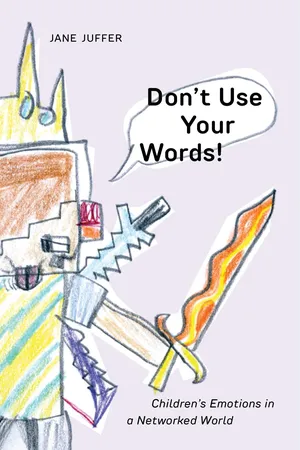
Today, even young kids talk to each other across social media by referencing memes,songs, and movements, constructing a common vernacular that resists parental, educational, and media imperatives to name their feelings and thus control their bodies. Over the past two decades, children's television programming has provided a therapeutic site for the processing of emotions such as anger, but in doing so has enforced normative structures of feeling that, Jane Juffer argues, weaken the intensity and range of children's affective experiences.
Don't Use Your Words! seeks to challenge those norms, highlighting the ways that kids express their feelings through cultural productions including drawings, fan art, memes, YouTube videos, dance moves, and conversations while gaming online. Focusing on kids between ages five and nine, Don't Use Your Words! situates these productions in specific contexts, including immigration policy referenced in drawings by Central American children just released from detention centers and electoral politics as contested in kids' artwork expressing their anger at Trump's victory. Taking issue with the mainstream tendency to speak on behalf of children, Juffer argues that kids have the agency to answer for themselves: what does it feel like to be a kid?
- English
- ePUB (mobile friendly)
- Available on iOS & Android
eBook - ePub
About this book
Information
Topic
Scienze socialiSubtopic
Psicologia dello sviluppo1
Affective Intensity and Children’s Embodiment
It is bedtime, and I tell him, “It makes me so happy to see you happy. It’s also OK to be sad, and then I feel sad, but that’s OK. Everybody gets sad.” And he says, “When you feel scared, I feel brave. And now I’m hungry, I’m just hungry.”
—Ezra, five years old
Brian Massumi, one of the most influential theorists of affect in the humanities, begins his “The Autonomy of Affect” (1995) with a reading of a study by German researchers on cognition and television. The impetus for the study was a short cartoon that aired on German television that prompted complaints from parents who said the story scared their children. Here is Massumi’s description of the cartoon: “A man builds a snowman on his roof garden. It starts to melt in the afternoon sun. He watches. After a time, he takes the snowman to the cool of the mountains, where it stops melting. He bids it good-bye, and leaves” (83).
In an attempt to understand why the story purportedly frightened the children, the research team gathered a group of nine-year-olds, attached wires to their bodies to measure their physiological responses, and added two versions to the original—one with a “factual” voiceover and one with an “emotional” voiceover that included “at crucial turning points words expressing the emotional tenor of the scene under way” (83). The children were asked to rate the versions on a scale ranging from pleasant to unpleasant as well as to rate individual scenes on a happy-sad scale. Here’s what the researchers found: “the factual version was consistently rated the least pleasant and also the worst remembered. The most pleasant was the original wordless version, which was rated just above the ‘emotional’ version. And it was the emotional version that was best remembered.” Interestingly, the “sad scenes were rated the most pleasant, the sadder the better” (84).
The findings of the study seem striking, on at least two counts. One, the facts that were used to presumably clarify what was happening and alleviate the children’s fears were not well received or remembered, suggesting that they had little effect. Two, perhaps the children were not initially afraid at all and their parents misinterpreted their reactions or were reluctant to understand that sadness can in fact be pleasant. Cumulatively, then, the study suggests to me the inadequacy of words such as “pleasant,” “unpleasant,” “happy,” and “sad” as well as the gap between adult forms of communicating (the need for facts) and children’s.
My interpretation can be supported by Massumi’s elaboration of affect, especially regarding the distinctions between emotions and affect. Massumi comments that the researchers seemed uncertain what to make of the results; “their only positive conclusion was the primacy of the affective in image reception.” Strangely, however, Massumi seems uninterested in the age of the subjects; only once does he refer to them as children, commenting that the children’s rating of the “sad” scenes as “pleasant” “suggests” that “in some kind of precocious anti-Freudian protest, the children were equating arousal with pleasure” (84). As he goes on with his argument about affect, there is no follow-up to this comment or to the question of how age might shape affective responses, nor to the question of why the parents assumed their children were scared by the original, wordless story when in fact the children rated it as the “most pleasant.” One wonders why he did not pursue these compelling questions, since he begins the article with a focus on children: what might this considerable gap between parents and children reveal about the embodiment of affect? How do bodies at different stages of physical and cognitive development respond differently from how adults might respond? As Ezra’s quote above indicates, how do children’s feelings manifest themselves in their bodies much as does a physical sensation such as hunger?
In this chapter, I use Massumi’s theory to set up my theoretical framework for the rest of the book, emphasizing the distinction between affect (with which I associate “feelings”) and emotions. This distinction proves useful for understanding how the discourse of emotional intelligence relies on teaching children to manage their emotions by suppressing their bodily feelings. Since Massumi’s essay was published in 1995, “affect studies” has developed as its own area and attracted a great deal of attention in the loosely defined field of cultural studies precisely because of this focus on intensity over cognition. However, I can find no essays that deal specifically with children, and only a few scattered references to kids. One might fathom (though disagree with) the bias against children in other academic areas, such as literature or philosophy, where the assumption is that children are not worthy of academic study because their language is too simplistic, their cultural productions not worthy of analysis, and their thoughts far from complex. They are “too emotional.” Yet it would seem that this very stereotype might draw scholars of affect to children, in order to both disprove the stereotype and further deconstruct the emotions/rationality binary as it governs all subjects. Sara Ahmed, for example, notes that “emotion has been viewed as ‘beneath’ the faculties of thought and reason. To be emotional is to have one’s judgement affected: it is to be reactive rather than active, dependent rather than autonomous. Feminist philosophers have shown us how the subordination of emotions also works to subordinate the feminine and the body” (2004, 3). And, we could add, the child and the body, for children, as much as if not more than women, have been defined as irrational creatures governed by their emotional “outbursts.” Yet Ahmed—one of the most prolific and frequently cited theorists to focus on affect and emotions—never attends to children as specific subjects.
This elision of children within affect studies is also linked to another tendency within cultural and media studies: the valorization of the text as a site from which to read meaning. In this chapter, I analyze this tendency within media studies of children, arguing that this textual focus prioritizes cognition over feelings. Texts tell stories, which, as I argued in the introduction, become the vehicle for socialization into the valorized realm of articulation and communication. Not just any language but a particular kind of linear language is linked to skills of critical reading and analysis—skills that are embedded not only in academia but also in parental and pedagogical spheres—really, any site of learning. I acknowledge my own limitations here—as an academic trained in the humanities with no expertise in biology or health, my own inclination is to turn to texts as a way of understanding the world. And while texts matter to kids as well, they do not likely matter in the same way, especially to younger kids. The question becomes, then, how to understand media texts as sites for kids’ affective expression. The last half of my book provides many examples of these expressions; here I provide the rationale and the theory for looking for them, for constructing an “archive of feeling.”
“Winding Boulevards”
Much work about affect and embodiment has not really been about the body—even though affect purports to ground itself in the body. This is Elspeth Probyn’s argument in Blush: Faces of Shame, published in 2005: “In more than a decade’s work that speaks of embodiment,” she asks, “what have we seen beyond the repetition of ‘the body,’ ‘corporeality,’ or ‘embodiment’?” (20). She adds that “we have tended to overly privilege the body’s cultural meanings and have not really tried to tell the psychosomatic body’s stories” (41). Drawing on the work of Silvan Tomkins to more fully capture the physiological, Probyn focuses on shame to illustrate that “affects are innate and compel us to see the human body as a baseline in all human activity” (28). Diverging from identity politics’ emphasis on difference, Probyn argues that “in some ways, we all share more than we don’t, although of course—and often with good cause—we tend to fixate on what separates us” (22). Focusing on what all humans share could, Probyn suggests, go some distance toward erasing the binary distinctions that are produced by yet also reproduce power differentials: man/women, gay/straight, black/white.
Precisely for these reasons, however, attention to the “innate” prompts suspicion about universalizing across time and space, says Probyn: “Essentialist or ethnocentric epithets hover in the air” (28); feminists in particular may fear a return to essentialist beliefs that have tied women to their bodies. These fears may explain why even some scholars of emotions distance themselves from the physiological, looking instead to the cultural and social structuring of emotions. For example, the editors of Emotions: A Cultural Studies Reader (2009) come down decidedly on the side of the social construction of emotions. In their introduction, Jennifer Harding and Deirdre Pribram acknowledge that “bodily states are vital to producing emotional states,” but emphasize that “the imperative to interpret and name bodily sensation as emotion must be learned and is bound up with socio-cultural meanings and social relationships” (8). They describe their approach as constructing “a culturalist formulation [that] does not focus on the biological individual” (12) but rather on “specific structures of feeling—that is, the emotions different categories of subjects are permitted to experience and express at any historical juncture, and how both individuals and collectives are brought into being through specific articulations of emotion” (13).
Similarly, Sara Ahmed rejects the idea that emotions are interior to the body; interiority, she argues, reverts to an individualized and psychological model of emotions—devoid of the social and cultural realms. The idea that emotions are exterior to the body, imposed on a subject from the outside, is equally reductive, says Ahmed: “Emotions are not simply something ‘I’ or ‘we’ have,” says Ahmed. “Rather, it is through emotions, or how we respond to objects and others, that surfaces or boundaries are made: the “I” and the “we” are shaped by, and even take the shape of, contact with others” (10). She tracks “how emotions circulate between bodies, examining how they ‘stick’ as well as move” (4). Ann Cvetkovich says her objects of analysis are texts, something she acknowledges could be seen as a limitation: “For a book on emotions, which argues that emotions cannot be separated from bodily sensations, this book may seem very orientated towards texts” (12). However, she argues that her “close readings of texts” illustrate how “‘figures of speech’ are crucial to the emotionality of texts … the emotionality of texts is one way of describing how texts are ‘moving,’ or how they generate effects” (13).
Yet this insistence on the structural, material, and textual over the bodily and the non-discursive ignores a significant realm of expression—that which cannot be analyzed through textual effects or structural positioning. The search for meaning in texts is a common practice in cultural studies, with its emphasis on various theories of “social construction.” Lawrence Grossberg addresses this tendency in his work on music and affect, where he argues that while the “identity and effects of any cultural practice” are important to analyze, they are not exhaustive: “And while I have never wanted to deny that cultural practices enable us to ‘make sense’ of the world and our experiences, I do want to contest the reduction of sense-making to cognitive meaning and interpretation, and the model of culture as somehow standing apart from another plane that it interprets. I have argued that cultural practices always operate on multiple planes, producing multiple effects that cannot be entirely analyzed in the terms of any theory of ideology, consciousness, or semiotic” (1997, 6). In other words, the positioning of “culture” as a practice apart from any other practice allows cultural critics to claim to understand the world through their readings of cultural texts. These readings invoke ideology, consciousness, and semiotics to interpret how the texts make meaning for their consumers, within particular conditions. By contrast, Grossberg asks, what is produced when we abandon the need to “make sense” of a text?
Affect offers a way to attend to bodily responses without devolving into essentialized claims about biology, an argument eloquently made by Anne Fausto-Sterling in her influential Sexing the Body (2000). For example, attending to the sexed body—hormones, chromosomes, genitalia, etc.—is crucial if we are in fact to understand and intervene in how women, and others, inhabit our bodies and live our desires, as well as to deconstruct binary differences between, for example, “male” and “female.” As Fausto-Sterling demonstrates, it is completely arbitrary for bodies to be divided into two sexes—five would more adequately capture the complexity of the human body. To deconstruct male/female, thus, requires at least some knowledge of how things like hormones work, even as one also acknowledges that seemingly scientific observations do not exist separately from “political, social, and moral struggles about our cultures and economies” (5). These struggles in turn become “quite literally embodied, incorporated into our very physiological being” (5). The nature versus nurture binary diverts us from understanding that the two are inseparable, says Fausto-Sterling, citing Elizabeth Grosz’s analogy of the Möbius strip, in which “the body and the mind come into being together” (24).
Similarly, I argue, it is imperative to attend to children’s biological differences from adults and from each other, at different ages and in different locations, even as we pursue the manner in which these biological differences are entangled with “political, social, and moral struggles.” Societal ideas (which of course differ across “societies”) about “childhood” shape childhood itself, taking on material form in children’s everyday lives; kids’ brains and bodies take shape in response to pedagogical imperatives such as “emotional intelligence.” Yet because “growing up” is believed to occur through a “normal” series of developmental stages, this entanglement of the biological and the social is not perceived as a problematic process but rather as the best way for children to mature. Thus, it is considered only healthy and proper for children to learn how to name their emotions. Little consideration is given to the possibility that such naming shapes the brain in a manner that shuts down nonnormative ways of seeing and experiencing the world.
How, then, do we attend to differences in body and brain development without invoking essential, universal truths about “children” or imposing a developmental model? Clearly, children are physically different from adults; also, three-year-olds are very different from 15-year-olds, who are different from 25-year-olds. As Alison Gopnik, a cognitive psychologist and philosopher, writes in The Philosophical Baby (2009), “Children aren’t just defective adults, primitive grown-ups gradually attaining our perfection and complexity. They have very different, though equally complex and powerful, minds, brains and forms of consciousness, designed to serve different evolutionary functions” (9). Here is how she describes a young child’s brain (her research focuses on children five and under, whom she calls, in a kind of shorthand, “babies”):
Babies’ brains seem to have special qualities that make them especially well suited for imagination and learning. Babies’ brains are actually more highly connected than adult brains; more neural pathways are available to babies than adults. As we grow older and experience more, our brains “prune out” the weaker, less used pathways and strengthen the ones that are used more often. If you looked at a map of the baby’s brain, it would look like old Paris, with lots of winding, interconnected little streets. In the adult brain, those little streets have been replaced by fewer but more efficient neural boulevards, capable of much more traffic. Young brains are also much more plastic and flexible—they change much more easily. But they are much less efficient; they don’t work as quickly or as effectively. (11–12)
As Gopnik further explains, the prefrontal cortex, “a part of the brain that is uniquely well developed in human beings, and that neuroscientists often argue is the seat of distinctively human abilities,” is far less developed in a child. This is the site of “thinking, planning, and control,” of rationality, so to speak; it may not be completely formed until one’s midtwenties (12). It is “especially involved in inhibition—“it actually helps shut down other parts of the brain, limiting and focusing experience, action, and thought” (13). It helps us make decisions and act efficiently; however, its downside, says Gopnik, is that it can squelch imagination and learning—to the extent that these require one to be open to multiple possibilities. Some studies show, says Gopnik, that the longer a child is allowed to maintain these complex and twisting “neural boulevards,” the more creative and intelligent they will be as adults.
Because the brain is malleable (though less so as we age), it is possible to reopen passages that have been shut down. Thus, it is possible that an adult brain could reopen those “winding boulevards,” recovering some of the divergent ways of seeing the world that may have been operative before. This insight returns us to the neurodiversity movement I discussed in the introduction—a movement that is gaining credence in both the humanities and in the sciences. In a 2004 article, The New York Times identified a “new kind of disabilities movement” in which “many of those who deviate from the shrinking subset of neurologically ‘normal’ want tolerance, not just of their diagnoses, but of their behavioral quirks. They say brain differences, like body differences, should be embraced, and argue for an acceptance of ‘neurodiversity.’” The movement has gained medical support from such leading neurologists as Dr. Antonio Damasio, who told the Times, “What all of our efforts in neuroscience are demonstrating is that you have many peculiar ways of arranging a human brain and there are all sorts of varieties of creative, successful human beings. For a while it is going to be a rather relentless process as there are more and more discoveries of people that have something that could be called a defect and yet have immense talents in one way or another” (quoted in Harmon 2004).
One of the “defects” that Damasio and others are addressing is the commonly diagnosed childhood disorder known as attention deficit hyperactivity disorder, or ADHD. The number of ADHD diagnoses has skyrocketed 41 percent in the last decade, to the point that “one in nine children between the ages of 4 and 17 have now at some point in their lives received a diagnosis of ADHD” (Hinshaw and Ellison 2016, xv). Some critics say there is no real medical issue here but rather the construction of a condition by a network of controlling adults—parents, teachers, and others—who are impatient with rambunctious child...
Table of contents
- Cover
- Title Page
- Copyright
- Contents
- Introduction: “Run Over by a Unicorn”
- 1. Affective Intensity and Children’s Embodiment
- Part I. Political Subjects
- Part II. Kids’ Television, from Problem Solving to Sideways Growth
- Part III. The Limits of Digital Literacy
- Conclusion: “Shame on You Killers, Shame on You”
- Color Photos
- Acknowledgments
- Notes
- Bibliography
- Index
- About the Author
Trusted by 375,005 students
Access to over 1.5 million titles for a fair monthly price.
Study more efficiently using our study tools.
Frequently asked questions
Yes, you can cancel anytime from the Subscription tab in your account settings on the Perlego website. Your subscription will stay active until the end of your current billing period. Learn how to cancel your subscription
No, books cannot be downloaded as external files, such as PDFs, for use outside of Perlego. However, you can download books within the Perlego app for offline reading on mobile or tablet. Learn how to download books offline
We are an online textbook subscription service, where you can get access to an entire online library for less than the price of a single book per month. With over 1.5 million books across 990+ topics, we’ve got you covered! Learn about our mission
Look out for the read-aloud symbol on your next book to see if you can listen to it. The read-aloud tool reads text aloud for you, highlighting the text as it is being read. You can pause it, speed it up and slow it down. Learn more about Read Aloud
Yes! You can use the Perlego app on both iOS and Android devices to read anytime, anywhere — even offline. Perfect for commutes or when you’re on the go.
Please note we cannot support devices running on iOS 13 and Android 7 or earlier. Learn more about using the app
Please note we cannot support devices running on iOS 13 and Android 7 or earlier. Learn more about using the app
Yes, you can access Don't Use Your Words! by Jane Juffer in PDF and/or ePUB format, as well as other popular books in Scienze sociali & Psicologia dello sviluppo. We have over 1.5 million books available in our catalogue for you to explore.