One of the twentieth century's foremost Marxian economists discusses the dialectical method, the contradictions of capitalism, and the future of Marxism.
- English
- ePUB (mobile friendly)
- Available on iOS & Android
eBook - ePub
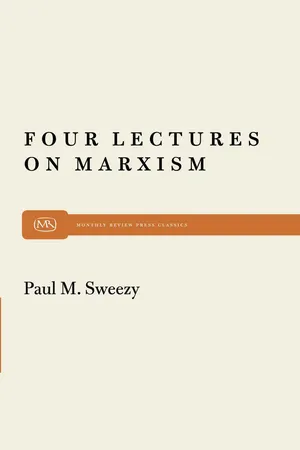
Four Lectures on Marxism
About this book
Information
[ 1 ]
DIALECTICS AND METAPHYSICS
The announced subject of these lectures is “Marxism Today,” and I want at the outset to explain what it means to me as well as what it does not mean.
I am not going to attempt a survey, still less a critique, of the various schools and tendencies that consider themselves to be intellectual and/or political descendants of the founding fathers of Marxism, Karl Marx himself and Friedrich Engels. (I ought perhaps to add that in my view the differences between Marx and Engels were mostly matters of emphasis and formulation and as such are irrelevant to a discussion of Marxism of the kind I am proposing: to the limited extent that I feel the need for textual quotation, I shall draw on the writings of either one depending on which seems more appropriate to the point at issue.)
What I want to accomplish can perhaps be best clarified if I begin with a few autobiographical observations. I came to economics in particular and social science in general as a college student in the late 1920s. Harvard in those days had one of the more distinguished North American economics departments. It included, reading from left to right, institutionalists like William Z. Ripley, Marshallians like Frank W. Taussig, and dyed-in-the-wool conservatives like Thomas Nixon Carver and Charles J. Bullock. There were of course no Marxists on the Harvard faculty, and if there were any in the student body they were unknown to me. I do not recall Marx’s name, let alone his ideas, ever being mentioned in any of the courses I took as an undergraduate. When I left Cambridge in 1932 for a year of graduate study at the London School of Economics, I had never been exposed to anything more radical than Thorstein Veblen’s Theory of the Leisure Class, his most famous but far from his most radical book.
The year 1932–1933 proved to be a turning point in the history of the twentieth century. The prelude to World War II, if not the first act itself, was under way in the Japanese invasion of what was then called Manchuria. The Great Depression hit bottom in Western Europe and North America, giving rise to two simultaneous experiments in capitalist reform: the liberal New Deal in the United States, and the fascist, war-oriented Hitler dictatorship in Germany. The First Soviet Five-Year Plan, launched a few years earlier, suddenly began to appear to a crisis-ridden world as a beacon of hope, a possible way out for humanity afflicted with the peculiarly modern plague of poverty in the midst of plenty.
Nothing I had learned in the course of what was presumably the best education available in the United States had prepared me to expect, and still less to understand, any of these momentous developments. My state of mind as I arrived in London in the fall of 1932 was one of bewilderment and confusion edged with resentment at the irrelevance of what I had spent the last four years trying to learn. Whether I knew it or not I was a perfect candidate for conversion to new ways of thinking. And fortunately for me the situation at the London School was very favorable. The brand of economics in vogue, a sort of Austrian-Swedish mixture, was distinctive but basically a variant of the bourgeois orthodoxy I had grown up with. But there was Harold Laski in political science, a brilliant teacher who had been fired from Harvard for his role in the Boston police strike of 1919, entering the most radical phase of a colorful career and exposing a wide circle of students to a sympathetic interpretation of Marxian ideas. And above all there were the graduate students in all the social sciences, a variegated group from all over the world (the British Empire was still intact), who, unlike any students I had known in the United States, were in a continuous state of intellectual and political ferment. It was in this stimulating atmosphere, and mostly through fellow students, that I first came into contact with Marxism and what were then its major representatives in the West: left social democrats, orthodox Communists, and Trotskyists. At that stage the differences among them interested me very little; what was of enormous importance was that I soon began to see the world through different eyes. What up to then had seemed a senseless chaos of inexplicable disasters now appeared as the logical, indeed the inevitable, consequence of the normal functioning of capitalism and imperialism. And I had as little difficulty as most of my new friends in accepting the thesis that the way out of the crisis was through revolution and socialism, a course that the Russian Bolsheviks were pioneering and in which they needed all the support like-minded people in the rest of the world could give them.
I returned to the United States after my year at the London School a convinced but very ignorant Marxist. By the fall of 1933, things were already different at home from the way they had been only a year earlier. The shocking growth of unemployment to a quarter of the labor force, the collapse of the banking system, and the beginnings of New Deal reforms—not to mention developments abroad—had unleashed powerful social movements that had their reflection in intellectual and academic circles. Graduate students and younger faculty members at some of the larger universities like Harvard began to take an active interest in Marxism: discussion groups proliferated, and even a few, formal course offerings made their appearance.
It was under these circumstances that I acquired a mission in life, not all at once and self-consciously but gradually and through a practice that had a logic of its own. That mission was to do what I could to make Marxism an integral and respected part of the intellectual life of the country, or, put in other terms, to take part in establishing a serious and authentic North American brand of Marxism. (I say North American not because it is an altogether accurate characterization but because it corresponds to the practice of our friends and colleagues in Latin America who quite rightly object to the implied arrogance of any nation in the Western Hemisphere describing itself as American without qualification.)
Adopting this course involved learning and teaching, writing, and finally editing and publishing. For the remainder of the 1930s and up to 1942 I had the advantages of working in an academic environment, but that became very difficult after World War II. The upsurge of U.S. imperialism on a global scale was matched by a powerful wave of reaction internally, and for nearly two decades U.S. colleges and universities were virtually closed to Marxists and Marxism. In economics the only significant exception was the late Paul Baran, who had been granted tenure at Stanford before the witch-hunting mania known as McCarthy ism swept the country, turning its institutions of higher learning into accomplices in the suppression of radical thought. It was not until the birth of powerful new movements of protest in the 1960s—the civil rights movement and the anti-Vietnam war movement—that a renaissance of radical thought became possible and the colleges and universities could muster up the courage to support, at least here and there and in small ways, the ideals of academic freedom and unfettered discussion, which they had inherited from the founding fathers of the Republic and to which they had never ceased to pay lip service.
During this difficult period, Marxism, to the extent that it was tolerated at all, obviously had to live on the margins of U.S. society with no institutional base and no financial support from even the most liberal of private foundations. Recognizing this, the late Leo Huberman and I founded Monthly Review (subtitled “An Independent Socialist Magazine”) with a few thousand dollars contributed by personal friends and an initial circulation of 400 subscribers. The first issue appeared in May 1949, which means that Monthly Review is now (1981) in its thirty-third year of publication. Two years later we began publishing books under the imprint of Monthly Review Press, at first simply as a means of assuring publication for books written by well-known authors like I. F. Stone and Harvey O’Connor who, in the repressive political atmosphere of the time, were being effectively boycotted by established publishing houses. Later on we expanded MR Press beyond this original function to become what I think is now generally recognized to be the leading publisher of Marxist and radical books in the English language. The magazine also expanded not only in terms of the number of subscribers but also through the establishment of several foreign-language editions: at the present time it is published in Italian in Rome, in Spanish in Barcelona, and in Greek in Athens.
In speaking of Monthly Review I have used the word “we.” Originally that referred to Leo Huberman and myself, but in the course of time a number of other distinguished Marxist writers became closely associated with the enterprise. One was Paul Baran, whose book The Political Economy of Growth, published by MR Press in 1957, played a key role in advancing and deepening Marxist ideas on development and underdevelopment and their mutual interaction. Another was Harry Braverman, who became director of MR Press in 1967 and whose book Labor and Monopoly Capital, published by MR Press in 1974, has performed a similar role with respect to Marxist ideas on the labor process and the composition of the working class in advanced capitalist societies. And a third was Harry Magdoff, who became co-editor of Monthly Review after Leo Huberman’s death in 1968 and whose book The Age of Imperialism, published by MR Press in 1969, is widely considered to be the standard Marxist work on U.S. imperialism in the post-World War II period.
One occasionally encounters references to a Monthly Review school of Marxism. If this is interpreted to mean, as I think the term “school” often is, a body of ideas inspired and guided by one or two dominant personalities, it is definitely misleading. Each member of the group that has been closely associated with MR came to Marxism by a different route and under a different combination of influences. The topics they chose to work on and the emphases they developed grew out of their own experiences and interests. If, on the other hand, “school” is taken to mean no more than that the members of the group have cooperated harmoniously, have criticized and influenced each other’s ideas, and have produced a flow of work that is generally internally consistent and has helped to shape a tendency within the overall framework of Marxism that has appealed to and in turn been further developed by younger radical intellectuals and political activists not only in North America but also in other regions, both developed and underdeveloped, of the capitalist world—if this is what is meant by “school” then I have no objection and indeed can only hope that the implied characterization of MR’s role and performance is deserved. But there is a corollary that I would ask you to bear in mind. The fact that an MR school exists only in the rather special sense I have indicated means that it has no authoritative representatives or spokes-people. Certainly the contents of these lectures have been greatly, and in some respects decisively, shaped by my having been privileged to work with my colleagues at MR, but I do not presume to speak for them any more than any of them would ever have presumed to speak for me.
The period about which I have been speaking, the nearly half century from the early 1930s to the end of the 1970s, was of course one of the most eventful in human history. It was a period of tremendous upheavals and profound changes on a world scale. And ways of interpreting the world as well as efforts to guide change in desirable directions have been caught up in the swift flow of events. Marxism—considered, as it should be, as an enterprise in both interpretation and guidance of change—has been particularly strongly affected. On the one hand, it has expanded enormously in terms of both its political influence and the numbers of its adherents, while on the other hand, its internal divisions and conflicts have multiplied and proliferated. In what follows I do not want to try to describe this process or analyze the stage at which it has now arrived—formidable and in any case probably not very rewarding tasks—but rather to bring together and present as intelligibly as I can the gist of my own thoughts on certain aspects of the present state of Marxism and some of the themes which occupy a central place in the Marxist universe of discourse.
First of all, I need a frame of reference not only as a point of departure but as a set of guidelines to be used in interpreting and criticizing a variety of ideas, theories, and formulations. For me this starting point can only be what Marx and Engels called the dialectical mode of thought, as contrasted to the metaphysical mode of thought which, paradoxical though it may seem, had been brought to its highest level of development by the methods and successes of modern science. But before we get to that, a few words must be said about what I understand to be the Marxist meaning of materialism.
For Marx and Engels materialism, as even a cursory reading of the first hundred pages of their joint work The German Ideology should make clear, is simply the obverse and alternative to idealism. It holds that ideas do not have an independent or primary existence; that they emanate from humanity and society; and that humanity and society are integral parts of a nature that existed before there was (terrestrial) life, including human life, and will continue to exist after it has become extinct. Dualities such as matter vs. spirit or mind vs. body are thus pseudo-problems; the infinite variety of nature is a manifestation of different modes and levels of organization of the ultimate building blocks of the universe (if indeed there are any such ultimate building blocks, a question about which the best scientists nowadays seem to be very unclear but the answer to which, if one were to be forthcoming, would in no way affect the validity or relevance of the Marxist conception of materialism). There is thus no unbridgeable divide between nature and society, nor, as a consequence, between natural and social sciences. Every science has as its object to understand/explain some aspect of reality; but since all aspects of reality have special problems and characteristics, it follows that each science has at least in some measure to devise its own methods and procedures, and that the ease and extent to which reliable knowledge can be attained vary widely from one to another. This, however, is no reason for reserving the term “science” for the more successful ones and denying it to those with less tractable subject matters.
With so much by way of introduction we can go on to consider the dialectical mode of thought. And here I want to introduce two quotations, one lengthy and one brief, from Engels’ Anti-Dühring, in my opinion a masterpiece of exposition and clarification that has too often been neglected or put down precisely because it was addressed to a popular audience rather than to an elite of self-anointed experts. The first quotation occurs in the first chapter of Part I, entitled “General”:
When we reflect on nature, or the history of mankind, or our own intellectual activity, the first picture presented to us is of an endless maze of relations and interactions, in which nothing remains what, where, and as it was, but everything moves, changes, comes into being and passes out of existence. This primitive, naive, yet intrinsically correct conception of the world was that of ancient Greek philosophy, and was first clearly formulated by Heraclitus: everything is and also is not, for everything is in flux, is constantly changing, constantly coming into being and passing away. But this conception, correctly as it covers the general character of the picture of phenomena as a whole, is yet inadequate to explain the details of which this total picture is composed; and so long as we do not understand these, we also have no clear idea of the picture as a whole. In order to understand these details, we must detach them from their natural or historical connections and examine each one separately as to its nature, its special causes and effects, etc. This is primarily the task of natural science and historical research—branches of science which the Greeks of the classical period, on very good grounds, relegated to a merely subordinate position, because they had first of all to collect materials for these sciences to work upon. The beginnings of the exact investigation of nature were first developed by the Greeks of the Alexandrian period, and later on in the Middle Ages were further developed by the Arabs. Real natural science, however, dates only from the second half of the fifteenth century, and from then on it has advanced with constantly increasing rapidity.
The analysis of nature into its individual parts, the grouping of the different natural processes and natural objects in definite classes, the study of the internal anatomy of organic bodies in their manifold forms—these were the fundamental conditions of the gigantic strides in our knowledge of nature which have been made during the last four hundred years. But this method of investigation has also left us as a legacy the habit of observing natural objects and natural processes in their isolation, detached from the whole vast interconnection of things; and therefore not in their motion, but in their repose; not in their life, but in their death. And when, as with the case of Bacon and Locke, this way of looking at things was transferred from natural science to philosophy, it produced the specific narrow-mindedness of the last centuries, the metaphysical mode of thought.
To the metaphysician, things and their mental images, ideas, are isolated, to be considered one after the other apart from each other, rigid, fixed objects of investigation given once for all. He thinks in absolutely discontinuous antitheses.… For him a thing either exists, or it does not exist; it is equally impossible for a thing to be itself and at the same time something else. Positive and negative absolutely exclude one another; cause and effect stand in equally rigid antithesis one to the other. At first sight this mode of thought seems to us extremely plausible because it is the mode of thought of common sense. But sound common sense, respectable fellow as he is within the homely precincts of his own four walls, has most wonderful adventures as soon as he ventures out into the wide world of scientific research. Here the metaphysical mode of outlook, justifiable and even necessary as it is in domains whose extent varies according to the nature of the object under investigation, nevertheless sooner or later always reaches a limit beyond which it becomes one-sided, limited, abstract, and loses its way in insoluble contradictions. And this is so because in considering individual things it loses sight of their connections; in contemplating their existence it forgets their coming into being and passing away; in looking at them at rest it leaves their motion out of account; because it cannot see the woods for the trees. (New York: International Publishers, n.d., pp. 27–28)
The second quotation from Anti-Dühring comes from the Preface to the 1885 edition (seven years after the work was first published in book form):
It is … the polar antagonisms put forward as irreconcilable and insoluble, the forcibly fixed lines of demarcation and distinctions between classes, which have given modern theoretical natural science its restricted and metaphysical character. The recognition that these antagonisms and distinctions are in fact to be found in nature, but only with relative validity, and that on the other hand their imagined rigidity and absoluteness have been introduced into nature only by our minds—this recognition is the kernel of the dialectical conception of nature. (Ibid., p. 19)
I have included these passages from Engels rather than simply recommending that you read and study them for two reasons: first, because I believe that they constitute the clearest and at the same time perhaps the most neglected statement by either Marx or Engels of their basic way of thinking and apprehending the world; and second, because I am distressed by the extent to which the metaphysical mode of thought, the nature and limitations of which Engels so clearly exposes, has invaded present...
Table of contents
- Cover
- Title Page
- Dedication
- Contents
- Preface
- Lecture 1: Dialectics and Metaphysics
- Lecture 2: The Contradictions of Capitalism
- Lecture 3: Center, Periphery, and the Crisis of the System
- Lecture 4: Marxism and the Future
Trusted by 375,005 students
Access to over 1.5 million titles for a fair monthly price.
Study more efficiently using our study tools.
Frequently asked questions
Yes, you can cancel anytime from the Subscription tab in your account settings on the Perlego website. Your subscription will stay active until the end of your current billing period. Learn how to cancel your subscription
No, books cannot be downloaded as external files, such as PDFs, for use outside of Perlego. However, you can download books within the Perlego app for offline reading on mobile or tablet. Learn how to download books offline
Perlego offers two plans: Essential and Complete
- Essential is ideal for learners and professionals who enjoy exploring a wide range of subjects. Access the Essential Library with 800,000+ trusted titles and best-sellers across business, personal growth, and the humanities. Includes unlimited reading time and Standard Read Aloud voice.
- Complete: Perfect for advanced learners and researchers needing full, unrestricted access. Unlock 1.5M+ books across hundreds of subjects, including academic and specialized titles. The Complete Plan also includes advanced features like Premium Read Aloud and Research Assistant.
We are an online textbook subscription service, where you can get access to an entire online library for less than the price of a single book per month. With over 1.5 million books across 990+ topics, we’ve got you covered! Learn about our mission
Look out for the read-aloud symbol on your next book to see if you can listen to it. The read-aloud tool reads text aloud for you, highlighting the text as it is being read. You can pause it, speed it up and slow it down. Learn more about Read Aloud
Yes! You can use the Perlego app on both iOS and Android devices to read anytime, anywhere — even offline. Perfect for commutes or when you’re on the go.
Please note we cannot support devices running on iOS 13 and Android 7 or earlier. Learn more about using the app
Please note we cannot support devices running on iOS 13 and Android 7 or earlier. Learn more about using the app
Yes, you can access Four Lectures on Marxism by Paul M. Sweezy in PDF and/or ePUB format, as well as other popular books in Politics & International Relations & Political Philosophy. We have over 1.5 million books available in our catalogue for you to explore.