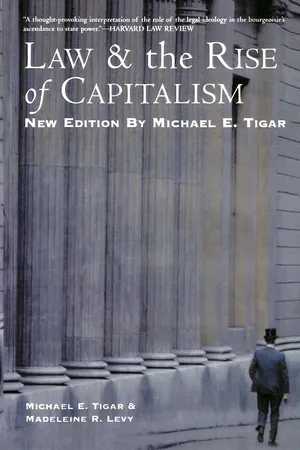
Against a backdrop of seven hundred years of bourgeois struggle, eminent lawyer and educator, Michael E. Tigar, develops a Marxist theory of law and jurisprudence based upon the Western experience. This well-researched and documented study traces the role of law and lawyers in the European bourgeoisies's conquest of power and in the process complements the analyses of such major figures as R.H. tawney and Max Weber. Using a wide frange of primary sources, Tigar demonstrates that the legal theory of insurgent bourgeoisie predated the Protestant Reformation and was a major ideological ingredient of the bourgeois revolution.
- English
- ePUB (mobile friendly)
- Available on iOS & Android
eBook - ePub
Law and the Rise of Capitalism
About this book
Information
PART ONE
LAW AND THE CAPITALIST RISE TO POWER AN OVERVIEW
1.
THE MERCHANT AS REBEL
In 1184 A.D., in the French town of Châteauneuf, revolutionaries took control of the principal buildings, announcing that they protested taxes, exactions, and the curtailment of their freedom to work and trade. Called upon to renounce the “commune or conjuration … they have erected,” they refused. A year passed before order was fully restored, and even so, rumors of plots, conspiracies, and secret societies persisted. The revolutionaries were, in the words of the Pope, “the said bourgeois,” or in the words of the archbishop, potentiores burgenses—powerful bourgeois.
This story was a familiar one in eleventh- and twelfth-century Europe, sometimes with the additional complaint that the rebels had broken into the house of their lord, or bishop, drunk up the wine, molested household members, and led off the sheep and cows. Little wonder that Philippe de Beaumanoir, a learned and even gentle legal historian of the thirteenth century, referring to such uprisings, wrote that “among the greatest crimes, which must be punished and avenged, is that of associating against the common good.”
This image of the medieval bourgeois as revolutionary may be surprising to us today. For the modern reader in the West, the respectability of the merchant class is self-evident. The word has become commonplace, and we use it automatically, without considering the system of laws which over the centuries has put these people in the center of economic activity.
But when he first appeared in Western Europe in about the year 1000 A.D., the merchant had a somewhat different image. Pies poudreux, “dusty feet,” he was called, for he took his goods from town to town, from fair to fair, from market to market, on foot or horseback, selling as he went. In the great halls of the feudal lords, the merchant was an object of derision, scorn, and even hatred. Lyric songs celebrated knightly robbery of merchant bands, as well as knightly valor in battle and knightly cuckoldry. Profit, the difference between the price at which the merchant bought and the price at which he sold, was considered dishonorable in a society that praised the noble virtues of killing and revered those who lived “by the weariness and toil”—in the words of a contemporary charter—of peasants. Profit-taking was considered a form of usury, and the merchant’s soul was thought to be in jeopardy. The hatred came later, when a nobility in need of cash to finance its wars and style of life discovered that the merchants had more of it than they did.
For the most part, however, the growth of merchant fortunes and merchant power was accomplished through armed conflict, and by what appeared to the established classes as nothing short of revolution, punishable—as Beaumanoir suggested—by long prison sentences and even death. In order to protect themselves and their goods from the arbitrary ravages of the nobility, the merchants felt compelled to establish conditions which permitted trade. One man, or several men, well-armed and skilled in the use of weapons, could cross Europe trading small items—like spices and silks—that were both valuable and easy to carry for cash on the spot. That would be sale. But for orderly and consistent trade, there had to be a system which guaranteed physical security and made possible credit, insurance, and the transmission of funds. Manufacture, as opposed to trading in imported goods, required an even more socially protected system of commerce, as well as a higher level of technology.
The relationship between the rising bourgeoisie and the law has three aspects. First, to the extent that one can speak of law in the jungle of feudal life, it was either silent about trade or hostile to it. The merchant was therefore in these terms a social outcast, who saw the legal system—the system which issued orders backed up by institutional force—as hostile and alien. The ordinary merchant, trader, or peddler sought to come to terms with this system so he could profit. As the number of merchants, and their power, increased, the legal ideologists of this class sought to justify the place of trade in the symmetry of the feudal system. They also sought accommodation with, and weak spots in, feudal law.
Second, as the merchant extended his field of activity to create institutions of commerce—cities, ports and harbors, stores, banks, manufactories, and so on—he came increasingly into head-on collision with the economic and political interests of the feudal masters of this or that section of territory. The merchant class chafed continually against laws and customs maintained to protect the feudal power holders. From the rules prohibiting or limiting the sale of land outside the family—which effectively prevented land from being an article of commerce—to the prohibition of most forms of bourgeois association, both political and economic, the conflict intensified and broadened until the bourgeois gradually discovered the points at which the legal system could no longer be bent to his will, accommodated at an affordable price, or evaded.
Finally, there are the laws that the merchants made for themselves, the legal system they fashioned to serve their own interests. First they set up tribunals to settle disputes among themselves, then wrested or cajoled concessions from spiritual and temporal princes in order to establish zones of free commerce, and finally—over a period of centuries—swept to power over nations. The process of bourgeois lawmaking saw the creation and application of specific legal rules about contracts, property, and procedure; these rules of law were fashioned in the context of a legal ideology which identified freedom of action for businessmen with natural law and natural reason. The men and women who fought for legal rules consistent with freer commerce did not claim to have invented the principles they sought to have applied. Respect for tradition forbade such a claim, and Beaumanoir, writing in the service of Philip III, warned that novelties not authorized by the sovereign are forbidden. Rather, the bourgeois sought old legal forms and principles, chiefly Roman, and invested them with a new commercial content.
These elements of the bourgeois relation to law do not correspond to sharply defined historical periods; they are present in each country of Western Europe from the eleventh century right up to the conquest of power by the bourgeoisie in the seventeenth to nineteenth centuries. The fall of the feudal system was a gradual process punctuated by sudden and violent upheavals. To borrow Diderot’s metaphor:
The rule of Nature and of my Trinity, against which the gates of Hell shall not prevail … establishes itself very quietly. The strange god settles himself humbly on the altar beside the god of the country. Little by little he establishes himself firmly. Then one fine morning he gives his neighbor a shove with his elbow and—crash!—the idol lies upon the ground.
One thing should be noted here. In this study, as the alert reader may already have noticed, “law” has no single meaning. As used by the protagonists in the struggle we describe, it means at different times (a) the rules made by the powerful to govern their subjects, backed up by organized violence; (b) the rules that some group or class thinks ought to be made in a godly, or at least a better, society; (c) the customs and habits of a people, which have been observed immemorially; (d) the manifesto of a revolutionary group; (e) the rules that some group makes for its own internal governance. But in daily speech, too, law means all these things, and we can only hope to make our meaning clear by context. In the final part we will attempt a fuller discussion of the meaning of law in a time when power relationships are undergoing revolutionary change.
2.
THE BACKDROP OF THE NEW LEGAL INSTITUTIONS
The eighteenth-century systems of law designed by and for the bourgeoisie take elements from, and look for authority to, six different bodies of legal thought:
1. ROMAN LAW, revived in various forms and carrying the authority of a civilization whose imperial military expansion left traces throughout the Western world. Roman legal thought had developed forms of legal relationships designed to accommodate and to further commerce with all parts of the Empire.
2. FEUDAL, OR SEIGNEURIAL, LAW: those rules defining the relationships of homage, dominance, exploitation, and protection which characterized the personal feudal tie between a lord and his vassals.
3. CANON LAW: the legal rules of the Western Roman Catholic Church, which claimed varying but always considerable amounts of control over the very secular business of trade.
4. ROYAL LAW: rules that manifest the consolidating influence of those who forced the creation of the first modern states, and of whom the bourgeoisie were early, if fickle, allies.
5. LAW, MERCHANT: rules derived from Roman law but adapted over the centuries to the needs of those whose business was business. The idea of a special set of rules for those with a certain status was less unsettling to the feudal age than to our own, and the merchants fought for a law developed by and specially applicable to them in the cities and towns and in the annual or seasonal fairs held in various places during the Middle Ages.
6. NATURAL LAW: the bourgeois claim, developed fully in the seventeenth century though portended earlier, that the combination of rules which best served free commerce was eternally true, in accord with God’s plan, and self-evidently wise.
These six categories of law reflect real patterns of power. Feudal power relationships were fragmented and patchwork, with several temporal and spiritual overlords jostling and fighting for the right to exploit each piece of arable or livable land—and the people on it. The contest was particularly keen over who had the right to judge, and to establish courts, for the fines and fees of judging were among the most lucrative sources of cash. So when a merchant of the medieval period made a contract, he would have in mind several kinds of law, and he would be anxious to know which court had enough power to make the opposite party pay up or deliver the goods.
In 1448, one Huguet Augier, a haberdasher from Grasse (in what is now southern France) who was anxious to purchase a quantity of goods from a businessman in Nice, agreed in the event of a lawsuit over the contract to submit to the jurisdiction of: the Chamber of Accounts of Aix (a royal court); the royal court of the Châtelet of Paris; a municipal court in Grasse; a merchant court in Marseille; the court of the Pope and the Apostolic Chamber; and the court of the ducal city of Nice. In each of these courts, the transaction might be judged by a different law, and the lawyer who drafted Augier’s contract would have to ensure that the deal was legal, that is to say protected, under each of them.
Just as the merchant Huguet Augier could not set out to engage in important trade without some understanding of these bodies of legal precedent, so we will begin with a brief discussion of them.
ROMAN LAW
By 1000 A.D. the Western Roman Empire had been gone six hundred years, but people in Western Europe still walked on roads that dated from Augustus Caesar’s time—the first century A.D. The ruins of Roman cities, Roman harbors, and Roman churches dotted the landscape. The well-educated merchant—and his lawyer—was taught that in the wake of the Roman conquest had come Roman laws and Roman commerce, including the freedom to buy and sell by means of enforceable contracts. Even those lords who claimed to apply ancient local custom in ruling their subjects were, sometimes unknowingly, handing on principles partly drawn from Roman Jurists. For the Church, and for those temporal lords who also aspired to universal overlordship, the Roman Empire provided a conscious organizational model. In order to understand the medieval merchant, we must look closely at some of these Roman institutions.
We do not claim that Roman society was the first to be regulated by law, in the sense of a system of rules backed by the power of the state. Medieval lawyers were aware that this was not so, and had access to written accounts of earlier societies, including the Athenian. But Rome, unlike earlier societies, had left a rich and diverse legal literature. Roman commerce had given rise to laws which medieval merchants and their lawyers found relevant. And Roman law came, as we shall see, to be endowed with the temporal and spiritual support of the Papacy.
The Roman legal system was created between the fifth century B.C. and the second century A.D. To shroud the law’s origins in mystery and to invest it with the sanction of tradition, Roman jurisprudents purported to derive every important legal principle from the Twelve Tables. This concise collection of laws, difficult to reconstruct but of undoubted authenticity, was drawn up around 450 B.C. under the Roman Republic, apocryphally from self-evident principles but actually after study of the constitutions of a number of Greek cities. The Tables outline only the simplest of legal principles concerning property, family law, and citizenship, and they are characterized by reliance upon magic and ritual as integral parts of legal procedure and as means for the creation of obligations. This “preclassical” law guaranteed certain rights to Romans—more particularly, to the members of the clans that had founded the Roman Republic.
In the Twelve Tables we first see the emergence of legal ideas of debt, contract, and civil wrong. These ideas turn up later in countless medieval charters and custumals (written collections of customs). Early Romans, like some others in societies organized on a clan basis, dealt with murder or injury of a kinsperson by revenge upon the murderer’s kinfolk. An early step away from this violent solution for the Romans was the “composition,” a payment in money or goods to the victim’s kin, accompanied by a solemn ceremony acknowledging the obligation to pay. It seems probable that the earliest Roman compositions took the form described in the Twelve Tables as nexum. Nexum was the bond created between a debtor and creditor by the former’s promise to subject himself to the latter until the debt was paid. By the time of the Twelve Tables, the device was used to create a lien between any creditor and any debtor, no matter how the debt arose.
Bonds persisted in all their original vigor long past the time when the debtors—nexi—had forgotten the origins of the law that bound them to their creditors. The distinctly Roman customs of southern France yielded contracts such as one of 1362 in which Jaciel of Grasse, a moneylender, required that his debtor, in the event of nonpayment, come from Nice (thirty-five miles away) and live in Grasse to work under Jaciel’s direction until the debt was paid. Municipal records show that Jaciel actually enforced this hostagium clause and obtained a court order requiring his debtor to lodge in the Grasse prison.
The valid sale or exchange of property required, according to the Twelve Tables, strict adherence to a precise formula of words and conduct, known as mancipatio:
In the presence of not less than five Roman citizens of full age, and also a sixth person having the same qualifications, known as the libripens, to hold a bronze scale, the party who is taking by the mancipation, holding a bronze ingot, says, “I declare this slave is mine ex jure Quiritium, and he be purchased to me with this bronze ingot and bronze scale.” He then strikes the scale with the ingot and gives it as a symbolic price to him from whom he is receiving by the mancipation.
The bronze ingot and scale are used, as a first-century A.D. jurist explained, because formerly only bronze money was in use; the value of these pieces was reckoned by weighing.
Early Roman procedure for the enforcement of claims was also laden with formalism. The plaintiff was required to fit his claim into a precise form and to speak the required words exactly to the magistrate. If the claim was, for example, for money, and the magistrate was satisfied with the ritual pleading of it, he would refer the matter to a delegate judge, or index, for decision. The index’s judgment would also turn on the invocation by plaintiff and defendant of formulae of claim and defense. Long past the time when clans had any significance, the plaintiff in a lawsuit was still required to swear that the demand he made for money or property was founded ex jure Quiritium, deriving from one’s rights as a member of a Roman clan. Non-Romans were, by the Twelve Tables, rightless, without capacity to make contracts, to own property, or to bring an action to enforce debts or obligations.
The rituals of procedure and of exchange of property carried forward the myth of a clan society, and of the earlier days of the Roman Republic. Republican institutions themselves decayed during the Roman wars of conquest and expansion of the third and second centuries B.C. and came to a formal end with Augustus Caesar’s organization of the Empire from 44 B.C. to 15 A.D.
With colonization on the shores of the Mediterranean in the third and second centuries B.C. came a great expansion of trade, and with it the need for a more comprehensive legal system. A legal system that gave rights only to Romans could not serve for commerce with non-Romans. And even in local transactions, rules devised for an agricultural economy did not encompass the interests of the great merchants, whose wealth was increasing at the expense of small peasants and artisans.
For Roman merchants, a new magistracy, the praetorship, was created in 367 B.C. with power to issue an annual edict stating the claims the courts would recognize in suits between Romans. At about the same time, treaties ceded commercial rights to some non-Romans and alterations were made in the ritual of procedure. Other non-Romans were permitted to allege, in pleading before the praetor, that they were Romans, and their opponents were not permitted to contest the allegation. (Fifteen centuries later, English cou...
Table of contents
- Cover
- Title Page
- Copyright
- Contents
- Acknowledgments
- Introduction to the Second Edition
- Part I: Law and the Capitalist Rise to Power: An Overview
- Part II: The Merchants Seek a Place in the Feudal Order (1000–1200)
- Part III: Bourgeois Lawyers, Royal Power, and Urban Development (1200–1400)
- Part IV: The Bourgeois Ascendancy (1400–1600)
- Part V: Bourgeois Victory ( 1600–1804)
- Part VI: Insurgency and Jurisprudence
- Afterword
- Appendix: Foreword to the First Edition
- Bibliography
- Index
Trusted by 375,005 students
Access to over 1.5 million titles for a fair monthly price.
Study more efficiently using our study tools.
Frequently asked questions
Yes, you can cancel anytime from the Subscription tab in your account settings on the Perlego website. Your subscription will stay active until the end of your current billing period. Learn how to cancel your subscription
No, books cannot be downloaded as external files, such as PDFs, for use outside of Perlego. However, you can download books within the Perlego app for offline reading on mobile or tablet. Learn how to download books offline
Perlego offers two plans: Essential and Complete
- Essential is ideal for learners and professionals who enjoy exploring a wide range of subjects. Access the Essential Library with 800,000+ trusted titles and best-sellers across business, personal growth, and the humanities. Includes unlimited reading time and Standard Read Aloud voice.
- Complete: Perfect for advanced learners and researchers needing full, unrestricted access. Unlock 1.5M+ books across hundreds of subjects, including academic and specialized titles. The Complete Plan also includes advanced features like Premium Read Aloud and Research Assistant.
We are an online textbook subscription service, where you can get access to an entire online library for less than the price of a single book per month. With over 1.5 million books across 990+ topics, we’ve got you covered! Learn about our mission
Look out for the read-aloud symbol on your next book to see if you can listen to it. The read-aloud tool reads text aloud for you, highlighting the text as it is being read. You can pause it, speed it up and slow it down. Learn more about Read Aloud
Yes! You can use the Perlego app on both iOS and Android devices to read anytime, anywhere — even offline. Perfect for commutes or when you’re on the go.
Please note we cannot support devices running on iOS 13 and Android 7 or earlier. Learn more about using the app
Please note we cannot support devices running on iOS 13 and Android 7 or earlier. Learn more about using the app
Yes, you can access Law and the Rise of Capitalism by Michael Tigar in PDF and/or ePUB format, as well as other popular books in Law & Law Theory & Practice. We have over 1.5 million books available in our catalogue for you to explore.