![]()
Chapter 1
You, my honored Herr Michelson began this work when I was only a small boy, not even a meter high. It was you who led the physicists into new paths, and through your marvelous experimental labors prepared for the development of the relativity theory. You uncovered a dangerous weakness in the ether theory of light as it then existed, and stimulated the thoughts of H. A. Lorentz and Fitzgerald from which the special theory of relativity emerged.
A. EINSTEIN, Speech in honor of Michelson, Pasadena,15 January 1931.
1.1 Premise
The Michelson-Morley experiment [
1] was designed to check Maxwell’s classical prediction [
2] that if the earth drifts in the ether with a velocity
v there should be an anisotropy
of the two-way velocity of light in the earth frame
1. Michelson’s idea was to detect this tiny effect by observing the interference fringes of two light rays propagating back and forth along perpendicular directions.
To introduce the argument, let us consider the two-way velocity of light c̄γ(θ). This is the only one that can be measured unambiguously and is defined in terms of the one-way velocity cγ(θ) as
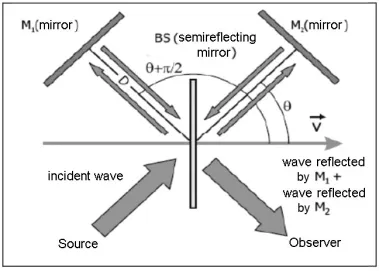
Fig. 1.1 The typical scheme of Michelson’s interferometer.
where θ represents the angle between the direction of light propagation and the earth velocity with respect to the hypothetical preferred frame Σ.
By introducing the anisotropy
there is a simple relation with the time difference Δt(θ) for light propagation back and forth along perpendicular rods of length D (see Fig.1.1)
(where, in the last relation, we have assumed that light propagates in a medium of refractive index
= 1 +
ϵ, with
ϵ ≪ 1). This gives the fringe patterns (
λ is the light wavelength)
and could be measured, in principle, by rotating the apparatus.
The classical prediction (see e.g. [3] for a simple derivation) was
and, for the Michelson-Morley apparatus, the relevant value was (D/λ) ∼ 2·107. Therefore, for v = 30 km/s (the earth orbital velocity about the sun, and consequently the minimum anticipated drift velocity) where v2/c2 = 10−8, under a 90 degree rotation, one was expecting a shift
that would have been about hundred times larger than the extraordinary sensitivity of the apparatus, about ±0.004 [1, 4, 5].
Instead, in the various experimental sessions, the observed shifts were about 10 ÷ 20 times smaller than expected [6, 7]. By using Eq.(1.5), these values were indicating earth velocities of about 6 ÷ 10 km/s which have no obvious interpretation. In addition, the observed pattern was irregular because observations performed at the same hour on consecutive days were showing sizeable differences. The simultaneous presence of these two aspects gave a strong argument to consider the data as typical instrumental effects, i.e. a “null” result.
The acceptance of this view, indicating a failure of the classical ideas and/or the non-existence of the ether, had a strong impact on the scientific ambiance and was crucial to stimulate the first, pioneering formulations of the relativistic length contraction and time dilation effects, by Fitzgerald in 1889 [8], Lorentz in 1895 [9] and 1899 [10], Larmor in 1897 [11] and 1900 [12]. These original developments of the theory of the electromagnetic ether induced Lorentz in 1904 [13] and Poincaré in 1905 [14] to derive a particular set of transformations of the space-time coordinates (Lorentz Transformations) : “Applying one of such transformations amounts to an overall translation to the whole system. Then two frames, one at rest in the ether and one in uniform translation, become the perfect images of each other”. This statement of Poincaré in 1905 was the precise formalization of the Principle of Relativity, already proposed by him in La Science et l’Hypothese (Flammarion, Paris 1902) and at the 1904 St. Louis Conference [15]2.
This first historical phase and its relation with special relativity [17] can be well described by quoting, twice, Einstein himself. The first quotation is from his address to Michelson during a social gathering of scientists at the California Institute of Technology in mid-January 1931:“You, my honored Herr Michelson began this work when I was only a small boy, not even a meter high. It was you who led the physicists into new paths, and through your marvelous experimental labors prepared for the development of the relativity theory. You uncovered a dangerous weakness in the ether theory of light as it then existed, and stimulated the thoughts of H. A. Lorentz and Fitzgerald from which the special theory of relativity emerged” [18].
The second quotation is from an Einstein’s interview delivered in 1955, a few months before his death. When asked, once more, about his original view and the relation with previous work he said:“ There is no doubt that the theory of relativity, if we regard its development in retrospect, was ripe for discovery in 1905. Lorentz had already observed that the transformations which later were known by his name were essential for the analysis of Maxwell equations and Poincaré had even penetrated deeper into these connections. Concerning myself, I knew only Lorentz’ important work of 1895 but not his later work nor the consecutive investigations by Poincaré. In this sense my work of 1905 was independent. The new feature of it was the realization that the bearing of Lorentz transformations transcended its connection with Maxwell equations and was concerned with the nature of space and time in general. The new result was that Lorentz invariance was the general condition for any physical theory” [19].
Thus, one could summarize as follows: (i) the Michelson-Morley experiment was crucial for the first formulation of the relativistic effects within the theory of the electromagnetic ether (ii) later on, by Einstein, relativity was recognized as a doctrine of nature and formulated in an axiomatic form, free of any association with ether and electromagnetism3.
Such premise is essential to properly frame the Michelson-Morley experiment in the history of physics. At the same time, nowadays, there is the tendency to consider this fundamental experiment, and its classical repetitions at the beginning of 20th century by Miller [7], Illingworth [21], Joos [22] ... as an old, well understood historical chapter for which there is nothing more to refine or clarify. All emphasis is now on the modern versions of these experiments, with lasers stabilized by optical cavities (see e.g. [23] for a review), which apparently have improved by orders of magnitude on those original measurements [24].
However, a basic aspect has been overlooked by most authors. The various measurements were performed in different conditions, i.e. with light propagating in gaseous media (as in [1, 7, 21, 22]) or in a high vacuum (as in [25–27]) or inside dielectrics with a large refractive index (as in [24, 30]) and there could be physical reasons which prevent a straightforward comparison. In this case, the difference between old experiments (in gases) and modern experiments (in vacuum or solid dielectrics) might not depend on the technological progress only but also on the different media that were tested. Then, if the small residuals of those original experiments were not mere instrumental artifacts, there would be substantial implications for both physics and history of science.
1.2 Lorentz vs. Einstein
Before going deeper into the analysis of the experiments, we want to add some general comment about Lorentz’ and Einstein’s views of relativity. Apart from all historical aspects, the basic difference could simply be phrased as follows. In a “Lorentzian” approach, the relativistic effects originate from the individual motion of each observer S’, S”...with respect to some preferred reference frame Σ, a convenient redefinition of Lorentz’ ether. Instead, according to Einstein, eliminating the concept of...