Is tai chi a stretching exercise, deep-breathing program, martial art, dance or prayer? Yes, it's all those and more.Tai chi, like many ancient Eastern practices, does not fit strict Western categories. Tai chi, together with the extraordinary self-healing method developed by Dr Lee, offers relief for stress, breathing disorders, muscular ailments, chronic headaches, and a variety of modern office- and sports-related complaints, as well as for deep emotional distress.Few today are as well positioned to explain the healing powers of tai chi as Dr. Martin Lee, a renowned engineering physicist and tai chi master. He and his wife, Emily, also a tai chi master, are the only Americans to have studied with Yu Pen-Shih, one of China's foremost ch'i kung masters. Dr. Lee has developed a groundbreaking practical program that combines Eastern and Western approaches to wellness, which he calls "physical philosophy." Its goal is to help people become "one with nature," a Buddhist term for the natural restoration of true health.The rewards of one-with-nature tai chi are inner happiness, self-control, self-realization, and self-healing. Each one of these benefits receives individual attention, complete with the 64 tai chi forms, thoroughly illustrated with photographs and diagrams. The central focus is on the flow of energy — the chi, or "inner breath" — that tai chi evokes through Lee's four basic instructions: Relax. Breathe. Feel the earth. Do nothing extra. Here is a valuable health, exercise, and meditation program that combines ancient spiritual insights with advanced scientific knowledge and important original discoveries.
- 144 pages
- English
- ePUB (mobile friendly)
- Available on iOS & Android
eBook - ePub
About this book
Information
Topic
MedicineCHAPTER ONE
One-with-Nature Theory

“Nature can never be completely described, for such a description of nature would have to duplicate nature. No name can fully express what it represents. It is nature itself, and not any part abstracted from nature, which is the ultimate source of all that happens, all that comes and goes, begins and ends, is and is not. But to describe nature as the ‘ultimate source of all’ is still only a description, and such a description is not nature itself Yet since, in order to speak of it, we must use words, we shall have to describe it as ‘the ultimate source of all.’”
Lao Tze
translated by Archie Bahm
translated by Archie Bahm
“Once Chuang Chou dreamt he was a butterfly, a butterfly flitting and fluttering around, happy with himself and doing as he pleased. He didn’t know he was Chuang Chou. Suddenly he woke up and there he was, solid and unmistakable, Chuang Chou. But he didn’t know if he was Chuang Chou who had dreamt he was a butterfly, or a butterfly dreaming he was Chuang Chou.”
Chuang Chou Tze
Nature and the Self
Coaxed by curiosity, a trait we consider an intrinsic part of human nature, we make great discoveries and succeed in little, important ways in our daily lives. But most great discoveries do not come easily, especially when dealing with fundamental questions about the self and nature. We continue to debate ancient philosophical questions about the relationship of humans to nature. And we probe these questions with science. Who are we? What is nature? What is our place in nature? Chuang Chou, more than 2,000 years ago, described not just human imagination, but a fleeting perception of the self as integral to nature.
Philosophers, scientists, literary men and women, and other thinkers have provided diverse answers to these important questions. But answers to these questions must lie within the mind and heart, where scientific and philosophical modes merge. Scientists make hypotheses to describe physical systems, as Sir Isaac Newton did when describing the motion of a physical force. Consider his hypothesis that for every action there is an equal and opposite reaction.

This hypothesis allowed Newton to develop classical mechanics, a discipline still used by scientists today to physically describe nature. The word action is usually not defined in terms of reactions at all, but it is a definition of action that scientists can use. You, however, might not find it useful in everyday life.
If we are to understand, in a scientific way, the relationship between nature and the self, we must also begin with a hypothesis. For me, as an engineering physicist, nature is a physical system composed of matter and energy. We can call the matter constituting nature the “universe,” or the “body of nature.” And we can call the physical energies in nature “nature’s energy.” With these simple terms, we can describe nature in this equation.

We can use a similar equation to describe nature philosophically. We can begin with a hypothesis based on the assumption that nature is composed of an infinite mind (nature’s mind) and an eternal thought (nature’s thought). So, we can describe nature in these terms.

Some people have described God in similar terms; one dictionary defines God as “infinite mind,” “eternal,” “that which is without beginning and end.” Eternal thought, then, is thought which has no beginning and no end. For simplicity, we can refer to these attributes as nature’s mind and nature’s thought.
If we combine these scientific and philosophical approaches to describing nature into one, here is the resulting definition of nature.

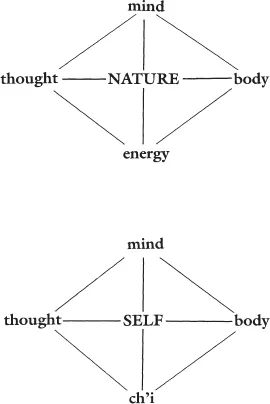
The word nature in this equation represents a physical–philosophical system composed of four essential elements. Since we are part of this physical–philosophical system, our being has the same composition as nature. Therefore, these same four elements may describe ourselves.

Note the distinction between thought and the mind. This is because thoughts may be considered things existing within the mind. The mind, in other words, acts as the thoughts’ body just as the brain acts as the mind’s body. Also, remember that the word ch’i means “inner energy,” or energy inside the body.
These diagrams illustrate the four elements of each system.
The Tao of Becoming One with Nature
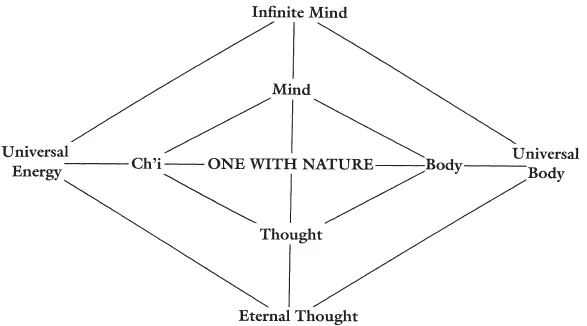
Let’s use the four basic elements of nature and the self to describe the four conditions of being one with nature.
I am one with nature . . .
when my mind is with nature’s mind
when my body is with nature’s body
when my ch’i is with nature’s energy
when my thought is with nature’s thought
when my mind is with nature’s mind
when my body is with nature’s body
when my ch’i is with nature’s energy
when my thought is with nature’s thought
The four elements of being one with nature can be understood in the diagram on p. 19 in which the self, one’s own existence, is surrounded by nature, expressed as universal, infinite, and eternal.
Bringing our state of being in line with that of nature is necessary if we are to make use of nature to heal ourselves. We can begin the process by asking ourselves these four basic questions.
How can my mind be with nature’s mind?
How can my body be with nature’s body?
How can my ch’i be with nature’s energy?
How can my thought be with nature’s thought?
How can my body be with nature’s body?
How can my ch’i be with nature’s energy?
How can my thought be with nature’s thought?
We can answer these questions in a simple way by recognizing that since nature created us, nature can also help us become one with itself. In accord with nature, the one-with-nature method described in this book can facilitate this process. Consider the words of Lao Tze.
“Things which act naturally do not need to be told how to act. The wind and rain begin without being ordered and quit without being commanded. This is the way with all natural beginnings and endings. If nature does not have to instruct the wind and rain, how much less should humans try to direct them? Whoever acts naturally is nature itself acting.”

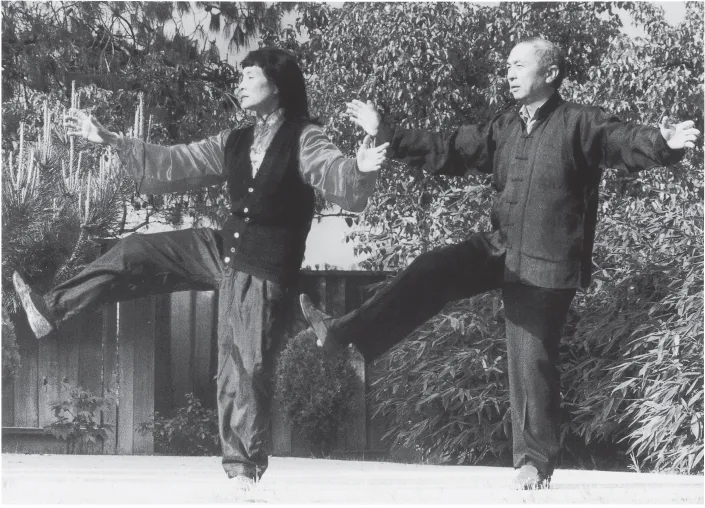
Tai Chi Masters Dr. Martin Lee and Emily Lee (shown above) received a grant from the National Institute of Aging to conduct a study from 1999 to 2002 on the benefits of tai chi for seniors under the Wellness Intervention for Self-Enrichment (WISE) project in association with the Stanford Center for Research on Disease Prevention.
The participants, most of whom were in their mid-70s, were volunteers over age 65. Before the study began, all seniors were in good general health, able to walk without assistance, and classed as “sedentary” because they exercised less than 60 minutes a week.
In this study, the Lees gave the seniors free tai chi instruction.
Study participants practiced tai chi twice a week for 6 months, then once a week for 6 months. The sedentary seniors found many of the same benefits as younger tai chi students. Most seniors were able to incorporate tai chi principles and practice into their daily lives almost immediately. In fact, these seniors, the Lees found, have achieved the same benefits as more active senior students enrolled in their regular Tai Chi for Total Fitness classes.
CHAPTER TWO
Becoming One with Nature
Drawing on more than 20 years’ experience of teaching tai chi to thousands of students, I devised a simple, practical way of teaching my students how to become one with nature. I often tell beginning students:
“I am a scientist. As a scientist I work with physical systems. But I am also a tai chi master, and as a tai chi master, I also understand the body as a mental and physical system. Let’s see what we have inside this mental and physical system: We all have a mind and a body, and inside the mind, we have thoughts. Thoughts are like the coffee inside a cup. The cup, then, is the mind and the coffee represents the thoughts. Similarly, inside the body, we have energy. Because this energy is inside us, we may think of it as inner energy”
We are all familiar with the concept of energy. Sunlight outside is, for example, full of energy. Scientists learn about energy by looking outward at nature, and many neglect attending to the energy that exists inside the body. Since nature does not distinguish between outside and inside, energy that exists outside the body must also exist inside. So, the ch’i inside us is the same as the energy to be found outside the body.
In the diagram of the self, four parts—mind, body, ch’i, and thought—are connected and form a single system. Well-being can be defined in terms of the relationships among these four parts. If all these relationships are intact, you are healthy, but if any relationship is not intact, you may get sick. What disrupts the vital, natural relationship of mind, body, ch’i, and thou...
Table of contents
- Cover
- Halftitle
- Title
- Copyright
- Dedication
- Contents
- Acknowledgements
- Preface
- East Meets West: How I Came to Tai Chi
- 1 One-with-Nature Theory
- 2 Becoming One with Nature
- 3 One-with-Nature Tone Ch’i and Inner Happiness
- 4 One-with-Nature Tai Chi and Self-Control
- 5 One-with-Nature Meditation and Self-Realization
- 6 One-with-Nature Touch and Self-Healing
- 7 Personal Wellness and Cell Wellness
- 8 The Tao, Science, Philosophy, and Spirituality
- 9 Beginner’s Guide to Tai Chi Practice
- One-with-Nature Tai Chi, the 64 Forms
- Index
Trusted by 375,005 students
Access to over 1.5 million titles for a fair monthly price.
Study more efficiently using our study tools.
Frequently asked questions
Yes, you can cancel anytime from the Subscription tab in your account settings on the Perlego website. Your subscription will stay active until the end of your current billing period. Learn how to cancel your subscription
No, books cannot be downloaded as external files, such as PDFs, for use outside of Perlego. However, you can download books within the Perlego app for offline reading on mobile or tablet. Learn how to download books offline
Perlego offers two plans: Essential and Complete
- Essential is ideal for learners and professionals who enjoy exploring a wide range of subjects. Access the Essential Library with 800,000+ trusted titles and best-sellers across business, personal growth, and the humanities. Includes unlimited reading time and Standard Read Aloud voice.
- Complete: Perfect for advanced learners and researchers needing full, unrestricted access. Unlock 1.5M+ books across hundreds of subjects, including academic and specialized titles. The Complete Plan also includes advanced features like Premium Read Aloud and Research Assistant.
We are an online textbook subscription service, where you can get access to an entire online library for less than the price of a single book per month. With over 1.5 million books across 990+ topics, we’ve got you covered! Learn about our mission
Look out for the read-aloud symbol on your next book to see if you can listen to it. The read-aloud tool reads text aloud for you, highlighting the text as it is being read. You can pause it, speed it up and slow it down. Learn more about Read Aloud
Yes! You can use the Perlego app on both iOS and Android devices to read anytime, anywhere — even offline. Perfect for commutes or when you’re on the go.
Please note we cannot support devices running on iOS 13 and Android 7 or earlier. Learn more about using the app
Please note we cannot support devices running on iOS 13 and Android 7 or earlier. Learn more about using the app
Yes, you can access The Healing Art of Tai Chi by Martin J Lee, Emily Lee;Joyce Lee in PDF and/or ePUB format, as well as other popular books in Medicine & Alternative & Complementary Medicine. We have over 1.5 million books available in our catalogue for you to explore.