Photoorganocatalysis in Organic Synthesis
eBook - ePub

Photoorganocatalysis in Organic Synthesis

  1. 600 pages
  2. English
  3. ePUB (mobile friendly)
  4. Available on iOS & Android
eBook - ePub

Photoorganocatalysis in Organic Synthesis

About this book

The use of organocatalysts able to photocatalyze an organic reaction is a rapidly growing field. These photocatalyzed transformations are more environmentally sustainable with respect to the use of expensive/toxic metal-based (photo)catalysts.

Based on the authors' extensive experience in photogenerated intermediates, this book presents an overview on photocatalyzed organic processes having a synthetic significance, where an organic molecule functions as the photocatalyst.

After a brief introduction defining the nature and the characteristics of a photoorganocatalyst (POC), the chapters are organized according to the class of POC used, as detailed below.

Each chapter begins with a summary of the photophysical characteristics of the POCs and is followed by selected examples of synthetic applications. The last two chapters are devoted to the adoption of photoorganocatalysis in polymerization and to flow photoorganocatalysis. These in-depth explanations and practical applications make this title an essential reading for any chemistry student interested in organic (sustainable) synthesis.

Contents:

  • Ketones and Aldehydes (Shin Kamijo)
  • Quinones (Akichika Itoh)
  • Aromatics and Cyanoaromatics (Stefano Protti and Davide Ravelli)
  • Sulfur Heterocycles (Katarzyna Goliszewska, Katarzyna Orłowska and Dorota Gryko)
  • Oxygen Heterocycles: Pyrylium Salts (Sergio M Bonesi and Al Postigo)
  • Oxygen Heterocycles: Eosin Derivatives (Wen-Jing Xiao, Xiao-Qiang Hu, and Jia-Rong Chen)
  • Oxygen Heterocycles: Fluorescein, Rhodamine, Rose Bengal (Daniele Leonori and Fabio Juliá)
  • Nitrogen Heterocycles: Porphyrins (Hermenegildo García and Sonia Remiro-Buenamañana)
  • Nitrogen Heterocycles: Acridinium Salts (Peter Fodran, Leticia Monjas and Carl-Johan Wallentin)
  • Other Nitrogen Heterocycles: Carbazoles, Imides and PDI, mpg-C₃N₄, Tetrazines, Riboflavin, and BODIPY (Pier Giorgio Cozzi, Paola Ceroni, Andrea Gualandi, and Marianna Marchini)
  • Photoorganocatalysts for Polymerization (Didier Gigmes, Frédéric Dumur, Nicolas Zivic, Ségolène Villotte, Jason C Morris, Jacques Lalevée and Aude Héloïse Bonardi)
  • Photoorganocatalysis in Flow (Manuel Anselmo, Andrea Basso and Lisa Moni)


Readership: Any chemistry student interested in organic (sustainable) synthesis.Organic Chemistry;Photochemistry;Photocatalysis;Organocatalysis;Reactive Intermediates;Radicals00

Frequently asked questions

Yes, you can cancel anytime from the Subscription tab in your account settings on the Perlego website. Your subscription will stay active until the end of your current billing period. Learn how to cancel your subscription.
At the moment all of our mobile-responsive ePub books are available to download via the app. Most of our PDFs are also available to download and we're working on making the final remaining ones downloadable now. Learn more here.
Perlego offers two plans: Essential and Complete
  • Essential is ideal for learners and professionals who enjoy exploring a wide range of subjects. Access the Essential Library with 800,000+ trusted titles and best-sellers across business, personal growth, and the humanities. Includes unlimited reading time and Standard Read Aloud voice.
  • Complete: Perfect for advanced learners and researchers needing full, unrestricted access. Unlock 1.4M+ books across hundreds of subjects, including academic and specialized titles. The Complete Plan also includes advanced features like Premium Read Aloud and Research Assistant.
Both plans are available with monthly, semester, or annual billing cycles.
We are an online textbook subscription service, where you can get access to an entire online library for less than the price of a single book per month. With over 1 million books across 1000+ topics, we’ve got you covered! Learn more here.
Look out for the read-aloud symbol on your next book to see if you can listen to it. The read-aloud tool reads text aloud for you, highlighting the text as it is being read. You can pause it, speed it up and slow it down. Learn more here.
Yes! You can use the Perlego app on both iOS or Android devices to read anytime, anywhere — even offline. Perfect for commutes or when you’re on the go.
Please note we cannot support devices running on iOS 13 and Android 7 or earlier. Learn more about using the app.
Yes, you can access Photoorganocatalysis in Organic Synthesis by Maurizio Fagnoni, Stefano Protti;Davide Ravelli in PDF and/or ePUB format, as well as other popular books in Physical Sciences & Organic Chemistry. We have over one million books available in our catalogue for you to explore.

Information

Chapter 1

Ketones and Aldehydes

Shin Kamijo
Graduate School of Sciences and Technology for Innovation, Yamaguchi University, Yamaguchi, Japan

1.1Introduction

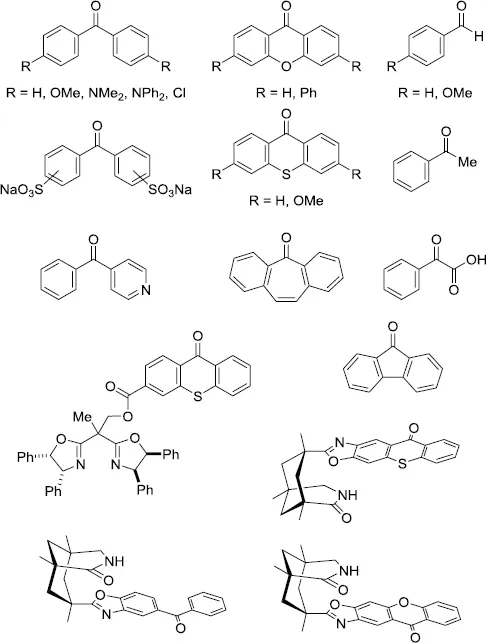
Extensive studies have been carried out in the photochemistry of carbonyl compounds, especially ketones, since photoexcited ketones are known to induce various types of transformations [14]. Among them, one of the most significant features of aryl ketones, such as benzophenone (Ph2CO) and its derivatives, is their ability to act as photoorganocatalysts (POCs) (Scheme 1.1).
For instance, Ph2CO is readily excited to a singlet state with light irradiation [>350 nm for nπ*] and is then rapidly converted to a triplet state through intersystem crossing. The relatively longer lifetimes of the triplet state of aryl ketones [10 ns–1 μs for Ph2CO depending on the solvent used] have allowed the promotion of photochemical transformations via energy transfer (EnT), hydrogen-atom transfer, and electron transfer (ET) reactions [redox potentials for triplet Ph2CO:
images
+ 1.28 V vs SCE,
images
− 0.61 V vs SCE; and energy for triplet Ph2CO:
images
3.0 eV]. This chapter mainly covers recent representative catalytic transformations involving carbonyl compounds, including ketones and aldehydes, under photoirradiation conditions.
images
Scheme 1.1.Representative ketone and aldehyde POCs.

1.2Functionalizations of Unsaturated Bonds

1.2.1Alkylation of olefins

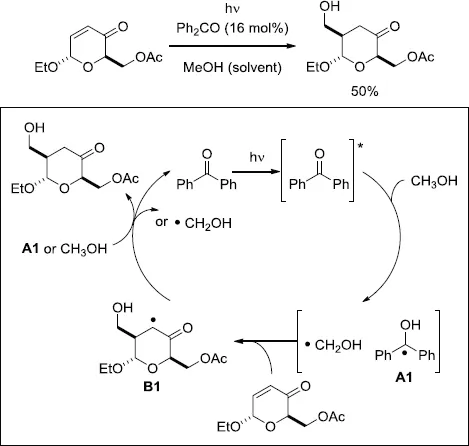
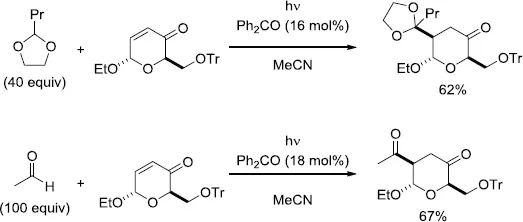
One of the pioneering investigations on the alkylation of oxygen containing compounds, such as alcohols and acetals, via the photoinduced conjugate addition to carbohydrate-derived enones in the presence of a catalytic amount of benzophenone (Ph2CO) was carried out by Fraser-Reid and co-workers [57]. As an example, irradiation of the enone derived from acetylated glucose in MeOH containing a catalytic amount of Ph2CO (16 mol%) resulted in the regioselective formation of the 1,4-adduct in 50% yield (Scheme 1.2) [5]. The reaction was proposed to proceed with hydrogen-atom abstraction from MeOH by the photoexcited Ph2CO. The derived hydroxymethyl radical then added to the enone in 1,4-fashion from the less-hindered face. This addition step should be favored due to the nucleophilic nature of the hydroxymethyl radical. Subsequently, the hydrogen-atom transfer between the generated radical B1 and the ketyl radical A1 or MeOH took place to form the adduct [6]. In addition to MeOH, the applicable substances were expanded to include diols, acetals, and aldehydes (Scheme 1.3) [7]. A similar type of diastereoselective alkylation of isopropanol, 1,3-dioxolane, and tetrahydrofuran (THF) was also investigated by Mattay and co-workers [8].
images
Scheme 1.2.Addition of alcohols to cyclic enones.
images
Scheme 1.3.Addition of acetals or aldehydes to cyclic enones.
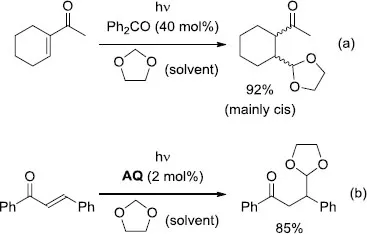
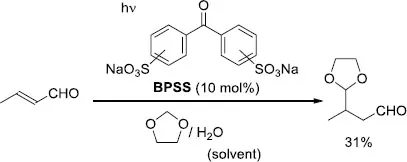
The research group of Fagnoni and Albini achieved the catalytic photoinduced alkylation of 1,3-dioxolane with α,β-unsaturated ketones (aliphatic, both acyclic and cyclic, as well as aryl-substituted) in the presence of a ketone as POC [9]. The irradiation of the alkyl ketone in dioxolane with Ph2CO (40 mol%) led to the formation of the addition product with a yield of 92% (Scheme 1.4(a)). On the other hand, the reaction employing the aryl ketone substrate was efficiently catalyzed by anthraquinone (AQ, 2 mol%) rather than Ph2CO, furnishing the expected adduct in 85% yield (Scheme 1.4(b)). Further investigations enabled the alkylation of dioxolane using α,β-unsaturated aldehydes in aqueous solution [10], as well as by designing the water-soluble photocatalyst disodium benzophenonedisulfonate (BPSS) (Scheme 1.5) [11].
images
Scheme 1.4.Addition of 1,3-dioxolane to enones.
images
Scheme 1.5.Addition of 1,3-dioxolane to enals.
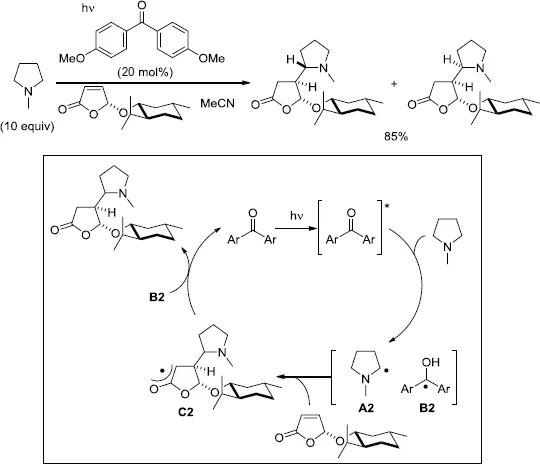
Hoffmann and co-workers investigated intensively the diastereoselective alkylation of amine derivatives by a chiral furanone via a photoinduced conjugated addition in the presence of a catalytic amount of aryl ketones [1216]. In the initial stage of the investigation, the alkylation of N-methylpyrrolidine was attained (Scheme 1.6) [12].
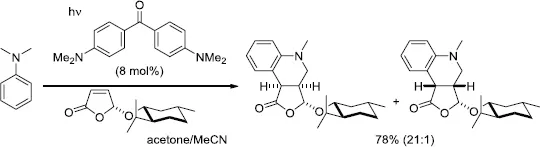
The treatment of the pyrrolidine (20 equiv) and the chiral furanone bearing a menthyloxy group in MeCN with a catalytic amount of 4,4′-dimethoxybenzophenone (10 mol%) under irradiation produced the addition products in 85% combined yield. A complete facial selectivity at the furanone ring was observed; however, the other asymmetric center adjacent to the nitrogen atom could not be controlled. The current strategy for diastereoselective alkylation of pyrrolidine derivatives was applied to the total synthesis of two pyrrolizidines alkaloids, viz. (–)-isoretronecanol and (+)-lauburine [13]. In the proposed catalytic cycle, the reaction was initiated by photoinduced electron transfer (PET) between the photoexcited aryl ketone and pyrrolidine followed by proton transfer to generate the α-aminoalkyl radical A2 and the ketyl radical B2 [14]. The derived radical A2 was added to the electron-deficient double bond of the furanone from the less-hindered face to form the oxoally radical C2. A hydrogen-atom transfer from the ketyl radical B2 to the radical C2 accounted for the recovery of the aryl ketone after the reaction. When dimethylaniline was employed as a starting amine in the presence of 4,4′-bis(N,N-dimethylamino)benzophenone (8 mol%), a radical tandem reaction took place to form tetrahydroquinolines in a highly diastereoselective manner (Scheme 1.7) [15]. Further investigations enabled the alkylation of aliphatic amines, including Et3N and six-membered azacycles with electron-deficient olefins [16].
images
Scheme 1.6.Diastereoselective addition of pyrrolidine to a furanone.
images
Scheme 1.7.D...

Table of contents

  1. Cover Page
  2. Title
  3. Copyright Page
  4. Preface
  5. About the Editors
  6. About the Contributors
  7. Contents
  8. Chapter 1 Ketones and Aldehydes
  9. Chapter 2 Quinones
  10. Chapter 3 Aromatics and Cyanoaromatics
  11. Chapter 4 Sulfur Heterocycles
  12. Chapter 5 Oxygen Heterocycles: Pyrylium Salts
  13. Chapter 6 Oxygen Heterocycles: Eosin Derivatives
  14. Chapter 7 Oxygen Heterocycles: Fluorescein, Rhodamines, Rose Bengal
  15. Chapter 8 Nitrogen Heterocycles: Porphyrins
  16. Chapter 9 Nitrogen Heterocycles: Acridinium Salts
  17. Chapter 10 Other Nitrogen Heterocycles: Carbazoles, Imides and PDI, mpg-C3N4, Tetrazines, Riboflavin, and BODIPY
  18. Chapter 11 Photoorganocatalysts for Polymerization
  19. Chapter 12 Photoorganocatalysis in Flow
  20. Index