![]()
CHAPTER 1
Recent Advances in the Theory of Thermoluminescence and Optically Stimulated Luminescence; Delocalized Transitions
Reuven Chen
Raymond and Beverly Sackler School of Physics and Astronomy
Tel Aviv University, Tel Aviv 69978, Israel
[email protected] Several theories explain different facets of the phenomena of thermoluminescence (TL) and optically stimulated luminescence (OSL). In the present chapter we concentrate on models dealing with processes occurring when charge carriers are moving between traps and centers through the conduction and valence bands. The processes involved include transitions occurring during excitation and during read-out: optical stimulation in OSL and heating in TL. Older theories explaining the basic properties of first-and second-order kinetics as well as the effects of non-linear dose dependence of TL and OSL are briefly mentioned. More recent models, developed in the last decade are described in more detail. The effects of competition between traps and between centers both during excitation and read-out are discussed in some detail, yielding the interpretation of superlinear dose dependence, non-monotonic dose dependence as well as dose-rate dependence. The theories can also explain the experimentally observed concentration quenching and the prevalence of first-order peaks in various materials. A model for explaining an anomalous heating-rate effect and thermal quenching is discussed. The occurrence of anomalously high or low activation energies and frequency factors, sometimes evaluated by standard peak-shape methods is also briefly discussed. Finally, the recently studied subject of two-electron traps or two-hole centers and their effects on TL and OSL phenomena are discussed.
1.1.Introduction
The phenomena of thermally stimulated luminescence, usually termed thermoluminescence (TL) and optically stimulated luminescence (OSL) consist of the emission of energy previously absorbed in a solid material in the form of light during thermal or optical stimulation. A prerequisite is that the energy be absorbed, usually by irradiating the sample in hand by ionizing or sometimes non-ionizing radiation. The captured energy may be released in the form of emitted light either by heating the sample, in TL measurements or by illuminating it by some light source. In the latter case, the emitted stimulated light is usually of different wavelength than the stimulating light.
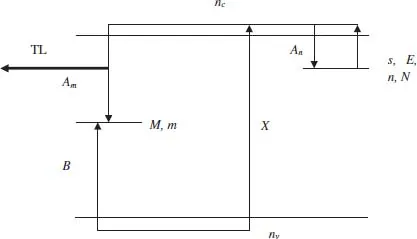
The basic theory of TL and OSL is based on the existence of imperfections, impurities and defects in the otherwise ordered crystals which give rise to allowed discrete energy levels in the forbidden gap of the crystal which may capture electrons or holes. During excitation, electron and hole pairs are produced by the radiation throughout the sample and certain fraction reach the conduction and valence bands, respectively. These carriers may be trapped in electron and hole traps located in the forbidden gap. It is rather conventional to talk about electron traps, located quite close to the conduction band and about hole centers located far from the valence band. Under these conditions, during TL read-out by heating, the trapped electrons may be raised into the conduction band, and following their motion in the conduction band, recombine with a hole in a luminescence center and recombine with it yielding an emitted photon. A schematic energy level diagram with one electron trap and one hole recombination center is shown in Fig. 1. It should be noted that a mirror-image model is just as likely to occur. If the hole trap is located close to the valence band and the electron trap, now referred to as a center, is far from the conduction band, the process taking place during heating includes the thermal release of a trapped hole into the valence band and its recombination with an electron in a center, thus yielding a TL photon. The situation in OSL is the same as far as the excitation is concerned. As for read-out, photons, e.g. infra-red light, raise electrons from the trap to the conduction band which then find counterpart holes in the center and recombine to yield OSL photons, usually with different wavelength than the stimulating IR light. Like in TL, the inverse picture of hole traps and electron centers can be considered as being relevant also to OSL. It should be mentioned that the models discussed in this chapter assume a homogeneous excitation of the sample which is a good assertion of the situation taking place with UV, X-ray and γ excitation and to a lesser extent, for β exposure.
Fig. 1.Schematic energy-level diagram showing an electron trap and a hole center.
The parameters shown in Fig. 1 are as follows: E(eV) is the activation energy for releasing a trapped electron, s(s–1) is the frequency factor, Am(cm3s–1) and An(cm3s–1) are the recombination and retrapping probability coefficients, B(cm3s–1) is the trapping probability coefficient of free holes into centers, M(cm–3) is the concentration of hole centers and m(cm–3) its instantaneous occupancy, N(cm–3) is the concentration of electron traps and n(cm–3) its instantaneous occupancy. nc(cm–3) and nv(cm–3) are, respectively, the instantaneous concentrations of free electrons and holes. X(cm–3s–1) is the rate of production of electron-hole pairs, proportional to the dose rate.
The set of simultaneous differential equations governing the process during excitation is (see e.g. Chen and Pagonis, [1])
At the end of excitation one ends up with a finite concentration of free electrons, nc, and free holes, nv. If one wishes to mimic the experimental procedure of TL or OSL, one has to consider a relaxation time between the end of excitation and the beginning of heating or exposure to stimulating light. This is done by setting X to zero and solving Eqs. (1–4) for a further period of time so that at the end, both nc and nv are negligibly small. Obviously, the final values of n, m, nc and nv at the end of excitation are used as initial values for the relaxation stage. Finally, for the readout stage, we take the final concentrations in the relaxation stage as initial values for the next stage and simulate either the heating in TL or the optical stimulation in OSL. It is worth mentioning that in this, relatively simple case of one trapping state and one kind of recombination center, the final concentrations of traps and centers, which are the initial concentrations n0 and m0 for the readout stage must be the same. However, when several traps and/or centers are involved, the solutions of the excitation and relaxation stages prior to the read-out stage are crucial in order to get realistic results.
Before moving to the discussion of the heating stage in TL in the one-trap-one recombination center (OTOR) case shown in Fig. 1, let us mention briefly the preceding models given in the earlier literature. Randall and Wilkins [2] developed the first theory for a single TL peak. These authors assumed that once an electron is thermally raised into the condu...