Introduction to Electricity and Magnetism
eBook - ePub

Introduction to Electricity and Magnetism

Solutions to Problems

  1. 140 pages
  2. English
  3. ePUB (mobile friendly)
  4. Available on iOS & Android
eBook - ePub

Introduction to Electricity and Magnetism

Solutions to Problems

About this book

The previously published book Introduction to Electricity and Magnetism provides a clear, calculus-based introduction to a subject that together with classical mechanics, quantum mechanics, and modern physics lies at the heart of today's physics curriculum. The lectures, although relatively concise, take one from Coulomb's law to Maxwell's equations and special relativity in a lucid and logical fashion. That book contains an extensive set of accessible problems that enhances and extends the coverage. As an aid to teaching and learning, the present book provides the solutions to those problems.

Contents:

  • Preface
  • Electricity:
    • Introduction
    • Coulomb's Law
    • The Electric Field
    • Gauss' Law
    • The Electrostatic Potential
    • Electric Energy
    • Capacitors and Dielectrics
    • Currents and Ohm's Law
    • DC Circuits
    • Review of Electricity
  • Magnetism:
    • Vectors
    • The Magnetic Force and Field
    • Ampere's Law
    • Electromagnetic Induction
    • Magnetic Materials
    • Time-Dependent Circuits
    • Review of Magnetism
  • Electromagnetism:
    • Maxwell's Equations
    • Waves
    • Electromagnetic Waves
    • More Electromagnetic Waves
    • The Theory of Special Relativity
    • Review of Electromagnetism
  • Appendix A: Vector Identities
  • Bibliography
  • Index


Readership: Undergraduates and academics in physics.Electricity and Magnetism;Electrostatics;Magnetostatics;Electromagnetism;Lorentz Force;Maxwell's Equations;Electromagnetic Waves;Special Relativity0 Key Features:

  • Presentation is self-contained even if the text is aimed at the very best students who have completed a good course in calculus and are familiar with vectors and Newton's laws
  • Given the astonishing range of applicability of the principles of electromagnetism, the introduction provides a comprehensive foundation to approach many more advanced texts and monographs with a better understanding


Frequently asked questions

Yes, you can cancel anytime from the Subscription tab in your account settings on the Perlego website. Your subscription will stay active until the end of your current billing period. Learn how to cancel your subscription.
No, books cannot be downloaded as external files, such as PDFs, for use outside of Perlego. However, you can download books within the Perlego app for offline reading on mobile or tablet. Learn more here.
Perlego offers two plans: Essential and Complete
  • Essential is ideal for learners and professionals who enjoy exploring a wide range of subjects. Access the Essential Library with 800,000+ trusted titles and best-sellers across business, personal growth, and the humanities. Includes unlimited reading time and Standard Read Aloud voice.
  • Complete: Perfect for advanced learners and researchers needing full, unrestricted access. Unlock 1.4M+ books across hundreds of subjects, including academic and specialized titles. The Complete Plan also includes advanced features like Premium Read Aloud and Research Assistant.
Both plans are available with monthly, semester, or annual billing cycles.
We are an online textbook subscription service, where you can get access to an entire online library for less than the price of a single book per month. With over 1 million books across 1000+ topics, we’ve got you covered! Learn more here.
Look out for the read-aloud symbol on your next book to see if you can listen to it. The read-aloud tool reads text aloud for you, highlighting the text as it is being read. You can pause it, speed it up and slow it down. Learn more here.
Yes! You can use the Perlego app on both iOS or Android devices to read anytime, anywhere — even offline. Perfect for commutes or when you’re on the go.
Please note we cannot support devices running on iOS 13 and Android 7 or earlier. Learn more about using the app.
Yes, you can access Introduction to Electricity and Magnetism by John Dirk Walecka in PDF and/or ePUB format, as well as other popular books in Physical Sciences & Electromagnetism. We have over one million books available in our catalogue for you to explore.

Information

Publisher
WSPC
Year
2019
eBook ISBN
9789811202650

PART 1

Electricity

Chapter 1

Introduction

There are no problems associated with the Introduction.

Chapter 2

Coulomb’s Law

Problem 2.1 What is the gravitational force between the two charges in the example in section 2.2? Compare it to the electrostatic force.
Solution to Problem 2.1
The expression for the gravitational force between two masses (m1, m2) separated by
figure
is due to Newton
figure
Here
figure
is the force exerted on particle 1 by particle 2, and
figure
is the unit vector
figure
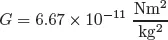
. G is the gravitational constant
figure
We work in SI units where the force is measured in “newtons”
figure
We are asked to compute the magnitude of the gravitational attraction of a completely ionized mole (12 grams) of
figure
separated from San Francisco to New York
figure
The number of atoms in one mole is given by Avogadro’s number
figure
The masses of the carbon nuclei and the electrons (six/atom) are
figure
Hence
figure
This is miniscule compared with the magnitude of the corresponding electrostatic force as calculated in the text
figure
The electrostatic force is as large as it is because of the many-many oppositely charged particles packed into the solid.

Chapter 3

The Electric Field

Problem 3.1 Show that Eq. (3.9) still holds to the given order when the origin of the vector
figure
lies at the midpoint of the displacement
figure
.1
Solution to Problem 3.1
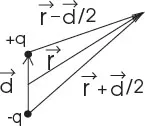
Suppose the origin of the field vector
figure
lies at the midpoint of the displacement
figure
in the dipole (Fig. 3.1 below). The field is then given by
figure
Fig. 3.1 Origin of the vector
figure
lies at the midpoint of the dipole displacement
figure
.
figure
Write
figure
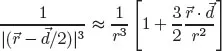
Then retaining terms up through order d, one has from the binomial theorem in Eq. (3.6)
figure
With the use of this expression
figure
Hence, as requested, we see that the field is still given through order d/r by the result in Eq. (3.9)
figure
Problem 3.2 Make a good numerical calcu...

Table of contents

  1. Cover
  2. Title Page
  3. Copyright Page
  4. Dedication
  5. Preface
  6. Contents
  7. Part 1 Electricity
  8. Part 2 Magnetism
  9. Part 3 Electromagnetism
  10. Appendix A Vector Identities
  11. Bibliography
  12. Index