Sketchnoting in the Classroom
eBook - ePub
Available until 26 Feb |Learn more

Sketchnoting in the Classroom

A Practical Guide to Deepen Student Learning

  1. English
  2. ePUB (mobile friendly)
  3. Available on iOS & Android
eBook - ePub
Available until 26 Feb |Learn more

Sketchnoting in the Classroom

A Practical Guide to Deepen Student Learning

About this book

Author Nichole Carter shows how sketchnotes can help students retain new material, develop skills to articulate empathy and build connections to larger concepts.

Sketchnoting in the Classroom includes strategies for helping students feel successful as they develop their skills, for example, asking them what their brain is telling them, asking how they learn best and encouraging the process through specific note-taking strategies.

The book includes:
  • Analysis of the brain science behind sketchnoting, including teaching students how to identify patterns and apply them effectively in their sketchnotes.
  • Lesson ideas for sketchnoting across content areas, including science, social studies, English language arts and math.
  • Tools and resources for both analog and digital sketchnoting techniques.
  • Tips for using sketchnotes for professional development, including at conferences and at department or staff meetings.
  • Examples from a variety of teachers with experience using sketchnotes in their classes.

This book makes sketchnotes more accessible to all teachers and helps both teachers and students feel confident in visual note-taking.

Audience: 3-12 educators, teacher educators
Frequently asked questions

Yes, you can cancel anytime from the Subscription tab in your account settings on the Perlego website. Your subscription will stay active until the end of your current billing period. Learn how to cancel your subscription.
No, books cannot be downloaded as external files, such as PDFs, for use outside of Perlego. However, you can download books within the Perlego app for offline reading on mobile or tablet. Learn more here.
Perlego offers two plans: Essential and Complete
  • Essential is ideal for learners and professionals who enjoy exploring a wide range of subjects. Access the Essential Library with 800,000+ trusted titles and best-sellers across business, personal growth, and the humanities. Includes unlimited reading time and Standard Read Aloud voice.
  • Complete: Perfect for advanced learners and researchers needing full, unrestricted access. Unlock 1.4M+ books across hundreds of subjects, including academic and specialized titles. The Complete Plan also includes advanced features like Premium Read Aloud and Research Assistant.
Both plans are available with monthly, semester, or annual billing cycles.
We are an online textbook subscription service, where you can get access to an entire online library for less than the price of a single book per month. With over 1 million books across 1000+ topics, we’ve got you covered! Learn more here.
Look out for the read-aloud symbol on your next book to see if you can listen to it. The read-aloud tool reads text aloud for you, highlighting the text as it is being read. You can pause it, speed it up and slow it down. Learn more here.
Yes! You can use the Perlego app on both iOS or Android devices to read anytime, anywhere — even offline. Perfect for commutes or when you’re on the go.
Please note we cannot support devices running on iOS 13 and Android 7 or earlier. Learn more about using the app.
Yes, you can access Sketchnoting in the Classroom by Nichole Carter in PDF and/or ePUB format, as well as other popular books in Education & Education Teaching Methods. We have over one million books available in our catalogue for you to explore.

Information

SECTION I

THE WHAT & WHY OF SKETCHNOTES

CHAPTER 1 Sketchnote Beginnings
CHAPTER 2 The Brain Research Behind Sketchnotes
CHAPTER 3 Standards, Metacognition & Focus
CHAPTER 4 Introducing Sketchnotes in a Class
CHAPTER 5 Analog versus Digital
CHAPTER 6 Real-Time versus Revisited Strategies

CHAPTER 1

SKETCHNOTE BEGINNINGS

Sketchnotes are a form of note taking. What is special about sketchnoting is that it teaches the best forms of strategic note taking, listening comprehension, synthesis, Dual Coding Theory, and note hierarchy. Plus, it allows note takers to personalize the experience based on their own past knowledge and, to some extent, their emotional connection to the new information they are learning.

The History of Modern Sketchnotes

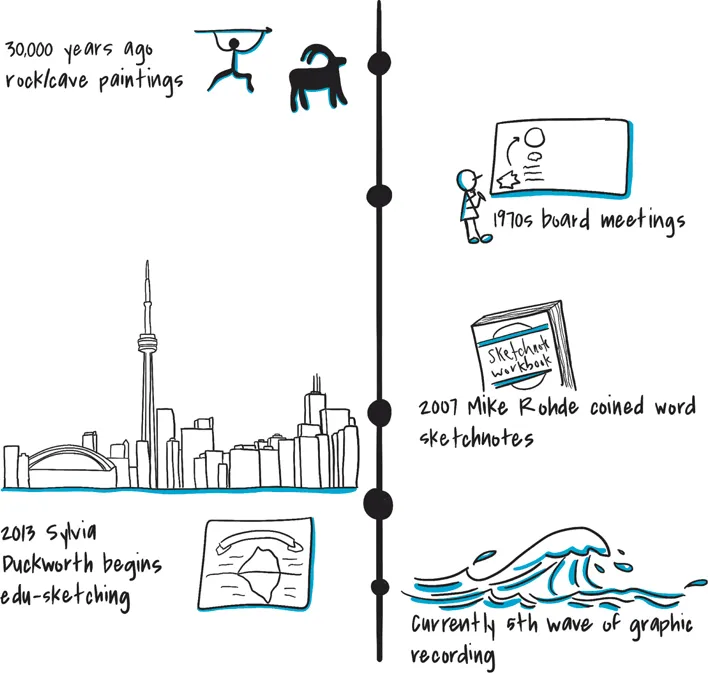
Although the story of modern sketchnotes and graphic recording can be traced back at least fifty years ago, in reality people have been telling stories and making connections with images since the cave drawings of Sulawesi, Indonesia, over 35,400 years ago. Despite this common ancestry, sketchnotes and graphic recording have definite differences.
Sketchnotes and visual note taking are similar in definition, and educators have been using visuals for decades, especially in relation to language acquisition. The word sketchnotes can be traced back to Mike Rohde and 2007; since then, the practice of sketchnoting, whether in a digital or analog form, has taken off. Sketchnotes for professional development and their use in education can be traced back to 2013, when Sylvia Duckworth, an educator from Toronto, began sketchnoting edtech buzzwords and pedagogy.
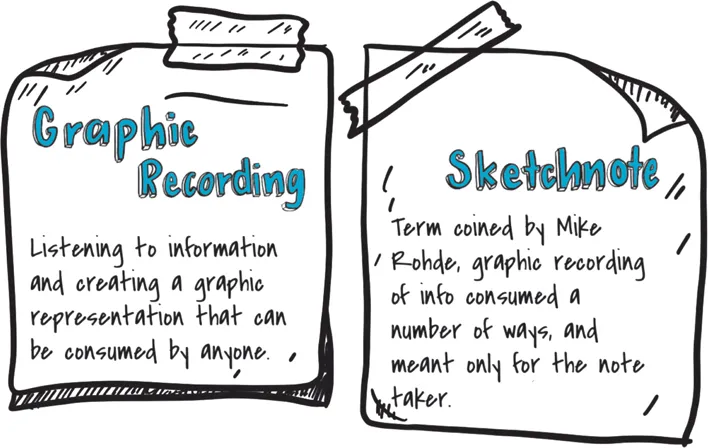
Graphic recording, however, can be traced back to the 1970s when visual facilitation experts could be seen popping up in board meetings. We are currently in the fifth or sixth wave of graphic recording. Today, for example, Fortune 500 companies ask graphic recording artists to record and make sense of their planning meetings. Graphic recording is much more difficult than sketchnoting, as it requires not just listening comprehension but the ability to make your notes consumable for others. With sketchnotes, the audience is you; it is a form of note taking that sticks, because it is unique and personal to you. For instance, this is how I would draw a sketchnote on what I learned about the differences between sketchnotes and graphic recording.

Yes, You Can Draw!

If you are looking at some of my sketchnotes already and comparing your first attempts, please don’t. Sketchnoting takes practice, and that is what this book is all about. One of the things that I hear the most from adults, and students over the age of twelve, is that they can’t draw.
By the time we reach middle school, many of us have identified ourselves as artistic or just not. In this book, we are going to let go of those preconceived notions and judgments. Moving forward you are a sketchnoter. You are taking the first steps to have the skill set to make this easier and easier for your brain and your artistic abilities!
Scan the QR code for Graham Shaw’s TEDx Talk, “Why People Believe They Can’t Draw.” Get out a pen and paper or a digital device, and draw along with him.
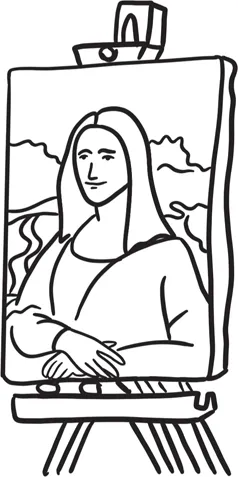
You can’t pick up a pencil and expect to draw the Mona Lisa on the first go; you have to practice. As my friend and colleague Carrie Baughcum (@HeckAwesome), a fellow sketchnoter, likes to say, “It’s not a sprint, it’s a marathon.” She’s right: You get better and better the more you train. The more you ask your brain to conjure up images or symbols, the easier it becomes. To prove it, jump-start your brain with a little game.
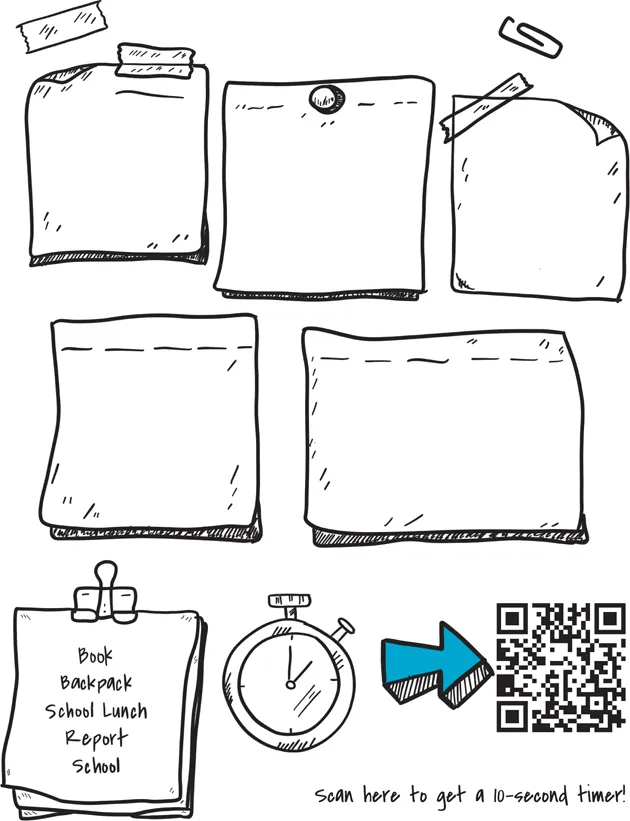
Draw an icon or image for each of the words in the bottom-left corner. Time yourself, allowing about 10 seconds to just draw, before moving to the next word.
What is interesting about this activity (which was inspired by a similar one in Sunni Brown’s The Doodle Revolution) is that our brains can come up with different icons and images for the same word. This makes our notes unique to us, thus helping with the retention. For example, when I introduce sketchnoting to a class—of educators or students—I always ask them to draw the word cup. Some will draw a water cup, and some will draw a coffee or tea cup. When I ask people how they might draw a phone, students automatically think of the iconic iPhone, which is much easier to draw. Adults typically think of a rotary phone and attempt to draw that, which is obviously much more difficult. Sometimes age and life experiences can influence your thought process.
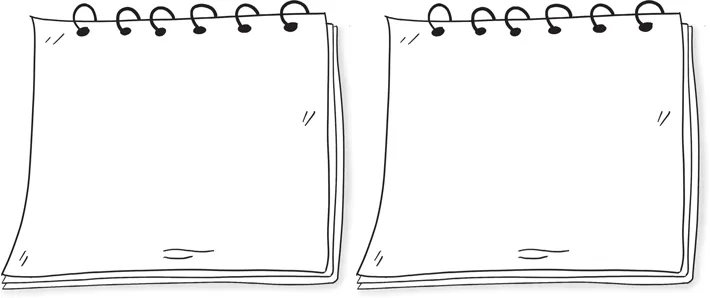
In the space provided draw a cup and a phone.
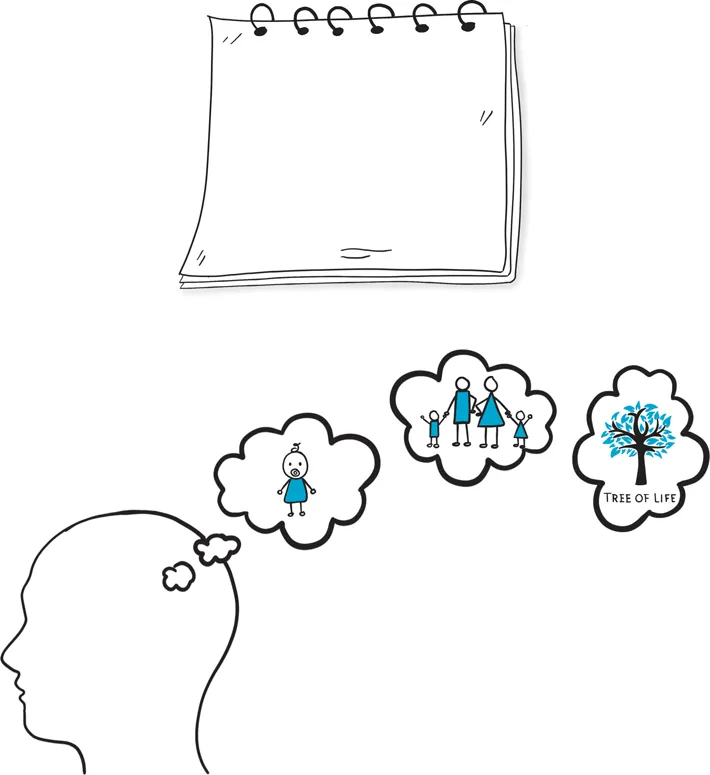
This difference of perspective is again what makes sketchnotes so important: They are unique to you. Giving your brain freedom of expression in that manner is a skill to practice. Try it now: Draw a symbol or icon for the word life.
A great way to continue your practice, or provide some for your students, is to check out the book’s companion site for Chapter 1 to find a list of school-related icons to draw.
Another option is to try Google Quick, Draw! With this online game, you draw the suggested word, while Google AI tries to guess what you are drawing! To try Google Quick, Draw!, scan the QR code.

CHAPTER 2

THE BRAIN RESEARCH BEHIND SKETCHNOTES

Brains love the ability to practice and build their muscle memory. We call this building
Brains also love visuals, and they need connections for what they learn. The more connections, the deeper the learning.
If we deliver information in only one specific way, we are neglecting other brain functions. When we teach the skill of reading, we know that in order for the brain to comprehend the text many different connections and areas of the brain have to be functioning. Sketchnotes ...

Table of contents

  1. COVER
  2. TITLE PAGE
  3. DEDICATION
  4. COPYRIGHT
  5. ABOUT ISTE
  6. ABOUT THE AUTHOR
  7. ACKNOWLEDGMENTS
  8. CONTENTS
  9. WHO IS THIS BOOK FOR?
  10. SECTION I: THE WHAT & WHY OF SKETCHNOTES
  11. SECTION II: SKETCHNOTES ACROSS CONTENT AREAS
  12. JOIN AN ONLINE COMMUNITY
  13. REFERENCES
  14. INDEX
  15. BONUS MATERIAL
  16. BACK COVER