eBook - ePub
Available until 26 Feb |Learn more
New Realms for Writing
Inspire Student Expression with Digital Age Formats
This book is available to read until 26th February, 2026
- English
- ePUB (mobile friendly)
- Available on iOS & Android
eBook - ePub
Available until 26 Feb |Learn more
About this book
Boost students’ communication and writing skills, with strategies and examples to help them craft their own stories, tell their truth and be heard.
The world should be the driving curriculum in our schools. Assignments should be authentic, have real-world connections and encourage students to create meaningful work. Accordingly, content created and read in school should go beyond books and include podcasts, popular culture, games and films to help students build writing and critical-thinking skills.
New Realms for Writing features a variety of teacher-created resources and samples of student work to illustrate how teachers can design inquiry units for their content area that are authentic and engage students while developing digital age skills.
This book:
There are many great tech tools to support learning, but the conversation must center on thoughtful teaching and purpose, with tech supporting robust pedagogy. This book offers strategies and lesson ideas to help teachers make sure their instruction does just that.
Audience: K-12 educators
The world should be the driving curriculum in our schools. Assignments should be authentic, have real-world connections and encourage students to create meaningful work. Accordingly, content created and read in school should go beyond books and include podcasts, popular culture, games and films to help students build writing and critical-thinking skills.
New Realms for Writing features a variety of teacher-created resources and samples of student work to illustrate how teachers can design inquiry units for their content area that are authentic and engage students while developing digital age skills.
This book:
- Provides insights into creating and using innovative materials and texts that are differentiated and personalized to student learners, specifically for teaching writing.
- Provides pedagogy and lesson ideas that promote student choice and voice within units of study that make cross-curricular connections.
- Offers tips to ensure that tech tools support student learning -- while not driving it.
There are many great tech tools to support learning, but the conversation must center on thoughtful teaching and purpose, with tech supporting robust pedagogy. This book offers strategies and lesson ideas to help teachers make sure their instruction does just that.
Audience: K-12 educators
Frequently asked questions
Yes, you can cancel anytime from the Subscription tab in your account settings on the Perlego website. Your subscription will stay active until the end of your current billing period. Learn how to cancel your subscription.
No, books cannot be downloaded as external files, such as PDFs, for use outside of Perlego. However, you can download books within the Perlego app for offline reading on mobile or tablet. Learn more here.
Perlego offers two plans: Essential and Complete
- Essential is ideal for learners and professionals who enjoy exploring a wide range of subjects. Access the Essential Library with 800,000+ trusted titles and best-sellers across business, personal growth, and the humanities. Includes unlimited reading time and Standard Read Aloud voice.
- Complete: Perfect for advanced learners and researchers needing full, unrestricted access. Unlock 1.4M+ books across hundreds of subjects, including academic and specialized titles. The Complete Plan also includes advanced features like Premium Read Aloud and Research Assistant.
We are an online textbook subscription service, where you can get access to an entire online library for less than the price of a single book per month. With over 1 million books across 1000+ topics, weâve got you covered! Learn more here.
Look out for the read-aloud symbol on your next book to see if you can listen to it. The read-aloud tool reads text aloud for you, highlighting the text as it is being read. You can pause it, speed it up and slow it down. Learn more here.
Yes! You can use the Perlego app on both iOS or Android devices to read anytime, anywhere â even offline. Perfect for commutes or when youâre on the go.
Please note we cannot support devices running on iOS 13 and Android 7 or earlier. Learn more about using the app.
Yes, you can access New Realms for Writing by Michele Haiken in PDF and/or ePUB format, as well as other popular books in Education & Education Teaching Methods. We have over one million books available in our catalogue for you to explore.
Information
Topic
EducationSubtopic
Education Teaching Methods
Inquiry-Based Writing
Investigative Science Research, Infographics, Writing, and Podcasting
Our job as educators today is not only to teach content-area skills and knowledge, but also to promote such life skills as creativity, critical thinking, and empathy. Empathy and character education, therefore, are embedded throughout my English curriculum with the books we read and writing students create. I want to help my students develop a social awareness about people and the world around them, so I start the school year with a unit that requires my students to write about their interests and inquiries about the world today. I pose this question to students: What do you wish you could change about your community, your country, your world?
The objectives of this unit are for students to research a topic that interests them and then write an investigative feature article that blends personal narrative writing with research. Grounded in informational nonfiction text, this inquiry-based writing unit requires students to research and write science-based investigative journalism articles, design infographics, and record podcasts with the guiding question: How do the choices we make impact the world?
Read, Pair, and Model
English and social studies lend themselves conveniently to reading and writing with historical fiction and written responses for document-based questions (DBQs), but you donât have to limit yourself to just this traditional pairing. Although the majority of my middle-school ELA curriculum is driven by the humanities with such books as Animal Farm, Warriors Donât Cry, and To Kill a Mockingbird on our required eighth-grade reading list, I try to draw in more science connections. For instance, I have incorporated interdisciplinary text pairings between To Kill a Mockingbird and articles on rabies from Using Informational Text (2014), and, during our Dystopian unit, drew connections between Animal Farm and Mark Bittmanâs editorial âSome Animals Are More Equal Than Othersâ in The New York Times. By making literacy connections between science and English, students can see the interconnectedness between their content-area classes.
When exploring pairings, reach beyond the obvious texts into social sciences, environmental science, biology, psychology, nutrition science and health, earth science and more. With science writers and superstars, such as Mary Roach, Andy Weir, and Neil deGrasse Tyson, and such podcasts as Science Friday, RadioLab, Brains On, and StarTalk Radio, science has been brought to the forefront through story. To introduce my students to story-driven science writing, for example, I start with a mentor text and article that addresses environmental science and biology. What better way to engage a middle-school audience than with Mary Beth Griggâs Popular Science article, âWhat Goes into Your Toilet Might Be a Literal Goldmineâ (2015)? Thatâs right, I hook them with a poop article, albeit one that discusses precious metals that are found in human excrement. Did you know that the American Chemical Societyâs intentions are to extract tons of valuable metals from sewage for environmental and financial gain? While the gross factor got my studentsâ attention, the article showed them interesting aspects of how people are trying to change the world by potentially turning recycled human waste into economic gains.
An excellent model to read with students before they attempt their own investigative journalism writing, Griggâs article is an informational text that demonstrates the rhetorical devices of ethos, pathos, and logos (see the sidebar). Used to show credibility, stir emotions, and provide evidence to support oneâs claims, these rhetorical strategies are the foundations of informative and argumentative writing. As writers, students need to understand how to identify these devices as well as use them to establish credibility so that their readers will trust that their information and reasoning are valid.
In my class, students read nonfiction books independently in conjunction with the inquiry-based writing unit. We do most of our reading and writing in class. Class time includes read-alouds, mini-lessons, independent reading, and writing time. Every day I begin my classes with a read-aloud, whether in the form of audio texts, podcasts, videos, or my own reading of a poem, book excerpt, or essay. The goal is to share an abundance of models and mentors of great, provocative writing so that my students can hear and see strategies to use in their own writing. Sometimes students use these texts as writing prompts, and at other times, the texts serve as discussion starters that coincide with the dayâs lesson. Where can you find good models? Read articles, listen to podcasts, and watch short videos. Some of my go-to publications include The New York Times, The Atlantic, National Geographic, WIRED, and Mental Floss. (For my favorite podcasts, see the section âTaking Student Writing Further with Podcasting.â) If you want students to write in a specific genre, then you need to immerse them in that style of writing. The world is a text, and as educators we need to be critical readers and writers of all texts: print, digital, visual, and audio. Curriculum is living, not static; it evolves with the times, and texts are added to reflect the changing times. Always be on the lookout for great stories to share with your students.
ETHOS, PATHOS, LOGOS
The Greek philosopher Aristotle identified three elements of persuasionâethos, pathos, and logosâthat are commonly used for persuasion, debate, and argument. Students need to be able to identify these rhetorical devices as well as use them for effective communication:


The New York State Next Generation writing standards imply that students will utilize these rhetorical devices in their own writing. Specifically, Standard 7w states that students should âgather relevant information from multiple sources, access the credibility and accuracy of each source, and investigate the information in writingâ (2017). This is the definition of ethos.
Researching Ideas: Building Ethos and Logos
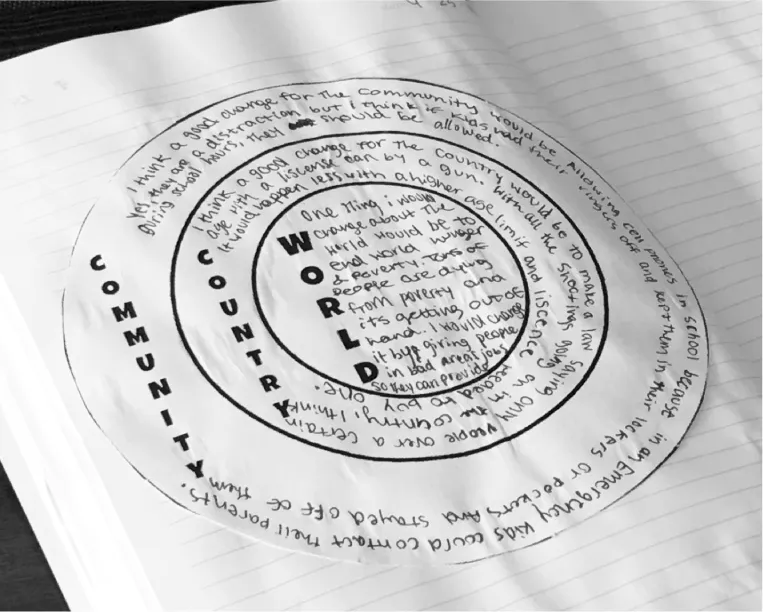
For the example inquiry-based writing unit, I want my students to live like science journalists, noticing the world around them and their impact on the world. The daily read-alouds help to build studentsâ world knowledge and introduce subjects that might pique their interest. After we read Mary Griggâs infamous poop article together, for instance, I ask students to write about ideas and aspects that they would like to change in their community or globally. Figure 1.1 illustrates the organizer that they copy and complete in their English notebooks. After completing the organizer, students share ideas in small groups, then I ask students to narrow down their ideas and select two topics that pique their interest. Then, students spend a class period conducting preliminary research, gathering the Five Ws (who, what, where, when, why) about these topics in their writerâs notebooks.

FIGURE 1.1 The âWhat Do You Wish You Could Change About the World, Country, and Community?â graphic organizer allows students to brainstorm possible topics they want to research and write more about.
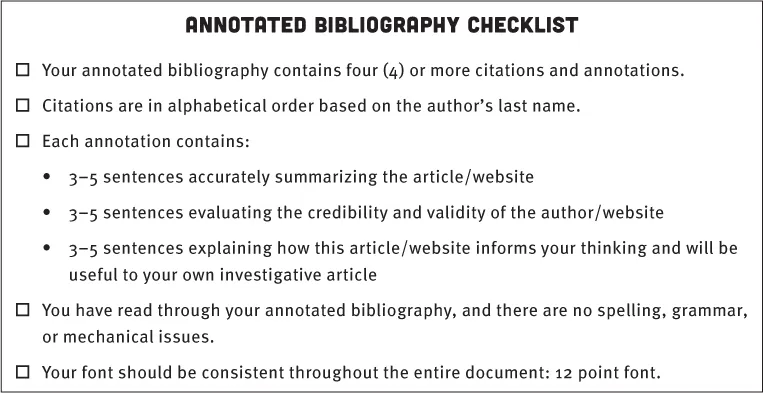
Over the course of two class periods, students narrow down their interests and commit to one topic. They then spend more time digging deeper to investigate the topic, gathering information to answer questions they had about their topic, as well as refining and developing more questions. Students spend a week in class reading and researching information that will help them better understand their topic, narrow down their topic, and give their own writing credibility. Based on their research, students then compile an annotated bibliography (see Figure 1.2) with four or more reliable and valid sources they used and will reference in their feature article.

FIGURE 1.2 Presenting the Annotated Bibliography Assignment as a checklist helps articulate the requirements and expectations for the completed assignment.
The New York State Next Generation Writing Standard W6 requires eighth-grade students to âconduct research to answer questions, including self-generated questions, drawing on multiple sourcesâŚgenerate additional related questions that allow for multiple avenues of explorationâ (2017). When students develop their own questions, they have ownership of the topics they are writing about. All writing is grounded in solid research, and when students develop questions and conduct research to help answer those questions they are empowered learners supporting their own learning process.
Not all students learn the same, so some of your students may need additional supports with their writing. Among the scaffolding tools I create to support my students with learning or language differences are graphic organizers to break multistep assignments into bite-size pieces. Graphic organizers are helpful tools for brainstorming, planning, and organizing information before writing or executing a project. This system of support is similar to an outline, breaking down a project into smaller pieces.
Figure 1.3 for example, highlights part of the Annotated Bibliography graphic organizer that I post on for all students in Google Classroom. (To access the full graphic organizer, scan the QR code.) Depending on the studentsâ abilities, you might reduce the quantity of annotations to support their learning needs.

Annotated Bibliography
DIGITAL CURATION TOOLS: THE 21ST CENTURY ANNOTATED BIBLIOGRAPHY
Creating an annotated bibliography is a traditional secondary school and college assignment, but itâs not the only way to manage research resources. Especially for upper-elementary students an...
Table of contents
- Cover
- Title Page
- Dedication
- Copyright
- About ISTE
- About the Author
- Acknowledgments
- Contents
- Foreword
- Introduction
- Chapter 1 Inquiry-Based Writing: Investigative Science Research, Infographics, Writing, and Podcasting
- Chapter 2 Multigenre Writing: Blending English and Social Studies to Examine the Holocaust and World War II
- Chapter 3 Essay Writing
- Chapter 4 Poetry: Traditional, Visual, Makerspace
- Chapter 5 Writing, Robots, Makerspaces, and More
- Chapter 6 Real-World Writing: Writing Skills to Succeed Beyond School
- Conclusion
- References
- Index
- Back Cover