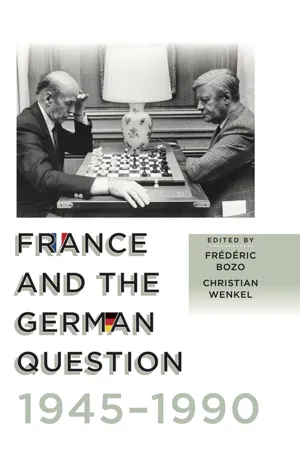
In the immediate aftermath of World War Two, the victors were unable to agree on Germany's fate, and the separation of the country—the result of the nascent Cold War—emerged as a de facto, if provisional, settlement. Yet East and West Germany would exist apart for half a century, making the "German question" a central foreign policy issue—and given the war-torn history between the two countries, this was felt no more keenly than in France. Drawing on the most recent historiography and previously untapped archival sources, this volume shows how France's approach to the German question was, for the duration of the Cold War, both more constructive and consequential than has been previously acknowledged.
eBook - ePub
France and the German Question, 1945–1990
- 308 pages
- English
- ePUB (mobile friendly)
- Available on iOS & Android
eBook - ePub
France and the German Question, 1945–1990
About this book
Trusted by 375,005 students
Access to over 1.5 million titles for a fair monthly price.
Study more efficiently using our study tools.
Information
PART I
FROM CAPITULATION TO COOPERATION
CHAPTER 1
FRANCE AND THE GERMAN QUESTION, 1945–1949
ON THE INTERDEPENDENCE OF HISTORIOGRAPHY, METHODOLOGY, AND INTERPRETATIONS
RAINER HUDEMANN
France still has the widespread reputation of having led a pure revenge policy in Germany in the early postwar years.1 According to many authors, it was Allied pressure on France at the Moscow conference of foreign ministers in 1947, or Robert Schuman’s plan for the European Coal and Steel Community (ECSC) in 1950, or the Elysée Treaty signed by General de Gaulle and Federal Chancellor Konrad Adenauer in 1963, that subsequently led to change in French policy, eventually allowing Franco-German reconciliation. The Nobel Committee referred to such a narrative when it awarded its Peace Prize to the European Union in 2012.2
Yet this image of French policy has been profoundly revised by broad historical research conducted over more than three decades.3 It had long been underestimated how profoundly French international policies started to change from 1944–45 onward, creating the paradigm of crisis and cooperation that has characterized Franco-German relations until the present. This change resulted from French decision makers’ efforts to understand the origins of the two world wars and from their willingness to determine the conditions for restoring France’s international position. As early as late summer 1945, the democratization of Germany, aimed at preventing new wars by transforming German society, became the third pillar of French security policy alongside the traditional goals of military security and economic enhancement, which had failed to establish a durable Franco-German peace after 1919. From summer 1945 on, a partition of Germany was looming as a result not only of the emerging Cold War, but also of the creation of two reparation zones at the Potsdam Conference and the rapid transformation of eastern German society by the Soviets. This only underlined the importance of a French contribution to forging a peaceful Western German society; international relations and reform of German society were thus intimately intertwined in the French approach to the German question, which from then on went far beyond the sheer issue of Germany’s division.
It gradually emerged that historical analysis of France’s attitude toward the German question after 1944–45 had to take into account a very large variety of domains simultaneously instead of isolating them from each other: from domestic to international politics, from diplomatic and military decisions to decision-making processes on the ground, from the dismantling of industrial plants to the physiology of nutrition, from currency and economic order theory to cultural policy, from informal structures of communication to specific decision-making processes, from so-called public opinion to administrative structures, from long-term experiences and stereotypes to innovative ideas and their origins after the two world wars. Only broad historical research of this kind can meet the methodological challenge of such complex situations and explain former misinterpretations.4
This chapter will first outline the advancement of this highly complex research process. We will then describe the contents of France’s constructive policies in Germany, which are less widely known than its policies on the international level. The following section will analyze the underpinnings of the constructive political concepts and practices that characterized France’s German policies. Finally, we will explore the interconnections between the international and the binational levels of these policies. As the international level is the priority in this volume, basic level and fundamental consequences of occupation policy, which are less known but have generated fundamental findings relevant to the international level, will be emphasized.5
Traditional Interpretations and Their Limits
According to the traditional approach, French policy essentially included the following components: dismembering Germany, separating the left bank of the Rhine, taking revenge for German warfare and war crimes, reinstating the security measures of 1919,6 resorting to obstruction in the Allied Control Council (the quadripartite governing body in Berlin) regarding measures concerning Germany as a whole, and strictly controlling German politics and administration.
Wilfried Loth summarized the traditional assumptions in 1983 by distinguishing between two contrary concepts: domination, following the Erbfeindschaft (hereditary enmity) tradition, and integration, represented by de Gaulle and the French resistance.7 But in reality, it was precisely the interconnection and interaction between such apparently contradictory elements that created the dynamics of Franco-German rapprochement and cooperation in the second half of the twentieth century. Already in 1962, the first general survey of French occupation by Frank Roy Willis differentiated among the various policies pursued by France after 1945.8 Raymond Poidevin and, in the following generation, Georges-Henri Soutou, among others, have discussed the validity of some of these elements early on.9 Over time, most of the features that have been attributed to French policy proved to be if not outright wrong, then at least far more complex or ambivalent, and reflecting only a minor part of France’s actual policies on the ground.10
Several factors explain this. “Filters of perception,” a term used by Hélène Miard-Delacroix in analyzing how, in the 1950s, old stereotypes (les vieux démons, or the old demons) fundamentally handicapped senior French officials in comprehending the profound changes Germany had been undergoing since the war, as illustrated first and foremost by French high commissioner André François-Poncet himself.11 But such filters were (and continue to be) effective on the German side as well. They have multiple origins. The myth of Franco-German Erbfeindschaft (which was of course an invention of the 1870s) was a powerful factor in German expectations toward French behavior after the German capitulation on 8 May 1945, and it remained strong in German and French media as well as in aspects of historiography for a long time. Nazi propaganda had anticipated a policy of annihilation, if not extermination, in case of Allied victory, a policy that had in fact been Nazi policy throughout great parts of Europe just previously. So when a famine occurred in Germany in 1946, even the Hartmannbund (the leading group representing German doctors) denounced what they represented as an Allied war by famine against Germany. In fact, the exact opposite was the case. Famine and black market were the consequence of the total breakdown of the hidden, silent, and amateurish Nazi economic and financial policies, and of the end of the exploitation of the occupied countries during the war.12 France, itself suffering from scarce nutrition, could not provide nutrition parcels as did the United States, a situation that seemed to confirm the erroneous interpretation of French exploitation policy. The destruction of southwestern Germany in the seventeenth century Palatine wars of Louis XIV—the ruins of the Heidelberg castle are famous throughout the world—was as rooted in collective memory as the struggles with Napoleon and the sometimes authoritarian behavior of French troops during the occupation of the Rhineland after 1919. These and other deeply engrained memories prepared the ground for efficient filters of perception: people often saw the policy they expected to see, and in their discourses of memory many recounted what they “saw,” and not what was really happening.
A second issue relates to sources. The interpretation of French policy with regard to Germany has indeed been widely influenced by the use of American documents on post-1945 Germany (published from 1960 onward), creating at least two series of problems. First, the American perception of French policies has long been influenced by the French defeat of 1940, which turned the country into a minor partner in American—though less so in British—eyes, by an underestimation of French resistance against the Vichy regime (which the United States supported for a long time), and by the severe conflicts that pitted de Gaulle against the Anglo-Saxons in 1944–46 (whether during the invasion of Germany, in the conflict over Aosta, or in Lebanon and Syria). Because French archives were not yet accessible in the 1960s, American documents (and therefore U.S. positions) often served as a source for understanding French ideas and policies, thereby creating an important bias.
Second, Soviet policy and the process leading to the Cold War was analyzed more accurately by French diplomacy than by American diplomacy in 1945. Some historians like Ernst Deuerlein (whose erroneous idea of a systematic French policy of obstruction in the Allied Control Council is still influential) were prone to read these American sources based on their own prejudices while, in fact, a thorough reading and evaluation of these documents could and should have led much sooner to a far more nuanced view of French policy on an international level.13 The discovery that the French government in its own zone implemented certain important decisions of the Allied Control Council that the British and Americans had refused—for example, the fundamental reform of social security concerning the whole population—gave the impetus for a thorough reexamination of French texts and policy on the quadripartite level, taking seriously the French conception of central Allied offices for administering a unified Germany.14 At the same time, Paris was—like London but unlike Washington—acutely aware of Soviet efforts to secure unilateral control of the German-headed central agencies they had created starting in June 1945 in Berlin.
A third issue stems from translation and ambivalence. Filters of perception are more difficult to identify when they contribute to simplified or inaccurate translations. One characteristic example is de Gaulle’s famous 1945 statement, “Plus de Reich centralisé” (no more centralized Reich), which has been frequently used as evidence of an alleged French policy of dismembering Germany. Although a grammatically accurate reading of this phrase points to the acceptance of a Reich, albeit one with a decentralized, federal structure, the fear of a dismembering of Germany often (and wrongly) influenced—and still influence—interpretations of the phrase in the sense of an annihilation of the Reich altogether, followed by the installation of a federation of independent states. But, in fact, establishing several independent German states was primarily an American concept, not a French one.15
A fourth issue revolves around discourse and actual policies. A main criterion for interpreting the former must be analyzing the latter; texts alone are not sufficient. It is therefore important to distinguish between the public proclamations that are relevant for policy, and those that are not significant. When the public speeches of de Gaulle in the occupation zone in October 1945 giving orders for Franco-German cooperation in order to materially and morally reconstruct Germany were followed by precise orders of the military government and a long series of concrete realizations, such speeches were not mere rhetoric, but must be taken seriously.16 De Gaulle often used volu...
Table of contents
- Cover
- Title Page
- Copyright Page
- Contents
- List of Abbreviations
- Introduction
- Part I. From Capitulation to Cooperation
- Part II. The Emergence of the Bloc System
- Part III. The de Gaulle Factor
- Part IV. The Era of Ostpolitik
- Part V. The End Game
- Part VI. Enduring Concerns: Anschluss, Borders, and the Two Germanys
- Index
Frequently asked questions
Yes, you can cancel anytime from the Subscription tab in your account settings on the Perlego website. Your subscription will stay active until the end of your current billing period. Learn how to cancel your subscription
No, books cannot be downloaded as external files, such as PDFs, for use outside of Perlego. However, you can download books within the Perlego app for offline reading on mobile or tablet. Learn how to download books offline
Perlego offers two plans: Essential and Complete
- Essential is ideal for learners and professionals who enjoy exploring a wide range of subjects. Access the Essential Library with 800,000+ trusted titles and best-sellers across business, personal growth, and the humanities. Includes unlimited reading time and Standard Read Aloud voice.
- Complete: Perfect for advanced learners and researchers needing full, unrestricted access. Unlock 1.5M+ books across hundreds of subjects, including academic and specialized titles. The Complete Plan also includes advanced features like Premium Read Aloud and Research Assistant.
We are an online textbook subscription service, where you can get access to an entire online library for less than the price of a single book per month. With over 1.5 million books across 990+ topics, we’ve got you covered! Learn about our mission
Look out for the read-aloud symbol on your next book to see if you can listen to it. The read-aloud tool reads text aloud for you, highlighting the text as it is being read. You can pause it, speed it up and slow it down. Learn more about Read Aloud
Yes! You can use the Perlego app on both iOS and Android devices to read anytime, anywhere — even offline. Perfect for commutes or when you’re on the go.
Please note we cannot support devices running on iOS 13 and Android 7 or earlier. Learn more about using the app
Please note we cannot support devices running on iOS 13 and Android 7 or earlier. Learn more about using the app
Yes, you can access France and the German Question, 1945–1990 by Frédéric Bozo, Christian Wenkel, Frédéric Bozo,Christian Wenkel in PDF and/or ePUB format, as well as other popular books in History & 20th Century History. We have over 1.5 million books available in our catalogue for you to explore.