A global journey of four generations of fathers and sons as they cope with grief and loss.
In 1978, Jakub Slucki passed away peacefully in his sleep at the age of seventy-seven. A Holocaust survivor whose first wife and two sons had been murdered at the Nazi death camp in Chelmno, Poland, Jakub had lived a turbulent life. Just over thirty-seven years later, his son Charles died of a heart attack. David Slucki's Sing This at My Funeral: A Memoir of Fathers and Sons tells the story of his father and his grandfather, and the grave legacy that they each passed on to him. This is a story about the Holocaust and its aftermath, about absence and the scars that never heal, and about fathers and sons and what it means to raise young men.
In Sing This at My Funeral, tragedy follows the Slucki family across the globe: from Jakub's early childhood in Warsaw, where he witnessed the death of his parents during World War I, to the loss of his family at the hands of the Nazis in April 1942 to his remarriage and relocation in Paris, where after years of bereavement he welcomes the birth of his third son before finally settling in Melbourne, Australia in 1950 in an attempt to get as far away from the ravages of war-torn Europe as he could. Charles (Shmulik in Yiddish) was named both after Jakub's eldest son and his slain grandfather—a burden he carried through his life, which was one otherwise marked by optimism and adventure. The ghosts of these relatives were a constant in the Slucki home, a small cottage that became the lifeblood of a small community of Jewish immigrants from Poland. David Slucki interweaves the stories of these men with his own story, showing how traumatic family histories leave their mark for generations.
Slucki's memoir blends the scholarly and literary, grounding the story of his grandfather and father in the broader context of the twentieth century. Based on thirty years of letters from Jakub to his brother Mendel, on archival materials, and on interviews with family members, this is a unique story and an innovative approach to writing both history and family narrative. Students, scholars, and general readers of memoirs will enjoy this deeply personal reflection on family and grief.
Frequently asked questions
Yes, you can cancel anytime from the Subscription tab in your account settings on the Perlego website. Your subscription will stay active until the end of your current billing period. Learn how to cancel your subscription.
At the moment all of our mobile-responsive ePub books are available to download via the app. Most of our PDFs are also available to download and we're working on making the final remaining ones downloadable now. Learn more here.
Perlego offers two plans: Essential and Complete
Essential is ideal for learners and professionals who enjoy exploring a wide range of subjects. Access the Essential Library with 800,000+ trusted titles and best-sellers across business, personal growth, and the humanities. Includes unlimited reading time and Standard Read Aloud voice.
Complete: Perfect for advanced learners and researchers needing full, unrestricted access. Unlock 1.4M+ books across hundreds of subjects, including academic and specialized titles. The Complete Plan also includes advanced features like Premium Read Aloud and Research Assistant.
Both plans are available with monthly, semester, or annual billing cycles.
We are an online textbook subscription service, where you can get access to an entire online library for less than the price of a single book per month. With over 1 million books across 1000+ topics, we’ve got you covered! Learn more here.
Look out for the read-aloud symbol on your next book to see if you can listen to it. The read-aloud tool reads text aloud for you, highlighting the text as it is being read. You can pause it, speed it up and slow it down. Learn more here.
Yes! You can use the Perlego app on both iOS or Android devices to read anytime, anywhere — even offline. Perfect for commutes or when you’re on the go. Please note we cannot support devices running on iOS 13 and Android 7 or earlier. Learn more about using the app.
Yes, you can access Sing This at My Funeral by David Slucki in PDF and/or ePUB format, as well as other popular books in History & Holocaust History. We have over one million books available in our catalogue for you to explore.
When I was little, I don’t remember how old, coming back from some summer holiday away, squeezed into our beat-up old Mitsubishi Sigma, Dad insisted on taking a detour through his childhood neighborhood, Carlton. He guided us through the broad thoroughfares, with their mix of grand Victorian mansions and tiny Edwardian workers’ cottages; down Lygon Street, the commercial and cultural center now lined with tourists and below par Italian restaurants; the narrow laneways, with their endless cast of characters from our parents’ past. We didn’t often come to this side of town. There was no need to drive the forty-five minutes to a neighborhood that held only sentimental value. On that day, the fact that it was on the way home was a chance for us to play tourists in our own city. Dad reveled in it: that was where this family lived; here was the old bookstore; there’s the old Yiddish library; here’s the median strip where we used to play cricket. He got to tell his old stories, bring the characters of postwar Jewish Carlton to life. Actually, he lived in North Carlton, but Carlton was really a mythical space that existed beyond its actual boundaries. It was a suburb where Polish Jewish migrants rubbed shoulders with immigrants from Italy, Greece, Malta, and Yugoslavia.
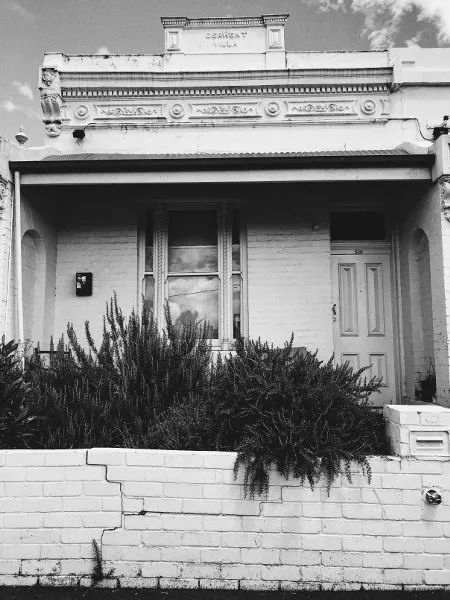
And there, in the middle of it all, was 501 Canning Street, where Zaida Jakub and Bubba Eda carved out their own tiny slice of Jewish Poland. A tiny, Victorian-era cottage, barely ten feet across, one among dozens on their block, indistinguishable in the rows of workers’ cottages that dot Melbourne’s inner city. If you went today, it would look much the same, frozen in time. The cars, much more expensive, much more modern, the only thing that would signal you’d stepped out of the 1950s. But there was something special about that address, the beating heart of a community. Unassuming on the outside, run down on the inside, but always full of food, people, laughter, tears, and life. Step in from the quiet streets of North Carlton and you were transported back to a workers’ club in Eastern Europe, where socialism ruled the day, the guttural, lyrical dialects of Yiddish filled the air, and there was always a bowl of soup or a slice of herring for the guests.
501 Canning Street, Photograph by Cara Mand.
501 Canning Street: somewhere between a community center, a halfway house, and a party headquarters. A private home transformed each night into a public sphere, a working-class salon, where the problems of the world were negotiated over a drink, where the concept of family was fluid, inclusive. A house where passions flared, where tensions simmered, and no one was turned away. A house I only ever saw from the outside, but knew its inner workings intimately. An environment Helen and I have tried to emulate, mostly unsuccessfully. Too stressful, too noisy for us. It was a unique atmosphere, impossible to replicate. How did they do it, I wonder?
• • •
In 2017, the United Nations High Commissioner for Refugees reported that there were 65.6 million forcibly displaced people in the world, including 22.5 million refugees and 10 million stateless people. Amidst protracted and bloody wars in Syria, Afghanistan, South Sudan, and many other countries, the flow of desperate people seeking safety and shelter closely resembles my parents’ and grandparents’ flight from their historic homes. Squint and these millions of displaced Afghans and Syrians could be Jews fleeing the rubble of central Europe. The world’s indifference to their struggles is eerily like its antipathy to Jews in the 1930s and 1940s.
• • •
Helen, Arthur, and I are immigrants. The lucky kind, far removed from these masses of asylum seekers and displaced persons. Rare success stories in a globalizing world. Forced to leave only by a contracting academic job market, we are immigrants by choice. We came to the United States on temporary work visas in 2013, then graduated to green cards after a few years, a sign of permanence, insofar as anything is permanent. I don’t know if we’ll apply for citizenship one day, but for years we’ve lived here, paid taxes, worked with young people, forged friendships, participated in our local community. It took a long time for me to come to terms with that word, immigrant. We weren’t immigrants, we said. We weren’t settling permanently, and in any case, immigration to me was always something you did out of desperation, despair. We came here for work, not because we were forced out. We could go home whenever we wanted, our family was still there, our friends, our football team. Life would be just as we left it, wouldn’t it?
To us, being an immigrant meant something completely different. Immigrants came to a new country and didn’t speak the language, didn’t have jobs or money. Life as an immigrant was difficult, an obstacle to overcome. If you were an immigrant, you couldn’t just pack up and move to another new country. Immigration was a statement of permanence, a new life, a break from the old. A set of circumstances thrust upon you, not something you chose. Our grandparents were immigrants, not us. All those Syrians and Afghans are immigrants, right? What are we, who choose this path, who can decide where on earth we want to settle and raise a family? What should we call ourselves, we who are in so many ways embedded into the white, urban, American middle class, so steeped in American culture and politics?
“Emigration is no light matter,” Zaida wrote to Mendel in 1955. After a decade traversing the globe, looking for somewhere to settle, he would have known. Even for those in the luckiest category, like us, there are major hurdles to overcome. Paperwork, uncertainty, endless waiting, endless scrutiny, invasive tests, interrogation. No freedom of movement for a period, everything we do possibly affecting our status. A feeling of being the outsider. And, for better or worse, we are the fortunate ones: Australian, white, college professor, living in Charleston. Still, we have many decisions to make about how we relate to this place, how we want Arthur to relate to it. What kind of accent will Arthur have? American? Southern? How will we feel about it being different from ours? What sort of feeling of Australianness do we want him to have? What about when we live in a place whose political culture is so different from ours, where Confederate flags wave proudly and people carrying weapons is a daily fact? Where the call for liberty often comes at the expense of those most vulnerable, at home or abroad? Where racial segregation is still so obvious, decades after being outlawed? Where white supremacists and Nazis marched the streets in 2017, more than seven decades after the Nazis were defeated, 150 years after the fall of the Confederacy? How do we connect to a place whose history is so remote from ours? What kind of Jewishness do we want to pass on, when the local Jewish community is so unlike ours?
The longer we lived in the United States, the more we saw the gaping cultural abyss. We accepted it but never felt at home. The legacy of slavery, the presence of guns, the pervasive Evangelical Christianity are simply parts of the daily vernacular here. “Which church do you go to?” we were often asked when we first arrived. I gave a talk on Jews in Eastern Europe to a local theatre group shortly after arriving. After naïvely, glibly, stating that I was an atheist—a label I’m now not so sure about—I was surprised at the audible gasp from the small audience of genteel southerners. There is also the unofficial segregation that continues to dot the urban landscapes, decades after desegregation. I am daily astonished at the obvious link between class and race in this city, and the way in which the racial makeup of neighborhoods seems to change block to block.
These issues all dovetailed in June 2015, while we were home visiting our family in Melbourne. That Wednesday night in Charleston, Thursday morning in Melbourne, white supremacist Dylann Roof entered the historic Emanuel AME Church in downtown Charleston, opened fire, and murdered nine parishioners. Two blocks from Arthur’s school; four blocks from our offices; one mile from our house. I caught wind of it on Twitter, early on a Thursday morning in Melbourne, and was glued to my phone the rest of the day. The rest of the month really. Concerned for my friends and colleagues, my community, my neighborhood, I followed it obsessively.
And then, in October 2018, a gunman murdered eleven Jews in a synagogue in Pittsburgh while shouting that “all Jews must die.” Another reminder of our vulnerability, a reminder that perhaps we ought to hide our Jewishness, not be too conspicuous. A sign that maybe we weren’t as safe or as welcome as we’d thought. Between the violence in our backyard and the violence targeting the Jewish community to which we belong, our sense of security is balanced on a tightrope, ready to collapse at the slightest tremor in the political landscape. Is this really a place for us to raise our son?
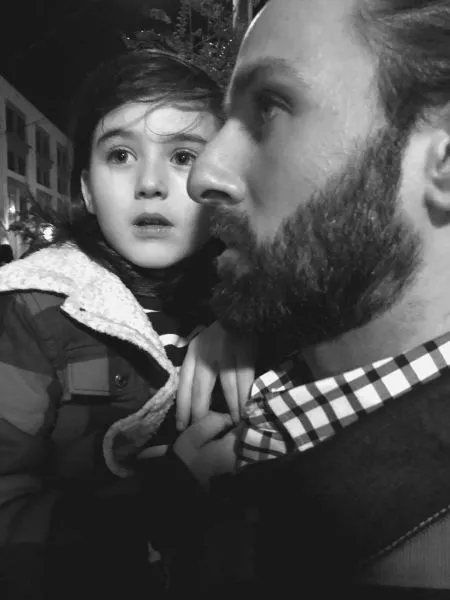
Arthur and I at a Charleston vigil for the victims of the shooting at the Tree of Life Synagogue in Pittsburgh. Earlier, I had been one of the speakers at the Holocaust memorial in Marion Square. This photo was taken as the vigil continued outside the Mother Emanuel AME Church, where a white supremacist murdered nine parishioners three years earlier. Charleston, South Carolina (October 28, 2018).
Australia has deeply rooted problems with racism, misogyny, a growing Far Right. Its political landscape is beginning to resemble the circus of American political life. But mass shootings are not a fact of life where we grew up. For Arthur, they will be. They are. How do we explain it to him? Whatever other challenges we face integrating into American life are immaterial in the face of material fears of violence, of not knowing how many people walking down King Street are packing heat. This is a cultural hurdle among many that is difficult to overcome. Daily we see these cultural differences. There are barriers to participation in American political life, and often it feels like we speak a different language. Almost every single day we are asked, interrogated, about where we are from, what we are doing here. Always very friendly, but a constant reminder that we are outsiders.
• • •
If immigration is principally about moving somewhere better, safer, more prosperous, we may have gotten it backward. On all statistical measures—life expectancy, health care, schools, safety, jobs, quality of life—Australia is ahead of the United States, Melbourne streets ahead of Charleston. Melbourne: the world’s most livable city, whatever that means. Better public transport, I think. According to the Economist. Up there with Tokyo, Vienna, Vancouver, Toronto. Culturally vibrant, multicultural, with socialized medicine. Why did we leave? I’m not sure. Why would anyone leave when you read that? Maybe I just idealize it too much, a form of homesickness. The grass is always greener and all that. That’s right, I couldn’t get a job. Contracting academic job market. Some things are the same everywhere.
What am I complaining about? We live in a cosmopolitan city, earn enough money in our white-collar jobs, live in an upscale part of town. The challenges we face pale in comparison to those of my parents and grandparents. First-world problems, really. We can’t even compare our experiences, although it often serves as a frame of reference.
I think often about how it was for Zaida, moving to a new country for the third (or was it fourth) time. He was very concerned that Dad and his sister, Miriam, were growing up as Australian kids at the expense of their yiddishkayt, their Jewishness. It pained him that although Sluggo and his friends all spoke Yiddish fluently, among themselves they spoke English, even at Yiddish Sunday school. “That’s just how life goes,” he lamented to Mendel in 1958, resigned to raising an Australian son, a faint hint of disappointment in his tone. Shmulek II would never become the serious bearer of Polish-Jewish civilization that Shmulek I might have turned out to be. The war years had taken care of that. More likely to be a larrikin, an easygoing, irreverent Aussie kid.
• • •
Jakub and Eda Slucki arrived in Melbourne on March 9, 1950, aboard the SS Cyrenia, their moonfaced, Francophone toddler in tow. The Cyrenia was then a forty-year-old Greek liner that had recently been converted into a passenger ship transporting displaced persons from Genoa to Melbourne, a trip it made a handful of times between 1949 and 1956, when it was retired. Like those on board, the old ship had seen a lot in its time. It had been a passenger ship, had been requisitioned as a military carrier, before being transformed into a commercial ship operating between Australia, New Zealand, and North America. In the late 1940s, its final assignment was to bring weary refugees to their new homes, far away from the smoldering ashes that they had left behind. A fitting duty for the ship that had, along with its cargo—desperate refugees dehumanized by the latest Thirty Years’ War—seen the best and worst the twentieth century had to offer.
When they arrived, my family’s nationality was listed as Polish, a step above the “Stateless” stamp that many carried, but not a designation that carried much comfort. As quickly as they could, on August 2, 1957, they shed that formal attachment to become Australian citizens, something into which I don’t think they ever fully grew. I don’t know if they attended a citizenship ceremony, or how they felt about being Australian. Certainly, they were grateful that Australia took them in when they were homeless. But there remained a gap between them and their Australian-raised children. They were stateless, in spirit at least, whether they liked it or not.
They came alone, their visas sponsored by Sender Burstin, an old friend of Zaida’s from Włocławek who had arrived in Melbourne in the late 1920s. Burstin had founded the first Bund club in Melbourne in 1928 and was a stalwart of the Yiddish community. His earnest, bespectacled brow stared down on us at the Kadimah and Waks House through our childhoods.
A year after they disembarked, Bubba’s parents and sisters joined them, all cramming temporarily into that cottage on Canning Street. More comfortable probably than their home in interwar Poland, and luxurious compared to what they had lived in during their Soviet exile. But still a small, nineteenth-century workers’ cottage housing an extended family. They moved shortly after to a house around the corner, so that they’d be just a stone’s throw from Bubba and Zaida. A few years later Bubba and Zaida welcomed a daughter, Miriam, into the world. Six years Dad’s junior, Miriam was the apple of Zaida’s eye. After three sons, finally a daughter to dote on. Theirs was a special bond, unencumbered by the same expectations placed on the first born into the new generation. Less pressure on the younger sibling; less pressure on the daughter. Little Shmulek was happy to have a baby sister, although he’d wanted a brother. “I am happy that you have born a sister for me,” he wrote to Bubba in the hospital, not allowed yet to visit. In a separate Yiddish note, he made sure to tell them that he missed them and couldn’t wait for them to come home.
Life was difficult for the immigrant Sluckis. The language was tough to pick up, the customs difficult to adapt to. They had to find homes and jobs, learn a new language, navigate the unfamiliar streets, pick up the social cues, adapt to the broader culture. I’m not sure Zaida ever learned to speak English particularly well. To be fair, he already spoke Yiddish, Polish, Russian, and basic French, and probably had a smattering of German and Hebrew also. But the language was a constant source of frustration for him. He was forty-nine when he arrived, a broken man. He had just lived for two years in a place where he didn’t speak the language, now he had to pick up another one. Not so easy for a weary old Jew.
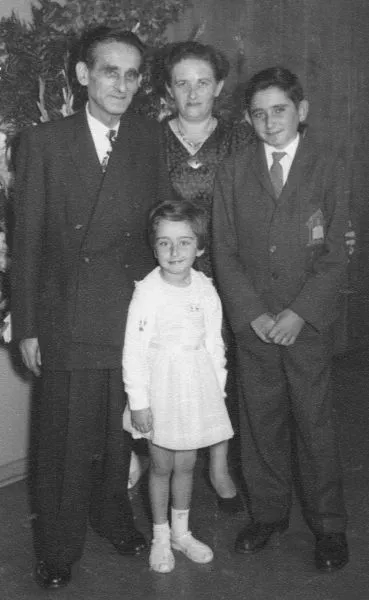
Family Portrait (ca. 1961).
Nothing so unusual or unique there—a typical immigrant story. And Australia wasn’t the worst place to be doing it. It was a young country still, with a tradition of immigration, even if the immigrants tended to be predominantly British until the 1950s. By the time Bubba and Zaida came, there was at least a Polish-Jewish community that had put down its roots in Melbourne. When they arrived, there were cultural and religious institutions, Jewish political organizations, grocery stores and bookstores catering to a Jewish population. There was Yiddish theatre, and Yiddish n...