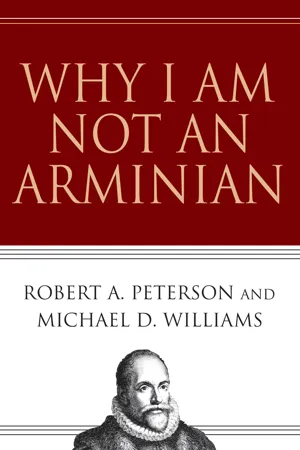
What's wrong with Arminianism?Arminian theology is sweeping through the evangelical churches of North America. While most Arminians are good, sincere, orthodox Christians, authors Robert A. Peterson and Michael D. Williams contend that aspects ofArminian thought are troubling both biblically and theologically. In particular, they argue, Arminians have too lofty a view of human nature and an inadequate understanding of God's sovereign love in Christ.
Why I Am Not an Arminian exploresthe biblical, theological and historical background to the Calvinist-Arminian debate. The irenic nature and keen insight of this book will be appreciated by laypeople, pastors and scholars alike.
J. I. Packer once observed that the very terms Calvinism and Arminianism represent an opposition: “The words are defined in terms of the antithesis, and the point is pressed that no Christian can avoid being on one side or the other.”[1] This suggests that the two ideologies—whatever each might stand for in its own right—are to be considered mutually exclusive positions. An Arminian is by definition not a Calvinist, and a Calvinist could not also be an Arminian. Whatever one stands for, the other represents its opposing perspective and thus its denial. Unfortunately, as is so often the case, an inability to affirm the other easily becomes hostility toward the other. This is especially so with ideologies or doctrinal commitments that are openly contrary. That which we cannot affirm—for it represents the denial of our commitments—must be openly and vocally opposed.
Hence, we should not be surprised that the history of the debate between Calvinism and Arminianism has been one of intense and often mean-spirited confrontation. And it has been so from the very beginning, when the Dutch theologian Jacob Arminius (1560-1609) rejected some of the basic assumptions of the Calvinist soteriology that was being taught at the Geneva Academy under Theodore Beza. Those who agreed with Arminius’s criticisms of Calvinism were called Remonstrants (“ones who complained against” the Calvinist orthodoxy of their day). The bitter controversy that erupted in the Dutch church between the Remonstrants and the Contra-Remonstrants (as the Calvinists were called) would assume national importance in the second decade of the seventeenth century, and would eventually lead to the calling of the Synod of Dort in 1618. The synod condemned the views of the Remonstrants as heretical and removed Remonstrant pastors from their posts.
Since Arminianism began as a reaction to Calvinism, it might be expected that any defense of Arminianism would be obligated to enumerate the errors of Calvinism. Yet the polemical relationship is not onesided. By and large, Calvinists feel duty bound to attack Arminianism at every possible opportunity. And far too often the debate between Calvinists and Arminians has failed to glorify God, promote understanding or honor one another as fellow members of the body of Christ. It is our aim, however, to treat our Arminian brothers and sisters in Christ as we would want to be treated.
People often assume that theological reflection is inherently polemical, that its job is to kick out the blocks from underneath the beliefs of others, that theology is properly done when one is being belligerent and adversarial. It is certainly true that polemics—showing why a particular belief is wrong—is part of the traditional kit of the theologian. The discipline of theology may even be depicted as having arisen for the purpose of polemical engagement with false understandings of the gospel and the Savior. The early church period (from the end of the New Testament era to the time of Nicaea [A.D. 325]) was typified by a wide range of belief concerning the nature of the Gospel and understandings of Jesus as the Savior and his relationship to God. Men like Irenaeus and Tertullian engaged in theological reflection in order to rid the church of heresy. Yet both men understood that polemics is no replacement for constructive theology and, indeed, that polemic is itself ultimately grounded in advocacy. Early Christian theologians opposed certain understandings of the gospel and the Savior because they were committed to the truthfulness of other positions, and those commitments informed and undergirded their arguments against false understandings. The work of the polemicist is never neutral or fully objective. Nor is it an end in itself. Polemic must serve advocacy. Polemic is subordinate to and serves theological construction.
Falsehood and truth bear an ironic relationship to one another. When one argues for a position as true, the argument includes an implicit denial of all counter claims. An argument in favor of supernaturalism implicitly denies naturalism. Arguing against a position or belief, however, does not automatically commend or advocate a counter belief. The false-choice fallacy, which suggests that if a claim is false, its counter claim is true, is false because a counter claim, even a claim that is designed to be the polar opposite of a known falsehood, may be just as false as the other option.
Positively stated, the false-choice fallacy suggests that constructive argument is stronger than polemical. Even the argument that has a polemical intention is best couched as an affirmation. We say this for two reasons. First, the strictly polemical, an argument that is simply negative, commends no belief. Such arguments are valid only as warnings against that which is evil or dangerous (e.g., arsenic is not a suitable coffee additive; racism is evil). In theological discourse, however, polemic alone merely removes options without giving its hearer guidance into what should be believed. If a broadside against a particular view of the millennium gives people no guidance about how they ought to believe concerning a biblical vision of the future, it may only sour its hearers against all biblical eschatology.
The second reason polemic is best pursued through affirmative construction is simply that the best argument against false doctrine is the proclamation of truth. It was the faithfulness of early Christian apologists to the biblical depiction of Jesus as God incarnate who came to save sinners that put to flight the false understandings of Christ held by such heretical groups as the Ebionites and the Marcionites. The best defense is a good offense. And the best theological offense is fidelity to the Word of God.
Students often come to seminary with the idea that theology is fundamentally a polemical enterprise, that the truest mark of orthodoxy is that one shares nothing in common with that which is false. The student has been taught that a particular belief is false, even dangerous to the faith. It then becomes a matter of religious necessity to put as much theological distance as possible between oneself and the falsehood. And one does this by rejecting every point of the false doctrine. Indeed, orthodoxy is found in the rejection. The thought seems to be that if one rejects what is false, he will find truth. But truth is not merely the denial of falsehood. Truth must be sought, and sought for its own sake.
It might be argued that the most hotly contested debate within the churches of the Reformation has been the Calvinist-Arminian controversy. It is certainly the most long-lived. The debate has produced so much literature over four centuries that it is difficult to get a handle on. Further, the debate has been so dominated by caricature, epithet, shibboleth and anathema that clarity on the issues has suffered. Declaring the other side heretical has often been more important than finding the biblical truth. The Arminian believes that he is capable of making significant contribution to his own salvation, and this destroys the gospel. He is a heretic. The Calvinist believes that God has foreordained the salvation of some while damning all others, and thus destroys the gospel call to believe. He is a heretic. Of course, in our condemnation of all who demur from our own doctrinal insights—and we are always orthodox, of course—we are simply carrying forth a time-honored Christian approach toward those with whom we disagree over doctrine. Sadly, the perception has been created that all doctrinal commitment serves as an agenda of hatred, bigotry, divisiveness and intolerance.
Well, if polemic is so dangerous, why on earth would anyone write a book entitled Why I Am Not an Arminian? Doesn’t that title demand a polemical presentation? And given the nature of this particular debate, doesn’t a book like this promise to be just one more broadside against the heretical side? Well, yes, it does demand polemics, but we hope that we will not present the usual caricatures, name calling and easy dismissals. If we had our druthers, we would have preferred to write a biblical presentation of Calvinism, a Why I Am a Calvinist book. But InterVarsity Press prevailed upon us to write under this title so that the book would complement another title: Why I Am Not a Calvinist. Thus we accept the polemical nature of the project. And as Calvinists we will put forth our argument against Arminianism. But to be honest, our true goal is to commend and defend Calvinism. We believe that we are obligated to say this because the answer to the question “Why am I not an Arminian?” is that we are Calvinists. We believe that Calvinism is true to the intent and content of Scripture. Because of our commitment concerning the character of the biblical faith, we are not predisposed to be anti-Arminian but rather predisposed to affirm the fundamental tenets of Calvinism.
Calvinism and Arminianism do disagree regarding significant issues having to do with salvation, issues that we believe Calvinism rightly addresses and Arminianism does not. We believe that at certain points Arminianism presents a skewed picture of the gospel. The Synod of Dort was right to condemn the Arminian misrepresentation of the saving ways of God. Yet we do not think of Arminianism as a heresy or Arminian Christians as unregenerate. You see, calling someone a heretic is serious business. Heresy is not merely doctrinal error; it is damnable error. The heretic so mangles the gospel of Jesus Christ that it no longer communicates the grace of God in Jesus Christ. Heresy is such a corruption of the grace of God in Christ that it invalidates either Jesus as the Savior or grace as the way of salvation. The Arminian tradition does neither. The Arminian Christian believes that Jesus Christ is God come in the flesh to save sinners and that the saving work of Christ comes to the sinner by way of the grace of God received through faith. Whatever issues relevant to salvation we disagree upon, let us agree on this: the Calvinist and the Arminian are brothers in Christ. Both belong to the household of faith. The issue of debate is not between belief and unbelief but rather which of two Christian perspectives better represents the biblical portrayal of the divine-human relationship in salvation and the contributions of both God and man in human history.
Christians may disagree with each other, and disagree profoundly over issues close to the center of the faith, yet affirm one another as fellow believers. For some on both sides, we are sure that this might seem to subtract from the seriousness of the divide between Calvinism and Arminianism. We do not seek to devalue the issues of contention. They are real and important. The character of the elective love of God, the nature of human response to divine grace, and the relationship between God’s sovereignty and human freedom are all issues of real disagreement between Calvinists and Arminians. But neither do we want to overestimate the debate. In the division between Christianity and Islam, the Arminian is our brother. In the contention between the gospel and the cults (e.g., Mormonism, Jehovah’s Witnesses), the Calvinist and the Arminian stand together.
With all of the foregoing in mind, we will seek to write under a number of self-imposed strictures that we hope will help us in addressing the issues of the contention without adding to the strife of the debate. Far too often, polemical works are not actually targeted at the other side of the debate. That is to say, they are not aimed at engaging the other side in discussion, or at seeking to persuade the other of the plausibility or truth of the author’s own position. Many of the discussions we have read—from both sides of the debate—seem to be written to those who already agree with the author. The point often seems to be one of arming one’s own troops, giving them ammunition for future firefights. We will not follow this strategy. We write as Calvinists to Arminians, as persons who hold the Word of God precious and worthy of our most careful reflection to other believers who share that same commitment of the heart.
In order to be heard by the other side, one must describe the commitments and doctrinal positions of the other party in such a way that the other person will recognize the description as a fair representation of what he or she actually believes. We have read descriptions of Calvinists that we suspect might fit someone but certainly do not do justice to our beliefs or those of most other Calvinists. Such writing aids neither party. It will not persuade the opposing side; nor will it inform and prepare one’s own.
Therefore, to adequately describe the Arminian tradition, we will have to be careful with our sources. Both sides of this debate have advocates who do not represent the best of their own tradition, what we might call the majority report. We will seek to engage primary contributors representative of the Arminian tradition. The marginal, the eclectic and the extremist never represent the best of a tradition. Engaging such people allows the polemicist to set up straw men, i.e., people and ideas that are easy to discredit. We will seek to play the best team, representatives whom most Arminians themselves would want playing for them. By consulting some of our Arminian friends and paying attention to authors whom Arminian thinkers cite as precedent for their own arguments, we have selected a historical sample of Arminian thinkers and documents for examination. Jacob Arminius’s “Declaration of Sentiments” and the “Remonstrant Articles” are crucial early sources for the Arminian reaction to Calvinism. The thought of John Wesley is the most significant of the eighteenth century. H. Orton Wiley’s Christian Theology (1940-1943) became the modern standard, and Ray Dunning and Ken Grider have built upon Wiley’s foundation.[2]
Genuine engagement demands that we will not employ guilt-by-association arguments. Even though a platypus has a bill that is ducklike in shape, it is not a duck. Only animals that waddle, quack and have duck parents are ducks. We Calvinists have been particularly guilty of the “if it quacks like a duck” smear. We have accused Arminianism of being Pelagian, Socinian, Erasmian, rationalist and liberal. And of course, since each of those ideologies is unorthodox, by association Arminianism too must be unorthodox. But merely saying the same thing on some particular point that a liberal theologian has said does not make one a liberal. Similarity is not sameness. And similarity does not necessarily indicate influence. Doctrinal similarity may be merely the result of different people coming to similar conclusions about some issue. The latter might even be totally unaware of the thought of the earlier thinker.
Polemics often degenerate into name calling. The principle we will use here is that we will not assign names or use descriptors in association with Arminians that Arminian theologians do not themselves employ. Rather than resort to name calling, we will seek to let people name themselves. Such a goal also demands that we refrain from making charges without clear evidence or from ascribing to Arminian theologians conclusions that they themselves refuse to draw. We should not push an adversary’s position to what seems to us to be a natural consequence of the position. At best, such consequences might be a danger or tendency of a belief if overly emphasized. People usually live in the middle of their commitments rather than at their logical periphery. This is so because it is usually the case that one theological commitment within a tradition is moderated by other commitments. To no small degree, the very heart of the Calvinist-Arminian debate is about the nature of the relationship between divine action in salvation and history, on the one hand, and human responsibility in salvation and history, on the other. Both traditions seek to relate the human to the divine. Thus what is said about human agency in history will necessarily moderate statements about God’s historical relationships. It would be easy to take the Calvinist commitment to the sovereignty of God in all things, push it to some “logical conclusion” through inference, and conclude that human beings have no proper role or agency in history, that they are but puppets trapped within an utterly amoral and deterministic stage play. Yet the characterization would not be one that many Calvinists would want to claim as their own. Indeed, the vast majority of us would strenuously object that we have been misrepresented.
As noted earlier, we write quite self-consciously from within the Calvinist tradition. Our ultimate goal is to commend a Calvinist understanding of the ways of God in salvation and history as being more biblical than the Arminian interpretation. But we also know just how daunting a challenge this is in contemporary culture. Judging by the way 16 Calvinism is so easily dismissed or denigrated in contemporary literature, we must face the reality that Calvinism is no longer considered a viable theological tradition by many believers within modern Western culture. In the popular mind, Calvinism belongs to the past. It is the theological equivalent of belief in a flat earth or in bloodletting.
Why is Calvinism so unacceptable in modern society? Calvinism stands for the doctrine that all of humankind is sinful, creatures turned in upon themselves at the deepest core of their being such that they will not—and cannot—make their way to God, retrieve their own lives or earn their salvation. If humankind is to be saved, God must act. God must be gracious. Human beings are utterly dependent upon the saving grace of God. And apparently, God has not acted on behalf of all. He has not chosen to be gracious to all human beings. Sovereign in his grace, God reserves the right to shower his redemptive love upon a Jacob but not an Esau, upon Israel but not Egypt, upon Peter but not Judas.
Because Calvinism holds that God is sovereign in his grace—that no human being may presume upon grace or assume it as a given or available by right—we begin to see why Calvinism is so out of step with contemporary culture. Modern democratic society is committed to an egalitarian notion of equal opportunity for all. Any discrimination, any favoring of one over another, violates our sense of fairness. If God is good and worthy of our belief, he must be fair, giving each person the same opportunity for redemption. Since Calvinism is predicated upon a divine discrimination regarding the recipients of saving grace, it must be rejected as contrary to all our enlightened and just conceptions of the saving ways of God.
Along with this commitment to egalitarianism, modern culture has also roundly rejected the traditional doctrine of original sin, the idea that we are tainted by sin from the very beginning of our lives and unable to commend ourselves to God for salvation. A recent poll of seminary students in the United States showed that the vast majority of them believe in the essential goodness of human beings and our ability to contribute to our salvation. But the Calvinist shows that he is a disbeliever in modernity in that he accepts the ancient Augustinian doctrine of original sin (man is tainted from birth) and pervasive depravity (he cannot help himself).
And how do we play our part in our own salvation? A common belief in meritorious works is the third plank of contemporary Christian culture. Ben Franklin spoke for the American doctrine of merit in his 18 Poor Richard’s Almanac when he wrote that “God helps those who help themselves.” The idea of advancement by personal merit is as American as our belief in our ability to achieve and our commitment to equal opportunity.
Calvinism does not fit the American ideal. We might even say that Calvinism is decidedly un-American in its fundamental commitments. Instead of standing for egalitarianism, it stands for discrimination, and a divine discrimination at that. Instead of recognizing human ability, the Calvinist contends that human beings are helpless. Rather than affirm a boot-strap doctrine of merit, the Calvinist insists upon the effectiveness of divine grace.
Why would anyone be a Calvinist then? The reason is quite simple. The gospel of Jesus Christ is countercultural. Arminians can claim that their position conforms to the sensibilities of modern democratic culture and that those of the Cal...
Table of contents
Cover
Title Page
Copyright
Dedication
Contents
Acknowledgments
1: Introduction
2: Augustine and Pelagius
3: Predestination
4: Perseverance
5: Arminius and the Synod of Dort
6: Freedom
7: Inability
8: Grace
9: Atonement
Notes
Names Index
Subject Index
Scripture Index
Praise for Why I Am Not an Arminian
About the Authors
More Titles from InterVarsity Press
Trusted by 375,005 students
Access to over 1.5 million titles for a fair monthly price.
Study more efficiently using our study tools.
Frequently asked questions
Yes, you can cancel anytime from the Subscription tab in your account settings on the Perlego website. Your subscription will stay active until the end of your current billing period. Learn how to cancel your subscription
No, books cannot be downloaded as external files, such as PDFs, for use outside of Perlego. However, you can download books within the Perlego app for offline reading on mobile or tablet. Learn how to download books offline
Perlego offers two plans: Essential and Complete
Essential is ideal for learners and professionals who enjoy exploring a wide range of subjects. Access the Essential Library with 800,000+ trusted titles and best-sellers across business, personal growth, and the humanities. Includes unlimited reading time and Standard Read Aloud voice.
Complete: Perfect for advanced learners and researchers needing full, unrestricted access. Unlock 1.5M+ books across hundreds of subjects, including academic and specialized titles. The Complete Plan also includes advanced features like Premium Read Aloud and Research Assistant.
Both plans are available with monthly, semester, or annual billing cycles.
We are an online textbook subscription service, where you can get access to an entire online library for less than the price of a single book per month. With over 1.5 million books across 990+ topics, we’ve got you covered! Learn about our mission
Look out for the read-aloud symbol on your next book to see if you can listen to it. The read-aloud tool reads text aloud for you, highlighting the text as it is being read. You can pause it, speed it up and slow it down. Learn more about Read Aloud
Yes! You can use the Perlego app on both iOS and Android devices to read anytime, anywhere — even offline. Perfect for commutes or when you’re on the go. Please note we cannot support devices running on iOS 13 and Android 7 or earlier. Learn more about using the app
Yes, you can access Why I Am Not an Arminian by Robert A. Peterson,Michael D. Williams in PDF and/or ePUB format, as well as other popular books in Theology & Religion & Christian Theology. We have over 1.5 million books available in our catalogue for you to explore.