- 128 pages
- English
- ePUB (mobile friendly)
- Available on iOS & Android
eBook - ePub
Antietam National Battlefield
About this book
Approximately 110,000 soldiers of the Union and Confederate armies fought along the banks of Antietam Creek in the bloodiest single-day battle in American history.
In 12 hours of fighting, approximately 23,000 men fell, either killed, wounded, or missing, forever scarring the landscape around the town of Sharpsburg. Established as the Antietam Battlefield Site in 1890, Antietam National Battlefield became a National Park Service landmark in 1933. The park grew from 33 acres in the 1890s to encompassing over 3,000 acres today. Some of the Civil War's most recognizable landmarks now sit within its boundaries, including Dunker Church, Bloody Lane, and Burnside Bridge. The events that occurred across the fields and woodlots around Sharpsburg and along Antietam Creek bring hundreds of thousands of visitors to Antietam National Battlefield every year.
Information
One
THE BATTLE
In the Civil War’s second summer, a Confederate army led by Robert E. Lee—spurred by recent victories—crossed into Maryland in an attempt to achieve Southern independence. It was one of several Confederate offensive thrusts rolling north that summer. One more Confederate victory might be enough to end the war. For Abraham Lincoln and the United States, the stakes were perhaps never higher. Something had to be done to drive Lee’s Confederates back into Virginia.
Lee’s forces clashed in the climactic battle of the campaign with US soldiers under George B. McClellan’s command along the banks of Antietam Creek. The farming community of Sharpsburg in western Maryland played host to over 100,000 soldiers, who clashed on September 17, 1862. By the end of the day, approximately 23,110 soldiers were casualties of war—killed, wounded, captured, or missing. “From sunrise to sunset the waves of battle ebbed and flowed. Men wrestled with each other in lines of regiment, brigade, and division while regiment, brigade, and division faded away under a terrible fire, leaving long lines of dead to mark where stood the living. Fields of corn were trampled into shreds, forests were battered and scathed, huge limbs sent crashing to the earth, rent by shell or round shot. Grape and canister mingled their hissing scream in this hellish carnival,” wrote Union general George Gordon. The woodlots, cornfields, orchards, and homes that served as the backdrop for America’s bloodiest day forever became intertwined with Antietam’s carnage.
Before all the dead were buried, sketch artists and, most significantly, two photographers, Alexander Gardner and James Gibson, arrived on the battlefield recently vacated by the Confederates on their way back to Virginia. Gardner and Gibson captured Antietam in all its raw horror for the public to see—bloated corpses, shot-strewn trees and structures, and the charred ruins of a once stately home. Their work brought the war home to Americans like never before.

In 1862, Sharpsburg was on the verge of celebrating the centennial anniversary of its founding in 1763. Approximately 1,300 people called the town home in 1860. Many German farmers settled the area. A total of 150 slaves and 203 free blacks lived there in the year prior to the beginning of the Civil War. Sharpsburg suffered extensive damage during the Battle of Antietam as the two armies battled through the fields adjoining the town. “The streets were filled with wreckage,” recalled Massachusetts soldier Robert Goldthwaite Carter. “Here and there a wagon, a wheel, a dead mule, or a defunct caisson were keeled up as though in their death agonies.” (Both, courtesy of the Library of Congress.)


Warned of an impending battle, the civilians of Sharpsburg fled the town in droves. “Many of the inhabitants … terror stricken fled from the town to the country, carrying with them a few articles of clothing,” recalled young resident John P. Smith. Some sought shelter at Killiansburg Cave along the Potomac River, while others escaped to neighboring communities. (Courtesy of the Library of Congress.)

Sharpsburg’s Lutheran Church, constructed in 1768, suffered heavily during the battle. Confederate signalmen used its steeple as an observation point, which attracted Union artillery. In the battle’s aftermath, the Federal army filled the building with sick and wounded soldiers. The church was so heavily damaged, as evidenced in the photograph, that its parishioners tore it down and built a new sanctuary. (Courtesy of the Library of Congress.)
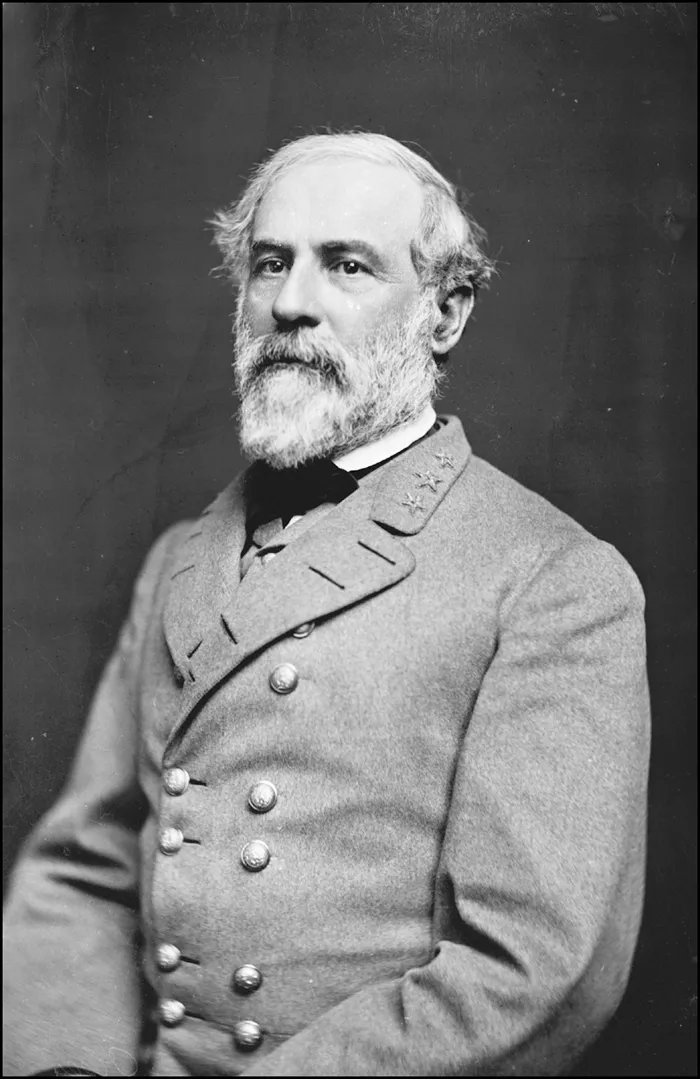
Robert E. Lee was 55 years old at the time of the Maryland Campaign. Throughout most of the campaign, Lee rode in an ambulance, unable to ride a horse due to injuries to his hands. He still commanded his army well at Antietam. Of 37,351 Confederates engaged, the Confederate army had 10,316 casualties—men killed, wounded, missing, or captured. (Courtesy of the Library of Congress.)
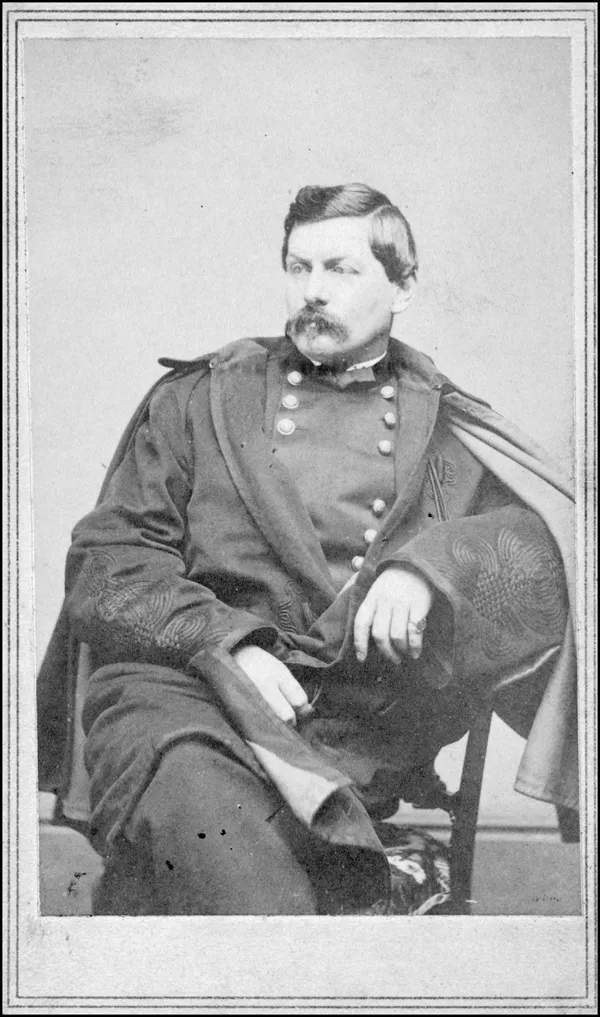
George B. McClellan was 20 years Lee’s junior in September 1862. He commanded an amalgamation of several Union armies formed under the title the Army of the Potomac. McClellan engaged 55,956 men on September 17, and 12,401 became casualties. His campaign stopped the first Confederate invasion north of the Potomac River. (Courtesy of the Library of Congress.)

Edwin Forbes captured the supreme moment of the fight for the Burnside Bridge. Here, soldiers of the 51st New York and 51st Pennsylvania are shown charging across the span and driving the Confederate defenders away. The two regiments had about 670 men total and collectively lost 207 men in the day’s fight. Union general Samuel Sturgis wrote of the charge in his after-action report, “[I] directed them to charge with the bayonet. They started on their mission of death full of enthusiasm, and taking a route less exposed than the regiments which had made the effort before them, rushed at a double-quick over the slope leading to the bridge and over the bridge itself with an impetuosity which the enemy could not resist, and the Stars and Stripes were planted on the opposite bank at 1 o’clock p.m., amid the most enthusiastic cheering from every part of the field from where they could be seen.” (Courtesy of the Library of Congress.)
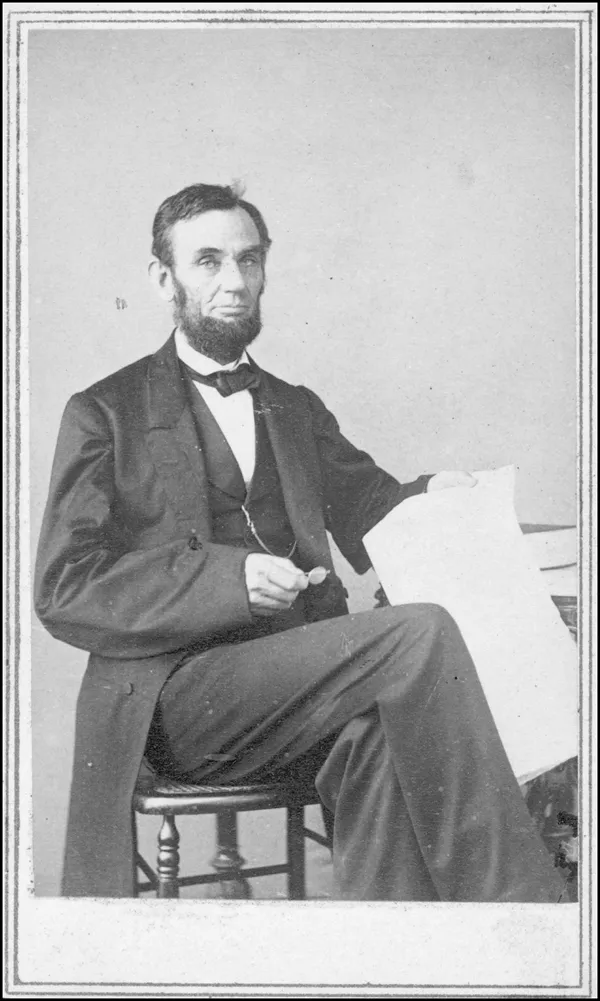
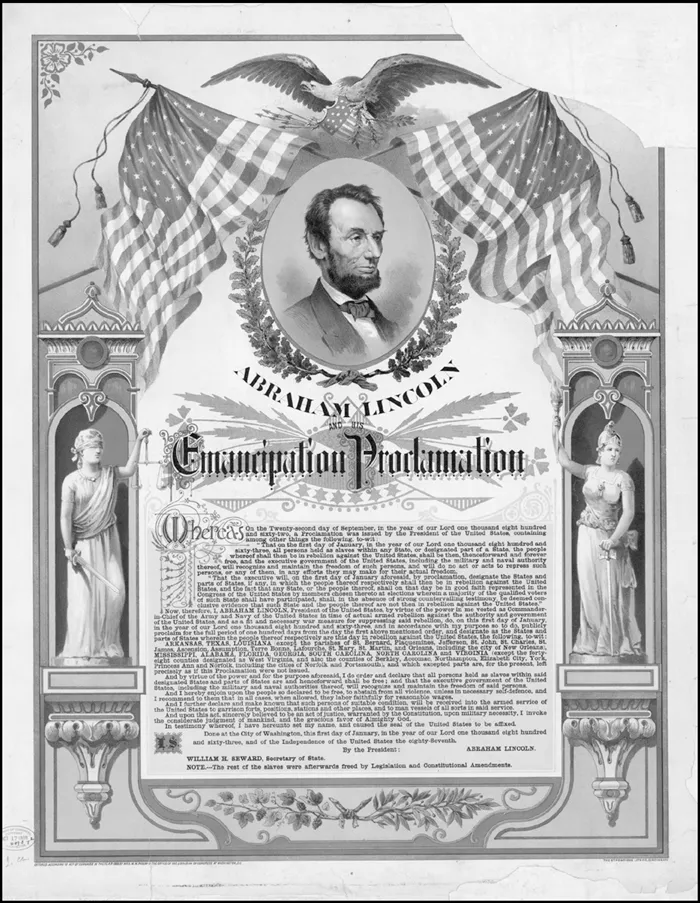
Abraham Lincoln vowed not to renege on signing the Emancipation Proclamation on January 1, 1863, after announcing his intention to do so following the Battle of Antietam. However, reactions were split, even among Northern citizens. Capt. Robert Gould Shaw, famous for leading an all-black regiment in the Civil War, wrote of it, “I can’t see what practical good it can do now.” The Confederacy vowed to fight on after Lincoln penned his name to the celebrated document, which was reproduced in many forms and iterations. Ultimately, Secretary of War Edwin Stanton claimed the measure “shook each day more and more the fabric built on human slavery” and helped end the war in favor of the Union. (Both, courtesy of the Library of Congress.)

A September 1862 edition of the Hagerstown Herald of Freedom and Torch Light reported, “From Hagerstown to the Southern limits of [Washington] county wounded and dying soldiers are to be found in every neighborhood and in nearly every house. The whole region of country between Boonsboro and Sharpsburg is one vast Hospital. Houses and Barns are filled with them, and nearly the whole population is engaged in waiting on and ministering to their wants.” Each of the flags in this contemporary map marks the position of a hospital following the Battle of Antietam. Besides houses and barns, churches were also prominently used, particularly in nearby Frederick, Maryland, and Shepherdstown, West Virginia, which became a haven for approximately 6,000 wounded Confederates. Some of the hospitals formed as a result of the battle did not disband until the next spring. (Courtesy of the Library of Congress.)
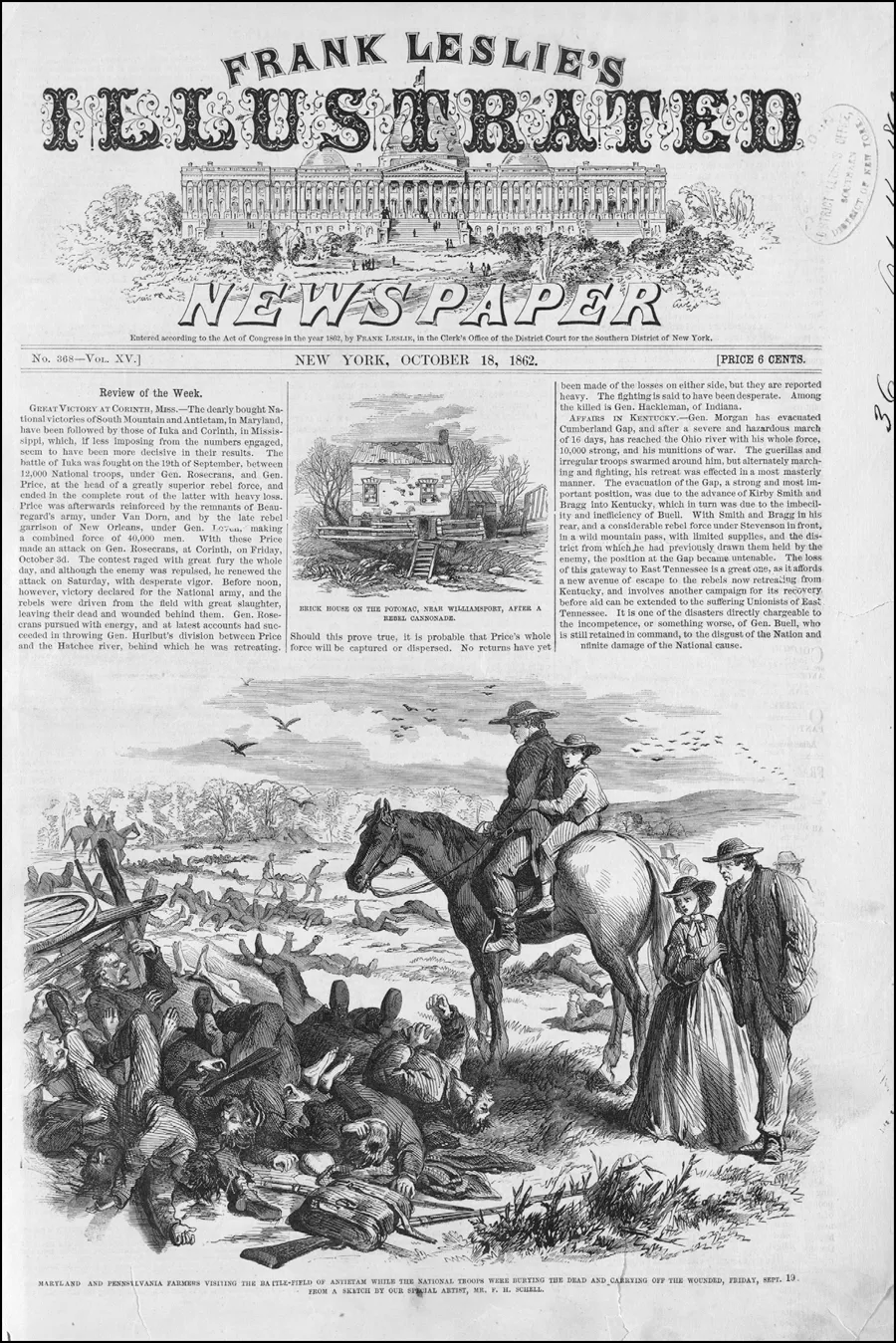
Sketch artist Frank Schell’s gruesome drawing of citizens viewing heaps of dead bodies ready for burial reached a wide viewership in Frank Leslie’s Illustrated Newspaper. Schell also published his reminiscences of Antietam after the war ended, recalling “the terrible evidences of the struggle...
Table of contents
- Cover Page
- Title Page
- Copyright Page
- Contents
- Acknowledgments
- Introduction
- 1. The Battle
- 2. The Cemetery
- 3. The Battlefield
- 4. The Memorial
- Bibliography
Trusted by 375,005 students
Access to over 1.5 million titles for a fair monthly price.
Study more efficiently using our study tools.
Frequently asked questions
Yes, you can cancel anytime from the Subscription tab in your account settings on the Perlego website. Your subscription will stay active until the end of your current billing period. Learn how to cancel your subscription
No, books cannot be downloaded as external files, such as PDFs, for use outside of Perlego. However, you can download books within the Perlego app for offline reading on mobile or tablet. Learn how to download books offline
Perlego offers two plans: Essential and Complete
- Essential is ideal for learners and professionals who enjoy exploring a wide range of subjects. Access the Essential Library with 800,000+ trusted titles and best-sellers across business, personal growth, and the humanities. Includes unlimited reading time and Standard Read Aloud voice.
- Complete: Perfect for advanced learners and researchers needing full, unrestricted access. Unlock 1.5M+ books across hundreds of subjects, including academic and specialized titles. The Complete Plan also includes advanced features like Premium Read Aloud and Research Assistant.
We are an online textbook subscription service, where you can get access to an entire online library for less than the price of a single book per month. With over 1.5 million books across 990+ topics, we’ve got you covered! Learn about our mission
Look out for the read-aloud symbol on your next book to see if you can listen to it. The read-aloud tool reads text aloud for you, highlighting the text as it is being read. You can pause it, speed it up and slow it down. Learn more about Read Aloud
Yes! You can use the Perlego app on both iOS and Android devices to read anytime, anywhere — even offline. Perfect for commutes or when you’re on the go.
Please note we cannot support devices running on iOS 13 and Android 7 or earlier. Learn more about using the app
Please note we cannot support devices running on iOS 13 and Android 7 or earlier. Learn more about using the app
Yes, you can access Antietam National Battlefield by Kevin R. Pawlak in PDF and/or ePUB format, as well as other popular books in History & American Civil War History. We have over 1.5 million books available in our catalogue for you to explore.