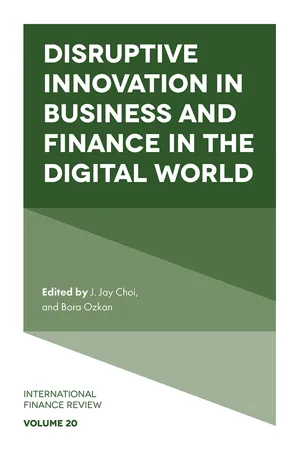
This volume contains fourteen articles split across four parts, exploring the debate around the topics of fintech, AI, blockchain, and cryptocurrency. Featuring a cast of global contributors, this is an unmissable volume exploring the most current research on digital innovation in the financial and business worlds.
eBook - ePub
Disruptive Innovation in Business and Finance in the Digital World
- 249 pages
- English
- ePUB (mobile friendly)
- Available on iOS & Android
eBook - ePub
Disruptive Innovation in Business and Finance in the Digital World
About this book
Digital disruption is ubiquitous and has changed both the way businesses operate and the way people live. Disruption caused by innovation affects firms across multiple industries, from financial services to industrial firms, business processes to payment systems, manufacturing to supply chains. Further, scholars hear more and more about artificial intelligence (AI), big data, machine learning, blockchain, and fintech as examples of contemporary manifestations of disruptive technology that will profoundly influence disciplines beyond business and finance, such as law, health care and government. Global extensions of these technologies and innovations challenge the efficacy and boundaries of law. Indeed, disruptive innovations are potentially change the way we consider the future as humans versus some super artificial intelligence.
Information
PART I
DISRUPTIVE INNOVATION AND FINTECH FIRMS
CHAPTER 1
INNOVATION AND DISRUPTION: INDUSTRY PRACTICES AND CONCEPTUAL BASES
ABSTRACT
Disruptive digital technological innovation has the potential to dramatically alter the corporate landscape as we know it. The authors explore this premise by examining both industry practices and their conceptual bases in the digital age. The authors then describe cases and trends in the three main mediums of digital innovation – artificial intelligence, fintech, and blockchain. The authors focus on how these innovative technologies can impact the firms by creating values as part of corporate strategy, and by changing the way employees work. However, the impacts will likely go well beyond business and finance, and are likely to be adopted by healthcare, non-government organizations, and governments as well.
Keywords: Disruptive innovation; platform firm; artificial intelligence; Fintech; blockchain; cryptocurrency; cloud or digital technology; competitive advantage
JEL classifications: O31, O32, O34, D26, M15
1. INTRODUCTION
Digital disruption is ubiquitous and has changed both the way businesses operate and the way people live. Disruption caused by innovation affects firms across multiple industries, from financial services to industrial firms, business processes to payment systems, manufacturing to supply chains. Further, scholars hear more and more about artificial intelligence (AI), big data, machine-learning, blockchain, financial technology (fintech), and so forth as examples of contemporary manifestations of disruptive technology that will profoundly influence disciplines beyond business and finance, such as law, healthcare, and government. Global extensions of these technologies and innovations challenge the efficacy and boundaries of law. Indeed, disruptive innovations potentially change the way we consider the future as humans versus some super AI.
Not all innovations are disruptive. Innovations can happen as a part of evolutionary progression based on existing ideas or processes rather than as a result of a revolutionary overhaul of existing systems. In ordinary communicative usage, either type of innovation can be disruptive if it leads to a rapid change in business that can dramatically alter the market. However, this is at odds with Bower and Christensen (1995), who defined a disruptive innovation in a particular fashion as an innovation that creates new market and eventually disrupts an existing market.
In the next section, we examine the role and implications of innovation models. In the subsequent section, we describe the advancements that we observe in three specific areas – AI, fintech, and blockchain – that are transforming the corporate landscape. We then close with concluding remarks.
2. CONCEPTUAL BASES
Considering disruptive innovation from a specific viewpoint, Bower and Christensen (1995) argue that disruptive innovation must create new markets before challenging the mainstream market. Christensen, Raynor, and McDonald (2015) further specify that disruptive innovation originates in low-end or new market footholds before challenging established incumbents in the mainstream market, and that disruptors are often regarded as inferior by incumbents. Thus, Uber may not be a disruptive innovator according to this theory as it challenged the mainstream taxi market from the beginning. While statistics may show revenue growth for the industry at large, it is not obvious that the creation of a new market was its objective, and Uber’s growth may have come at the expense of traditional taxi firms.
Instead, Uber is a good example of platform-based innovation that challenges the traditional taxi industry in the mainstream market. Compared to traditional taxis, Uber provides a service that is more flexible, more customizable, lower cost, and features immediate feedback. This is made possible by platform technology combined with a network of freelance drivers. The competitive advantage of Uber is not easily understood by existing industrial organization theory such as transaction cost economics (Williamson, 1983) or resource-based theory (Barney, 1991; Peteraf, 1993) as the underlying technology can be imitated without a great deal of capital investment – see the rather long list of competitors already emerged: Lyft, Curb, Ola, Grab, Didi Chuxing, Lift Hero, Turo, etc.
The question, then, is what are the sources of competitive advantage for disruptive innovators? Mihet and Philippon (2019) in this volume examine the economics of big data and AI. They argue that big data technology can be understood as an intangible asset that acts as the source of competitive advantage to innovating firms. The creation of an intangible asset requires high fixed costs and low marginal costs. As such, large firms with technological or financial resources or firms with the ability to generate startup capital have competitive advantage vis-á-vis small firms or firms without access to venture capital. However, the human capital investment – an indispensable ingredient for the creation of intangible asset – does not have to be as large upfront as it occurs over a period of time.
In addition to low marginal cost advantage, the aggregation of big data aided by AI can provide an important informational advantage to an innovative data-based firm such as Google, which uses customized consumer data for advertisement and search. These data can be used across many different business lines. In addition, big data firms produce information good (e.g., Google search) which is not consumed, hence the marginal cost of one more search is close to zero.
However, barriers to entry can still be set by incumbents and institutional environments rather than economic fundamentals. Ozalp, Cennamo, and Gawer (2018) extend disruptive innovation theory to platform technology transitions in the US videogame industry and conclude that incumbents tend to steepen complementors’ learning curves, causing their defection to less challenging rival platforms rather than the superior technology. Nevertheless, the platform can act as a signaling device, which reduces information asymmetry. Lehdonvirta et al. (2019) indicate that such platform signaling benefits are larger for emerging economy providers (e.g., Alibaba, JD) given the large ex ante information asymmetry caused by institutional devoids due to underdeveloped infrastructure (Khanna & Palepu, 1997).
As another example, Amazon is a content-based platform firm in retail industry. It has large technology startup costs but the marginal cost for scaling is comparatively small (although not as small as pure service-based IT firms due to warehousing cost). This enables the firm to offer highly competitive prices, disrupting traditional retail firms like Barnes & Noble or Borders. Once the technology is set up, it can extend the same crowd-based technology to other retailing business lines and expand into the entire retailing industry beyond books, pharmaceuticals, and traditional items. It now competes with diverse retail firms such as WalMart, Alibaba, eBay, Priceline, JD, and others. It is unclear whether Amazon qualifies as disruptive innovation as defined by Christensen and his collaborators, since it aimed to disrupt existing mainstream retail markets. Regardless, platform-based firms such as Amazon can still be disruptive in the broad sense to retails firms across different types of retail industry.
In sum, the particulars of business models differ from firms to firms, depending on the menu of disrupting technological advantages adopted as well as different business models firms pursue. Theory that helps to understand disruption and innovation is at its infancy. In the next section, we will examine three mediums of innovation that are expected to alter and disrupt corporate landscape going forward – AI, fintech, and blockchain.
3. THREE MEDIUMS OF INNOVATION
3.1 Artificial Intelligence
The term AI is said to come from a 1956 Dartmouth College summer workshop where researchers from various fields gathered to work on “thinking machines.” More recently, Merriam-Webster defines AI as a branch of computer science dealing with the simulation of intelligent behavior in computers; or the capability of a machine to imitate intelligent human behavior.1 MIT Sloan Management Review’s Global Executive Study and Research Report on AI (2018) documents that firms were investing heavily in AI for the purpose of mimicking human reasoning through machines.
We can see the impacts of these investments throughout the corporate landscape. Not only consumers see Roomba sweep the floor, but AI-based systems analyzing consumer behaviors and guide them for purchase according to personal preferences revealed in consumer data. Several music and video streaming services such as Hulu or Netflix recommend videos to their users based on their streaming history aimed at creating better user experience. Amazon uses a subset of AI, machine-learning to grow its business by enhancing customer experience including logistic quality and speed.2 According to Reuters (2019), Amazon is also piloting new automated packing machines at its warehouses, which can pack much faster than a human.
International businesses have often been early adopters of new technological advancements. Modern supply-chain technology is used by numerous global firms as their sourcing strategy. An example of this, as noted in Wall Street Journal (2019a), is that Absolut Vodka recently changed the way they manage their supply chains by adopting a demand-planning software that uses machine-learning. T...
Table of contents
- Cover
- Title
- Part I. Disruptive Innovation and Fintech Firms
- Part II. Artificial Intelligence and Technological Innovaton
- Part III. Blockchain and Applications
- Part IV. Cryptocurrency, Initial Coin Offerings, and Anomaly Trading
Trusted by 375,005 students
Access to over 1.5 million titles for a fair monthly price.
Study more efficiently using our study tools.
Frequently asked questions
Yes, you can cancel anytime from the Subscription tab in your account settings on the Perlego website. Your subscription will stay active until the end of your current billing period. Learn how to cancel your subscription
No, books cannot be downloaded as external files, such as PDFs, for use outside of Perlego. However, you can download books within the Perlego app for offline reading on mobile or tablet. Learn how to download books offline
Perlego offers two plans: Essential and Complete
- Essential is ideal for learners and professionals who enjoy exploring a wide range of subjects. Access the Essential Library with 800,000+ trusted titles and best-sellers across business, personal growth, and the humanities. Includes unlimited reading time and Standard Read Aloud voice.
- Complete: Perfect for advanced learners and researchers needing full, unrestricted access. Unlock 1.5M+ books across hundreds of subjects, including academic and specialized titles. The Complete Plan also includes advanced features like Premium Read Aloud and Research Assistant.
We are an online textbook subscription service, where you can get access to an entire online library for less than the price of a single book per month. With over 1.5 million books across 990+ topics, we’ve got you covered! Learn about our mission
Look out for the read-aloud symbol on your next book to see if you can listen to it. The read-aloud tool reads text aloud for you, highlighting the text as it is being read. You can pause it, speed it up and slow it down. Learn more about Read Aloud
Yes! You can use the Perlego app on both iOS and Android devices to read anytime, anywhere — even offline. Perfect for commutes or when you’re on the go.
Please note we cannot support devices running on iOS 13 and Android 7 or earlier. Learn more about using the app
Please note we cannot support devices running on iOS 13 and Android 7 or earlier. Learn more about using the app
Yes, you can access Disruptive Innovation in Business and Finance in the Digital World by J. Jay Choi,Bora Ozkan in PDF and/or ePUB format, as well as other popular books in Business & Business General. We have over 1.5 million books available in our catalogue for you to explore.