"Amazing . . . A must-have must-read bible for lovers of toy history and in particular toy soldiers. Absolutely glorious!" —Books Monthly
Humans have made and collected toy soldiers from time immemorial. They amuse and comfort us, awaken our curiosity, turn aggressiveness into creativity. In
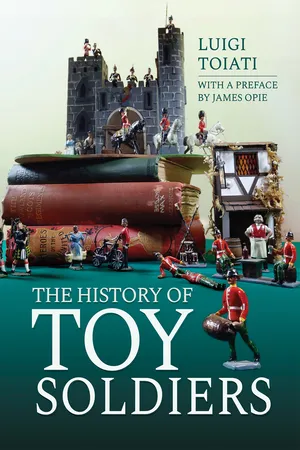
The History of Toy Soldiers, Luigi Toiati, himself an avid collector and manufacturer of toy soldiers, conveys and shares the pleasure of collecting and playing with them. Far from a dry encyclopedia, it leads the reader through the fascinating evolution of the toy soldier from ancient times to the early twenty-first century. The author, as a sociologist with an interest in semiotics (the study of signs), offers truly original insights into why different types of toy soldiers were born in a given period and country, or why in a given size and material. The author's writing is packed with factual detail about the different types of toy (and model) soldiers and their manufacturers, but also with anecdotes, nostalgia, wit and his enduring passion for the subject. Six hundred beautiful color photographs, many depicting the author's own collection, complete this delightful book.
"Toiati creatively delivers exhaustive details, captivating anecdotes and a sense of nostalgia that exudes the fundamental childhood joy of playing with toy soldiers combined with adult collectors' wonderment at their charms." —
Toy Soldier & Model Figure
"A book that will enter the annals of Toy Soldier collections as one of the best and most complete books on this topic." —
IPMS/USA
"A great journey of exploration." —Miniature Wargaming
- 640 pages
- English
- ePUB (mobile friendly)
- Available on iOS & Android
eBook - ePub
The History of Toy Soldiers
About this book
Information
Print ISBN
9781473897298
Toy and Model Soldiers History and Gossip
CHAPTER 1
Some reasons why you too can love toy and model soldiers and figures
‘The charm of the old toy soldier lies in its simplicity of shape, which verges on that of a caricature. With his doll-like rosy cheeks and small black-dot eyes – unblinking, wide-awake – he seems to be awaiting your command in a fantasy world where his only claim to individuality is the slight variation of his bright, glossy uniform supplied by the painter’s hand.
A new box of toy soldiers must have enthralled many a youngster, mesmerized by these tiny men in perfect order. Once he took them from their box, a young boy could review the little army from above, or, by lying at floor level, could march with them into battle. It is such childhood memories that are the start of many toy soldier collections.’ (Roy Selwyn-Smith, foreword to The Art of the Toy Soldier, Kurtz & Ehrlich)
We have just explained the difference between toy and model soldiers, regardless of their materials, sizes, etc. We also said that the name does not necessarily correspond to the function, so that you can breezily collect toy soldiers or play with the model ones. I even dare say that everything becomes a pleasure with toy or model soldiers, even the most rigorous historical reconstruction or the most elitist collection in the world. The toy soldier is the realm of freedom: only, please, if you decide to fight with cowboys against the Sheriff of Nottingham, do not invite me!
What do we feel in front of a toy soldier, or a bunch of them? Joy. The soul becomes bubbly, we are under the impression of having bubbles inside, and a big smile seems to grow within us. Our eyes are gratified at the sight, now of the figures’ details or colours, now of the way we have arranged them on the table or on the showcases.

Picture 1.1: My best friend Gianni (left) and myself with our magic box. (ca. 1957)
The toy soldier has this gift of being like a fountain of eternal youth. When Proust tasted a Madeleine biscuit, he could smell again his childhood home, he saw again his aunt’s living room and he seemed to touch objects dear to him. Similarly, toy soldiers – without our realizing it – send us back to the smells of laundry and macaroni sauce, to the flavour of warm bread, to the sound of a radio playing or of a courtyard full of children, to the touch of the hands of people dear to us but now no longer around. In other places, memory will translate the same feelings into the smell of eggs and bacon or of sausage with sauerkraut, and the radios will speak French or Finnish, or the snow will cover some courtyards, while others will be by the sea. The call nevertheless will be forever and for everybody the same: our childhood.
Being children again
Mostly, toy soldiers take us back to childhood, and I am sure that this also happens to the more serious collector and historian, or the most experienced trader. So, when and if we ask, ‘why play with toy soldiers, why collect them?’, the first answer will be, ‘to find a little piece of the paradise of childhood’. We play or collect to relive our emotions, which is why in general as adults we begin to collect the toy soldiers we played with as kids. Those who today are around 60 almost certainly collect toy soldiers in metal or composition, those younger than 60 in plastic. Toy soldiers bring out feelings and sensory experiences from the trunk of forgotten memories, and remind us of moments, feelings, sounds and smells which we thought were dormant.
Anaesthetizing memory, reviving recollections
Toy soldiers have the merit, so to speak, of ‘purging’ the memory of bad times. Thomas Brussig, a German author, described it well: ‘Blessed is he who has good recollections and a bad memory.’ Here lies, in my opinion, the quality of toy soldiers, of anaesthetizing the memory and reviving the recollections. They will not bring back memory of the family arguments, the cold, the hardship, the daily boredom of school. Nor the crowded buses, the cockroaches and the morning Mass on Sundays, with our hair freshly trimmed high on the nape. They will instead bring back the recollection of the small room where, listening to the radio, we spent so many afternoons with twenty soldiers – mine in papiermâché, yours perhaps in tin, or hollow-cast, or clay – and we relived the cowboy films seen at the parish cinema, Protestant or Catholic, whichever you prefer.
At the same time they also anaesthetize the memory of the horrors of war, and keep alive values such as courage, adventure, heroism and – why not? – homeland. Perhaps we no longer believe in these values, but they continue – whether we are aware or not – to stay with us, as long as a figurine a few centimetres tall brings them back to light.
The child’s hand
Again, we collect toy soldiers or play with them because they bring us back to when we started playing with them, or to our first or most loved ones. When I have one of my little friends in my hands, I see myself running excitedly to the small shop in the square with my pockets full of the right change, hoarded to buy a little soldier of papier-mâché, or of lead or plastic. We collect and we play because nearly always a toy soldier in our hands makes us become that child again, who perhaps is less able to play and has less imagination than then, but is still in touch with his inner world. Therefore it is worth collecting and playing with toy soldiers because it produces pleasant emotions. We need these. Rely on the hand of the child you were, and let yourself be guided towards the simplest pleasure, beyond the market value of figures or the correctness of uniforms.
The pleasure of sight
Still, we play or we collect because toy soldiers are above all a feast for the eyes and satisfy our sense of aesthetics. Many are ugly, you may say, coarse, inaccurate, as for someone some post-war ‘B’ figures are, or for others the American dimestore items. Yet who said that beauty is universal? They are beautiful just because we played with them, or precisely since they are beautiful to us, they satisfy our aesthetics.
Again, we collect or we play because we like to have the figures before our eyes that we gathered, sometimes painted, over the years.
It is clear that collecting and playing do not always go hand-in-hand. Both of them imply the pleasure of sight, but with some differences.
We play for the pleasure of ‘staging’ something, real or imaginary. We do it alone or by taking part in wargames (which, I confess, an asocial person like me has always abhorred). Speaking in general, our eyes then go to the painting, the poses of the figures and the effect of the deployed troops.
We collect, on the other hand – regardless of whether model or toy soldiers – for different reasons. The pleasure of sight here focuses primarily on the workmanship of a single figure, which in turn is determined by our aesthetic taste.
Let me give you an example: we can enjoy the sight of a good model, painted to the highest degree of excellence, but also of an old flaking toy soldier which we bought at a stall or an auction, according to either its material or its symbolic value, e.g. ‘it’s rare’, or ‘Dad gave me it in 1961; I lost it, and I finally found it again.’
The challenge of finding
We therefore collect toy soldiers – and play with them, if we like – even for the challenge of finding figures we were looking for for years; it is ‘just what I was missing’ in order to complete something we already have.
I wish to say now just one thing that might make me enemies: for me – there are many of us who think so, actually – whoever collects just for money is not a true collector. The monetary value certainly has its importance, but it is secondary to the collector. Firstly, because he or she has not bought for money, but for love; secondly, because perhaps they will never resell that toy soldier, so particularly dear to them; thirdly, because the aware collector knows that what today is worth £100 and yesterday was worth £50, tomorrow can be worth just £5 or as much as £500. The true collector discourses on the economic value, but does not care about it. So much the better for his or her heirs if the price rises, but not for him or her. It is certainly important that your collection should be valuable. However – although this is just my personal opinion – sometimes, not always, those who collect just to create capital are not able to distinguish a toy soldier from an electric train, and they think that Julius Caesar died at Little Big Horn, where, as everyone knows, the charge of the 600 took place!
Consequently, ‘à l’amour comme à l’amour, au p’tit soldat comme au p’tit soldat.’
Go hunting
Yet, again, why collect? Well, to go ‘hunting’ for toy soldiers, which is slightly different from ‘finding’ them.
‘Finding’ implies trying to fulfil one’s aim: a systematic search for a definite and known object, and finally being able to have it, at any cost.
‘Hunting’ means instead relying on fate, whatever you discover. It is a wonderful feeling. As travelling is often far better than arriving, hunting is more attractive than finding – which nevertheless has an important role. No safari or shooting thrushes, the goal is to stroll and flush out both long-sought figures and unknown rarities, simply hoping to come across something unexpected. In every collector’s heart there are two dreams: to discover by chance in the dusty back room of a small shop the box you have dreamed about for years; or to find a box or a figure that no one has ever identified before, or whose traces were lost in remote ages. And maybe to realize too into the bargain that the seller is unaware of having such an exquisite item. Consequently, that he is also unaware of its value. Thus in our dreams he will sell us that precious little box of a magic gloss red at his ‘best price’ of £6 and 37 pence.
Hunting, searching, is even more exciting in my view than a planned purchase (at an auction, for example), because it can also occur by chance, and involves these dreams.
I must say that these dreams remain disregarded for the most part, except perhaps in the years between the war and Swinging London, back when you could have such strokes of luck in one of the many stalls in the bric-à-brac markets. Read the experience of James Opie, when he was a boy cycling in search of toy soldiers, and you will better understand what I mean. I must add, however, that some miracles happened to me. For example, at an exhibition in Rome I ran into a bewildered collector of toy cars holding an original cardboard box of composition ‘Garibaldini’ (Garibaldi red-shirts) by Rovello, a renowned Italian brand of the 1950s. He was wandering about, looking for a buyer: I suddenly caught him, and I bought a troop of eight Garibaldini for 10,000 lire (then about £6), each of which is now worth at least 45 euro (about £39). But it is also true that some years ago, when I took my first steps in collecting civilians, I paid 25 euro for a Britains bench which I later found out was worth just 7. Punished by the law of retaliation! And to think that a few lines ago I was writing that the price does not matter to us collectors.
We have a huge range of desires, between heart and mind. We are ...
Table of contents
- Cover
- Dedication
- Title
- Copyright
- Contents
- Preface
- Introduction: Toy soldiers: what a passion!
- Acknowledgements
- Foreword: The miniature through the ages
- Toy and Model Soldiers: History and Gossip
Trusted by 375,005 students
Access to over 1.5 million titles for a fair monthly price.
Study more efficiently using our study tools.