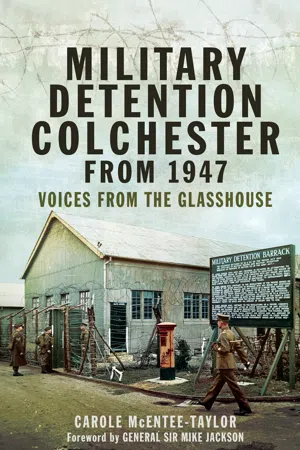
Author royalties to The Soldiers Charity (ABF) and MPSC Association. Foreword by General Mike Jackson From a German POW camp to HM Forces only remaining detention center the mere mention of Colly struck fear into the hearts of thousands of servicemen over the years. But what was it really like behind the forbidding barbed wire in those ancient Nissan Huts? How much has it changed since 1947? Written in the words of those who were there, from the 1940s through to the present day, Commandants, Members of Staff, Detainees, Military Escorts, Padres and visitors have shared their own experiences to create a unique history that sheds light on an almost unknown area of military life. At turns funny, sad and sometimes surprising, the accounts show how much the Military Corrective Training Centre (MCTC) and the idea of military detention has evolved.
- 256 pages
- English
- ePUB (mobile friendly)
- Available on iOS & Android
eBook - ePub
About this book
Information
Subtopic
Military BiographiesIndex
HistoryChapter 1
Military Punishments Prior to 1907
By virtue of the Royal prerogative enacted through a statute of Edward I in 1279, the Sovereign of England had the right to command all the military forces of the nation. This gave the Crown exclusive jurisdiction over military offences, but shared jurisdiction with civil authorities of any civilian offences committed by soldiers. Military law was administered through the Court of the Constable (The Commander of the King’s armies) and Marshal (the second-in-command). On the advice of the Constable and Marshal, the King would issue a list of Rules and Ordinance of War at the start of any expedition or campaign and this formed the basis of the code of military law. These became known as Articles of War and set out purely military offences such as desertion, cowardice and disobedience, for which the main punishments were flogging, mutilation, forfeiture of possessions or even death. In the Articles of 1642, for instance, the punishment for forty-three different offences alone was death, imprisonment, burning the tongue with a hot iron and flogging.
Through the centuries the power of the Constable and Marshal began to decline and then, in 1521, after a quarrel with Henry VII, the Lord High Constable was tried for treason and beheaded. The office of Constable reverted to the Crown and was then only bestowed on a temporary basis. Although the Marshal continued to convene the Court on his own authority, the frequency of sittings decreased. Eventually the right to try military offences was taken over by committees of officers and became known initially as Marshal Courts and eventually as Courts Martial.
Because the inner workings of the Army was of little interest to the wider public and was seen as emanating from the King rather than Parliament, military justice continued to be viewed separately from civilian justice. Thus, during the seventeenth century, military courts began to develop their own set procedures and also split into two kinds, the General or High Court and the Regimental or Low Court. The General Court could try officers and soldiers of any rank and was advised on legal matters by a Judge-Advocate, who was normally a civilian lawyer. The Regimental Court could not try an officer above Captain and received no legal guidance.
The first Mutiny Act in 1689 provided parliamentary recognition of the legality of both types of military courts. Of these, most Army officers preferred the informality of the Regimental Court to General Courts Martial. Convened by commanding officers, composing of a captain and four lieutenants, they were usually brief and sentences were imposed immediately. They kept no written record until 1805 and no witnesses, defendants or the members of the court, took any oaths. Although they were intended for lesser disciplinary matters, there was no defined jurisdiction so commanding officers frequently used vague charges to cover more serious breaches of discipline allowing them to try defendants through these courts instead of the General Courts Martial. In the early eighteenth century there were several complaints by the Advocate General that not only were regimental courts being used for serious military offences, but also that they were imposing unnecessarily severe Corporal punishments on those convicted.
By contrast, General Courts Martial were much more formal, could only be convened by an Army commander and comprised at least thirteen officers. Full transcripts were taken and witnesses and other members of the court were sworn in. Any decisions taken had to be agreed by the sovereign or commander in chief – either of whom could reverse or change the decisions – and the Judge-Advocate General who had to check the legality of the proceedings.
Flogging, hanging or death by firing squad were still the normal punishments and were usually administered at the barracks or in the field. Flogging ranged from twenty-five lashes to 1,200, a sentence that would almost certainly permanently disable and probably kill the recipient. The Mutiny Act of 1765 also included branding as a form of punishment. This was done using needles and gunpowder to tattoo the letters BC for ‘Bad Character’ on the chests of transgressors. Some regiments provided a basic cell called a black hole which was completely empty of furniture and had no windows or source of light. Others also had a dry hole which was mainly for those who were drunk. Here they were just left to dry out, often in their own vomit. Given the choice, men would often prefer the lash, delivered in full view of the rest of the regiment, to solitary incarceration in the black hole.
However, by the time of the Peninsula Wars in the late eighteenth and early nineteenth centuries, questions were beginning to be asked in Parliament about the brutality of flogging as a punishment in the Navy and Army. But, as no immediate alternative was suggested, the debate continued, as did flogging. Military detention as a punishment did not really take hold until the latter part of the nineteenth century after the Army returned home from the Napoleonic Wars.
These ended in 1815 and, apart from the overseas garrison and the Army of occupation, the rest of the Army came home. As usual, once the Army had served its immediate purpose, the government began disbanding regiments and cutting costs, but there were still considerable numbers of men in uniform on British soil. Apart from the small percentage of ‘ne’er do wells’ who were useful to the Army during wars but a burden in peacetime, there were also a larger percentage of soldiers who had joined up for adventure and excitement and to see action. Being garrisoned at home with little to do, some became bored, got into fights, and generally caused a fair amount of trouble in the areas they were stationed.
Needing some kind of sanction or punishment more civilized than flogging, the local population and the Army looked around for alternative solutions to dealing with those society considered ‘badly behaved’ or those who had simply ‘gone off the rails’. Eventually, the normal punishment was to lock them up in local jails with those accused of desertion branded by a tattooed ‘D’ on the top of each arm. However, in the nineteenth century there was no nationwide prison system. Jails were administered by local justices aided by the parson and paid for by local taxes. Income tax had already been introduced as a temporary measure to raise money and was universally hated, so the idea of imposing more taxes was anathema and it was decided that the best way to increase the number of jails was to take over existing buildings and convert them into prisons. Prison warders were not paid and raised money by utilizing the labour available to them. This was done by hiring out the men to work in the fields and offering the women as prostitutes to anyone who could afford to pay. The whole point was to make money out of the prisoners meaning they lived in appalling cramped common rooms in extremely basic conditions. The food provided was little more than swill, although prisoners could buy in their own from outside if they had money. Very few people left the prisons without increasing their criminal knowledge. Thus, for many military offenders whose only crime was transgressing military rules such as being absent without leave (AWOL) or insubordination, being locked up with hardened criminals was hardly an ideal solution.
Finally, the government was compelled by social reformers to take more control so visitors were introduced and warders were paid. Local Justices were now responsible for regularly inspecting the conditions of local jails, and warders at those near garrison towns were delighted to identify the proximity of garrisons as the main reason for the overcrowding and rowdy behaviour in the jail they were responsible for.
Eventually, in 1836, a Committee of Investigation was appointed which stated that soldiers should be confined separately. The reason given was that ‘a soldier, though under punishment, should not lose sight of the profession against whose rules he has offended, nor should he be placed in contact with other men, whose notions of crime are not very strict and have none whatever of the nature of the military offence.’

This is a map showing the locations of the MPSC throughout Britain and Europe. Picture courtesy of WO2 Craig Patterson.
Although the committee’s recommendations were noted, for several years nothing was done to implement them and the situation remained the same. Then, in 1844, a Royal Commission, chaired by Lieutenant General Earl Cathcart, was set up to examine whether it was feasible to establish separate prisons for military offenders. These would replace imprisonment in civil jails with military discipline of ‘shot drill, breaking stones or other hard labour.’ Its remit also included making recommendations on the diet, bedding and clothes that should be provided. After considerable investigation, the final conclusion was that military offenders should be incarcerated in military prisons and that there should be two types of punishment – solitary confinement and hard labour.
By 1850, society’s aversion to the use of the lash meant it was normally only applied in military prisons. Initially, those sentenced to transportation were sent to Australia’s convict prisons in New South Wales. If the sentence was just transportation they went as guards, but if it was with hard labour they travelled as ordinary convicts. But after the Royal Commission’s report, new military prisons were built in Chatham, Kent, and at the Hampshire bases of Gosport and Southsea Castle in Portsmouth. A large section of the ordnance stores in Weedon, Northamptonshire, was converted into cells, and a hospital building attached to the barracks at Greenlaw, on the Scottish border, was converted into an Army prison. In Ireland four prisons were converted from Provost cells and as Robert Boyes records in his book In Glasshouses, others were built in Nova Scotia and Quebec and on Barbados, Bermuda, Mauritius, the Ionian Islands and Malta, at St Elmo.
The inmates of these new prisons were invariably young and most had served less than two years. Some were not regular soldiers but militia men who had failed to attend their training. Others had not completed training and had been absent for so long they had already forgotten the little they had learned. Literacy and numeracy levels were low and most were there for absence or desertion, drunkenness, insubordination, violence or fraud. Somewhat surprisingly, fraudulent enlistment also figured quite high on the list with men enlisting in one regiment, deserting, and then re-enlisting elsewhere. Those unlucky enough to be sent to these new military prisons soon learned that this was not the easy option and many may have wished they had been incarcerated in civilian jails.
The men’s uniforms were taken away from them at the gate as they arrived, leaving them shivering in their socks and braces. The uniforms were taken back to the regiment by the escort to be sold and the proceeds given to public funds. The prisoners had to share a compulsory bath in cold, dirty water with all the others who had arrived with them. They were then searched and issued with a grey, cloth jacket, grey waistcoat and trousers. Those in Britain were given a Glengarry Infantry coat without the ribbons. Those in warmer climates had blue jeans and a straw hat. In colder climates they would be issued with a used greatcoat, fur hat, knee boots and a jumper.
The day began at 0600 when prisoners slopped out and were given their clothes and water for washing. Those entering the prison would remain at Stage One for at least twenty-eight days and after being weighed by the medical officer they would be allocated work. Stage 1 was extremely unpleasant and deterred prisoners from committing any misdemeanours which meant they would have to return to it. Other than exercise and meals, days were spent carrying out shot drill and oakum picking.

The Crank. This was the crank prisoners turned air – a way of making sure they were not idle when in their cells.
Shot drill meant prisoners were commanded to take heavy metal balls from a pyramid heap at one end of the yard, carry them to the other end and pile them on another heap. They then had to move them back. This was normally done for an hour and a half in the morning and afternoon. Men weighing less than ten stone carried 12lb shot, while others carried 14lb shot. When not doing this, the prisoner would be returned to his cell. Stage One prisoners were not allowed mattresses and all prisoners handed over their clothes at night. These were labelled and tied in neat bundles to be re-allocated the next morning when the cell doors were once again opened.
While in his cell, each prisoner was expected to undertake a certain amount of oakum-picking so that he was doing something productive. The raw material for oakum was old rope that could no longer be used in dockyards. Most of it was stiffened by tar and each individual fibre or strand had to be teased out and softened without tools. The finished product was sent back to the dockyards to be used in caulking of wooden vessels. An even more useless activity was to sit and grind air with an £8 10s patent crank designed by a Mr Underhay. The crank was a simple handle with a dial which recorded the number of times the prisoner turned it. The pressure could be changed to make it harder or easier and the prisoner had to complete a set number of revolutions. The use of this crank led to the colloquial name for prison officers (screws).
After a while other work was introduced which was rather more productive and helped to pay towards the costs of the prison. The type of work largely depended on where the prisoner was. In some prisons laundries were introduced so the men washed their own clothes and those of the garrison’s hospital. In others, stones were broken down to a set size for the Royal Engineers to use in making roads. Chopping wood and providing kindling was gradually introduced. This was not an easy option as the wood sent was often oak from hulk ships or from gun carriages from which the iron and rivets had to first be removed. Other work in the UK and abroad included making prison clothes and palliasse (straw mattress) covers, quarrying and clearing jungles.
Although a proposal in 1879 to abolish flogging was defeated by 106 votes, it was finally abolished in 1882. In 1894, the Inspectorate of Military Prisons and a committee headed by Lord Monkswell produced a report that suggested different ways of operating within military prisons and by 1896 changes began to slowly filter through. Squad drill was introduced and physical training replaced the walking exercise. Shot drill was relegated to a punishment rather than a normal part of the daily routine. Prisoners were now allowed to have one library book a week from a centrally approved list and to have their cell light on an hour later to allow them to read. They could also receive elementary schooling if they needed it. Previously, only those already in education would be allowed this – and only if their Commanding Officer had given his written permission.
Food was still monotonous and consisted of 10oz of bread and one pint of cocoa for breakfast. Dinner was 5oz of bread and 5oz of meat served in its own liquor with onion and flour to thicken it. Supper consisted of 9oz of bread and a pint of porridge. The meat varied from day to day. On Mondays and Fridays it was beef on its own, whereas on Tuesdays and Saturdays it was served with vegetables and 2oz of cheese. On Thursday it was mutton and on Sundays there was suet pudding as well. Most prisoners actually gained weight during their time in prison, possibly due to the time spent in their cells. Food was also used as a punishment. No 1 Punishment Diet was 1lb of bread and unlimited water to be served consecutively for three days. If the prisoner was put on this for longer, it was alternated with three days of normal diet. The No 2 Punishment Diet was more substantial with dinner consisting of 3oz oatmeal, 3oz Indian meal, 8oz of bread and salt and potatoes. Breakfast and supper consisted of more bread (8oz). Flogging still took place although it was now restricted to twenty-five lashes with either the cat or birch and had to be carried out in the presence of three visitors in addition to the governor and medical officer. The use of irons was also no longer used as punishment and was now solely for restraint purposes.
Dan Cowley (former Staff Sergeant from the1970s):
‘In 1894 the Clothing Regulations authorized the issue of carpet slippers for warders on night duty within military prisons. Previously, ammunition boots within the C block meant the approach of staff was unmistakable. With the issue of DMS and patrol boots this advance warning was eliminated.
‘As the gate lodge was outside the cell blocks, the prisoners had devised an early-warning system of their own. On the last night of lockup it was customary to allow a mug of water to be taken into the night cell to eliminate the request,“Staff, I want a drink of water”. This would mean a call for the keys from the main gate lodge and an “unlock”. As the night staff passed out of the cell block the air pressure stabilized. This allowed those inside to move about without upsetting the pressure. As the member of night staff entered the cell block the air pressure was increased until he was fully in the block. The pressure then returned to a state of equilibrium. Over this time the pressure changes caused the water surface within the mug to vibrate in concentric circles. This also occurred when night staff exited the cell block and warned that they we...
Table of contents
- Cover
- Title
- Copyright
- Contents
- Acknowledgements
- Foreword
- Introduction
- Chapter 1 Military Punishments Prior to 1907
- Chapter 2 The Military Provost Staff Corp, Military Prisons and Detention Centres: 1907 – 1939
- Chapter 3 Military Detention: 1939 – 1947
- Chapter 4 Detention in Colchester – Camp 186
- Chapter 5 ‘It was a mad, mad world’: 1947 – 1950
- Chapter 6 ‘A bleak and dismal place’: 1950 – 1952
- Chapter 7 ‘I couldn’t hear myself think for all the shouting’: 1952 – 1954
- Chapter 8 ‘Everything at the double’: 1955 – 1957
- Chapter 9 ‘Quite harrowing’: 1957 – 1960
- Chapter 10 ‘Never again’: 1960 – 1965
- Chapter 11 ‘Bloody Red Caps!’: 1966 – 1968
- Chapter 12 ‘Don’t let this bloke get away!’: 1968 – 1970
- Chapter 13 ‘I was left holding the baby while the newly-weds had half an hour together’: 1970 – 1973
- Chapter 14 The Motor Cycle Training Centre: 1973 – 1976
- Chapter 15 ‘Let’s break the door down’: 1976 – 1980
- Chapter 16 The Rebuild: 1980 – 1984
- Chapter 17 ‘Where the f*** are your boot laces?’: 1984 – 1990
- Chapter 18 Changes: 1989 – 1994
- Chapter 19 Marching Towards Better Citizenship: 1995 – 2000
- Chapter 20 HMIP Comes to MCTC: 2000 – 2004
- Chapter 21 ‘Awesome’: 2005 – 2010
- Chapter 22 ‘There are no priorities’: 2011 – 2012
- Chapter 23 ‘I saw two very tall men in long grey coats just standing watching me’
- Chapter 24 The Last Words
- Notes
- Appendix 1: HMIP Inspections
- Appendix 2: Contributors
- Appendix 3: Commanders
- Appendix 4: Inspectors of Military Establishments
Trusted by 375,005 students
Access to over 1.5 million titles for a fair monthly price.
Study more efficiently using our study tools.
Frequently asked questions
Yes, you can cancel anytime from the Subscription tab in your account settings on the Perlego website. Your subscription will stay active until the end of your current billing period. Learn how to cancel your subscription
No, books cannot be downloaded as external files, such as PDFs, for use outside of Perlego. However, you can download books within the Perlego app for offline reading on mobile or tablet. Learn how to download books offline
We are an online textbook subscription service, where you can get access to an entire online library for less than the price of a single book per month. With over 1.5 million books across 990+ topics, we’ve got you covered! Learn about our mission
Look out for the read-aloud symbol on your next book to see if you can listen to it. The read-aloud tool reads text aloud for you, highlighting the text as it is being read. You can pause it, speed it up and slow it down. Learn more about Read Aloud
Yes! You can use the Perlego app on both iOS and Android devices to read anytime, anywhere — even offline. Perfect for commutes or when you’re on the go.
Please note we cannot support devices running on iOS 13 and Android 7 or earlier. Learn more about using the app
Please note we cannot support devices running on iOS 13 and Android 7 or earlier. Learn more about using the app
Yes, you can access Military Detention Colchester From 1947 by Carole Mcentee-Taylor in PDF and/or ePUB format, as well as other popular books in History & Military Biographies. We have over 1.5 million books available in our catalogue for you to explore.