For more than one hundred years, governments have grappled with the complex problem of how to revitalize distressed urban areas. In 1995, the original urban Empowerment Zones (Atlanta, Baltimore, Chicago, Detroit, New York, and Philadelphia) each received a $100 million federal block grant and access to a variety of market-oriented policy tools to support the implementation of a ten-year strategic plan to increase economic opportunities and promote sustainable community development in high-poverty neighborhoods. In Collaborative Governance for Urban Revitalization, Michael J. Rich and Robert P. Stoker confront the puzzle of why the outcomes achieved by the original Empowerment Zones varied so widely given that each city had the same set of federal policy tools and resources and comparable neighborhood characteristics.The authors' analysis, based on more than ten years of field research in Atlanta and Baltimore and extensive empirical analysis of EZ processes and outcomes in all six cities shows that revitalization outcomes are best explained by the quality of local governance. Good local governance makes positive contributions to revitalization efforts, while poor local governance retards progress. While policy design and contextual factors are important, how cities craft and carry out their strategies are critical determinants of successful revitalization. Rich and Stoker find that good governance is often founded on public-private cooperation, a stance that argues against both the strongest critics of neoliberalism (who see private enterprise as dangerous in principle) and the strongest opponents of liberalism (who would like to reduce the role of government).
eBook - ePub
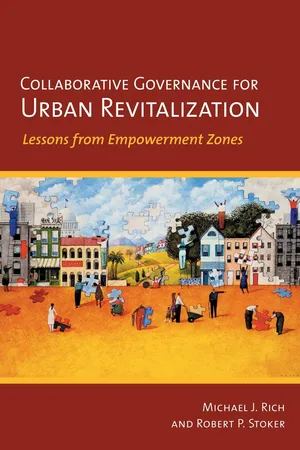
Collaborative Governance for Urban Revitalization
Lessons from Empowerment Zones
- 296 pages
- English
- ePUB (mobile friendly)
- Available on iOS & Android
eBook - ePub
Collaborative Governance for Urban Revitalization
Lessons from Empowerment Zones
About this book
Information
Subtopic
Business GeneralIndex
Social Sciences1
FEDERAL AID AND THE CITIES
In the aftermath of the riots in South Central Los Angeles in April 1992, big-city mayors hoped national attention would once again focus on the problems of the cities. Although mayors and other urban leaders thought the time was ripe for a new approach to federal urban policy, political partisans disagreed about the causes of the riots. Marlin Fitzwater, President George H. W. Bush’s press secretary, suggested that the violence in Los Angeles was caused by the failure of the Great Society’s antipoverty programs when he remarked that “many of the root problems that have resulted in inner-city difficulties were started in the ’60s and ’70s” (Devroy 1992, A8). When Fitzwater’s comment was met with an outcry by leading congressional Democrats the Bush administration retreated from this claim.
Public opinion reflected the partisan divide. In a survey conducted by the Washington Post more than half (55 percent) of the respondents blamed current urban problems on “the failure of President Bush and former President Ronald Reagan to deal with the problems of inner cities” (Morin and Yang 1992, A1). On the other hand, more than four of ten respondents attributed urban distress to the failure of Great Society programs. Regardless of where they placed blame however, the vast majority of respondents noted that older urban programs should be abandoned in favor of “a whole new approach” and three of four suggested that a “lack of knowledge and understanding about the best ways to solve the problems” was the major impediment to addressing the nation’s urban problems.
The Evolution of Federal Urban Policy
The Empowerment Zones and Enterprise Communities (EZ-EC) initiative was created in response to the Los Angeles riots. The initiative’s distinctive design combined federal grants-in-aid, the long-standing foundation of federal urban policy, with supply-side policy tools (tax and regulatory relief) that became popular during the Reagan administration. As we noted in chapter 1, the initiative also reflected lessons learned from comprehensive community development demonstrations that were gaining traction in several national foundations in the early 1990s (Kubisch et al. 2010) and included features that reflected the efforts of President Bill Clinton’s administration to reinvent government. Finally, the EZ-EC initiative was also a legacy of earlier federal urban programs.
In this chapter we review the evolution of federal urban policy to highlight the legacies and unresolved issues from previous policies that influenced the design of the EZ-EC initiative. We pay particular attention to the local context to illustrate how the historical development of federal urban programs has affected the institutions, organizations, and practices for addressing concentrated poverty and its consequences in American cities.
Rebuilding the Inner City
Urban historian Jon Teaford (1990, 11) observed that by the close of the 1930s the nation’s big cities “were perceived as relics in radical need of rehabilitation and restructuring. Local leaders and urban experts viewed this decline of the central cities largely as physical rather than a social problem…[and] the commonly identified enemy of the late 1930s and early 1940s was ‘blight.’” Although notable renaissance partnerships emerged in a few cities, in part as a consequence of state laws that granted cities the power of eminent domain and authorized public aid to private interests through tax exemptions and special bond financing, the 1940s were, in Teaford’s words, largely “a decade of planning and proposal development.” Teaford noted that “a perquisite for renewal was a mobilized private sector, an energetic leadership in city hall, and a firm financial foundation” and while many cities had achieved the first two, finding the money to pay for their grand plans proved more difficult.
The federal urban renewal program, authorized under Title I of the Housing Act of 1949, appeared to be the catalyst many cities had been waiting for; the federal government agreed to cover two-thirds of the net cost incurred by local governments for acquiring and clearing blighted properties and selling the cleared land to private developers (Foard and Fefferman 1966). The local one-third share could be met by contributions from state or city governments and could also include in-kind assistance such as street, water and sewer, and related public improvements to make the site more attractive for private development. The urban renewal program, however, restricted federal funds to only those projects that cleared predominantly residential sites or prepared land for predominantly residential development. Consequently, the program was little used by cities interested in revitalizing the urban core, which in most cities at that time was largely composed of a collection of aging commercial and industrial properties, many vacant or abandoned.
In the 1960s, urban renewal gathered momentum, partly because of legislative amendments that extended the eligible uses of urban renewal funds to include commercial, industrial, institutional, and mixed-use developments. The rise in redevelopment activity, coupled with the increased pace of federally funded expressway construction, substantially increased the disruption in inner-city neighborhoods. By 1964, nearly two-thirds (63 percent) of the families relocated by urban renewal were nonwhite, leading one observer to note, “It is not surprising that slum clearance came to be labeled ‘Negro clearance,’ and urban renewal as ‘Negro removal,’ and a target for civil rights groups” (Lowe 1967, 207).1
A counter narrative to the revitalization agenda advocated by business and political elites emerged in the 1960s that encouraged rehabilitation, renewal, and preservation of existing neighborhoods as opposed to clearance and redevelopment. Perhaps the clearest statement was made by Jane Jacobs (1961, 270–73), who wrote in The Death and Life of Great American Cities that urban renewal “merely shifts slums from here to there, adding its own tincture of extra hardship and disruption.” Jacobs added that the antidote to the elimination of slums and blight, or “unslumming” as she preferred, “hinges paradoxically, on the retention of a very considerable part of a slum population within a slum…. If the conditions for generating diversity can be introduced into a neighborhood while it is a slum, and if any indications of unslumming are encouraged rather than thwarted, I believe there is no reason that any slum need be perpetual.”
A year later a detailed ethnographic portrait of Boston’s West End urban renewal project was provided by Herbert Gans (1962). Although the West End was deemed by urban planners to be a slum, Gans revealed it to have a well-functioning social structure where life was similar to what one would find in any neighborhood or small town. By mid-decade, several critiques of urban renewal were circulating in the academy and the popular press. These included Martin Anderson’s (1964) The Federal Bulldozer, James Wilson’s (1966) Urban Renewal: The Record and the Controversy, and Jeanne Lowe’s (1967) Cities in a Race with Time. A common theme in these works was that the human aspects of communities were being lost in the fervor to revitalize the physical landscape of cities. As Lowe (1967, 207) observed, “Many local [urban renewal] agency officials exhibited little understanding of or concern for complicating ‘social’ problems. They were under pressure from their city’s business and government leaders to reach the ‘brick and mortar’ stage so that higher taxes could be realized from new buildings on the former slum land. There was a tendency, as one federal housing official put it, to ‘give the families a few dollars and tell them to get lost.’”
Fighting Poverty
Although the critiques of urban renewal may have been sufficient to shift federal policy toward a more comprehensive approach, a broad array of societal forces were reformulating the urban problem, with poverty at the center of that reformulation. As James Sundquist (1968, 19), who served in the Bureau of the Budget during the administration of President Lyndon B. Johnson, observed in Politics and Policy, offering his assessment of the formulation and implementation of Johnson’s Great Society, “Until 1964 the word ‘poverty’ did not appear as a heading in the index of either the Congressional Record or the Public Papers of the President.”
Sundquist attributes the origins of the War on Poverty to the convergence of several “streams of thought and action” that began to flow together in the early 1960s, fundamentally changing the federal role in urban affairs. The first was President John F. Kennedy’s Committee on Juvenile Delinquency and Youth Crime, which was directed to formulate a coherent, community-based strategy for addressing the problem of juvenile delinquency. The second came from the Ford Foundation, then the nation’s largest philanthropy, which in the late 1950s developed an interest in urban problems. According to Sundquist (1969, 11), the foundation’s leaders were “looking for a new and broader approach to the social as well as the physical problems of the urban ‘gray areas.’” By 1963, the Foundation’s Community Development Program had funded local initiatives in four cities—Oakland, New Haven, Boston, and Philadelphia—and a statewide effort in North Carolina to create new nonprofit corporations to “coordinate all agencies in the community, public and private, whose activities impinged upon the poor.”
Other contributions to the War on Poverty came from the nation’s welfare and employment and training programs, which increasingly emphasized helping welfare recipients and the long-term chronically unemployed achieve self-sufficiency through supportive services such as training in literacy and basic work skills. According to Sundquist, these developments, along with the growing civil rights movement, Michael Harrington’s (1962) The Other America, and several newspaper articles that vividly described poverty in rural and urban America, contributed to President Kennedy’s decision to make a comprehensive assault on poverty the centerpiece of his 1964 legislative agenda.
Although work on the antipoverty initiative was briefly suspended following Kennedy’s assassination, Sundquist (1969, 21) reports that “President Johnson lost no time in restoring their momentum,” as he fully endorsed the poverty initiative, considering it to be “my kind of program…. Move full speed ahead.” One of Johnson’s first actions as president was to declare an “unconditional war on poverty in America,” in his budget message to Congress in January 1964, calling for over $1 billion ($7.4 billion in 2012 dollars) in new budget authority to begin an all-out assault on poverty.
ECONOMIC OPPORTUNITY ACT
The Economic Opportunity Act of 1964 created new programs and brought structural changes to antipoverty efforts. According to Sundquist (1969, 31), “the distinctive contribution of the War on Poverty as an idea lay less in what it added to the battery of operating programs than in the unifying theme it provided for the activities of many governmental and private agencies and the coordinating devices that were created—OEO [Office of Economic Opportunity] in the executive office of the President and the community-action agency in each community.” Sanford Kravitz (1969, 58–59), who was associate director of the Community Action Program (CAP), observed an array of problems with existing efforts that formed the foundation for the CAP. These included the following:
- Many voluntary ‘welfare’ programs were not reaching the poor.
- If programs were reaching the poor, the services offered were often inappropriate.
- Services aimed at meeting the needs of disadvantaged people were typically fragmented and unrelated.
- Realistic understanding by professionals and community leaders of the problems faced by the poor was limited.
- Each specialty field was typically working in encapsulated fashion on a particular kind of problem, without awareness of the other fields or of efforts toward interlock.
- There was little political leadership involvement in the decision-making processes of voluntary social welfare.
- There was little or no serious participation of program beneficiaries in programs being planned and implemented by professionals and elite community leadership.
Kravitz (1969, 60) added that the planning team responsible for the CAP “accepted the basic concept that a local group—a city, a county, several counties, or a tribe—had the capacity for coherent, rational, cooperative action in a War on Poverty.” Kravitz explained:
Our model of how the community-action program would work went something like this: A community would carefully study its poverty problems, locate the most severe pockets of need, and identify them as target areas slated for intensive effort. It would plan a program for these areas that would affect all relevant institutions, that is, the schools, social services, job opportunities. It would enhance its ability to implement program objectives by inclusion of political leadership. It would “remain honest” to its purposes by inclusion of voices representing the poor, residents of the target neighborhoods.
Thus, the model implied a central local authority to exert influence on and make decisions about the local poverty program, presumed the capacity to engage the major community-service-delivery institutions in a coordinated effort, and above all, assumed the power of persuasion necessary to allocate resources to carry on the program.
In most cities, the local institutions established to coordinate the CAP were new nonprofits created specifically for that purpose, which was a major departure from the prevailing practice that had typically relied on local government agencies. The task force that prepared the administration’s legislative proposal cited several reasons not to limit community action agencies (CAAs) to local government agencies, including not having the program captured by “establishment” agencies that in the opinion of the task force had not been responsive to the needs of the poor and the fact that many communities did not have a “unit of local government which realistically could be counted on to provide the comprehensive coordination that experience had indicated was needed” (ACIR 1966, 25).
The regulations issued to implement the CAP required that “each applicant agency must demonstrate its ability and intention to mobilize community resources against poverty through the establishment of linkages among and within service systems and through other means.”2 The CAAs were also required to “provide ample opportunity for participation in policy-making by the major public and private agencies responsible for services and programs concerned with poverty, other elements in the community as a whole, and the population to be served by the community action program” (ACIR 1966, 27).
John Wofford (1969, 83), who served as staff assistant to the deputy director for operations at the Office of Economic Opportunity, notes that while OEO received a great deal of criticism (much of this from big-city mayors) in 1965 and 1966 for paying too much attention to the structure of CAAs and not enough to the content of their plans, “structure was essential, too. Only by focusing on local structure, we believed, would communities significantly change local institutions so that the community could itself cope with its poverty.”
What became known as “maximum feasible participation” (of residents in the target areas and the groups and agencies that serve them) as a means to foster local change was the most controversial aspect of the CAP (Moynihan 1969) and, as Sundquist observed, became a counterforce to the act’s intention of fostering the mobilization and coordination of resources to address poverty. Based on several hundred field interviews with individuals at all levels of government involved in local CAPs, Sundquist and David Davis (1969, 47) concluded that “the CAAs successes have not been as coordinators. They have been, rather, as inducers of innovation and constructive change—and those objectives, as will be seen, are at war with the objective of coordination.” Sundquist and Davis (1969, 46) attributed the weaknesses of CAAs as resource coordinators to two fundamental factors: “One was the pervasive conflict with other institutions that rose when the CAAs began vigorously to challenge the status quo, to innovate, to raise a myriad of questions about how America’s communities had served their poor.” The second was the “frequently adverse community impressions of the agencies as administrative organizations—impressions of their competence, their leadership, their efficiency.”3
MODEL CITIES
Reflecting on his experience with the CAP, John Wofford (1969, 98) noted, “The controversies that erupted in community after community in building a consensus behind a local program found their way quickly to the national stage, antagonizing Republicans and Democrats alike.” He added that “The White House was an important receiver of complaints from governors, mayors, congressmen, and senators, and before a year of operation was barely over, it had become embroiled in controversy.”4 Sundquist and Davis (1969, 79) report that it quickly became evident that if the administration was to move forward in its War on Poverty, a new approach was required, and within three years of launching the CAP, a new program—Model Cities—“had supplanted community action, in the minds of the President and his staff advisers, as the central instrument for coordinating the Great Society’s attack upon the problems of the urban slums.”
Charles Haar, who served on the presidential task force that designed the Model Cities program and later as an assistant secretary at the Department of Housing and Urban Development (HUD), noted that Model Cities represented a “new approach” to urban problems through an amalgamation of urban renewal and community action. According to Haar (1975, 44; emphasis in original), Model Cities was based on five principles: “concentration of sufficient resources to show what selected cities could achieve in a few years; coordination of all available talent and aid in target areas; mobilization of local leadership and initiative, public and private; locally initiated programs, but with limited federal oversight; and experimentation in devising fresh solutions and applying new technologies to city problems.”
As with community action, the key to a coordinated, comprehensive response would rest wit...
Table of contents
- Preface
- Introduction
- 1. Federal Aid and the Cities
- 2. Good Governance
- 3. Revitalization Strategies and Programs
- 4. Local Governance Structures and Processes
- 5. What Happened in EZ Neighborhoods?
- 6. Atlanta’s Empowerment Zone
- 7. Baltimore’s Empowerment Zone
- 8. Explaining Revitalization Outcomes
- Conclusion
- Notes
- References
Trusted by 375,005 students
Access to over 1.5 million titles for a fair monthly price.
Study more efficiently using our study tools.
Frequently asked questions
Yes, you can cancel anytime from the Subscription tab in your account settings on the Perlego website. Your subscription will stay active until the end of your current billing period. Learn how to cancel your subscription
No, books cannot be downloaded as external files, such as PDFs, for use outside of Perlego. However, you can download books within the Perlego app for offline reading on mobile or tablet. Learn how to download books offline
Perlego offers two plans: Essential and Complete
- Essential is ideal for learners and professionals who enjoy exploring a wide range of subjects. Access the Essential Library with 800,000+ trusted titles and best-sellers across business, personal growth, and the humanities. Includes unlimited reading time and Standard Read Aloud voice.
- Complete: Perfect for advanced learners and researchers needing full, unrestricted access. Unlock 1.5M+ books across hundreds of subjects, including academic and specialized titles. The Complete Plan also includes advanced features like Premium Read Aloud and Research Assistant.
We are an online textbook subscription service, where you can get access to an entire online library for less than the price of a single book per month. With over 1.5 million books across 990+ topics, we’ve got you covered! Learn about our mission
Look out for the read-aloud symbol on your next book to see if you can listen to it. The read-aloud tool reads text aloud for you, highlighting the text as it is being read. You can pause it, speed it up and slow it down. Learn more about Read Aloud
Yes! You can use the Perlego app on both iOS and Android devices to read anytime, anywhere — even offline. Perfect for commutes or when you’re on the go.
Please note we cannot support devices running on iOS 13 and Android 7 or earlier. Learn more about using the app
Please note we cannot support devices running on iOS 13 and Android 7 or earlier. Learn more about using the app
Yes, you can access Collaborative Governance for Urban Revitalization by Michael J. Rich,Robert P. Stoker in PDF and/or ePUB format, as well as other popular books in Social Sciences & Business General. We have over 1.5 million books available in our catalogue for you to explore.