1
MEDIATOR OF FASCISM: SHIMOI HARUKICHI, 1915–1928
Fascism has only three principles: the ancestral land, duty, and discipline.
—Shimoi Harukichi, 1925
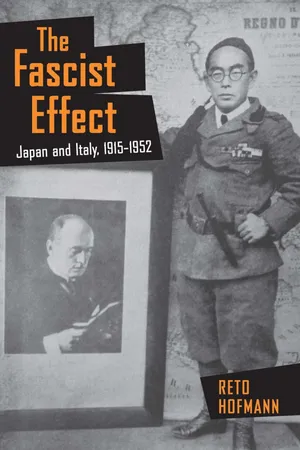
In 1924, Shimoi Harukichi returned to Japan after a decade’s long stay in Naples and Rome. Having witnessed the destruction wrought by World War I, he announced that under Benito Mussolini’s Fascist government Italy was experiencing an unprecedented resurgence. The fourteenth-century Renaissance, he proclaimed, had been “a revival of the arts, but the renaissance that happened during the war was the great renaissance of all the nation.” The result, he argued, was Fascism, a movement that “opened the people’s eyes, unifying them and making them one with the state.” In other words, Fascism was an Italian “spiritual movement.”1 Yet, Shimoi continued, the Fascist aesthetics of heroism, sacrifice, and war mirrored the essential traits of what he understood to be Japan’s cultural essence. “Japan’s way of the warrior [bushido], that ancient morality and spirit, is completely identical. I believe the Blackshirts and their truncheon are manifest in Japan’s loyalty to the emperor and patriotism [chūkun aikokushugi].”2 To Shimoi’s mind, then, a timeless spirit of patriotism was characteristic of both Japanese and Italian history and bonded the two countries. Fascism was a manifestation of this spirit, and he made it his life’s endeavor to convey this conviction to a Japanese audience.
In the 1920s Shimoi became known as the most indefatigable propagandist of Italian Fascism in Japan. However, this characterization is only partly correct.3 Paradoxically, despite his efforts to herald the achievements of Fascist Italy, Shimoi advocated that fascist change in Japan take a different route. He admired Fascism and its Duce but did not aim to replicate a seizure of power or a leader such as Mussolini; rather, he sought to mediate the story of Italian Fascism to an audience of young Japanese in order to stir them into seeking a patriotic politics of their own. As he would proclaim in later years, “Fascism is a typically Italian phenomenon: it would be a mistake if [it] were to try to cross borders and upset the systems of other states. The life of Fascism depends on fascism itself, that is, on its own men.”4 To Shimoi’s mind, the Japanese already possessed the patriotic spirit that Italians were displaying in their Fascist resurgence; they just failed to realize it. Telling the story of Italian Fascism as a narrative of ordinary heroism, patriotic sacrifice, and social order would act as a catalyst in Japan, making Japanese conscious of the values surrounding the nation and disciplining them into becoming obedient citizens.
The premise that fascist change depended on the Japanese recognizing the spiritual commonality between Japan and Italy was what distinguished Shimoi from his contemporaries. From the 1920s, Fascism did indeed attract the attention of many observers in Japan, as elsewhere in the world, but no one found in Fascism the deep links that Shimoi had detected.5 Rather, the early Japanese debates on Fascism intersected with a discourse on political and cultural reform that swept across the ideological landscape of this period.6 Liberal observers commented on the violence that characterized the Blackshirts. Fascist “private groups, whose actions are beyond the law,” wrote the journalist Maida Minoru, threatened not only freedom of expression but, effectively representing the establishment of “dual political organs,” imperiled the state of law itself.7 Marxists, who called for social revolution, saw in Fascism a sign of bourgeois reaction. In the eyes of the communist leader Katayama Sen, then stationed in Moscow as a Comintern officer, Fascism bolstered bourgeois rule “as a reactionary force and as a powerful representative of the capitalist class [that] is hardening the ground for the capitalists in view of a renewed conflict.”8 On the other side of the spectrum, right-wingers welcomed the Fascists as a force against communism. Ninagawa Arata, an adviser to the Japanese Red Cross in Geneva and a member of the Japanese mission to the Washington Conference (1921–1922), praised the “extirpation” of Marxism at the hands of the Fascists, even arguing that they had enacted “true democracy…unlike Lenin, they are not despotic, nor destructive, for in reality they are constructive, democratic [minshuteki].”9
As these appraisals show, Fascism was a subject of public debate from early on. Yet in the eyes of many ideologues Fascism’s practical and theoretical applicability to Japan was problematic. Fascism did not carry the clout of liberalism and socialism: in the 1920s few even considered it a fully fledged ideology with a coherent doctrine encompassing politics, economics, and culture. Indeed, initially Japanese focused their debates on the Fascists—that is, the actions of individuals, the Fascist Party, or its leader, Benito Mussolini—more than on discussing fascism as an ideology. That fascism was a term in flux is also evident from its Japanese spelling: the transliteration of the word “fascism” as fashizumu became standard only in the early 1930s.10 The association of Fascism with Italy also contributed to its limits. In the Japanese cosmology of the “West,” Italy did not occupy a privileged position: since Japan’s first contacts with Europe, Italy remained a destination for artists, adventurers, and the handful of scholars who, by means of English literature, had developed an interest in the exotic peninsular home to Ancient Rome; Japanese politicians, economists, and intellectuals took inspiration from their German, British, and French counterparts.11 How could Italy suddenly generate an ideology capable of competing with the intellectual traditions of its neighbors?
Shimoi made a virtue of Japan’s relative lack of interest in Italy, promoting the notion that Fascism was a patriotic movement, led by robust young leaders such as Mussolini, to rescue a nation that had been betrayed by socialist revolutionaries and an ossified, liberal ruling class. This interpretation mirrored the official Fascist discourse, but at the same time it was closely connected to Shimoi’s thought as it developed in the late Meiji period (1890–1911). This link is particularly evident in the theme of youth. In Shimoi’s narrative of Fascism, youth is presented in the highly aestheticized terms characteristic of late nineteenth-century romanticism as the social group that, through its virility and poetic sensibility, is capable of effectuating a broader national awakening. Youth also reflected Shimoi’s conviction as a conservative educator that training young people with national morals was the basis for social order. Cultural romanticism and social conservatism merged in his understanding of World War I, which he experienced in Italy. For him, the war had enabled youth to express their vitality, but in a controlled, socially safe manner: by dedicating their energy to the nation. Regarding Fascism as a continuation of the mobilization of youth during wartime, he came to understand this ideology as a kind of updated nationalism for the age of the masses.12
The significance of Shimoi for the history of fascism in Japan, therefore, lies not so much in his peculiarity or his many, often bizarre, enterprises to bring Japan and Italy together. Rather, by considering his role as a mediator it will become clear that his understanding of Fascism was produced between Japan and Italy through a process that reveals the marks of a right-wing activist who merged the romantic sensibility of a late nineteenth-century romantic with the anxieties of a conservative educator—all expressed in the language of Italian Fascism. In this sense, Shimoi was less idiosyncratic than he liked to style himself. Indeed, his ideas were often banal, crude refashionings of the mainstream views he encountered during his life, both in Japan and Italy. And yet the popularity of Italian Fascism that he contributed so much to generating in the 1920s is evidence that, like him, many Japanese recognized Fascism as an Italian story with wider, transnational, meanings.
A Late Meiji Educator
Shimoi may have stood out for his stance on Fascism, but before he left for Naples in 1915, he was an archetypal middle-class youth of the late Meiji period (1890s–1911). The generation of ideologues, writers, educators, and politicians who came of age in this period held a view of the world that was colored by a deep ambivalence toward modern mass society. They no longer enjoyed the degree of social mobility, of “rising in the world” (risshin shusse), that was open to the schooled generation that had preceded them. In response, this “anguished youth” (hanmon seinen), as they were sometimes called, denounced the culture of materialism associated with business.13 They lamented the lack of a raison d’être in modern civilization, delighting instead in a romanticism drawn both from contemporary Japanese literature of the likes of Yosano Akiko, Kitamura Tōkoku, and Shimazaki Tōson, as well as from the neo-romantic German works of Hermann Hesse, Thomas Mann, and Robert Musil. Spurred by the wave of nationalism after Japan’s victory over Russia (1905), they turned away from socialist critiques of society, forming instead a discourse on social redress based on civil morality and loyalty to the state and emperor.14
From an early age, Shimoi demonstrated an eagerness to rise in society, as is evident from his move from Asagura-chō, a village in rural Fukuoka prefecture on the southern island of Kyūshū, to Tokyo. Born in 1883 as Inoue Harukichi, Shimoi was the son of an impoverished former samurai whom the agricultural crisis of the 1890s had forced to seek employment in the coal mines near his hometown. It has been speculated that, through his father’s connections, Shimoi became familiar with right-wing organizations such as the ones headed by Tōyama Mitsuru, many of which originated around Fukuoka.15 Although in later years Shimoi would indeed be close to Tōyama, in his younger years his primary concerns were with gaining an education. Shimoi’s father, Kikuzō, was able to provide Harukichi with a privileged education. He attended both compulsory primary school and the optional middle school, from which he graduated in 1902. By all accounts Harukichi was a bright student and, following a practice common for the times, Shimoi Kasuke, a wealthy trader in timber from Tokyo, adopted him and arranged for him to marry his daughter Fūji in 1907. It is unclear why Kasuke, despite having a son of his own, Eiichi (who, influenced by Harukichi, would become an Italian literary scholar), intended to make Harukichi his successor. In any case, it was an unfortunate decision. Although Harukichi strove to make it to the capital, he had no intention of becoming a businessman.
In fact, Shimoi disdained the prospect of pursuing a materialist career. Two reasons account for this attitude, both related to his training at the First Normal School in Tokyo, which he entered in 1907. As Donald Roden has shown, two very different streams of thought coexisted at this institution. There was the conservative side. The normal schools had been established in the 1880s by the architect of the Meiji education system, Mori Arinori, as stepping-stones to the Imperial universities and as the training ground for teachers and bureaucrats who were to educate and administer future generations of Japanese in the spirit of Meiji ideology. The instruction in these schools was strict, with an emphasis on inculcating moral values that would create an orderly society and self-abnegating national leaders.16 On the other side, at the normal schools students were also immersed in the romantic culture of late Meiji, exploring their feelings as individuals through literature and literary clubs. Indeed, even before entering these schools, many students were steeped in popular adventure novels that promoted ideals of heroism, courage, and chivalry.17 This romanticis...