eBook - ePub
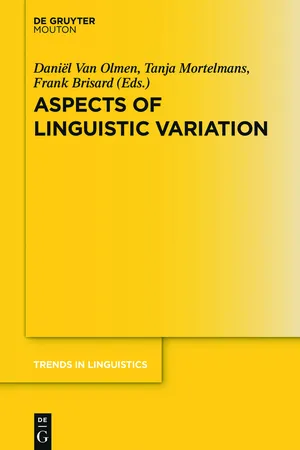
Aspects of Linguistic Variation
- 285 pages
- English
- ePUB (mobile friendly)
- Available on iOS & Android
eBook - ePub
Aspects of Linguistic Variation
About this book
Linguistic variation is a topic of ongoing interest to the field. Its description and its explanations continue to intrigue scholars from many different backgrounds. By taking a deliberately broad perspective on the matter, covering not only crosslinguistic and diachronic but also intralinguistic and interspeaker variation and examining phenomena ranging from negation over connectives to definite articles in well- and lesser-known languages, the volume furthers our understanding of variation in general. The papers offer new insights into, among other things, the theoretical notion of comparative concepts, the social or mental nature of language structure, the areal factor in lexical typology and the diachronic implications of semantic maps. The collection will thus be of relevance to typologists and historical linguists, as well as to people studying variation within the areas of cognitive and functional linguistics.
Information
Subtopic
LinguisticsDagmar Divjak
Binding scale dynamics
Fact or fiction?
Dagmar Divjak, University of Sheffield, School of Languages and Cultures, Jessop West, 1 Upper Hanover Street, Sheffield, S3 7RA, United Kingdom, [email protected]
Abstract: This paper contributes to current debates in linguistic theory and methodology by focusing on discreteness versus continuity in linguistic description as well as on the importance of structure versus use for understanding mental representations of language phenomena. It does so through a case study on the Polish [finite verb + infinitive] construction, henceforth [Vfin Vinf]. Within a Cognitive Linguistic framework, Divjak (2007) proposed a structurally underpinned Binding Scale encompassing eight levels of looser to tighter integration, with verbs expressing modality, intention, attempt, result and phase representing the most integrated type of [Vfin Vinf] constructions. Cognitive Linguistics aims to give a usage-based account of the complex system that language is, grounded in general cognitive principles. But at which level of abstraction should we pitch the linguistic description of a system such as the [Vfin Vinf] system to find such motivating principles at work? In this paper, I assess the distance between usage and structure by investigating whether the proposed Binding Scale can be reliably distinguished in judgments of usage events through statistical unsupervised learning. By experimenting with the type of abstraction that needs to be imposed on acceptability ratings to arrive at a meaningful classification, conclusions can be drawn about the social or mental nature of this structure.
Keywords: structure, use, discreteness, continuity, cluster analysis, Polish, Binding Scale, complementation
1The structure versus usage debate
During most of the 20th century, the classical Saussurean distinction between Langue and Parole dominated mainstream linguistic theory. Generativists took the distinction between Langue and Parole on board, accepting there to be structural facts and usage facts that are in principle independent of each other and can be described in complete isolation from each other. Once performance errors are declared irrelevant to competence, it suffices to describe facts about structure or competence, to the neglect of use or performance. As an added bonus, allowing linguists to study an idealized version of language greatly simplified linguistic analysis.
Cognitive and functional approaches have been challenging this view for the past four decades, stressing the usage-based nature of structure. Within the functional-cognitive camp, this has led to a focus on usage facts to the extent that now structure is largely ignored. A radical usage-based approach would seem to do away with the notion of system altogether, indeed (Geeraerts 2010: 258). Yet, “accounts of language usage, language acquisition and language change are impossible without an assumption about what it is that is being used, acquired, or subjected to change. And more moderate functionalists and cognitive functionalists recognize both structural facts and usage facts as genuine facts central to the understanding of language” (Boye and Engberg-Pedersen 2010: vii).
Much cognitive and functional writing does not concern itself with characterizing the precise relationship between usage and structure. Usage is observable, but where is the structure? Geeraerts (2010: 237) suggests “a dialectal relationship between Structure and Use: individual usage events are realizations of an existing systemic structure, but at the same time, it is only through the individual usage events that changes might be introduced into the structure”. Boye and Harder (2007: 572) agree that “language is indeed based on actual, attested usage, but that it rises above attested instances in providing the speaker not only with actual usage tokens but also with a structured potential that is distilled out of previous usage”.
Structure plays no doubt a role in linguistic description and theorizing but the question that I want to pose here is whether speakers distil and store structure out of use. And if they do, how similar is the structure stored by speakers to the structure proposed by linguists?
2The role of abstraction in linguistic description and representation
On a methodological level, the discussion about the relationship between structure and usage resurfaces as the ongoing debate about the choice for continuity or discreteness in linguistic analysis (for a first book-length treatment, see Fuchs and Victorri 1994). In the following two sections, I will discuss the role of abstraction in linguistic description (Section 2.1) and in linguistic representation (Section 2.2).
2.1The role of abstraction in linguistic description
Separating Langue from Parole and declaring the former to be the object of linguistic study allowed Saussureans to focus on the “neat and tidy” side of linguistics and to describe language structure independently of language use in terms of clean paradigmatic and syntagmatic relations. This discrete frame of description marginalized phenomena falling outside the realm of such an approach, a trend that was further supported by the Chomskyan focus on syntax and preference for algebraic formalizations.
Nevertheless, there have always been dissidents, denouncing the reductionism inherent in discrete models. The past few decades have witnessed a surge in explicitly continuous models, both for analysis and for representation, c...
Table of contents
- Cover
- Title Page
- Copyright
- Dedication
- Contents
- Introduction
- Binding scale dynamics
- The areal factor in lexical typology
- How comparative concepts and descriptive linguistic categories are different
- An areal typology of clause-final negation in Africa
- Definite articles and their uses
- Pathways of evolution, contiguity and bridging contexts
- On the pragmatics of logical connectives
- Notes on Eastern Armenian verbal paradigms
- ‘Perhaps’ in Cape York Peninsula
- On the origins of Italian anzi
Trusted by 375,005 students
Access to over 1.5 million titles for a fair monthly price.
Study more efficiently using our study tools.
Frequently asked questions
Yes, you can cancel anytime from the Subscription tab in your account settings on the Perlego website. Your subscription will stay active until the end of your current billing period. Learn how to cancel your subscription
No, books cannot be downloaded as external files, such as PDFs, for use outside of Perlego. However, you can download books within the Perlego app for offline reading on mobile or tablet. Learn how to download books offline
Perlego offers two plans: Essential and Complete
- Essential is ideal for learners and professionals who enjoy exploring a wide range of subjects. Access the Essential Library with 800,000+ trusted titles and best-sellers across business, personal growth, and the humanities. Includes unlimited reading time and Standard Read Aloud voice.
- Complete: Perfect for advanced learners and researchers needing full, unrestricted access. Unlock 1.5M+ books across hundreds of subjects, including academic and specialized titles. The Complete Plan also includes advanced features like Premium Read Aloud and Research Assistant.
We are an online textbook subscription service, where you can get access to an entire online library for less than the price of a single book per month. With over 1.5 million books across 990+ topics, we’ve got you covered! Learn about our mission
Look out for the read-aloud symbol on your next book to see if you can listen to it. The read-aloud tool reads text aloud for you, highlighting the text as it is being read. You can pause it, speed it up and slow it down. Learn more about Read Aloud
Yes! You can use the Perlego app on both iOS and Android devices to read anytime, anywhere — even offline. Perfect for commutes or when you’re on the go.
Please note we cannot support devices running on iOS 13 and Android 7 or earlier. Learn more about using the app
Please note we cannot support devices running on iOS 13 and Android 7 or earlier. Learn more about using the app
Yes, you can access Aspects of Linguistic Variation by Daniël Olmen, Tanja Mortelmans, Frank Brisard, Daniël Olmen,Tanja Mortelmans,Frank Brisard in PDF and/or ePUB format, as well as other popular books in Languages & Linguistics & Linguistics. We have over 1.5 million books available in our catalogue for you to explore.