- 288 pages
- English
- ePUB (mobile friendly)
- Available on iOS & Android
eBook - ePub
About this book
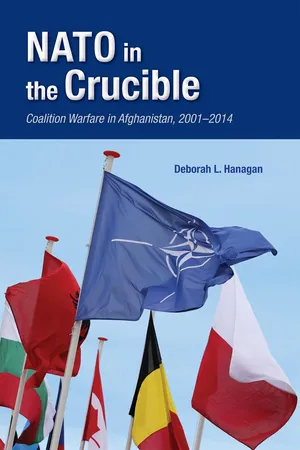
When the North Atlantic Treaty Organization (NATO) became involved in security operations during the War in Afghanistan, it faced a range of complex challenges, including a highly motivated Afghan insurgency that changed over time and repeatedly defied assumptions. Conflicts within NATO also posed challenges. The alliance brought together a quarter of the world's nations, each with its own goals and interests, in an effort to stabilize an agrarian country that posed no immediate security threat. For more than a decade, through changes in leadership and strategy, the nations experienced bitter disagreements, resentments, and a conflict that escalated to a level of violence and uncertainty few had anticipated. In NATO in the Crucible, Deborah Lynn Hanagan analyzes these challenges and explains how the alliance maintained cohesion despite them. She examines why NATO succeeded in Afghanistan when history suggests most coalitions fracture under such intense pressure. In the end, she argues, member nations summoned the political will and organizational capacity to cooperate and endure. And they agreed, above all, that failure in Afghanistan would be catastrophic—both for NATO and for the world.
Information
Subtopic
GéopolitiqueCHAPTER 1
Setting the Stage
The Puzzle
In the annals of North Atlantic Treaty Organization history, 2011 was a banner year. NATO was engaged in ground, naval, and air operations around the world, including the ongoing peace support mission in Kosovo via the NATO-led Kosovo Force.1 Maritime operations involved two missions: Active Endeavour (launched in response to the Alliance’s Article 5 collective defense declaration after the United States was attacked by al-Qaeda on September 11, 2001) and Ocean Shield (a counterpiracy mission operating off the Horn of Africa and in the Gulf of Aden). The NATO Training Mission–Iraq developed Iraqi security forces through training and mentoring activities and contributed to establishing training structures and institutions.2 The NATO-led intervention in Libya, called Operation Unified Protector, was undertaken under a UN mandate and with the support of the League of Arab States. But despite their wide breadth of activity, these operations were dwarfed by the operations in Afghanistan.
The largest and most significant military activity in 2011, and the only mission in which all twenty-eight of the allies participated, was the NATO-led International Security Assistance Force (ISAF) mission in Afghanistan. Its objective was to ensure the country would never again serve as the base for global terrorism.3 This year was the apogee of NATO’s involvement in Afghanistan and also the year the ISAF coalition reached its maximum size in terms of participating nations (fifty) and number of troops deployed (over 130,000).4 Over the course of the year, ISAF, in partnership with Afghan security forces, engaged in counterinsurgency and counterterrorism operations against an insurgent coalition that included a reconstituted Taliban and associated groups such as the Haqqani Network (an Islamist organization operating in Afghanistan and Pakistan) and al-Qaeda. ISAF’s peace support operations included stabilization and reconstruction activities via twenty-eight provincial reconstruction teams (PRTs). In addition, the NATO Training Mission–Afghanistan (NTM-A), the coalition’s main effort, focused on developing the Afghan National Security Forces (ANSF) by training and mentoring the Afghan National Army and Afghan National Police.5 Finally, ISAF began transitioning full responsibility for security to Afghan forces in 2011. Each major division of the transition was referred to as a tranche. Tranche 1 of the transition began in March, covering Bamiyan Province and the city of Mazar-e-Sharif. Tranche 2 began in November. In the relevant provinces, districts, and cities, ISAF maintained a presence but the troops no longer engaged in direct combat, instead supporting ANSF.6
This extensive range of global military activity undertaken with various coalitions was unprecedented for a security organization created more than six decades earlier to defend against Soviet aggression, prevent the reemergence of German territorial ambitions, and keep the United States engaged in Europe. The wide range of coalition warfare—precision combat strikes, peace support operations, humanitarian assistance, counterterrorism, counterpiracy, counterinsurgency, stabilization and reconstruction, and training—indicated that NATO was capable of changing to meet the demands of a changing world. NATO had evolved from a static, defensive alliance focused on deterring conventional and nuclear war to a security organization that could respond to a wide range of challenges.
Of all NATO’s activities in 2011, the ISAF mission was the most ambitious (in reality it was trying to help create a resilient Afghan state) and the most extensive in terms of the multinational force contributions involved (ground, air, and naval troops and assets) and the range of missions. The NATO engaged in Afghanistan was almost unrecognizable from the Cold War NATO, just as the ISAF operating in 2011 was dramatically transformed from the ISAF that deployed in December 2001.
NATO was not initially involved in military operations in Afghanistan, but this slowly changed. First, the Alliance decided to take over the ISAF mission in Kabul and expanded the mission geographically and operationally. ISAF then surged, followed by an organized withdrawal. Why did this happen and how did ISAF maintain cohesion throughout the campaign in Afghanistan?
The fact that cohesion endured among the allies and partners in Afghanistan is a puzzle. Many forces were in play that should have frayed the coalition. These forces included intra-Alliance tensions and conflicts over burden-sharing; disagreements about what ISAF should do; concerns about US unilateralism; and reluctance to get involved in combat operations or to remain engaged over the long term. Also, operational inefficiencies (from restrictive national caveats to resource, training, and doctrinal shortfalls) leading to inconclusive battles produced a widespread perception that the international effort was a failure. These problems were exacerbated by major miscalculations about the character of the conflict, underestimations of Taliban resilience, and significant deficiencies among the Afghan partners, including corruption and human capital weaknesses.
This book seeks to address many questions. Why did NATO get involved when the enemy did not threaten the survival of its members? How come the complexity of the conflict in Afghanistan did not fracture the coalition, especially when it was going badly? Why did the missions expand, particularly into the governance and economic domains when that is not what security alliances are traditionally for and why did this not undermine cohesion? Why did no NATO member defect from the coalition, especially considering the Alliance was otherwise globally engaged? Why did partner nations join and stay engaged when they had no formal power in Alliance decision making?
History seems to suggest that alliances and coalitions can be fragile. They have often fractured under combat pressures or when members undergo national political or economic crises. Shouldn’t alliances, which result from formal treaties or agreements and have a long-term nature, be more durable than coalitions, which are short term in nature and result from ad hoc and temporary combinations in response to sudden or emerging threats? Logic suggests that when the stakes are high it is more likely allies and partners will stick together, especially in formal alliances, than in cases when the stakes are lower, the situation is opaque, or goals are tenuous. However, actual history seems to indicate otherwise. Alliances have often been as brittle as coalitions, since political, social, economic, or battlefield conditions can fatally undermine the ties that should bind alliances together. For example, in the fifth century BC, the existential threat posed by recurring Persian invasions did not deter constantly shifting alignments among the Greek city-states as they fought each other and against Persia.7 During the Thirty Years War, despite the invariably heavy costs imposed by war, a number of the protagonists in the Holy Roman Empire changed sides during the conflict due to religious, political, and combat pressures.8 The six coalitions formed against France during the French revolutionary and Napoleonic wars were a constantly shifting kaleidoscope. The early coalitions in particular were “fragmented by divergent war aims and mutual suspicions” which led to uncoordinated operations, battlefield failures, and disintegration as allies sued for peace individually with France.9 In June 1940, rather than continuing the war from its territories and colonies overseas, in continued alliance with Britain, the French government decided to defect and surrender to Germany.10 The subsequent Anglo-American alliance was fraught with rivalries and disagreements from the political level to military operational and tactical levels. Some strategic disagreements were so serious they threatened the alliance’s continued cohesion. However, they did not prevent an unprecedented degree of cooperation and the complete fusion of allied strategy and intelligence sharing or the execution of unified operations which ultimately achieved victory.11 It seems even when allies share a view of the danger they face, as the United Kingdom and France and the United States and United Kingdom did against Adolf Hitler’s Germany, a solid and enduring alliance is not necessarily a foregone conclusion. If this applies to cases of extreme danger, then one would expect an alliance or coalition facing lesser risk to fray even more easily. That this did not happen here makes it all the more interesting.
Alliances and coalitions are not necessarily distinct. Since the end of the Cold War, NATO has developed into a formal alliance that can generate discrete multinational coalitions to deal with different security challenges. Its wide range of missions in 2011 demonstrates this point. However, the level of allied participation in them has varied widely and they face different levels of fraying forces. Afghanistan presented a particular challenge since it seemed to represent a synthesis of contemporary threats and challenges. It included a rogue state that was also a failed state, a transnational terrorist group and insurgents, ethnic conflict, ungoverned spaces, and a humanitarian catastrophe. Operations were further complicated by Afghanistan’s remote geographic location and its complex cultural context. In fact, given the negative historical experiences of alliances and coalitions, the low stakes involved in the war in Afghanistan, the inconclusive nature of the conflict against the Taliban, the fraying forces identified above, and the fact that today for many European countries war is considered an illegitimate means for resolving international differences, one could argue that the ISAF coalition should have fallen apart and that NATO’s involvement in Afghanistan should not have happened or that it should not have developed in the way that it did. However, the fact remains that somehow the Alliance became engaged and ISAF stayed together and maintained an unprecedented level of cohesion in a highly complex conflict, for a long time, in a region far from Alliance territory. Furthermore, ISAF was able to accommodate an ever larger coalition and expand the forms of warfare it undertook as the character of the conflict changed.
This book proposes an explanation for these developments. Its main focus is at the operational level, which entails the command and control structures that integrate multinational military contributions and manage, direct, and coordinate military activities in a specific geographic area—a theater of operations. Operational-level commanders and their staffs translate strategic-level direction into campaigns and major operations (this is known as operational art). As such, the operational level links higher-level direction and objectives to tactical activities. In Afghanistan, ISAF was the operational-level headquarters that provided goals, objectives, and plans which were meant to orient the tactical-level activities of battle groups, PRTs, and embedded trainers. This book examines the decision process in the lead-up to NATO taking over the ISAF mission and then the organizational changes that occurred within the coalition over time, specifically the changes in ISAF’s organizational structure and the extensive changes and expansion in ISAF’s actual operations. ISAF underwent a dramatic transformation, both structurally and operationally, over the course of its existence. This helped sustain the members’ political commitment and enabled the coalition to stay the course in the face of adverse and unexpected conditions as well as to overcome the fraying forces that undermined cohesion. Since ISAF was not an autonomous entity, its examination requires two levels of analysis: the strategic level at NATO and the operational level at ISAF. The levels were inextricably linked. Political authorities in the North Atlantic Council decided whether and when to commit the Alliance in Afghanistan. The Council also issued political direction to ISAF. The military authorities at Supreme Headquarters Allied Powers Europe (SHAPE) and Joint Force Command Brunssum issued strategic and operational direction. While ISAF had wide latitude in translating the higher-level direction into plans and operations, the NATO political and military authorities retained final approval authority over ISAF’s successive campaign plans. In addition, the Alliance’s various structural elements, such as training facilities, educational programs, and force-generation processes, supported the coalition’s activities. Analyzing the ISAF coalition, therefore, requires maintaining an eye on relevant strategic-level developments in NATO.
NATO’s eventual involvement in Afghanistan and ISAF’s transformation were essentially a case of multinational military adaptation. This book proposes an analytical framework that identifies the main drivers and influences which shaped NATO’s initial lack of involvement, its decision to get involved, ISAF’s adaptation to the war over time, and the sustainment of cohesion as the conflict changed. The drivers are political will and organizational capacity.
Political will. Security organizations require effort on the part of the member states for action to occur because they are not autonomous. In this case, political will manifests as national policy that is related to NATO. Political will is expressed in public statements and the subsequent activation of Alliance decision forums, persuasion efforts with other members to achieve consensus on an organizational policy or action, and physical contributions, such as defense spending, equipment acquisition, and provision of military forces through the force-generation process for the activation and sustainment of operational missions. Political will must also converge among the members in order for Alliance action to occur. In effect, the convergence of pol...
Table of contents
- Cover
- Series Page
- Title Page
- Copyright
- Dedication
- Contents
- List of Figures and Tables
- Foreword
- 1. Setting the Stage
- 2. September 2001–July 2003: NATO Absence
- 3. August 2003–September 2008: NATO Gets into the Game
- 4. October 2008–December 2014: NATO Surges
- 5. Why Cohesion Endured under Adversity
- Appendix 1: Command Structures (OEF and ISAF), 2001–2012
- Appendix 2: ISAF Rotations and Commanders
- Appendix 3: Coalition Force Levels
- Appendix 4: Provincial Reconstruction Teams
- Glossary
- Notes
- References
- About the Author
- Index
Trusted by 375,005 students
Access to over 1.5 million titles for a fair monthly price.
Study more efficiently using our study tools.
Frequently asked questions
Yes, you can cancel anytime from the Subscription tab in your account settings on the Perlego website. Your subscription will stay active until the end of your current billing period. Learn how to cancel your subscription
No, books cannot be downloaded as external files, such as PDFs, for use outside of Perlego. However, you can download books within the Perlego app for offline reading on mobile or tablet. Learn how to download books offline
Perlego offers two plans: Essential and Complete
- Essential is ideal for learners and professionals who enjoy exploring a wide range of subjects. Access the Essential Library with 800,000+ trusted titles and best-sellers across business, personal growth, and the humanities. Includes unlimited reading time and Standard Read Aloud voice.
- Complete: Perfect for advanced learners and researchers needing full, unrestricted access. Unlock 1.5M+ books across hundreds of subjects, including academic and specialized titles. The Complete Plan also includes advanced features like Premium Read Aloud and Research Assistant.
We are an online textbook subscription service, where you can get access to an entire online library for less than the price of a single book per month. With over 1.5 million books across 990+ topics, we’ve got you covered! Learn about our mission
Look out for the read-aloud symbol on your next book to see if you can listen to it. The read-aloud tool reads text aloud for you, highlighting the text as it is being read. You can pause it, speed it up and slow it down. Learn more about Read Aloud
Yes! You can use the Perlego app on both iOS and Android devices to read anytime, anywhere — even offline. Perfect for commutes or when you’re on the go.
Please note we cannot support devices running on iOS 13 and Android 7 or earlier. Learn more about using the app
Please note we cannot support devices running on iOS 13 and Android 7 or earlier. Learn more about using the app
Yes, you can access NATO in the Crucible by Deborah L. Hanagan in PDF and/or ePUB format, as well as other popular books in Politique et relations internationales & Géopolitique. We have over 1.5 million books available in our catalogue for you to explore.