Representative democracy is beset by a crisis of legitimacy across the world, but in Europe this crisis is compounded by the inadequacy of national governments to address citizens' frustrations and to achieve transnational unity on common issues. How representative are national parliaments in their decision-making on EU matters?
This volume investigates the relationship between the democratic institutions of the member states and those of the EU. With a focus on polity rather than policy, it looks at voting and decision-shaping mechanisms in selected member states, in particular the 'Europeanisation' of representative democracy at national level. It also assesses the state of parliamentary democracy at the EU level. Expert analysts share their insights into the changing nature of our political eco-systems and the (dis)connections within and between them.
Representative Democracy in the EU: Recovering Legitimacy is part of the 'Towards a Citizens' Union' project co-funded by the EU's Erasmus+ Programme. It is the product of collaboration with 20 renowned think tanks from the European Policy Institutes Network (EPIN). This volume follows the first in the series, Direct Democracy in the EU: The Myth of a Citizens' Union. A third and final publication will offer ideas for how democratic institutions and processes can meet the challenges facing Europe today.
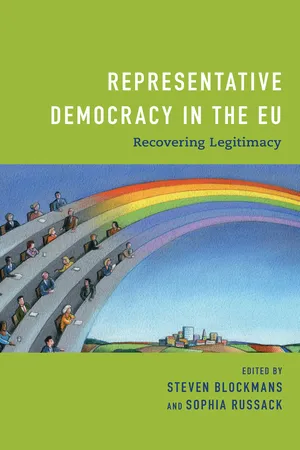
eBook - ePub
Representative Democracy in the EU
Recovering Legitimacy
- 385 pages
- English
- ePUB (mobile friendly)
- Available on iOS & Android
eBook - ePub
Representative Democracy in the EU
Recovering Legitimacy
About this book
Information
1. INTRODUCTION
Representative democracy is beset by a crisis of confidence. With its increasingly vocal critics and assertive opponents, growing numbers of citizens either take parliamentary democracy for granted or doubt its merits. In some EU member states, it seems to have become toothless yet at the same time it is noisier. Meanwhile, anti-parliamentarianism is on the rise.
1.1 Decline in democratic freedoms
Reports by Freedom House and others show that democratic freedoms have been in retreat for 13 straight years in many parts of the world, as more and more elected authoritarians emerge. In Europe too we are witnessing the rise of anti-democratic leaders, including some who have consolidated power beyond constitutional limits and continue to undermine the institutions that protect freedom of expression and association, and the rule of law.
In Hungary, Prime Minister Viktor Orbán has presided over one of the most dramatic declines of democracy ever charted within the European Union. Having worked methodically to deny critical voices a platform in the media or civil society, Orbán and his right-wing nationalist Fidesz party comfortably defended their parliamentary supermajority in the 2018 elections. Soon afterwards, the government forced the closure of the Budapest-based Central European University, evicting its academic community from the country. In Poland, the conservative Law and Justice party, led by Jarosław Kaczyński, who plays a dominant political role despite holding no formal executive position, laid waste to the country’s legal framework in its drive to assert political control over the entire judiciary. This included attempts to force the retirement of Supreme Court judges and gain partisan influence over the selection of commission members. Both countries are in the crosshairs of the EU. The most emblematic, yet cumbersome, tool for defending the rule of law is the procedure of Article 7 TEU, which was triggered in December 2017 in the case of Poland (by the Commission) and in September 2018 in the case of Hungary (by the European Parliament).
Meanwhile, attacks on media independence have spread to other European democracies. Austria’s new right-wing government put pressure on the public broadcaster, while Czech Prime Minister Andrej Babiš drew on closely allied media outlets to counter injurious scandals. The brutal mafia-style murder of Maltese investigative journalist Daphne Caruana Galizia shocked the continent. She had been probing numerous cases of corruption on the island before a powerful bomb blew up her car near her home. In Slovakia, investigative reporter Ján Kuciak was killed in his home after uncovering corrupt links between government officials and organised crime. Bulgarian reporter Viktoria Marinova became the latest murder victim in October 2018, a year on from the most high-profile killings.
1.2 A crisis of efficiency and legitimacy
In democracy’s historic heartlands we are also witnessing a shift in the perceptions and practice of democracy. The violent gilets jaunes protests in France, the fall of the Belgian government over the UN migration pact, the student-led climate protests inspired by Swedish teen activist Greta Thunberg and the Brexit deadlock in the UK are political crises that each have their own substantive origins. But they share an underlying weakness that is also visible in Germany, the Netherlands, Spain and elsewhere in Europe: the inability of political representatives to make tough choices. There is a gulf between what citizens think and what they see politicians doing; between what they regard as vital and what in their view the state is neglecting: loss of purchasing power, corruption, migration and climate change, to name but a few.
Every political system has to strike a balance between two fundamental realities: efficiency, i.e. the speed with which institutions can find effective solutions to problems, and legitimacy, i.e. the degree to which people support the solution (Manin, 1995). Representative democracy in Europe is undergoing a crisis of both efficiency and legitimacy. Coalition negotiations are taking longer than ever, especially in countries where complex alliances are needed (at 589 days, Belgium holds the world record for going without a federal government). Parliaments can take months to reach long-term strategic decisions (e.g. investment in emerging technologies, choosing the right energy mix) and many governments appear powerless in the face of acute crises (e.g. eurozone debt, a spike in arrivals of refugees and migrants) and in the implementation of policy (e.g. large infrastructure projects).
In Europe, representative democracy is undergoing a crisis of efficiency and legitimacy.
As a result, trust in the institutions of democracy is on the wane across Europe. In the autumn of 2012, Eurobarometer noted that only 33% of Europeans had confidence in the EU institutions – down from 50% in 2004. There was even less faith in national parliaments and governments, at 28% and 27% respectively. Political parties met with the greatest distrust of all: they scored an average of 3.9 out of 10 among EU citizens, followed by governments (4 out of 10), parliaments (4.2 out of 10) and the press (4.3 out of 10). Even if figures have rebounded somewhat since,1 they are still among the lowest in decades, an indication that today, half to two-thirds of the population distrust the most important institutions of their political systems (Van Reybrouck, 2016).
The declining trust in professional politicians in Europe is further evidenced by lower levels of voter participation (from an average of 85% in the 1960s to less than 40% in certain member states), falling membership of mainstream political parties and increasing electoral volatility (Gallagher, Laver & Mair, 2011; Van Biezen, Mair & Poguntke, 2012). Incidentally, the mistrust is mutual. Politicians assume that, on the whole, citizens are guided by other (i.e. less worthy) values than they are (Kanne, 2011).
People – especially in member states that are struggling with low growth and rising poverty levels – compare representative democracy unfavourably with the apparent successes of authoritarian regimes (Foa and Mounk, 2016). This has set the scene for the resurgence of populism. Charismatic individuals and fake prophets promise simplistic solutions to people’s grievances through radical policies that dismiss existing institutions and laws as either irrelevant or inconvenient. In a growing number of member states, electoral gains have propelled these populists into government. In Hungary, the most prominent case, this has led to majoritarian rule that erodes minority rights, further hollowing out the very fundaments of representative democracy which enabled the rise of the ‘strongman’ in the first place (Krastev, 2017).
Of course, there is reason to be sceptical about the sustainability of this resurgent authoritarianism. In most cases, both historically and globally, these regimes become fragile when growth slows or ends, because they have no other sources of legitimacy.
Another, less sinister, expression of discontent is reflected in the rise of a number of movements that are not satisfied with symbolic protest at the margins. These ‘neo-parliamentarians’ have sought to enter the system to change it from within. The Pirate Party that emerged in Sweden in 2006 as a platform for digital rights has become a political movement that aims to enrich representative democracy with direct democracy. It is a model that has been replicated elsewhere in Europe, to become the third largest party in Czechia and – briefly – Germany. Since its creation in 2009 by comedian and blogger Beppe Grillo, the anti-establishment, anti-globalist, Eurosceptic and environmentalist Five Star Movement (M5S) became the largest individual party in the Italian Parliament in the 2018 general election and entered government. Despite its leader’s raucous populist rhetoric, the M5S seeks to improve the quality of representative politics by imposing new rules: no representatives with criminal records; no seats for life; no election of the same person for more than two terms. But the M5S is finding it hard to implement its agenda in a coalition government which is de facto led by the authoritarian Minister of the Interior, Matteo Salvini, who is riding the xenophobic wave that his Lega Nord helped whip up during the migrant crisis.
Given that the great challenges of today – migration, climate change, banking crises, offshore fraud – can no longer be dealt with adequately by national governments, how representative are national parliaments in their decision-making on EU matters? This question is the main focus of the present volume.
1.3 This book
Representative Democracy in the EU: Recovering Legitimacy is part of the ‘Towards a Citizens’ Union (2CU)’ project co-funded by the Erasmus+ Programme of the EU and is the product of a sustained collaboration with 20 renowned think tanks from the European Policy Institutes Network (EPIN).
Building on the notion of increasing social, economic and political interdependence in a multi-layered European Union, we devoted the first volume to the question of whether a sense of solidarity and European identity could be rescued from the bottom up by empowering citizens to ‘take back control’ of their Union. Our research revealed, among other things, that people’s interest in exploring direct democracy has increased as a result of the EU’s polycrisis of recent years – although this trend is not widespread and is even absent in some member states. Yet, as Richard Youngs points out in his concluding chapter of our first volume, to move beyond being “a heavily instrumentalised wrecking-ball” the instruments of direct democracy would need to meet certain participatory preconditions to contribute to the quality of democracy overall. “As citizens make what experts consider to be ‘wrong’ populist-fuelled choices, sympathy has resurged for the classical concept of elite-mediated governance” (Youngs, 2018).
How representative are national parliaments in their decision-making on EU matters?
In this second book, we investigate how the relationship between the democratic institutions of the member states and those of the EU has changed as a result of a decade of crisis. Rather than assess the state of collective government (Van Middelaar, 2019), we focus on the role of parliaments. The national level lends itself best to a broad investigation of the health of representative democracy in Europe. That is why our project unpacks the theory and practice of voting and decision-shaping mechanisms (Part I) that affect citizens in an illustrative cross-section of member states. This analysis of the ‘Europeanisation’ of representative democracy at the national level (Part III) is complemented by an investigation of the state of parliamentary democracy at the EU level (Part II).
On both levels, our focus is on polity rather than on policy or populism. The contributions examine issues of representation and deliberation from a constitutional, institutional and procedural perspective; the machinery and mechanisms that power European affairs and the tracks along which opinions and decisions are moved between the national and EU levels. As such, the changing nature of our political eco-systems and the (dis)connections within and between them will be discussed.
The third and final publication will bring the lessons of volumes I and II together and offer ideas for how democratic institutions and processes can be enhanced to meet tomorrow’s challenges. The underlying assumption is that direct and representative democracy can go hand-in-hand to improve the quality of democracy in Europe.
References
Foa, R.S. and Y. Mounk (2016), “The Democratic Disconnect”, Journal ofDemocracy, Vol. 27, No. 3, pp. 5–17.
Freedom House (2019), Democracy in Retreat: Freedom in the World 2019.
Gallagher, M., M. Laver and P. Mair (2011), Representative Government inModern Europe, 5th revised ed., London: McGraw-Hill.
Kanne, P. (2011), Gedoogdemocratie, Amsterdam: Meulenhoff.
Krastev, I. (2017), “Majoritarian Futures”, in H. Geiselberger (ed.), The GreatRecession, London: Polity Press, pp. 65–77.
Manin, B. (1995), The Principles of Representative Government, Cambridge: Cambridge University Press.
Siedentop, L. (2001), Democracy in Europe, London: Penguin Books.
Van Biezen, I., P. Mair and T. Poguntke (2012), “Going, Going, … Gone? The decline of party membership in contemporary Europe”, European Journal of Political Research, Vol. 51, No. 1, pp. 24–56.
Van Middelaar, L. (2019), Alarums and Excursions: Improvising Politics on theEuropean Stage, Newcastle upon Tyne: Agenda Publishing.
Van Reybrouck, D. (2018), Against Elections, New York: Seven Stories Press.
Youngs, R. (2018), “Gettings Europe’s Direct Democracy Right”, in S. Blockmans and S. Russack (eds), Direct Democracy in the European Union: The Myth of a Citzens’ Union, London: Rowman & Littlefield International, pp. 443–452.
Note
1 See, e.g., https://ec.europa.eu/eurostat/web/products-datasets/-/sdg_16_60 and Standard Eurobarometer 90 of autumn 2018: 42% Europeans trusted the EU, while only 35% trust their national government and parliament. Distrust in the national parliament (58%) and in the national government (59%) had decreased by 2% since spring 2018. Though still the majority, less than half of Europeans tended not to trust the EU (48%), and one in ten respondents answered that they didn’t know.
PART I.
TRANSVERSAL ASPECTS AND THEMATIC ISSUES
2. REPRESENTATIVE DEMOCRACY UNDER PRESSURE: SHOCKS, AGENTS AND USERS
This chapter assumes that representative democracy is under pressure from the numerous challenges it is facing: external shocks, external actors, internal actors and its own users. How should we understand the new limits of sovereignty, representation and responsibility in an interconnected world and how can the notion of interdependence offer alternative ways to address these challenges?
Introduction
One of the greatest thinkers on democracy, Robert Dahl (1989), defined democratic processes as “the most reliable means for protecting and advancing the good and interests of all the persons...
Table of contents
- Abbreviations
- 1. Introduction
- Part I. Transversal Aspects and Thematic Issues
- Part II. EU-level
- Part III. Country Reports
- Part IV. Conclusions
- About the Contributors
Trusted by 375,005 students
Access to over 1.5 million titles for a fair monthly price.
Study more efficiently using our study tools.
Frequently asked questions
Yes, you can cancel anytime from the Subscription tab in your account settings on the Perlego website. Your subscription will stay active until the end of your current billing period. Learn how to cancel your subscription
No, books cannot be downloaded as external files, such as PDFs, for use outside of Perlego. However, you can download books within the Perlego app for offline reading on mobile or tablet. Learn how to download books offline
Perlego offers two plans: Essential and Complete
- Essential is ideal for learners and professionals who enjoy exploring a wide range of subjects. Access the Essential Library with 800,000+ trusted titles and best-sellers across business, personal growth, and the humanities. Includes unlimited reading time and Standard Read Aloud voice.
- Complete: Perfect for advanced learners and researchers needing full, unrestricted access. Unlock 1.5M+ books across hundreds of subjects, including academic and specialized titles. The Complete Plan also includes advanced features like Premium Read Aloud and Research Assistant.
We are an online textbook subscription service, where you can get access to an entire online library for less than the price of a single book per month. With over 1.5 million books across 990+ topics, we’ve got you covered! Learn about our mission
Look out for the read-aloud symbol on your next book to see if you can listen to it. The read-aloud tool reads text aloud for you, highlighting the text as it is being read. You can pause it, speed it up and slow it down. Learn more about Read Aloud
Yes! You can use the Perlego app on both iOS and Android devices to read anytime, anywhere — even offline. Perfect for commutes or when you’re on the go.
Please note we cannot support devices running on iOS 13 and Android 7 or earlier. Learn more about using the app
Please note we cannot support devices running on iOS 13 and Android 7 or earlier. Learn more about using the app
Yes, you can access Representative Democracy in the EU by Steven Blockmans,Sophia Russack, Steven Blockmans, Sophia Russack in PDF and/or ePUB format, as well as other popular books in Politique et relations internationales & Conservatisme et libéralisme. We have over 1.5 million books available in our catalogue for you to explore.