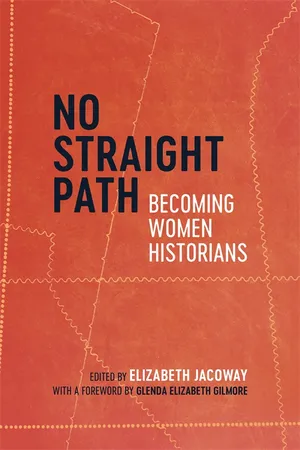
No Straight Path tells the stories of ten successful female historians who came of age in an era when it was unusual for women to pursue careers in academia, especially in the field of history. These first-person accounts illuminate the experiences women of the post–World War II generation encountered when they chose to enter this male-dominated professional world.
None of the contributors took a straight path into the profession; most first opted instead for the more conventional pursuits of college, public-school teaching, marriage, and motherhood. Despite these commonalities, their stories are individually unique: one rose from poverty in Arkansas to attend graduate school at Rutgers before earning the chairmanship of the history department at the University of Memphis; another pursued an archaeology degree, studied social work, and served as a college administrator before becoming a history professor at Tulane University; a third was a lobbyist who attended seminary, then taught high school, entered the history graduate program at Indiana University, and helped develop two honors colleges before entering academia; and yet another grew up in segregated Memphis and then worked in public schools in New Jersey before earning a graduate degree in history at the University of Memphis, where she now teaches. The experiences of the other historians featured in this collection are equally varied and distinctive.
Several themes emerge in their collective stories. Most assumed they would become teachers, nurses, secretaries, or society ladies—the only "respectable" choices available to women at the time. The obligations of marriage and family, they believed, would far outweigh their careers outside the home. Upon making the unusual decision, at the time, to move beyond high-school teaching and attend graduate school, few grasped the extent to which men dominated the field of history or that they would be perceived by many as little more than objects of sexual desire. The work/home balance proved problematic for them throughout their careers, as they struggled to combine the needs and demands of their families with the expectations of the profession.
These women had no road maps to follow. The giants who preceded them—Gerda Lerner, Anne Firor Scott, Linda K. Kerber, Joan Wallach Scott, A. Elizabeth Taylor, and others—had breached the gates but only with great drive and determination. Few of the contributors to No Straight Path expected to undertake such heroics or to rise to that level of accomplishment. They may have had modest expectations when entering the field, but with the help of female scholars past and present, they kept climbing and reached a level of success within the profession that holds great promise for the women who follow.
- 264 pages
- English
- ePUB (mobile friendly)
- Available on iOS & Android
eBook - ePub
About this book
Information
Subtopic
Teaching HistoryIndex
HistoryCOLLECTIVE BIBLIOGRAPHY
BEVERLY GREENE BOND
“‘Educating the Common Man’: Developing the Public School Systems in Memphis and Shelby County, 1820–1944.” In The Dynamics of School Consolidation: Race, Economics, and the Politics of Educational Change, edited by John M. Amis and Paul M. Wright, 21–56. Knoxville: University of Tennessee Press, 2018.
“Taylor-Made: Envisioning Black Memphis at Mid-Century.” In An Unseen Light: Black Struggles for Freedom in Memphis, Tennessee, edited by Aram Goudsouzian and Charles McKinney, 107–29. Lexington: University of Kentucky Press, 2018.
“‘Ma . . . Did Not Make a Good Slave’: African American Women and Slavery in Tennessee.” In Tennessee Women: Their Lives and Times, vol. 2, edited by Bond and Sarah Wilkerson Freeman, 7–35. Athens: University of Georgia Press, 2015.
——— and Sarah Wilkerson Freeman, eds. Tennessee Women, Their Lives and Times. Vol. 2. Athens: University of Georgia Press, 2015.
——— and Janann Sherman. University of Memphis: A Pictorial History. Charleston, SC: Arcadia, 2012.
——— and Janann Sherman. Dreamers, Thinkers, Doers: A Centennial History of the University of Memphis. Virginia Beach, VA: Donning, 2011.
“Millie Swan Price.” In Tennessee Women: Their Lives and Times, vol. 1, edited by Sarah Wilkerson Freeman and Bond, 44–67. Athens: University of Georgia Press, 2009.
——— and Sarah Wilkerson Freeman. Tennessee Women: Their Lives and Times. Vol. 1. Athens: University of Georgia Press, 2009.
——— and Betty Huehls. “Sue Shelton White.” In Tennessee Women: Their Lives and Times, vol. 1, edited by Sarah Wilkerson Freeman and Bond, 140–64. Athens: University of Georgia Press, 2009.
——— and Janann Sherman. Images of America: Beale Street. Charleston, SC: Arcadia, 2006.
“Roberta Church (1914–1996): Race and the Republican Party in the 1950s.” In The Human Tradition in African American History: Portraits of African American Life since 1865, edited by Nina Mjagkji, 181–97. Wilmington, DE: Scholarly Resources, 2003.
——— and Janann Sherman. Memphis in Black and White. Charleston, SC: Arcadia, 2003.
“‘Every Duty Incumbent upon Them’: African American Women in Nineteenth-Century Memphis.” Tennessee Historical Quarterly 59, no. 4 (Winter 2000): 254–73. Reprinted in Trial and Triumph: Readings in Tennessee’s African American Past, edited by Carroll Van West, 203–26. Knoxville: University of Tennessee Press, 2002; and in Tennessee Women in the Civil War: The Best of the Tennessee Historical Quarterly, vol. 8, edited by Antoinette G. van Zelm, 140–62. Nashville: Tennessee Historical Society, 2014.
“‘The Extent of the Law’: Free Women of Color in Antebellum Memphis, Tennessee.” In Negotiating the Boundaries of Southern Womanhood: Dealing with the Powers That Be, edited by Janet Coryell, Thomas Appleton Jr., Anastatia Sims, and Sandra Gioia Treadway, 7–26. Columbia: University of Missouri Press, 2000.
EMILY CLARK
“Slave Testimonies: The Long View.” In Slave Narratives in French and British North America, 1700–1848, edited by Trevor Burnard and Sophie White. London: Routledge, 2019.
———, Ibrahima Thioub, and Cécile Vidal, eds. New Orleans, Louisiana, and Saint-Louis, Senegal: Mirror Cities in the Atlantic World, 1659–2000s. Baton Rouge: Louisiana State University Press, 2019.
“Genre et conversion religieuse des esclaves: La Nouvelle-Orléans 1729–1800.” In Les Laïcs dans la mission, Europe et Amériques, xvie–xviiiem siècles, edited by Aliocha Maldavsky, 183–94. Tours: Presses Universitaires François Rabelais, 2017.
“Missionary Orders in French Colonial New Orleans.” In New Orleans: The Founding Era, edited by Erin Greenwald. New Orleans: Historic New Orleans Collection, 2017.
“The Ursuline Nuns and the Roots of New Orleans Catholicism.” In New Orleans and the World: 1718–2018 Tricentennial Anthology, edited by Nancy Dixon. New Orleans: Louisiana Endowment for the Humanities, 2017.
“The Tragic Mulatto and Passing.” In The Palgrave Handbook of Southern Gothic, edited by Susan Castillo Street and Charles Crow, 259–70. London: Palgrave Macmillan, 2016.
“The Women across from Congo Square.” In Louisiana Women: Their Lives and Times, vol. 2, edited by Mary Farmer Kaiser and Shannon Frystak, 11–24. Athens: University of Georgia Press, 2016.
——— and Greg Lambousy. “Archivist Meets Historian: A Conversation.” In “Atlantic World Archives of Louisiana,” special issue, Collections: A Journal for Museum and Archive Professionals 11, no. 3 (August 2015): 259–67.
——— and Greg Lamousy, eds. “Atlantic World Archives of Louisiana.” Special issue, Collections: A Journal for Museum and Archive Professionals 11, no. 3 (August 2015).
——— and Greg Lambousy. “A Note from the Guest Editors.” In “Atlantic World Archives of Louisiana,” special issue, Collections: A Journal for Museum and Archive Professionals 11, no. 3 (August 2015): 163–66.
“Atlantic Alliances: Marriage among People of African Descent in New Orleans.” In Louisiana: Crossroads of the Atlantic World, edited by Cécile Vidal, 165–83. Philadelphia: University of Pennsylvania Press, 2014.
The Strange History of the American Quadroon: Free Women of Color in the Revolutionary Atlantic World. Chapel Hill: University of North Carolina Press, 2013.
“When Is a Cloister Not a Cloister? Comparing Women and Religion in the Colonies of France and Spain.” In Women and Religion in the Atlantic Age, 1550–1900, edited by Clark and Mary Laven, 67–87. London: Ashgate, 2013.
——— and Mary Laven, eds. Women and Religion in the Atlantic Age, 1550–1900. London: Ashgate, 2013.
——— and Cécile Vidal. “Les familles d’esclaves à La Nouvelle-Orléans et sur les plantations environnantes sous le Régime français (1699–1769).” Annales de Démographie Historique 122 (2011–12): 99–126.
“Refracted Reformations and the Making of Republicans.” In Empires of the Imagination: Transatlantic Histories of the Louisiana Purchase, edited by Peter J. Kastor and François Weil, 180–203. Charlottesville: University of Virginia Press, 2009.
“How American Is New Orleans? What the Founding Era Has to Tell Us.” In Place, Identity, and Urban Culture: Odesa and New Orleans, Kennen Institute Occasional Paper no. 31, edited by Samuel C. Ramer and Blair Ruble, 27–34. Washington, DC: Woodrow Wilson International Center for Scholars, 2008.
“Elite Designs and Popular Uprisings: Building and Rebuilding New Orleans, 1721, 1788, 2005.” Historical Reflections/Réflexions Historiques 33, no. 2 (Summer 2007): 1–22.
“Hail Mary down by the Riverside: Black and White Catholic Women in Early America,” In The Religious History of American Women: Reimagining the Past, edited by Catherine A. Brekus, 91–107. Chapel Hill: University of North Carolina Press, 2007.
Masterless Mistresses: The New Orleans Ursulines and the Development of a New World Society: 1727–1834. Chapel Hill: University of North Carolina Press for the Omohundro Institute of Early American History and Culture, 2007.
Ed. and trans. Voices from an Early American Convent: Marie Madeleine Hachard and the New Orleans Ursulines, 1727–1760. Baton Rouge: Louisiana State University Press, 2007.
“Patrimony without Pater: The New Orleans Ursulines and the Creation of a Material Legacy.” In French Colonial Louisiana and the Atlantic World, edited by Bradley G. Bond, 95–110. Baton Rouge: Louisiana State University Press, 2005.
“Felicite Girodeau: Racial and Religious Identity in Antebel...
Table of contents
- COVER
- TITLE PAGE
- COPYRIGHT PAGE
- CONTENTS
- FOREWORD
- INTRODUCTION
- MY IMPROBABLE JOURNEY
- CLUELESS
- AN UNTIDY LIFE IN ACADEME
- THE HIVE
- IN PURSUIT OF THE DREAM
- VOCATION
- CREATING MYSELF
- ONCE A TEACHER, ALWAYS A TEACHER
- TURNING POINTS
- THE PAST SHOULD BE FOREVER
- AFTERWORD
- COLLECTIVE BIBLIOGRAPHY
- CONTRIBUTORS
Trusted by 375,005 students
Access to over 1.5 million titles for a fair monthly price.
Study more efficiently using our study tools.
Frequently asked questions
Yes, you can cancel anytime from the Subscription tab in your account settings on the Perlego website. Your subscription will stay active until the end of your current billing period. Learn how to cancel your subscription
No, books cannot be downloaded as external files, such as PDFs, for use outside of Perlego. However, you can download books within the Perlego app for offline reading on mobile or tablet. Learn how to download books offline
Perlego offers two plans: Essential and Complete
- Essential is ideal for learners and professionals who enjoy exploring a wide range of subjects. Access the Essential Library with 800,000+ trusted titles and best-sellers across business, personal growth, and the humanities. Includes unlimited reading time and Standard Read Aloud voice.
- Complete: Perfect for advanced learners and researchers needing full, unrestricted access. Unlock 1.5M+ books across hundreds of subjects, including academic and specialized titles. The Complete Plan also includes advanced features like Premium Read Aloud and Research Assistant.
We are an online textbook subscription service, where you can get access to an entire online library for less than the price of a single book per month. With over 1.5 million books across 990+ topics, we’ve got you covered! Learn about our mission
Look out for the read-aloud symbol on your next book to see if you can listen to it. The read-aloud tool reads text aloud for you, highlighting the text as it is being read. You can pause it, speed it up and slow it down. Learn more about Read Aloud
Yes! You can use the Perlego app on both iOS and Android devices to read anytime, anywhere — even offline. Perfect for commutes or when you’re on the go.
Please note we cannot support devices running on iOS 13 and Android 7 or earlier. Learn more about using the app
Please note we cannot support devices running on iOS 13 and Android 7 or earlier. Learn more about using the app
Yes, you can access No Straight Path by Elizabeth Jacoway in PDF and/or ePUB format, as well as other popular books in History & Teaching History. We have over 1.5 million books available in our catalogue for you to explore.